Category: Dailies

Strasburg On Cardboard

With the scouting observation that the most impressive part of Stephen Strasburg’s night was his willingness to work quickly, to maintain ownership of the pace and momentum of the game, a little sneak preview of a much more “official” welcome to the big leagues.

RC1.jpg
This will be what Strasburg’s rookie Topps card will look like, and it’s more than just a nice shot of the rookie’s classic delivery. It is, in fact, an image of the first pitch of Strasburg’s Major League career, to Pittsburgh’s Andrew McCutchen, Tuesday night at Nationals’ Park.
The other memorabilia for the most hyped rookie since Griffey consists mostly of his Bowman 2010 cards (including a 1-of-1 variety which inspired insanity and could never recoup its purchase price unless Strasburg ended his career 511-0). A few game tickets have already popped up (standard Ticketmaster style around $50, nicer Ticketmaster around $60, the deluxe Season-Ticket style not being offered as eBay buy-it-now, but with a minimum of $70).
But with Upper Deck out of the game, the Topps card is the gold standard. And this is what it will look like.
UPDATE: The card is destined for general release in the annual update set in the fall but the grass doesn’t grow between the toes of the execs at the place with the renewed card monopoly: they’ll be giving some away earlier as part of this year-long “Million Card Giveaway.”
ONE LAST UPDATE: I can’t think of Strasburg – and this only has tangentially to do with the card – and not flash back to a summer’s day 17 years ago when I saw another can’t-miss pitcher who did not get as far as the Washington rookie now has. I had never seen, and have never seen, anything like it. Some guys throw extraordinarily hard (I was in the Red Sox dugout for a Daniel Bard inning in Spring Training, 2009, and I watched him paint the corners with 98’s and 99’s), but all of them show it.
Not Brien Taylor.
The ill-fated Yankees’ top pick of 1991 had already made it to AA ball in ’93 and was pitching for Albany at the Beehive in New Britain, CT, just 10 minutes from my home when I worked at ESPN. Taylor was to pitch and a bunch of us went to see him. And he was not just everything they said, but he was more – by being less.
The sound of his effortless warm-up pitches thudding the catcher’s glove resonated around the park. And then he got serious, and you couldn’t see the ball any more. Of course, there was nothing to suggest Taylor was trying to throw that hard, even though a nearby scout with a gun told us “that hard” was 102. Taylor still looked like he was warming up, or perhaps just playing a serious game of catch. Not that the first pitch was caught – it hit the backstop on the fly. The next one nearly did the same, and then a coach hustled out to the mound and put both hands on Taylor’s shoulders.
A slightly quieter thud. Strike one, 97 MPH. Another one. Strike two, on a curveball, about 90, I think. The last. Strike three, 96 MPH. By this point, having taken something off his fastball, it appeared the catcher was trying harder to throw the ball back to Taylor than Taylor was pitching it.
The Taylor I saw was 21 years old. An outfielder just up from A-ball (might have been Brian Brown) took him over the fence in a very big ballpark, and Taylor got a little angrier, fired it back up to triple digits, almost looked like he was trying, and soon reached his pitch count. Six months later came the bar brawl that would destroy his shoulder and end his career.
I wonder how many pitchers I’ve seen, live or on television, in 44 years of being a fan. I do not wonder about how many of them threw that blindingly fast, that effortlessly. Strasburg was as impressive as any rookie pitcher I’ve ever seen at the big league level. But he’s not on the other list. Only Brien Taylor is on that one.

Stanton, Improbable Pitchers, And Joseph Joseph

So the guy many observers think is better than Jason Heyward has made the majors. Florida has promoted 20-year old Michael Stanton, the leading home run hitter in the game, and presumably he will make his major league debut on Tuesday – just as Stephen Strasburg makes his.
The question is: who loses their job in the Marlins’ lineup? Stanton is a corner outfielder, but Cody Ross can play an adequate centerfield. The assumption has been that the odd man out is the current occupant Cameron Maybin, and in that equation is the eternal caveat about the can’t-miss-prospect. Cameron Maybin has/had been that guy for nearly four seasons.
Maybin in the Dustbin of History might not be an automatic, however. There are other options for Florida, and it will be intriguing to see if they try any of them. Leftfielder Chris Coghlan has just awakened from his slumber of the season’s first seven weeks, and has infield experience. Putting him at third or second and leaving Maybin and Ross where they are, shifting either Jorge Cantu or Dan Uggla to first in place of the flaccid Gaby Sanchez, might actually improve the Florida defense, to say nothing of the offense.
WHICH PITCHING STATISTIC WON’T LAST?
Ubaldo Jimenez is a tidy 11-1 through his first twelve starts. He made the average number of starts last year, 33, and if he can match that, statistical projection has him finishing up at 30-3. This is why statistical projection is crap, but fun.
Just as entertaining is the line of Mitch Talbot of Cleveland: 11 starts, 7-4, 32 strikeouts. This extends out to a record of 21-12 with 96 K’s. If Mitch Talbot can win 21 games (and stay in all  his starts long enough to get a decision in every one of them) with just 96 strikeouts all season, he should get the Cy Young Award, the AFC Defensive Player of the Year, and The Lady Byng Trophy.
Still, the weirdest numbers a third of the way through belong to Tyler Clippard of the Nationals. If the Yankee castoff were to continue his current pace, he would end up with about 106 innings pitched in relief, featuring 123 strikeouts, 22 wins, 8 losses, 34 holds, and 14 blown saves. I’m not sure if those numbers would put him in the Hall of Fame or AAA, but you needn’t worry – Jimenez and Talbot’s projections seem likely by contrast.
PHOTO OF THE DAY:
IMG_2412.jpg
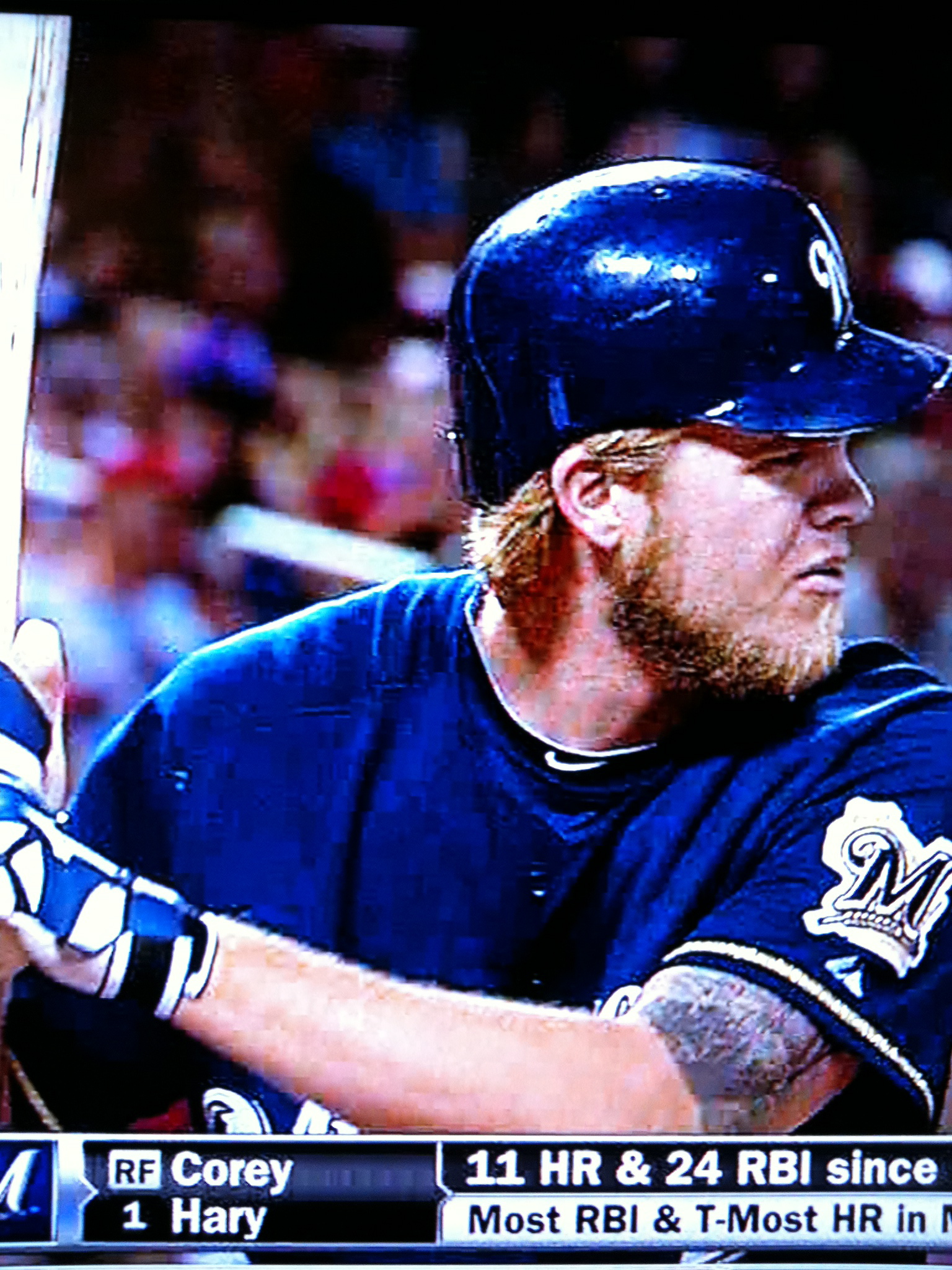
This is why being a graphics operator might be the most difficult job in television. You rarely have an editor, and very often you’re working on the road in a smelly, crowded truck, that might have the air conditioning sputtering, and the room is full of idiots shouting and spilling sodas and corndogs all over your console and whining about management and then shutting up when management suddenly walks in and before you’ve noticed it you’ve finished typing up all the Brewers’ names into their templates and you’ve made sure you put the second “l” in Counsell and that you haven’t typed in “Carlos Villauneuva” and you’ve double-checked whether Braddock is “Zach” or “Zack” and then there goes another corndog and the manager leaves and that one guy starts whining again about his per diem and before you’ve known it you’ve looked at the beard and typed in “Corey Hary” instead of Hart.

FROM A RESEARCHER’S NOTEBOOK:
Thumbnail image for lafata.jpg
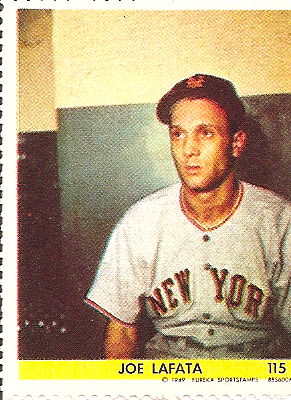
Other than perhaps the untouchable king of the hill, onetime pitcher Eugene Hamlet Krapp, this gentleman to the right might have the best full name in baseball history. He is the late Joe LaFata and he was a pretty nondescript lefthanded bat off the bench, playing some first base and a little outfield for the New York Giants in 1947 and 1949 (and for one game in 1948). 
He is something of a mystery, and not just for the fact that even in the minors he never cleared 14 homers or a .289 batting average in a single season. He is a mystery because all his records agree: his first name was Joseph, and his second name was… Joseph. 
Joseph Joseph LaFata.
Of course, Eugene Hamlet Krapp’s nickname was “Rubber.”

After No Further Review

My baseball sources now confirm that despite the meandering nature of Commissioner Bud Selig’s statement today about the Armando Galarraga game, Jim Joyce, Replay, and Zen And The Art Of Mistake Repair, you can take that statement as an indication that the matter of correcting Joyce’s mistake is closed.

It is conceivable that the Commissioner might revisit intervening at some later date, but the further we march away from the hour of the blown call, the less likely any change is – and the chances right now are almost nil.

It should be noted again, of course, that from 1917 until late in the 1991, Ernie Shore and his family and friends were under the impression that he had thrown a Perfect Game – admittedly with an asterisk – until a special committee serving under the previous commissioner decided otherwise. Similarly, Harvey Haddix went from 1959 to ’91 thinking he’d thrown one, too.

The Commissioner’s lovely words about Mr. Joyce’s honesty, and Mr. Galarraga’s graciousness, sound filling and satisfying right now. I suspect history will be a lot tougher on the umpire – and the Commissioner.

Sources: Commissioner Selig Reviews Galarraga Game

Major League Baseball sources with direct knowledge of the meeting confirm that key members of baseball’s hierarchy were to convene this morning in New York to review the circumstances of Umpire Jim Joyce’s erroneous “safe” call at first base in Detroit, which last night denied the Tigers’ Armando Galarraga what would have been the 21st Perfect Game in baseball history and the third in just 25 days.

There was considerable doubt that Commissioner Bud Selig felt he could or should intervene in overturning the results of an umpire’s on-the-field ruling. The Detroit News reported that the Tigers might be contacting MLB in hopes of remedying what umpire Joyce later admitted, clearly and emotionally, was a wildly incorrect call. The News quoted Tigers’ General Manager Dave Dombrowski as saying “I wouldn’t get into telling you what I would do. That’s a private matter. He shouldn’t have missed it. It’s a shame for the kid…”
Baseball sources said that as of late morning, the Tigers’ opponents, the Cleveland Indians, had not contacted the Commissioner’s office. Their support of any change to last night’s call might be a key factor.
“This isn’t a call,” Joyce said afterwards, “this is a history call. And I kicked the **** out of it, and nobody feels worse than I do…I took a perfect game away from that kid.”
Jon Heyman of Sports Illustrated and MLB Network tweeted that Commissioner Selig was “involved” and his office would have a statement at some point today.

Some in the Commissoner’s office were to urge Selig to declare that with Joyce’s admission, the 27th out of the game was recorded when Cleveland’s Jason Donald grounded out, first baseman Miguel Cabrera to pitcher Galarraga, covering first. The base hit credited to Donald, and the following at bat, by Cleveland’s Trevor Crowe, would be wiped off the books and thus Galarraga would be credited with a perfect game.
There is precedent for the Commissioner’s Office to decide what is, and isn’t, a perfect game. On September 4, 1991, a so-called “Statistical Accuracy Committee” ruled that the game would only official recognize as perfect games, ones in which pitchers retired 27 (or more) consecutive batters and completed the game without a batter reaching first base. The ruling wiped off the books the 1959 game in which Harvey Haddix of Pittsburgh pitched 12 perfect innings, only to lose the game to Milwaukee on a base hit. It also erased the 1917 game in which then-pitcher Babe Ruth of the Boston Red Sox had walked the lead off batter, then been ejected by the umpire for arguing the call. Reliever Ernie Shore entered the game with none out and that runner on first, who was promptly caught stealing. Shore then retired the 26 batters he faced, and had, at the time of the Commissioner’s Office ruling, been credited with a perfect game for more than 74 years. 48 more no-hit games were also erased by the re-definition of the rules.
There are also countless instances of umpires’ on-field decisions being reviewed and even overruled by the now dormant offices of the Presidents of the American and National League. One such review confirmed a controversial “out” ruling that ultimately decided the 1908 NL pennant. More recently, in 1983, after Kansas City’s George Brett had hit a two-out, 9th inning home run to bring his team from behind to ahead in a game in New York, umpire Tim McClelland determined that Brett had broken the rules by having the gripping substance “pine tar” further up his bat than rules permitted. McClelland nullified Brett’s home run and called him out for the final out of the game. Within days, American League President Lee MacPhail had overruled McClelland, declared the home run valid, and ordered the game replayed, more than a month later, from the point directly after Brett’s home run.

    Huffing And Horhay-Ing (Updated: Photos)
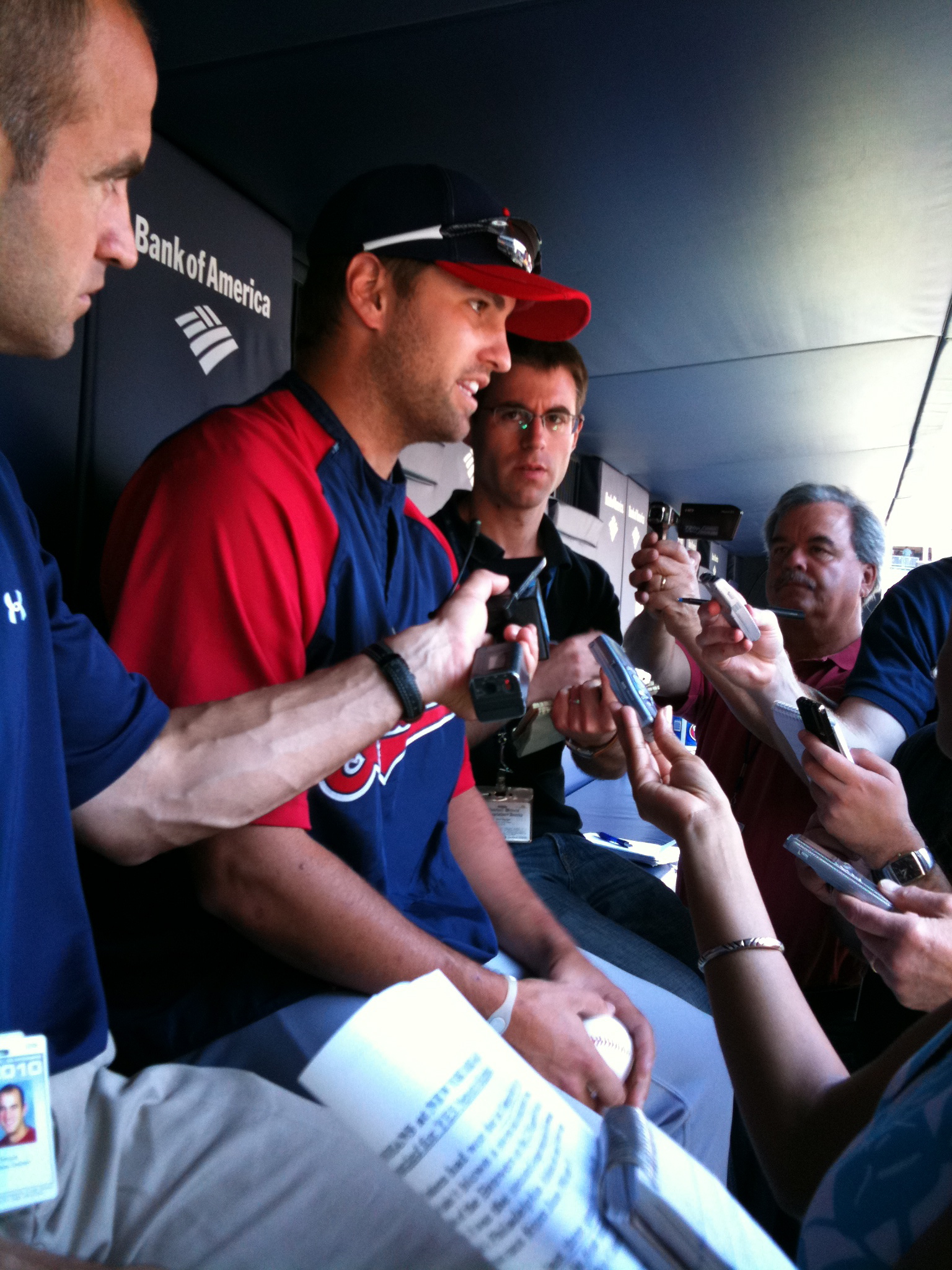
    IMG_2393.jpgDavid Huff of the Indians lifted up his cap and pointed to a spot above his left ear. “I never saw the ball, but I saw everything else. An inch this way, an inch down – I wouldn’t be talking to you guys. But I’m fine. I hope to make my next start.”

    Huff looked bright-eyed and (figuratively) bushy-tailed on the Cleveland bench an hour before today’s matinee in the Bronx. He remains unconvinced that any additional safety measures need be taken by pitchers, especially not a helmet, even though the ball that hit him would clearly have been deflected by a helmet or even a plastic liner for his soft cap, the kind batters used to wear. “A helmet is heavy. It would just rattle around on your head, probably come off. Hey, this stuff just happens. The key is just trying to keep it from happening to you.” Huff did not say, other than trusting to luck, how exactly he’ll do that….
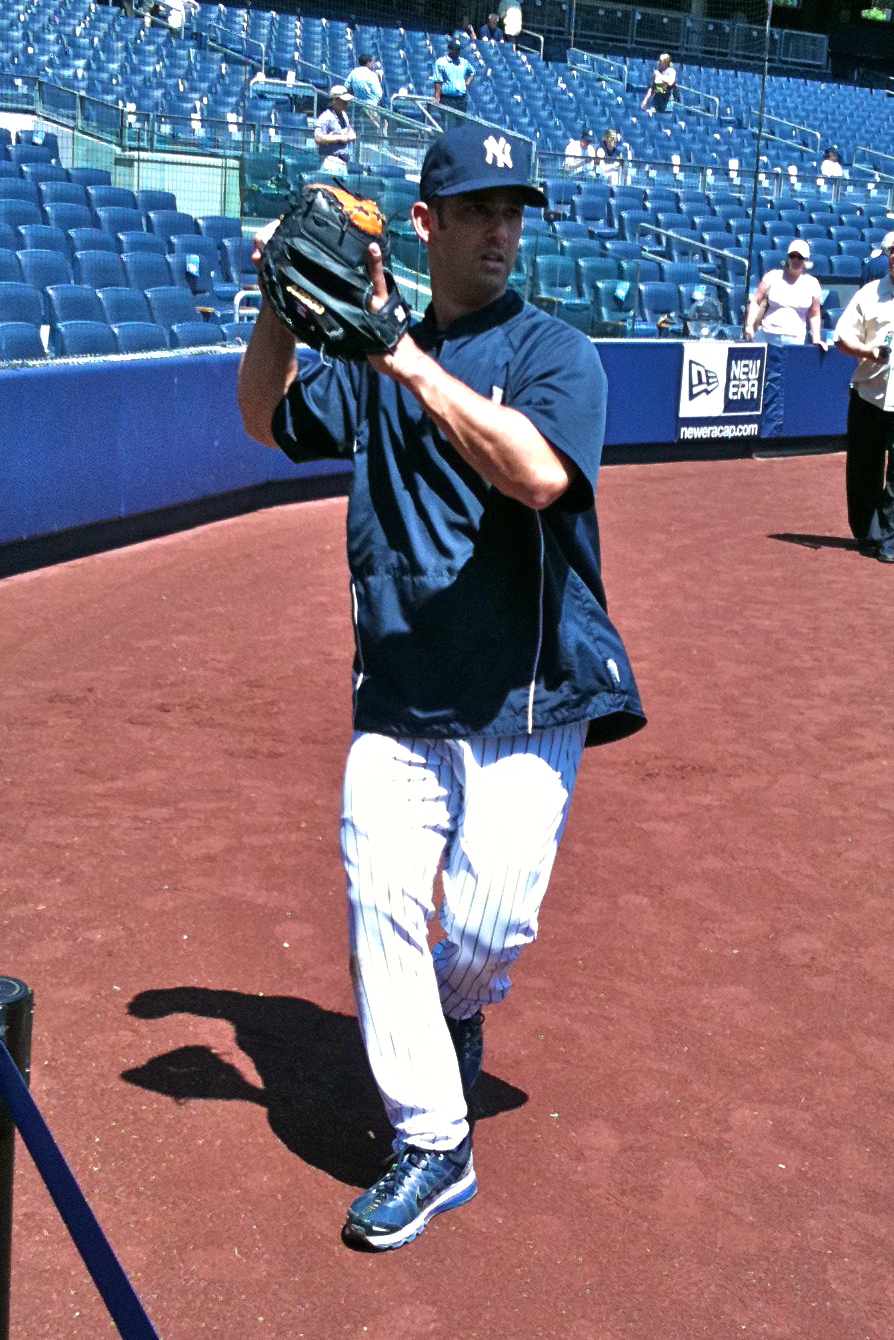
    Meantime Jorge Posada is apparently not kidding about being ahead of schedule in his return from his foot injury. Posada today took batting practice, and perhaps more importantly, today long-tossing with his substitute Francisco Cervelli and wasn’t even wincing as he pivoted off the bum foot. “Feels normal,” he said in his nonchalant manner. He was also confident he would be playing again by the weekend series in Toronto: “maybe earlier.”…

    IMG_2390.jpgIMG_2388.jpg

    The Unbearable Lightness of Perfect Games

    There have been 20 official Perfect Games (sorry, Harvey Haddix; sorry, Pedro Martinez) in baseball history, and thanks to Dallas Braden and now Roy Halladay, there have been two of them in just twenty days.
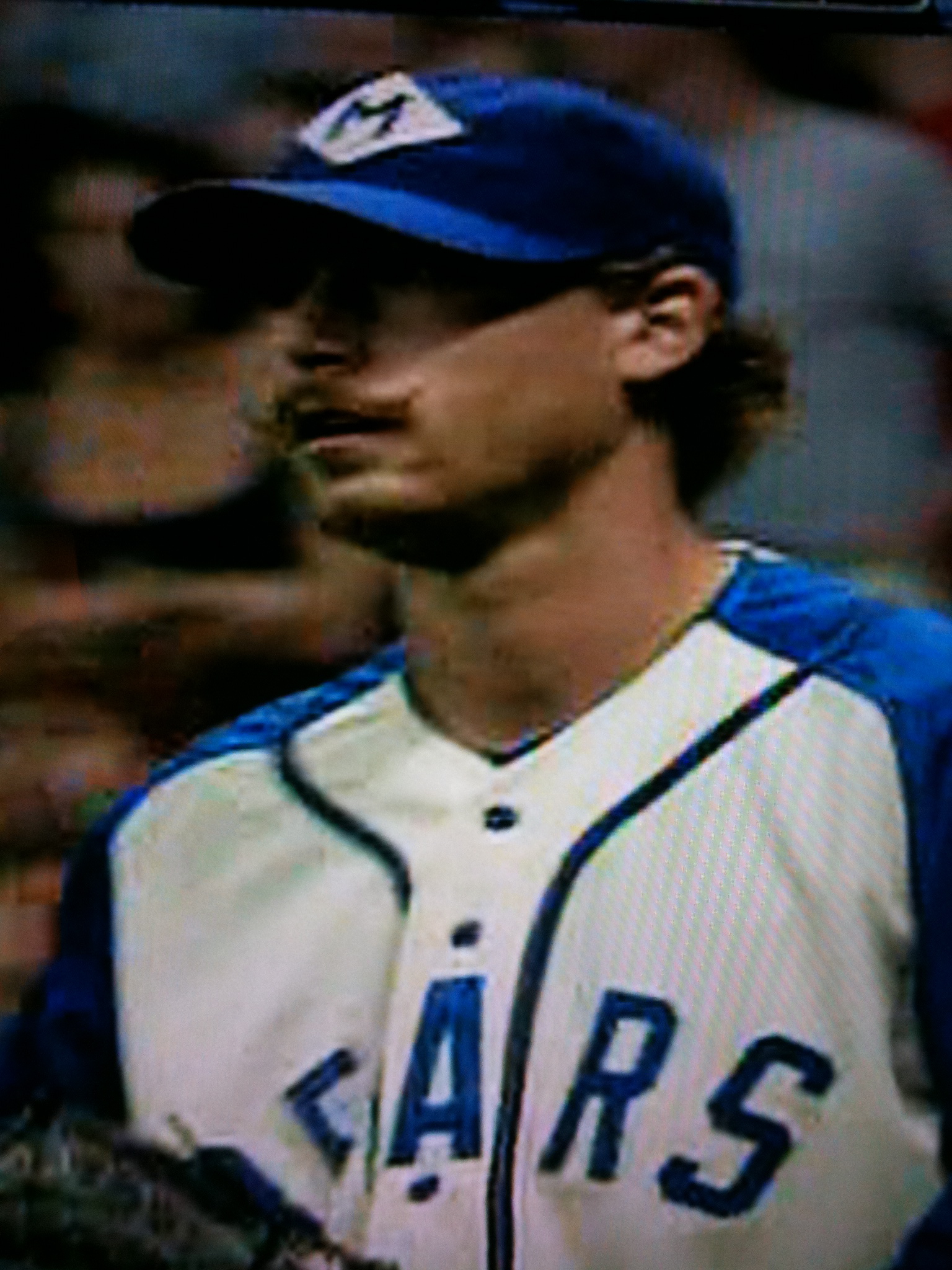
    Of course it’s more preposterous than that. Because Mark Buehrle threw his perfecto for the White Sox just last July 23rd, there have now been three perfect games (15 percent of all of them, ever) in the last 130 days of Major League Baseball play.
    Wait – it gets worse. The first perfect game, by Lee Richmond of Worcester of the National League, was thrown on June 12, 1880. The second, by Johnny Ward of Providence (also still in the NL that season), took place just five days later. So now we’re talking about a quarter of all of them, ever, being concentrated in a net span of 135 days of play.
    Wait – it gets worse still. After Richmond and Ward set the standard for pitching perfection in less than a week, the next perfect game thrown in their league, was a mere 84 years and four days after Ward’s, on June 21, 1964. That was Jim Bunning’s 27-for-27 against the Mets, which, to round it out neatly, was the last such game thrown by a Philadelphia Phillies’ pitcher until Halladay did it tonight in Miami.
    And yes, therein lies the last bizarre coincidence. Halladay’s victim: Florida. Braden’s, three weeks ago? Tampa Bay. Buehrle’s, last year? Tampa Bay. Those three perfect games in the 130-day span were each against the two Florida teams.
    HELMETS AND GROUP HUGS:
    Baseball got lucky again; David Huff of the Indians was sending out his own health updates on Twitter, and actually back in the ballpark with his teammates before they finished their rally against the Yankees. But the luck can’t last forever: at the current rate of growth of bat speed, a pitcher will be maimed or killed before the decade is out, and the sport must take any action that will even slightly reduce the chance or delay the possibility. The easiest solution has been mentioned here before: since at the end of their deliveries, pitchers are closer to batters, than batters were when the pitchers released the ball, pitchers and batters alike should be wearing helmets. Period.
    As to the Kendry Morales disaster, this too has been coming for awhile (ask Jake Peavy about it, or Denny Hocking). You are not excluded from the laws of physics just because you’re happy and celebrating. Presumably this needs no new rules, just players seeing the videotape.
    MAYBE IT’S THE DO:
    Having just watched John Axford (right) record his second career save with a 1-2-3 inning against the Mets, I’m beginning to wonder if half of closing is style.
    IMG_2387.jpg

    Thumbnail image for Thumbnail image for gossage.jpg

                                       COURTESY WPIX-TV
    Axford’s story is well-known now: Notre Dame, Tommy John surgery, transfer, independent ball, released, A-ball last season, and suddenly thrust into succeeding Trevor Hoffman in Milwaukee when his velocity jumped up to the mid-90’s this spring. Plus he donned the Rollie Fingers style handlebar. The gentleman on the left you may not recognize, and if he had his way, this photo would never have seen the light of day. It is during his time in the Puerto Rican Winter League of 1972-73, at which point his career stats were 7-1, 4.28, 2 saves. Soon would come a Fu Manchu (and a grownup haircut), 309 more saves and eventually Cooperstown. That’s Rich Gossage, aged 21, and, no, the hair wasn’t attached to the cap.

    Tea Leaves

    If you have a fantasy league team – or just like to play Closer Roulette – there is nothing more perversely fascinating than to watch an actual big league club suddenly go to Bullpen Plan B, or even Plans C and D, seven weeks into the season.

    Such a scenario seems to be playing out in Milwaukee where future Hall of Famer Trevor Hoffman may have finally taken a curve he can’t handle. Carlos Villanueva was handed the keys and wound up on the sidewalk, too. And suddenly it was rookie John Axford successfully stanching the flow in Minnesota Sunday, with his fellow freshman Zach Braddock setting up.
    The key for reading signs in Milwaukee was Tuesday’s game, and with the Brewers up 2-0 on Houston in the seventh it seemed like the perfect opportunity to find out what Ken Macha had in mind. Then the Brewers scored four and suddenly there was nothing to be gauged by the exercise innings of Villanueva and Todd Coffey in the 8th and 9th.
    Maybe there was. While it was still 2-0, Macha had Villanueva warming up to pitch the 8th, putting the lie to the presumption that Axford had pitched Sunday only because Villanueva was overworked. We will never know who Macha would have used in a save situation, but it clearly wasn’t going to be Carlos.
    Brewer management, incidentally, is giddy over the power arms of the two rookies. It is always sad to see the possible end for a class act and nearly unbeatable performer like Hoffman (and make no mistake about it, this could easily be the end), and it seems a little cruel to hear of two guys who combined don’t have a week invested in the pension plan drawing drools, but such is baseball life.
    All of which reminds me somehow of one of those rare instances in which Rotisserie can speak volumes about reality. I am in my fourth year with a bunch of actors in an NL-only league. Among the ten of us, and counting 12 guys on our two-man disabled lists, we “own” 262 National League players. Only ten of them are Pittsburgh Pirates and it’s only that high because somebody just took a flier on Neil Walker (the other nine are Doumit, Cedeno, LaRoche, Jones, McCutchen, Milledge; Dotel, Hanrahan, and Meek – we count Holds).

    Marian-No Saves?

    My buddy and ex-colleague Rich Eisen of NFL Network asks a fascinating question. Apart from his meltdowns against Minnesota and Boston this week, Mariano Rivera has another startling skein in progress.

    He’s gone nineteen days without a save.
    Is that his personal record, at least since John Wetteland left and he inherited the closer’s role (so long ago that I was still working at ESPN)? My memory jumped to the last time we heard the “Mo’s Done” refrain, a terrible skid early in 2005. Retrosheet confirms he saved only one game between April 13 and May 9, and had none over the last seventeen days of that stretch.
    I have not examiner Rivera’s full career but there’s an even longer skid, and it completely escaped my recall. Mo staggered out of the gate in 2007, not recording a save in his first eight appearances, the 26 days between the opener on April 2, and his first save on the 28th. The Yankees opened the season 8-13 and at that point Rivera had… none. That’ll be tough to beat.
    The Necessity of Rivera underscores the Yankees’ critical problem. The age-to-depth ratio is not strong, and it is causing the team to sag. Posada, Granderson, Johnson, Swisher, Mo himself, to say nothing of the middle relievers or Javier Vazquez. Are you thinking Joba Chamberlain to close right now, if there’s another injury problem for 42?

    They Booed The Winning Run

    This is not unique to the Bronx. I’ve heard it in Boston, I’ve heard it in Philly, I’ve heard it in all the places where the smart fans dwell and even the ones where they don’t. 

    The sequence last night went as follows:

    1. Alex Rodriguez ties up the game in the bottom of the ninth with a two-run homer off Jonathan Papelbon.

    2. Papelbon retires Robinson Cano for the second out to keep alive his chances of getting out of the game alive.

    3. Papelbon hits Francisco Cervelli on the elbow putting the winning run on base and bringing home run threat Marcus Thames to the plate.

    4. The Yankee crowd boos.


    You’re aware of what Thames did next. I’d just like to stop at the booing part. Nobody’s suggesting a Bronx crowd should be applauding Papelbon for plunking a Yankee, but, honestly, if Cervelli can get up and walk to first, that’s a good thing, why on earth are you booing the gift of the winning run sent to first on a hit batsman?
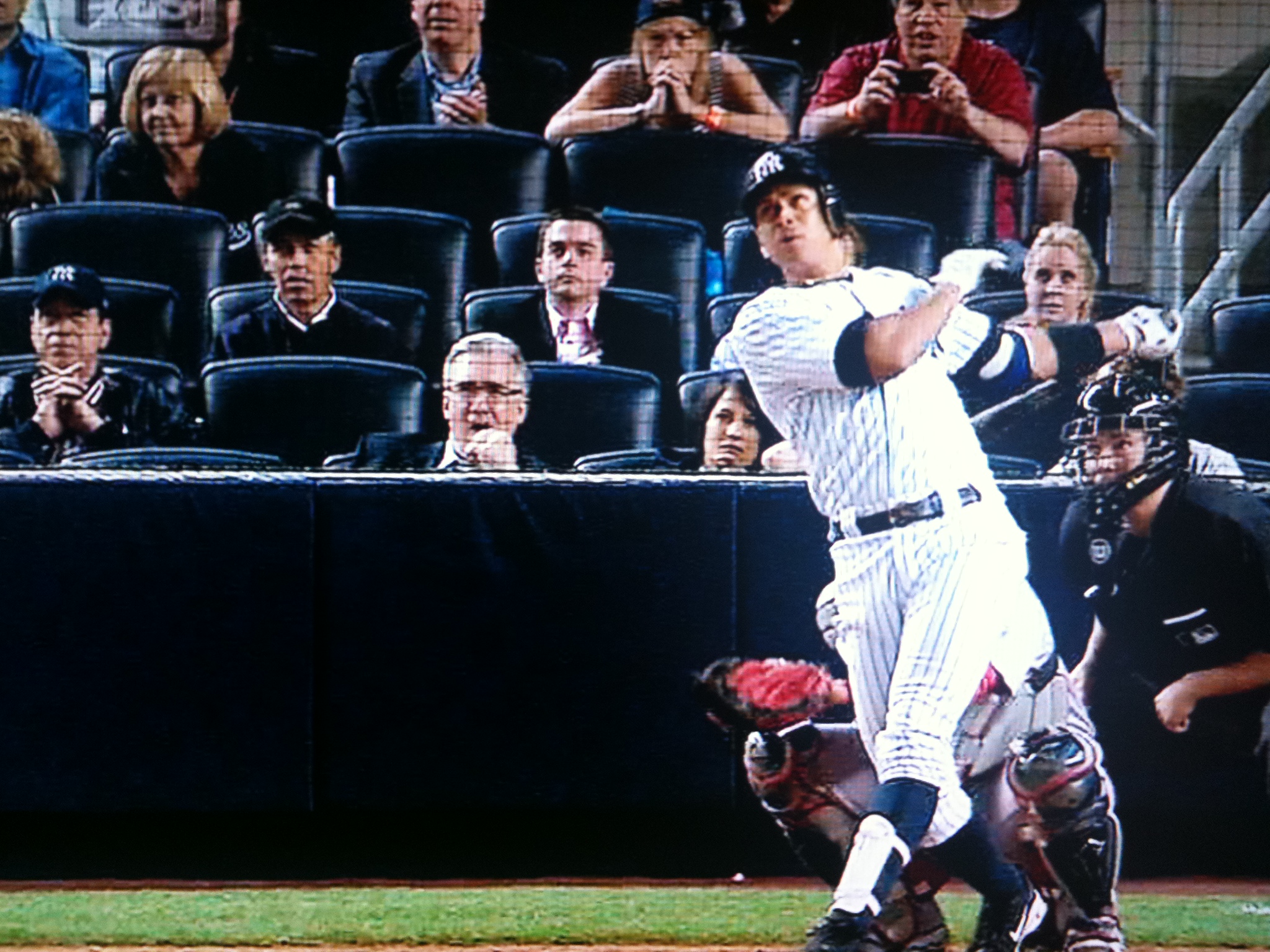

    Sigh.
    Incidentally, Thames’ subsequent game-winning home run ended a truly long drought. That was his first homer as a Yankee in (any) Yankee Stadium since June 10, 2002, when he debuted with an improbable first-pitch-he-saw-in-the-bigs blast off Randy Johnson. This statistic is somewhat skewed by the fact that he didn’t play for the Yankees during the 2003-09 seasons. Still, a bizarre fact.
    As was the reality that I have now witnessed both of Thames’ home Yankee homers. Not to say the Red Sox and Yanks play a Tom & Jerry Cartoon version of the game, but even though I was on tv until 9 PM, I figured if I could get to the yard by 9:30 I’d still get to see 90 minutes of baseball (I got there at 9:28; they ended at 10:58 – and eight runs were scored, including five homers, after my arrival)
    Can’t resist the screen cap, sorry:
    IMG_2359.JPG

    YES NETWORK VIA MLB NETWORK

    Goofy McSlackjaw there in the middle is yours truly. At the far left, in the Yankee cap, is Joe Piscopo, live, even though it wasn’t Saturday Night Sports.
    One more image (I keep saying this is the last of them; I make no promises) from over the weekend. All that’s left of the old place is a collapsed pile of the rightfield corner.
    IMG_2347.JPG
    Thanks to all for pumping this blog up to 4th in the MLB Pro category in April. I’m genuinely honored by the interest.

    They Gave Me Eyes But I Could Not See

    Did two posts (here, and here) last month on the likeliest successors for each of the 30 current active big league skippers.

    Since I’m delighted to post successful forecasts here, it’s incumbent on me to mention the other kind, in the wake of Trey Hillman’s dismissal as manager of the Royals, and his replacement by Ned Yost.

    ATLANTA: Maybe Chico Cadahia or Eddie Perez, but I think the best bets are two former Cox lieutenants, Fredi Gonzalez of the Marlins, and ex-Brewers boss Ned Yost. If the latter were the obvious choice, he’d probably be back on the staff, not an advisor in KC.


    KANSAS CITY: John Gibbons. Hiring a recently dismissed, no-nonsense ex-manager as your bench coach, is the standard process for anointing an heir apparent.


    There’s an old Monty Python sketch about a terrible stage actor who ranks the difficulty of each role based on how many words it has. “But,” he adds, thoughtfully, “it’s not just about knowing all the words. It’s also important to get them in the right order!”
    Sigh. Right guy, right logic, wrong prediction!