Category: Dailies

Rory Markas, 1955-2010

I met Rory Markas at KNX Radio in Los Angeles in 1989 and by the next year was fortunate enough to have him working for me as my weekend sports anchor and reporter at KCBS-TV downstairs in the same building.

Today, as an old colleague of mine from that time and I wept to each other over the phone about a man we knew well and long but not truly intimately, we tried to figure out exactly why his passing struck us so deeply. It was not just his youth, not just his having finally achieved after years of struggle his dream job.
There was something more. Separately, sports, and broadcasting, are industries full of prima donnas and the thin-skinned and I’ll confess to having been each, often at the same time, often for months on end. And Rory was never thus. Whether he was being sent out by one of us on some dippy sports feature in LA twenty years ago, or he was doing play-by-play in some less-than-heavenly minor league town, Rory just never was that way. His loudest complaint was a knowing smile and an accepting shake of the head.
People like him have not only a great gift, but are themselves a gift to the rest of us.
Rory had been the Angels’ play-by-play man since 2002, and it was always an honor to sit in with him for an inning whenever the team was here in New York or I was in Anaheim. Those who knew his work need not be told about its quality. Those who were not privileged enough to know him personally need to be told about his quality.
 
One quick update: I am remiss in not emphasizing Rory’s remarkable quick wit. I would often sit with him and Terry Smith for long stretches of games, and usually he’d put me on for a half inning or so, even letting me dabble in play-by-play. I just recounted for a friend something from 2006 or 2007, on the occasion of my first trip to the Angels Stadium booth:
 
Me: Ball two to Damon, low, outside.
RM: And Molina’s going to the mound.
Me: I notice, my friend, that your booth here is the size of a small Olympic village.
RM: Roomy, yes.
Me: Looks like the Yale Bowl, with microphones.
RM: We call it home.
Me: In fact, this second deck of the press box, this radio-tv gallery of yours – it’s bigger than the entire press box at Yankee Stadium.
RM: The umpires are going out to break up the conference.
Me: You know you could easily convert half this area to private seating and you’d never miss an inch of it.
RM: Thank you, Keith Olbermann, always a pleasure and thank you for never, ever, making any reference to such a thing ever again. Lackey’s ready, Molina crouches and we’re ready for action…
 
Below is the Angels’ press release:

BROADCASTER RORY MARKAS PASSES AWAY


ANAHEIM, CA:   Angels Baseball Tuesday announced that veteran broadcaster Rory Markas passed away yesterday at his home in Palmdale, CA.  No other details are available, and funeral service information is pending. 


Markas, 54, spent eight seasons calling play-by-play with the Angels, both on television and radio.  In addition to his responsibilities with the Angels, Markas also served as the play-by-play voice for the University of Southern California men’s basketball team, and as a reporter for FOX 11 KTTV in Los Angeles.


Prior to joining the Angels, Markas handled the play-by-play duties for the USC baseball team on the Trojan Radio Network, as well as pre-game reporting for Trojan football.  During that time, he also served as a sports reporter on KNX Newsradio 1070 in Los Angeles, and a sports anchor on FOX 11.  From 1994-97, he was the lead announcer for the NBA’s Los Angeles Clippers on the Clippers radio network.


Markas had extensive baseball broadcasting experience prior to joining the Angels, as he worked as a play-by-play announcer for the Milwaukee Brewers television network (1992-94) and as a substitute radio play-by-play announcer with the Brewers radio network from 1984-1994.  He spent six seasons calling Pacific Coast League baseball, including three years with the Salt Lake City Gulls and three years with the Vancouver Canadians.


Markas’ career included stints as an on-air sports talent for KCBS 2 (1990-97) and Prime Ticket (1987-90).  He was honored with several broadcasting awards, including four Golden Mike Awards for radio reporting, and two Associated Press Sportscasting Awards.  He also received the 2008 Radio Play-by-Play Award from the Southern California Sports Broadcasters Association.


A native of San Fernando Valley, CA, Markas attended Chatsworth High School.  He later attended Los Angeles Valley College and Cal State Northridge.  He is survived by his mother, Billie and brothers, Gary and Troy.

 –ANGELS–

George Michael – Baseball Historian – RIP

The prominent television sportscaster, perhaps the last “up-and-coming” Top 40 disc jockey at the height of the genre, and onetime NHL announcer, George Michael, passed away this morning in Washington after a two-year fight with leukemia. He was 70 years old.

Less known about George was that he, like so many people I’ve discussed here in the last few months, had a remarkably specific and utterly satisfying contribution to the game we love. Nellie King has been a fixture of Pittsburgh player, reporter, game announcer, and now author. With only 25 major league games under his belt, Dirk Hayhurst has probably written the best baseball book of the young century. Lester Rodney, who I memorialized here on Tuesday, was perhaps the only white journalist of the 1930’s and 1940’s who not only pointed out the unstated ban on black players but tirelessly advocated for its repudiation.
And now there’s George, who for all the eccentric devotion of his program “The Sports Machine” to rodeo, or (when it was hardly known to exist north of the Carolinas, NASCAR), was an ardent baseball researcher and historian. He had a general interest in vintage baseball game photography, but, like all of us, you could cut to the chase with him and quickly discover his exact, precise fascination with… slides into the plate or the bases.
It was George’s self-appointed duty to identify every participant in every such photograph, and the game depicted. He focused on the days before uniform numbers, when often you couldn’t see the runner’s face, the catcher’s back was turned to you, the uniforms were barely identifiable (if that), and even the stadiums were hard to pin down. He was published on the subject in a Society for American Baseball Research Journal a few years back, and his walk-through of his step-by-step process for finding clues was not only fascinating, but terrifically instructional to anybody trying to figure out the identities in any vintage baseball photography (when logos are not visible, you can most easily narrow down years and teams, even in black-and-white photos, by whether the caps and socks were dark, light, or striped; also don’t forget to judge where the throw originated – was it from an outfielder, or was it from the catcher? In the latter case you’re most likely dealing with a stolen base attempt – and probably a guy with a few steals under his belt).
I remember once getting a large package from George containing a series of photocopies of the top ten or twenty photos that were giving him the hardest time. Inevitably he had already found the era, at least one of the teams, possibly the ballpark. One, I believe, he had found to be from a 1911 A’s-Red Sox game, in Philadelphia, in the sixth inning. The third baseman was Home Run Baker but the runner tearing into third was problematic because the face was partially obscured and, incredibly, there had been two different plays made at third during the inning.
So if you think of George’s untimely passing this holiday season, remember that for all his larger-than-life tv persona, and the seemingly endless rodeo highlights — he was truly one of us, and his hobby underscored how otherwise diverse a crowd “we” are.

Lester Rodney Has Died

Lester Rodney, the onetime sportswriter who in the 1930’s and 1940’s was one of the fiercest and most insistent white advocates of the integration of major league baseball, died on Sunday, his family has announced. He was 98 years old.

Rodney’s advocacy found its forum in the pages of The Daily Worker, the house organ of the American Communist Party, from which he resigned in 1958. In 1936, he talked the paper into changing its paucity of sports coverage into a full-fledged section, of which he was hired as editor, even though he was not yet a member of the party. His writings consistently underscored a parallel few were willing to recognize, especially in sports: that the growing marginalization of the Jews and other religious and social groups by the Nazis in Germany and later Europe, had a too-close-for-comfort parallel in this country’s marginalization of African-Americans. 
In a less violent but no less prejudiced aspect, Rodney noted that most Americans were appalled – or at least discomfited – at the thought that deference to Hitler led to our American team leaving Marty Glickman off the Jesse Owens-led relay squad at the 1936 Olympics in Berlin. But few seemed disturbed that America was denying its greatest black baseball players an opportunity to reach whatever success they could achieve here.
Given how the color line was ultimately broken, it was particularly ironic that Rodney aimed much of his criticism at his favorite team, the Brooklyn Dodgers. As early as 1938 Rodney was advocating a baseball opportunity for a young multi-sport athlete from Southern California named Jackie Robinson. The writer would be completing his honorable military service in the South Pacific when Branch Rickey signed Robinson to a minor league contract for the 1946 season, nearly a decade after Rodney had begun to champion the cause most other white writers – and even fans – ignored.
Moving to California about the same time the Dodgers did, Rodney became, of all things, the religion editor of The Long Beach Press-Telegram. Ever the athlete, he was still playing competitive tennis at the age of 87. His children report that he passed away on the morning of the 20th, at home, and in what may be no surprise to anyone who knew him or knew of him, “he was with it until just before the end and thanks to hospice he had a pain free week.”
Robinson’s role in the integration of the game is obvious and Rickey’s has been lauded. Pressure from the great black sportswriters of the ’30s and ’40s, like Sam Lacy of The Baltimore Afro-American, is even acknowledged. Lester Rodney – writing in the most unlikely setting and advocating what was then the most unlikely of societal changes – was as important as any of them to the eventual righting of this extraordinary wrong.
RODNEY_025.jpg
LESTER RODNEY, 1911-2009

Milton Bradley Makes The Worst Teams In The World

Jack Zduriencik was one move away from completely rebuilding a shaken franchise in a little over thirteen months.
And then he made the move.
How much easier could this be to understand? You do not trade for Milton Bradley. You do not trade for Milton Bradley. You do not trade for Milton Bradley. 
He’s a “good teammate and a nice guy,” said the Mariners’ GM, hours after guaranteeing that all the startlingly good work he and his manager Don Wakamatsu had done in the last year would be washed away by some cataclysm (or “event,” as the nuclear plant engineers pleasantly call them) involving Bradley next season. Since April 1978, when his Dad filled out the name on his birth certificate without his Mom’s consent, there’s always been something. Tearing an ACL while having to be restrained from hitting an umpire. Bumping an umpire. Charging a third umpire. Suspended for the season by the Cubs. Trying to get to the press box during the game to confront the visiting announcer. Fighting with Eric Wedge. Fighting with Lou Piniella. Throwing the baseball bag on the field. Throwing a bottle back into the stands. Throwing the game ball into the stands – after the second out.
And by the way, we are talking about a player whose career highs are 34 doubles, 22 homers,  77 RBI, 17 steals, and a .321 average. This is not Albert Belle. This is not even Carl Everett. Statistically, this is a poor man’s Ben Grieve (my apologies to Ben Grieve).
And after signing Chone Figgins and Russell Branyan (and maybe even re-signing him), and dealing for Franklin Gutierrez, Jack Wilson, Cliff Lee, Ian Snell, and David Aardsma, all the good work by Zduriencik is undone by adding a player who is being described as looking for a “fresh start.” This’d be his seventh. 

FROM A RESEARCHER’S NOTEBOOK:

This was my favorite part of the annual SABR Journal – the curious things the late Al Kermisch found, presumably in pursuit of grander truths (an example from his last “From,” published after his passing in 2002: as a professional, Phil Rizzuto never played on a team that finished worst than third, and in 17 years, he was on 14 pennant-winners). I can’t hope to emulate the quality of Mr. Kermisch’s work but I do hope to touch the curiosity factor, both with nuts-and-bolts research and, in the case of my first effort, whimsy.
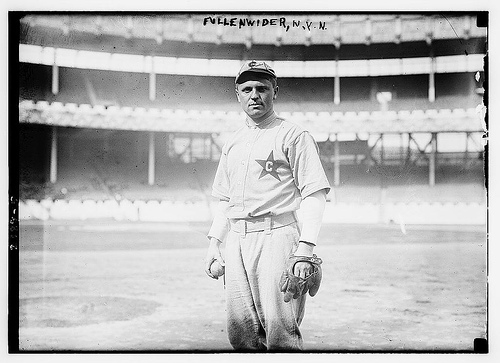
Meet the greatest name in baseball history: Phifer Fullenwider. 
Don’t go looking him up in the Baseball Encyclopedia; he never actually pitched in the big leagues (though he did make it to Spring Training one year, at a time when less than 30 men per team did so).
Fullenwider graduated with a degree in pharmacy from the University of North Carolina in 1908, but instead of to a drug store, he headed to the Carolina Association, where, as Baseball Reference’s superb minor league database indicates, he opened a fourteen-year minor league career with a 13-4 record for Charlotte. But it would be 1911 before he really broke through with a 26-9 mark for Columbia of the South Atlantic (SALLY) League.
And that impressive season leads us to this rather remarkable public domain image from the Polo Grounds in New York:
Fullenwider1912,jpg.jpg

That is none other than our Mr. Fullenwider, in the uniform of the Columbia Commies (had a different meaning then), standing in New York’s Polo Grounds, most likely late in the season of 1911, or possibly early in 1912. In those days before extensive farm systems, major league teams not only drafted players from minor league teams, but did so wholesale – and usually days after the minor league season ended. Thus it was not unusual for “bushers” to report to the big leagues – and apparently to bring their uniforms with them.

The Giants thought enough of Fullenwider to bring him to spring training in 1912. The camp was in Marlin, Texas, and the team picture indicates just how few prospects were included among the veterans:
1912 Giants.jpg

NATIONAL BASEBALL HALL OF FAME

The bottom row is, left to right, Giants aces Red Ames and Hall of Famer Rube Marquard, an otherwise unidentified “trainer,” Fullenwider, and outfielder Josh Devore. The legendary John McGraw is second from right in the middle row (almost right behind his prized pitching prospect), and in the back are the only two guys not wearing the goofy hats: catcher Chief Meyers (fourth from the right) who is capless, and next to him, wearing his cap backwards, Christy Mathewson. For this team photo is nothing less than a 1912 manifestation of that which we purists fear may some day happen in the future – players wearing advertisements on their uniforms! Those caps are ads for “ANGER’S Ice Cream Cones.” And evidently Mathewson and Meyers are having none of it (and yes, that’s my boy Merkle, back row, far right).
But back to Phifer Fullenwider, and something even stranger than an ad for ice cream cones on his uniform.
Fullenwider1912.jpg
The one-time UNC pitching hero is still wearing his Carolina cold-weather baseball sweater. The thing is four years old at least, he’s the property of the defending National League Champion New York Giants,  they took him to spring training in hopes that he might pitch alongside Christy Mathewson – and nobody gave him his own Giants’ sweater!
As it proved, Fullenwider never would pitch alongside Matty, nor any other big leaguer. The records of 1912 are a lot less precise than today, but while nearly everybody else in that photo went on to win the N.L. crown again in 1912 and 1913, Fullenwider shows up pitching for Buffalo of the International League (where the Giants often sent their extra players, in an informal arrangement), where he would win 20, 19, and 17 games in the next three seasons and yet never get a call to the big time. After a 19-victory season at Atlanta in 1917, he apparently quit. A 1919 entry in the University of North Carolina alumni review notes that Fullenwider (“Phar. ’08”) “is a druggist, with the Rose Drug Co., of Rocky Mount. He will be remembered as a star pitcher on the varsity baseball team. He has a one-year old child.”
The game was not gone from his system, however. Phifer Fullenwider, at the age of 34, reapp
ears in the minor league record in that same city – Rocky Mount, pitching for the Tarheels of the Virginia League for two seasons, then Columbia in 1922 and Greenville in ’23. He’d finish up with a record of 194 and 146, with memories of a trip to Marlin, Texas with McGraw and the boys, and at least one winter of the greatest kind of hope and optimism. One wonders if he got to keep the Ice Cream Cone hat.
There’s one other note before we let Mr. Fullenwider out of the clutches of the researcher. He may not have gotten a big league game under his belt, but he did make it onto a baseball card. From the Contentnea Cigarettes series called T209, dating from the 1909 season — and a dandy it is, I might add.
Thumbnail image for Thumbnail image for Fullenwider.jpg

Best Baseball Autobiography Since Bouton?

Dirk Hayhurst’s description of himself for the author’s ID in his upcoming book The Bullpen Gospels reads in part, “Dirk is a former member of the San Diego Padres, and after this book gets printed, a former member of the Toronto Blue Jays.”

I’m not sure he’s correct. In fact, I’m not sure that in these times when so many fans feel like they’re constantly having the wool pulled over their eyes by athletes ill-equipped for the attempt, if Hayhurst’s constant honesty, his remarkable candor, his drumbeat of unadorned confessed self-doubt, and his seamless writing, won’t resonate through the sport like the first true wonderful day of spring when the game and the weather finally reassure you that winter has been beaten back, at least for a season.
In fact, I’m not sure that he hasn’t written the best baseball autobiography since Jim Bouton’s Ball Four. For Hayhurst, who bombed as a starter for the Padres in 2008 and then showed promise out of the Jays’ bullpen the season past, has written what Bouton wrote, and what a decade before Bouton, what Jim Brosnan wrote – a book that is seemingly about baseball but which, as you read further and further into it, is obviously much bigger than that. These are books about life: struggle, confusion, purpose, purposelessness, and the startling realization that achievement and failure are nearly-identical twins, one which gnaws and deadens, the other which just as often produces not elation but a tinny, empty sound.
Brosnan’s achievement, in The Long Season and Pennant Race, was to introduce to a world which previously had no information of any kind on the subject, the concept of athlete as human being. What did he have to do when demoted, or traded? What happened when management changed? Was there a Mrs. Athlete, and could they share a martini now and again? (answer: You bet). 
Bouton’s breakthrough was to show the concept of athlete as flawed human being. Too many martinis, some of them shared with women other than Mrs. Athlete. Athletes who might not have been geniuses on the field or off, but who seemed invariably managed and coached by men even less intelligent. The struggle to self-start as one’s team sank from optimism, to contention, to inconsistency, to irrelevance, to embarrassment. And yet, were they enjoying themselves, did their lives change for the better, was being an athlete fun? (answer: You bet).
And now here is Hayhurst, who may single-handedly steer baseball away from the two decades-long vise grip of Sport-As-Skill-Development. Since my own childhood, we have ever-increasingly devalued every major leaguer but the superstar. Late in the last century we began to devalue every minor leaguer but the top draft choice. If you don’t make it into somebody’s Top Prospects list, you might as well not exist. Dirk Hayhurst is writing of his days, his months, his years, as far away from the Top Prospects lists as imaginable. He is, in The Bullpen Gospels, often the last man on an A-ball pitching staff, and trying to answer a series of successively worsening questions cascading from the simplest of them: Why?
This, of course, is why the book transcends the game. It’s not just Dirk Hayhurst’s existential doubt about whether he’ll reach the majors or why he’s still trying or if he shouldn’t be helping the homeless instead of worrying about getting the last out of a seven-run inning. He is experiencing the crisis of reality through which we all pass, often daily: when our dreams about life crash head first into its realities, what the hell are we supposed to do then?
Thus The Bullpen Gospels is a baseball book the way “Is That All There Is?” is a Leiber-Stoller pop song by Peggy Lee from 1969. It is the primordial battle of hope and faith and inspiration versus disillusionment and rust and inertia.
Sounds pretty grim, doesn’t it? But of course therein lies the delightful twist: like Brosnan and Bouton before him, Hayhurst repeatedly rediscovers the absurd hilarity of it all, and the book is consistently laugh-out-loud funny. And like all great artists, he pulls back curtains we never thought to investigate: from how assiduously minor leaguers debate which “Come-out songs” they will choose or which numbers they will wear, to the pecking order of seat locations on the ever-infamous bush league bus trip.
My favorite is probably the mechanics of something the average reader will have never heard of before, let alone have contemplated. It’s “the host family” – the living arrangements by which the non-first-rounders survive their seasons in the minors. Hayhurst hilariously defines such temporary homes as ranging from Wackford Squeers’ Dotheboys Hall, to the visitations from In Cold Blood:

Some families are the perfect model citizens, Mr. and Mrs. John Q. Host family with their white picket fence and adorable little children with their cherub faces who can’t wait to be just like their new older brother. Some families are wealthy and treat you like the draft pick you always wanted to be. Some host families aren’t even families at all; some are just one person: a well-toned Cougar looking for an after-hours power hitter to keep her company between filming.

Depending on the makeup of the player, all these choices are desirable. However, they only represent one side of the coin. On the flip side, there is the family who has a pack of misbehaved trolls for children with parents who don’t believe in discipline. The reason your PlayStation has peanut butter leaking from the optical drive can be chalked up to “youthful curiosity.” You may live with a super fan who wants to play coach, manager, and parent. He’ll live vicariously through you and evaluate, criticize, judge, blog, and call the organization about you. Or you may end up with a miserable old spinster who loves cats and hates men…

Players aren’t saints either, and it takes a special family to agree to house one. If you’re a devout Catholic family, getting a Mormon player can make things a tad awkward. If you’re parents of little children, getting that Bostonian player who uses “****” for greetings, good-byes, pronouns, adjectives, verb, and prayer, might be more than you bargained for…

As this excerpt suggests (and the asterisks are mine), it doesn’t hurt that Hayhurst is a fluid and gifted writer, whose prose can take off like a jet and compel you to read for half an hour more than you have. He populates the pages of The Bullpen Gospels with teammates, some identified, some amalgamated, some under aliases – and if the book takes off, ripping the Hayhurstian masks off the more colorful ones may become a low-key hobby after the book is published on March 30 (it’s already up for pre-orders on Amazon and no doubt elsewhere – I’d get it now because I think they’ll be able to raise the price later).

The reaction will be fascinating to see. In 1970, my father endured my clamoring and bought Ball Four and read it himself before handing it to me: “I know you know all these words. Just don’t use them around the house. Read this carefully, there’s a lot of truth in here.” But ever since, we fans have been bombarded for decades by altered versions of truth, all of them writ large and desperately trying to impress us with their essential-ness. Baseball books have tended to focus only on the big, and to try to make it bigger still. We’ve gone from the unlikely accuracy of Jose Canseco’s slimy indictment of the steroid era, through the analyze-all-the-damn-fun-out-of-the-game-why-don’t-you tone of Moneyball and its imitators, through what may in retrospect be seen as a Hayhurst-precursor in Matt McCarthy’s fraudulent Odd Man Out, through dozens of historical works insisting everything that has ever happened in baseball has re-shaped the nation – Jackie Robinson (yes), the 1951 N.L. pennant race (very possibly), the 1912 World Series (no way).
Here, instead, will be a modest book by a modest relief pitcher who has appeared in the modest total of 25 major league games presenting what the modest author thinks (incorrectly) is only modest truth. He has yet to get his own major league baseball card and as I write this there are exactly two of his souvenirs available on eBay and one of them is a photo for $6.99 (“Or Best Offer”). His preface warns you if you seek scandal or steroids, look elsewhere, and the only bold face name in the whole 340 pages, Trevor Hoffman, comes across as a low-key gentleman.
And yet there in the prologue Hayhurst offers a key to what he has written and why, self-guidance to which he sticks pretty neatly: “I also believe there is more to the game than just baseball. For all the great things baseball is, there are some things it is absolutely not. And that is what this story is all about.”
Of course, just as Bouton’s exposure of the real flaws of the real men who played baseball in 1969 made them even more appealing than the phony deities into which they’d been transformed, the great things are made somehow greater by how well Hayhurst contextualizes them, how honestly he tells his story, and how vividly he takes us inside his world.

Hall of Famers and Numbers Without Wings

They don’t give me a vote.
I was once gratified to read somebody argue that they should, but if I remember correctly this was written by somebody else who also didn’t get a vote, but probably should. 
The logic behind that assertion will presumably decrease as time goes by. But it is staggering to consider that for decades, writers elected – or prevented the election of – dozens of players who they literally never saw play in a game that mattered. By the time Ron Santo was first seen by future Hall of Fame voters working in Baltimore, Boston, and all the other American League cities save for Chicago, L.A., and New York, he was a worn-out 34-year old part-time second baseman who had already hit 337 of the 342 homers he would ever hit. Seeing them on television has been the actual qualification for some large number of voter-nominee interactions since television began.
But I digress. Capsule summaries of the candidacies of those on the new ballot just released Friday:
Roberto Alomar: No, just barely. I don’t think he was as good as Sandberg and I always said Sandberg shouldn’t go in before Joe Gordon. I’m not judging Alomar on the spitting incident, I’m judging him on the fact that for whatever reason, at age 34 he not only turned from a superstar into a fringe major leaguer, but he also turned into a millstone around the neck of a franchise. The bad taste may fade with time, but right now I couldn’t vote for him.
Harold Baines: Yes, just barely. He’s hurt by the 2,866 hits – he’s in that Buckner zone. Everybody else who got to Buckner’s level of hits (2,763) has gotten in, or will, or is Pete Rose.
Bert Blyleven: Definitely. Fifth all-time in strikeouts now (passed by Clemens), by any measure one of the game’s great curveballers, and 287 wins. And by the way, those 3,701 strikeouts? They came with only 1,322 walks. 

Andre Dawson: Yes. Farcical he has had to wait.
Andres Galarraga: I just don’t see it. 399 homers in the power era just doesn’t get there.

Barry Larkin: A great player and one of my favorites, but I don’t recall ever during his playing career having had even that Alomarian sense that this could be a Hall-of-Famer. If we’re looking to put a Reds shortstop in Cooperstown, it should be David Concepcion.
Edgar Martinez: The first test of how the DH-as-position will resonate through history. I can see electing pure DH’s but to me the batting bar is a little higher for them than other batsmen who field. Two batting championships and a RBI title is not sufficient. Ferris Fain won two batting championships, too, and I don’t see a big argument for him in Cooperstown (and he did it in consecutive years, too).
Don Mattingly: Sigh, no. I wish. The back injury killed his chances – he dropped from superior to slightly-above-average. For competitive fire, diligence, class, yes. But we don’t do it that way.
Fred McGriff: Amazingly, yes. Here is the silver lining to the steroid era. Suddenly his 493 homers and ten 30-home run seasons look surprising, even refreshing, considering the worst thing he was ever accused of taking were Boring Pills. No offense, but when the Yankees had to bribe Toronto to take Dave Collins off their hands in the winter of 1982-83 and the Jays said “OK, but you have to take Dale Murray off our hands – and we want this kid McGriff,” the Yanks would have been better off saying “take Mattingly.”
Mark McGwire: Hall of Fame? For what? For pretending to Congress that nothing happened before that steroid hearing? Fine. You got your wish. Nothing happened. Your lifetime numbers are 0-0-.000. And by the way, why is it ok for him to just waltz back in as batting coach of the Cardinals? Would we let Bonds come back in? This is unacceptable, and it gives credence to the very disturbing claim that race is at play when it comes to the punishment of steroid cheats. Mark McGwire is a steroid cheater.
Jack Morris: Another beneficiary of a little perspective. I used to flinch at that 3.90 ERA. There seems very little doubt that Tom Glavine will go in on the first ballot at 3.54. I’m looking more at the 254 wins and the clutch performances. Aye.
Dale Murphy: Yes. Preposterous that he’s had to wait. Two-time MVP, thought he was tailing off at the end of one season so he went to the Instructional League that fall to work on his hitting, turned himself from a defensive disaster to a star centerfielder, and was cooperative with every fan, reporter, and vendor. During his era as an every-day starter, 1978 through 1991, he was baseball’s leading home-run hitter, and he’s not in because he hit 398 homers and not 400? And we’re seriously considering Edgar Martinez before him?
Dave Parker: To be fair, something of a victim of expectations. But when he came up he was thought to have been the best all-around talent to ascend to the majors perhaps since Mays. 339-1493-.290 with 147 steals, two batting titles, and no homer crowns, isn’t very much, I’m afraid.
Tim Raines: No. It is very close. Maybe the steals should earn him a spot. The rest of the offensive production just doesn’t.
Lee Smith: Here’s a startling question: who led his league in saves more often during his career? Lee Smith, Mariano Rivera, or Trevor Hoffman? The answer is Smith (four), though Rivera (three), and Hoffman (two) can still do something about it. But doesn’t it at least suggest Smith’s 478 saves should be taken seriously, too? I vote yes.
Alan Trammell: No. I wish it were otherwise.
I do want to see how many guys vote for Shayne Reynolds.
THE UNEXPECTED BENEFIT OF WATCHING MLB NET’S ‘ALL-TIME GAMES’:
There are at least two big heavy fascinating books devoted to no less a topic than the attempt to record all of the uniform numbers worn by big leaguers. It may not fascinate you, but it fascinated two guys, including the eminent researcher Mark Stang, to take the time to do the research, and two publishers to pay the costs.
That’s why an odd vigne
tte from an odd MLB Network choice for one of its “All-Time Games” is fascinating – to a few, anyway. It’s a black-and-white video of the Montreal Expos outlasting the Pittsburgh Pirates at Jarry Park in Montreal on September 2, 1970. And at mid-game, rookie announcer Don Drysdale starts commenting to his partner Hal Kelly about the odd spectacle he’s seeing in the visitors’ bullpen. 
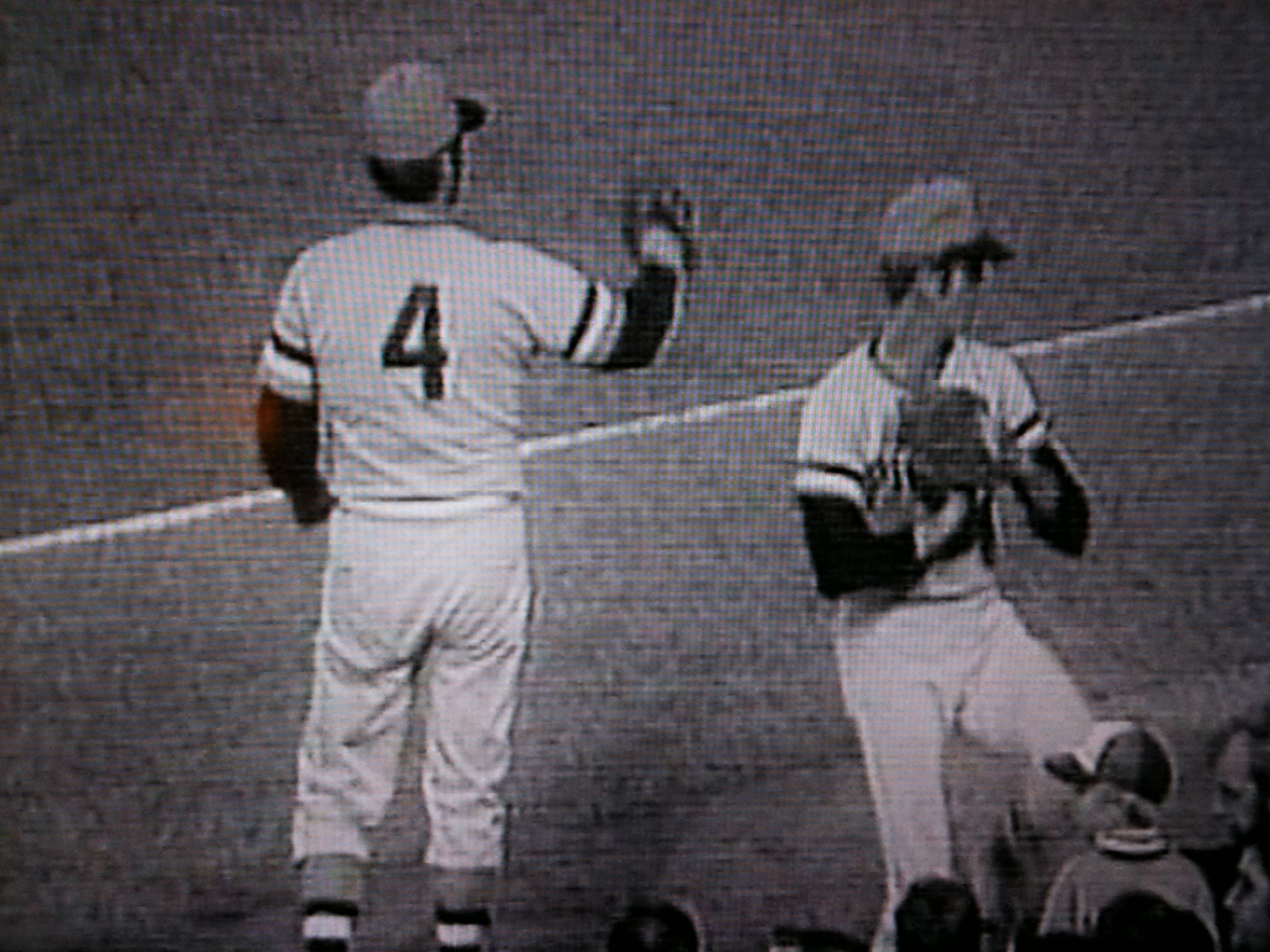
This – and forgive the photographed screen grab – is the spectacle:
IMG_2007.JPG
COURTESY MLB NETWORK

The righthander in mid-pitch is John Lamb (of the Pirates’ odd Lamb/Moose/Veale pitching staff). The lefty awaiting the throw is George Brunet, and he is not an outfielder loosening up his arm to replace Roberto Clemente. He’s a lefthanded pitcher – one who pitched fifteen seasons for nine different teams, plus thirteen more in the American minors, plus teams in Mexico up until nearly the day he died in 1991 – whom the Bucs had obtained from the Washington Senators three days earlier.
And he is wearing uniform number 4. Drysdale says to Kelly that Brunet is going to change the number as soon as possible because: a) pitchers just don’t wear “low numbers” like that, and b) Brunet has told him so. Left unspoken is the fact that Brunet, listed at 6’1″, 195, was probably closer to 220 by the time he got to Pittsburgh, and they probably gave him number 4 because, in that first year in which double-knit unis were ever used in the majors, it was likely the only shirt they had that fit him.
Both those big heavy uniform books show Brunet wearing only 22 for Pittsburgh. Yet, there he is, a few moments later, years ahead of Toronto’s Number 7 Josh Towers, actually getting into his second game as a Pirate, wearing the number they would eventually get around to retiring in honor of Ralph Kiner.
IMG_2008.JPG
COURTESY MLB NETWORK

As an utter sidebar, I loved watching this game until I realized that the second of my two trips to Montreal as a kid to explore unbeatable, electric (and frigid in August with aluminum seats)  Parc Jarry, was exactly one week before this game was played. Alors! This game is newer than the last time I actually saw that old field!

Elect A New System

I got asked a lot about the contrasts between sports and politics. Here’s one hard-to-believe truth: the elections are far more screwed up in sports.

Just when I thought a baseball vote could no longer surprise me, The Writers’ Association manages to confer the Cy Young Award on the guy who got the second most first-place votes. Now, I’ve seen a lot of screwy elections in politics, but a system which is designed to permit this to happen would never last in a democracy (or anything close to it).
I say this as a supporter of Tim Lincecum for the award: look, this is simple. Why is this archaic “top three vote getters” method still in use? Is there a particular reason each voter is not asked for a selection, and then the winner – you know – wins? Where if there is a tie, either you leave it as such and give out two awards, or perhaps you hold a run-off among the electors?
The “top three” is a variation of the older long-sheet ballots the writers began using in the ’30s when they took over the MVP voting, and a cousin to the ludicrous Hall of Fame ballots. They date to a time of inferior communications where the practicality of a run-off vote was far lower. They are anachronisms, and they produce shoddy results like this one.
The Hall of Fame, obviously, should just be an up-or-down vote on each nominee, not another top ten list and percentage thresholds. The NFL has this system down: its voters convene and argue their votes, and then reach consensus.
Even that kind of system is not fool-proof. There is the story of Rick Ferrell, the long-time executive of the Detroit Tigers and, before that, long-time slightly-above-average Hall of Famer. For years, the voters on the Veterans’ Committee would sit around and talk through – and even choreograph – their voting. They’d pay tribute to this beloved figure by throwing him “courtesy votes,” so when the balloting was completed they could truthfully say “You got three, you needed six, maybe next year, Old Sport.” One year signals were supposedly crossed and twice as many guys thought they were supposed to give Rick his courtesy votes  and instead of three, he got six – and a man who hit .281, caught for eighteen years without ever backstopping a pennant-winner, and was out-homered by his pitcher/brother – got elected. Or so the story goes (those vote numbers are pulled out of thin air, incidentally).
Still, any method that permits the runner-up to win because of how few runner-up votes the leader got (Lincecum 2009), while not precluding a tie (Hernandez and Stargell, 1979), and still permits personal pique to decide (1947: one voter leaves Williams off the ballot and three leave off DiMaggio), has got to be improved upon.
Maybe the writers could leave a phone number at which they could be reached to cast a run-off ballot in the event of a tie. If that’s not too much trouble.

Recommended Reading: Nellie King

People will little note nor long remember what Steven Jackson did pitching in relief last season for the Pittsburgh Pirates. For that matter, not until now, were they likely to remember what Nellie King did pitching in relief for the Bucs in 1956.
Without both of these men, and all others like them, baseball would cease to exist.
2009 was an encouraging year for Jackson. Up from Indianapolis, he pitched 40 times for a total of 43 innings, 21 strikeouts, 22 walks, two wins, three losses, and a 3.14 ERA. This was the culmination of nearly six years along a heavily-guided, clearly-lit, little-left-to-chance route that began when Howard McCullough of the Diamondbacks started scouting him at Clemson in 2003. The next year, Arizona drafted him in the tenth round, and, despite the fact he was already 22, they started him in the instruction-focused Pioneer and Northwest Leagues. The Yankees were following him, too, and when they worked out a deal to return Randy Johnson to Arizona, Jackson was one of the pitchers they demanded. New York began to work Jackson in relief in ’07 and their instructors helped him find a new arm slot that turned a mediocre sinker into an out pitch. He was the third arm the Yankees called up from the minors last April, but they wasted his last option by letting him sit in the bullpen for a week without an appearance. When they tried to sneak him off the major league roster, the Pirates pounced and picked him up on waivers. Within weeks, he was a regular in the Pittsburgh bullpen.
This tortuous recital of the provenance of Steven Jackson – scouted, trained, guided, instructed, groomed (and paid around $275,000 in his first big league season) is provided to underscore a point about ex-Pirate reliever Nellie King’s wonderful new book Happiness Is Like A Cur Dog. In King’s first full season in the bigs, in 1956, he appeared 38 times in Pittsburgh, pitched 60 innings, won four and lost one, and finished with a 3.15 ERA (and earned about $6,000 – still just $47,000 in 2009 dollars). This was the culmination of eleven years of fighting to get anybody to notice him long enough to invite him to a mass tryout camp, then possibly to spring training, then possibly onto the roster of a minor league team like the New Iberia Cardinals of the Class-D Evangeline League.
Class D.
As he vividly recounts in this warm, understated memoir, Nellie King’s career began in a time when a ballplayer had at least three jobs: what he did during the actual season, what he did delivering packages or bailing hay during the off-season, and what he had to do 24 hours a day to make sure he didn’t get released with no more than ten days’ notice and not even a bus ticket home. It is almost unfathomable to consider the pioneer-like hacking through the woods of hidden opportunity that King so fondly recalls. A part-time Cardinals’ scout liked what he saw of him in a glorified summer high school league and invited him to a tryout. He got a uniform with a three digit number on it. Hooking on with a team in Louisiana he arrived there by bus in the middle of the night, clueless of who to contact or where to go. He was released twice before his 19th birthday, and made it back into organized ball only because that first scout had gone to work filling out the rosters of some independent clubs. And that only got him into the Pittsburgh system because the owner sold those obscure franchises to the Pirates. 
And that’s when he got to begin his climb up the ladder in a Pirates’ farm system that was a little smaller than most – it only had about a dozen clubs. Having won 15 or more three separate times for Pirates’ farms (a feat which today would put him on the cover of The Baseball America Prospect Handbook) and having survived, unfazed, two years at Fort Dix during the Korean War, Nelson Joseph King finally got to the big leagues in 1954.

“It had taken me eight years, including two outright releases in 1946, plus two years in the Army, to get to this moment at Ebbets Field. I thought of all those innings and games I spent pitching in small, minor league towns such as Geneva, Ozark, Brewton, Troy, Dorhan, Greenville, Andalusia, and Enterprise, in the Class “D” Alabama State League during my first season in professional baseball. The contrast between Ebbets Field and those minor league towns and fields magnified the contrasts and the satisfaction I was feeling. Having viewed Ebbets Field only in black and white photos and on television in World Series games, I was now seeing it up close, in full color and from the center of the picture. In my eighth decade of life, the memory of that moment is so vivid I can still visualize Ebbets Field…”

Injuries would end King’s pitching career in 1957, and he went into radio – following the same steep staircase that described his playing days – through local markets in Western Pennsylvania. Finally, a decade after he stopped pitching for them, he rejoined the Pirates a decade later as an announcer, and the primary partner of the legendary Bob “The Gunner” Prince. Once again the reality of the business of today and that of an earlier time is underscored. As the third announcer of a major league team just 42 years ago, Nellie King was paid $13,000 – and even that only translates to $83,000 in today’s money.
The remarkable part of King’s story is that the struggle and the finances seem to have made every step, and every misstep, all the more satisfying. Nellie King’s story is a triumph of perseverance and contentment. Even the title comes from one of the odder of the aphorisms of the legendary Branch Rickey, for whom King worked in the Pittsburgh organization. Figures like Rickey, and Bill Mazeroski, and Roberto Clemente, and Willie Stargell, populate its pages, but Happiness Is Like A Cur Dog should not be mistaken for the kind of dramatic but sometimes self-important recent biographies of, say, Satchel Paige or George Steinbrenner. And though King goes into depth about the two epic Pirates’ World Championship years he covered, he does not seek to elevate either to world-changing status, such as a recent book on the 1912 Series does.
Nellie King has simply written a book about the backbone of baseball, a tale like that of 75 percent of the players in the game’s history. And in its own matter-of-fact style, it’s terrific. It’s available from the usual suspects like Amazon, but more directly (and economically) from the publisher, and Nellie and his family have also launched a blog for Cur.

CORRECTIONS AND NOTES:
In advocating for Danny Murtaugh’s Hall of Fame qualifications I gave him credit for one more NL East title than he deserved. I’d forgotten Murtaugh retired four times as Pittsburgh skipper, not three, and the 1972 crown belonged to Bill Virdon… And having composed this as MLB Network rolled out its World Series highlight films, these trivial observations about Yankee Stadium. The boxes remained in the “opera style” – no permanent seats, just as many hard wooden chairs as you needed or could fit in – through at least 1943. And the dirt stripe from the mound to the plate, most recently resurrected in Detroit and Phoenix, was in place in the Bronx through at least 1947 – but gone by 1949.

No Replay, No Problem – And The Vet Vote

Two things to consider about the General Managers’ decision not to make a decision on expanding videotape replay: A) whatever it is, baseball has almost always done it, and B) once it’s been done, baseball has almost always done more of it, later.

This is just a brief list of the things the game’s protectors and magnates have guaranteed would never, ever, happen to the great traditions and sanctity of our private world:
1. Overhand pitching
2. Integration
3. Videotape replay
4. Night games
5. Batting helmets
6. A players’ union
7. The American League
8. The banning of the spitball
9. Farming out players to the minors
10. Universal radio broadcasts. Well, okay, radio, but no television. All right, television, but never cable.

Video replay did not celebrate its first anniversary late this season; it celebrated its tenth. In October 13, 1998, third base ump John Shulock threatened to eject me and my six-inch NBC monitor from the reporter’s well next to the visitors’ dugout at Yankee Stadium for Game Six of the ALCS, because he thought some of the Indians players might have been able to see a replay of a call Ted Hendry didn’t do a very good job on at second. Seven months later, on May 31, 1999, the venerable ump Frank Pulli decided he couldn’t decide whether Cliff Floyd’s blast in Florida was a home run or not. So he went over to a tv cameraman and asked if they’d show him some replays. Pulli decided that per the grounds rules, Floyd’s blast had been incorrectly called a homer and was in fact a double, and he so ruled. The National League got mad at him. 
Replay was fully and suddenly introduced in 2008 – by this year it played a vital role in the regular season and the World Series. Now the GM’s have demurred. Within eighteen months there will be a video replay rulebook issued to every ump and manager and included in every media guide. You watch.
FOR YOUR HALL OF FAME CONSIDERATION:

Everybody except me seems to have a vote in one of the 87 committees that may elect some managers, umpires, and executives, to Cooperstown next month. I’m in favor of putting in all deserving candidates and I really don’t care if we put it to voice vote at Dodger Stadium one night, just so long as we honor the deserving.
So here is a yes/no on each of the candidates, without getting into the woods of who’s doing the voting or how:
Manager – Charlie Grimm: No. Longevity, not results.
Manager – Whitey Herzog: Yes. 
Manager – Davey Johnson: No, but close.
Manager – Tom Kelly: Yes. Rebuilt that franchise.
Manager – Billy Martin: a controversial Yes. There’s an amazing stat on him: he only had nine full seasons of managing. Eight of those nine teams finished first or second. 
Manager – Gene Mauch: I’m sorry, no. Presided over two of the worst collapses in history.
Manager – Danny Murtaugh: You know what? Yes. Two World’s Championships, and in his last stint (1970-75) he won the second of them, and a division in four of the other five years.
Manager – Steve O’Neill: No. See Grimm.
Umpire – Doug Harvey: Yes. 
Umpire – Hank O’Day: No. There are about a dozen deserving umps. Not him. Whoever you think was right in the Merkle game, his ruling was wrong. It was either a New York win or a forfeit, not a tie.
Executive – Gene Autry: No. Bringing the A.L. to Southern California would’ve been done 20 years before he did it, had it not been for Pearl Harbor.
Executive – Sam Breadon: Yes. Saved the Cardinals from bankruptcy or moving in the ’20s, built a dynasty with Branch Rickey.
Executive – John Fetzer: No.
Executive – Bob Howsam: No. The Frank Robinson trade gets you into Cooperstown?
Executive – Ewing Kauffman: No. An elegant, dedicated man.
Executive – John McHale: No.
Executive – Marvin Miller: Yes. For good or for ill, his impact for changing the game was comparable to Babe Ruth.
Executive – Jacob Ruppert: Yes. The Yankees were a joke before him.
Executive – Bill White: Yes. Could qualify in this role, or as a player, or as an announcer. Get him in there!