Category: Dailies

Bob Sheppard and The Yankees

It took him a long time to see the amusement in the story, let alone the fact that with one accident, he had channeled the growing frustration among Yankee fans. I think in the end Bob Sheppard was just a little proud of one of his very few mistakes behind the microphone at Yankee Stadium.
It was, I’m pretty sure, 1982. It was the year the wheels fell off at Yankee Stadium. George Steinbrenner went through three pitchers, sent veteran third baseman Butch Hobson to Columbus with the instructions “learn how to be a catcher,” inspired the Rich Gossage (“take it upstairs! To the fat man!” tirade) and engaged in public disputes with two of his best players, Tommy John and Dave Winfield. A team that had won the first two games of the preceding World Series had collapsed into a quagmire of futility.
One of the players Steinbrenner had to have, no matter the cost (in this case, a future closer named Bill Caudill, and a long-term top middle reliever, Gene Nelson) was pitcher Shane Rawley of Seattle. Not long after arriving in New York, Rawley, having pitched poorly in relief, was inserted into the rotation. More arson followed – only earlier in the game. Finally, one day, not long after a Yankee player had asked me why people actually paid money to get into Yankee Stadium when he would’ve happily paid money to get out, the masochists in the seats heard this:
“And pitching for the Yankees…” 
Long pause.
“Number 26.”
Pause.
“Shane… Rawley.”
Pause.
“Number 26.”
Pause.
“If you call that….a pitcher.”
Pause.
“What?” 
Clicking sound of microphone being switched off.
Bob was mortified. In point of fact, he had given unintentional voice to the frustration of Yankee fans. It was as if “The Voice of God,” as Reggie Jackson had termed him but a few years before, had been reading everybody’s mind.
Long afterwards, Derek Jeter would pay tribute to the voice of Yankee Stadium by suggesting to management – with no offense to his successor Paul Olden – that a recording of Sheppard’s introduction of him be played whenever Jeter came to bat in the new Yankee Stadium. It is a tribute that will be carried, it is reported today, into Tuesday’s All-Star Game. And then, presumably, Derek Jeter, and all the other Yankees and Yankees fans and baseball fans like you and I, will have to let him go, with deep affection, and even deeper gratitude.

Bob Sheppard and Preparation

I’ve heard the story with several different players, one of them being the delightfully-named Kenny Szotkiewicz, utility infielder of the 1970 Detroit Tigers. When such an idiosyncratic name would appear on Bob Sheppard’s scorecard at Yankee Stadium, he would take no chances. He would go to the visitors’ clubhouse (and especially in the pre-renovation Stadium of the ’50s, ’60s, and early ’70s, this meant more than just a quick trip into the elevator) and ask someone he knew to introduce him to the player in question. 

“Forgive me for intruding. I am Bob Sheppard, the public address announcer here at Yankee Stadium.” As the years wore on this, the self-introdfuction became less and less necessary, of course. “Could you pronounce your name for me so I make no mistake during your introduction?” Then the ritual would ensue: “It’s Soka-witz.” “Sock…a…witz.” “Right.” “As in punching some wits?” The meticulousness extended to the subtler variables. He asked Rick Burleson of the Red Sox if it was “Burl-son” or “Burl-a-son.” That’s how much it mattered to him. 
The personal trips would end in the ’90s or early ’00s (an emissary would ask) but only because Bob eventually had to have an artificial hip implanted. Even then, he was vigorous and with inspiring endurance. Bob missed a game a few years back and the Yankees announced he had had a minor household injury. In fact, the artificial hip had dislodged. Bob’s son Chris found this out when his father called him from the ground floor of his house, having walked – with a loose artificial hip – downstairs from his bedroom. 
The diligence and the work ethic paid off. As outlined below, players like Tony Gwynn consider hearing Sheppard introducing them at Yankee Stadium to be a thrill something close to winning a batting championship. And, after today’s game at CitiField, Ron Darling of the Mets told me that during the two career starts he made in the Bronx, he actually paused while warming up in the Oakland bullpen. “I had to hear Bob Sheppard say may name. I just had to.”

Bob Sheppard and Tony Gwynn

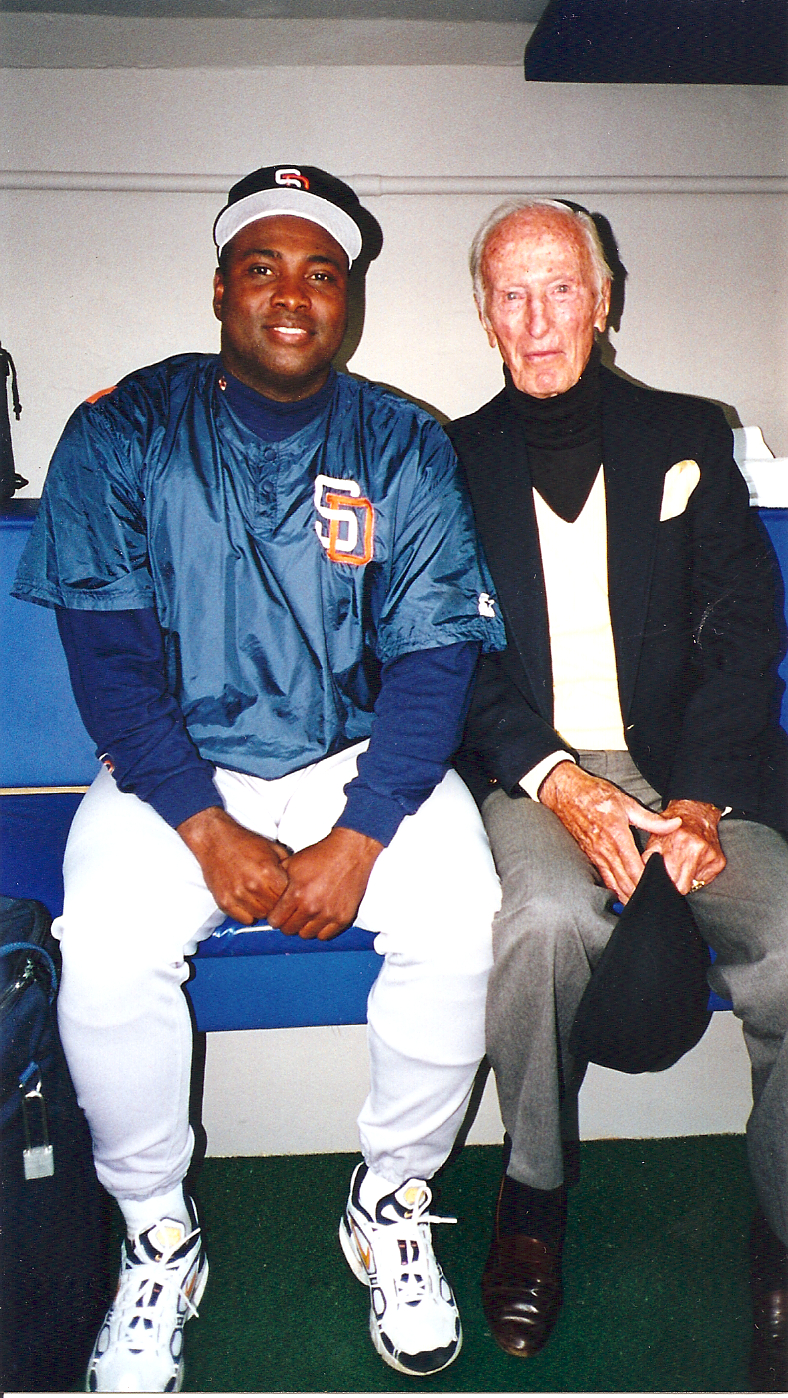
The photograph in the previous post merits an explanation. 

In 1998, when interleague play was still new, the San Diego Padres made it to the World Series against the vaunted Yankees. After he and his teammates won the NLCS, one of the first things Gwynn mentioned was that he would finally get to play in Yankee Stadium, and moreover, hear his name announced over the PA system by Bob Sheppard. I knew both men and decided to introduce them, and listened in delight as the former St John’s speech and public speaking professor talked the nuances of diction with the batting champion who used to take communications courses at San Diego State. 
Afterwards, as I escorted Bob back upstairs, I asked Bob if I could record him introducing a hypothetical Gwynn at bat, so I could transfer it to one of those “talking birthday card” electronic chips. Bob not only obliged, but asked me to confirm for him Tony’s position and number just to make sure. “We can’t have any mistakes.” Tony still has the recording (“in my trophy case, next to my silver bats”). And I cherish the memory.

Bob Sheppard, 1910-2010

Bob Sheppard, whose voice was so synonymous with Yankee Stadium that many of us who had heard him since our youths still hear him in the background of our dreams, has died at the age of 99. 

Mr. Sheppard had suffered through severe congestion for most of the last season in the old park in 2008, and though he held hopes of opening the new stadium last year, he never made it back. His family had reported as late as the end of the Yankee homestand last Sunday, that he was happy, alert, and feeling well – not strong enough to get far from his home, but well enough to have enjoyed a cocktail. Yankee Stadium videographers were in the process of compiling a second tape of greetings and well wishes from those of us at the Stadium who knew him and missed not merely the quality of the work but more importantly the quality of the man. 
His sense of humor was nearly as legendary as his enunciation and the meticulousness of his preparation. He had joined the Yankees so long ago – 1951 – that it was a point of perverse pride that the team had no record of who preceded him, and said so in its media guide. When I picked up the gauntlet of research I went first to Mr. Sheppard himself and asked him if, by chance, he knew but just hadn’t been asked. “Yes,” he intoned, pausing just as he did while behind the microphone. “Methusaleh,” he said with a laugh, referencing a biblical figure who lasted into quadruple figures.
It turned out Bob had actually been hired by Red Patterson, the Yankees’ public relations director of the time. 
Sheppard1998.jpg

In the ’40s and ’50s, public address announcing at Yankee Stadium – and elsewhere – was an afterthought. Patterson did it in between bon mots with the writers. He and other Yankee officials attended a football game played by the old Yankees of the All American Football Conference and were struck by the professionalism and thoroughness of the PA announcer there. They approached him as early as 1948 about doing baseball, but Sheppard could not fit the team’s weekday schedule into his full-time life as a speech professor at St. John’s University. Bob was more of a football guy anyway – he had quarterbacked St. John’s in the ’30s – and once confessed to me with a laugh that he had never attended a baseball game at Yankee Stadium until the team hired him during what would be Mickey Mantle’s first year (and Joe DiMaggio’s last). 
In the new job, Sheppard essentially invented the process with which we are familiar today. Before him, stadium announcers rarely provided any information to the audience. Line-ups would be announced, and then each batter’s first plate appearance as we, but often thereafter the fan was on his own. The idea of the dramatic announcement in the ninth inning of a tie in the Bronx: “Now batting for the Yankees, number seven, Mickey 
Mantle,” was Sheppard’s. It truly changed not just the fans’ experience at the game, but the game itself. 
I will add more reminiscences of Bob Sheppard throughout the day here – including the story of the above photograph with Tony Gwynn – as opportunities present themselves.

More Than Just A Mid-Game Interview

I’m a little late on this but I was watching my friend Kevin Burkhardt of SNY do a seemingly typical Independence Day interview in the middle of the Mets-Reds opener Monday night, when another friend popped up on my screen. 

Kevin was interviewing MSNBC analyst Jack Jacobs, who is usually a part of the Mets’ commendable but never over-the-top salutes to our military heroes. He’s part of them not just because he’s a Brooklyn kid, and media-savvy, and a baseball fan, but because he is truly one of those heroes.

I’ve known Jack Jacobs for seven years or so. When I returned to my television news job, he was already there, one of what was then a flock of “military analysts.” The analysts program would prove to have some serious ethical breaches but several of the men proved themselves well above and beyond such standards, and Jack was one of them. He could be analytical about the mechanics of war and strategy, he was skeptical about the interaction of politics and war, and he was unafraid to criticize bad judgements whether they were in the field or in Washington, or at the anchor desk.
At some point early in our acquaintanceship, I happened to hear – not from Jack, mind you – that he was one of what is still less than 3500 Americans to have been awarded the Congressional Medal of Honor. One would be tempted to analogize this to membership in the Hall of Fame, except given the millions of men who have fought for this nation, the ratio is wildly inappropriate. It might be closer to the Military parallel for a Perfect Game. Or maybe two of them.
Only ninety of the recipients are still living. Ninety. Thus it is, perhaps, like bumping into Sandy Koufax in the office and he’s joking about your tie or his shoes.
Whenever I see Jack in a public setting (I know him too well to do this when I bump into him in the office, because he’s always got some funky word-game going on, and invariably, and inexplicably, calls me “Doctor”) I am always reminded to go and re-read Jack’s Medal of Honor citation. It invariably gives me chills, and it invariably reads like something out of your worst nightmare, or some kind of science fiction.
Read it. We always talk about “remembering the troops every day of the year” and the week following the 4th of July is the perfect time to put that into practice. Read it, and then let me tell you one more thing about my friend Jack:

JACOBS, JACK H.

Rank and organization: Captain, U.S. Army, U.S. Army Element, U.S. Military Assistance Command, Republic of Vietnam. Place and date: Kien Phong Province, Republic of Vietnam, 9 March 1968. Entered service at: Trenton, N.J. Born: 2 August 1945, Brooklyn, N.Y. Citation: For conspicuous gallantry and intrepidity in action at the risk of his life above and beyond the call of duty. Capt. Jacobs (then 1st Lt.), Infantry, distinguished himself while serving as assistant battalion advisor, 2d Battalion, 16th Infantry, 9th Infantry Division, Army of the Republic of Vietnam. The 2d Battalion was advancing to contact when it came under intense heavy machine gun and mortar fire from a Viet Cong battalion positioned in well fortified bunkers. As the 2d Battalion deployed into attack formation its advance was halted by devastating fire. Capt. Jacobs, with the command element of the lead company, called for and directed air strikes on the enemy positions to facilitate a renewed attack. Due to the intensity of the enemy fire and heavy casualties to the command group, including the company commander, the attack stopped and the friendly troops became disorganized. Although wounded by mortar fragments, Capt. Jacobs assumed command of the allied company, ordered a withdrawal from the exposed position and established a defensive perimeter. Despite profuse bleeding from head wounds which impaired his vision, Capt. Jacobs, with complete disregard for his safety, returned under intense fire to evacuate a seriously wounded advisor to the safety of a wooded area where he administered lifesaving first aid. He then returned through heavy automatic weapons fire to evacuate the wounded company commander. Capt. Jacobs made repeated trips across the fire-swept open rice paddies evacuating wounded and their weapons. On 3 separate occasions, Capt. Jacobs contacted and drove off Viet Cong squads who were searching for allied wounded and weapons, single-handedly killing 3 and wounding several others. His gallant actions and extraordinary heroism saved the lives of 1 U.S. advisor and 13 allied soldiers. Through his effort the allied company was restored to an effective fighting unit and prevented defeat of the friendly forces by a strong and determined enemy. Capt. Jacobs, by his gallantry and bravery in action in the highest traditions of the military service, has reflected great credit upon himself, his unit, and the U.S. Army.

The one more thing? I don’t think Jack will be upset if I mention this. As you picture him dodging bullets to repeatedly carry other men across his back, you need to have the full picture. I believe I may be generous in estimating Jack Jacobs’ height at about 5’8″. That’s Colonel Jack Jacobs, thank you. And 5’8″ goes a long way in the clutch. 
As ever, Jack, thank you.

Your All-Star Controlled Scrimmage

Jayson Stark tweets that All-Star Managers Joe Girardi and Charlie Manuel were told to pick one “multi-position” player to their teams, which explains, if not excuses, the ludicrous selections of Omar Infante of Atlanta and Ty Wigginton of Baltimore. 

They are not All-Stars. They do not play every day. They are a kind of baseball equivalent of Special Teams guys, and that’s okay if that’s the way you want the All-Star Game to devolve. But you have taken it from an All-Star Game in which the actual stars often used to play the entire game, to an All-Star exhibition in which the roster is framed around a fans’ popularity vote, to one in which it is further restricted by a requirement that each team have a representative, to an All-Star Controlled Scrimmage in which a few more of the precious discretionary roster spots are awarded based on very narrowly defined “success.”
“Multi-Position Players”? “Middle Relievers”? What next, “Pinch-Hitters”? “Top Rule 5 Picks”? I mean, you could legitimize the ludicrous talk of having The Strasburg pitch in the game seven starts into his career by making sure a place on each team was reserved for “Top Rookies Brought Up Late To Avoid Super Two Arbitration Status.” And when you get to that point – and we’re close enough as it is – just call the thing on Monday “The Home Run Hitting Contest,” and the thing on Tuesday “All-Star Pitching Warm-Ups and Batting Practice.”
To expand on the issue of Middle Relievers, I have no problem with them. When Joe Torre put Mike Stanton on the 2001 All-Star team, many howled, I did not. But they have to be having a season that is as proportionately good as any Closer or Starter. And I don’t think Matt Thornton of the White Sox or Evan Meek of the Pirates are close to the top. Thornton is not an embarrassing pick (another tweet today suggested a good MLB scout considered him one of baseball’s top ten relievers – though I’d argue that surely at least one of the Padres’ Mike Adams, Heath Bell, or Luke Gregerson deserves to be ahead of him on that last, as does Bard of Boston, and very possibly Kuo of the Dodgers).
But I went a little further into the selection of Meek and it is just indefensible. 
Meek has pitched brilliantly this season. Obviously leads in Pittsburgh are scarce, but not impossible: Octavio Dotel has as many Saves as Jonathan Papelbon and one more than Mariano Rivera. One can argue that an All-Star Reliever – like Evan Meek – is more valuable with the Pirates than he is with the Yankees because leads are such a precious thing. Yet though he has pitched 38 times this year, the Bucs have only used Meek twelve times when they were ahead, and only five other times when they were tied. 
He comes to the All-Star table with more than half of his statistics compiled in games already lost, or nearly so. Twelve appearances with a lead. Ten appearances with his team already losing by three runs or more. These just aren’t the circumstances in which the other nine All-Star relievers have had their mettle tested. That he has been spectacular in 21 meaningless games, and less so in 17 others, is a virtual disqualification for consideration. You’re a step up from factoring how well guys did in AAA this year, or on Rehab, or in the AFL last fall.
It is also discouraging to how Meek has fared in the middle relievers’ equivalent of “Close And Late”:
Twelve Meek Appearances With Lead:
Games Saved:                                1
Games Held:                                   5
Games Won:                                   1
Blown Saves:                                  5*
No Win, Hold, Save, or BS:              1
“Record”:                                  7*-5-1
   * Blown Save 4/13, received Win
Five Meek Appearances In Ties:
Games Won:                                   2
Games Lost:                                   2
No Won or Loss:                              1
“Record”:                                    2-2-1

Even giving him both statistics in that April 13th game against the Giants in which he inherited a runner in the sixth, then gave up a single and a groundout producing the tie run, and then becoming the pitcher of record in what was ultimately a Pittsburgh victory, Meek, “Close And Late,” is 9-7-2. It’s counted seventeen times, and he has failed on seven of those occasions, and only twice because he inherited a runner and let him score.

Not only that, but the Pirates seem to be using him ‘when it counts’ less frequently as the season has worn on. Seven of his first fourteen appearances came while Pittsburgh was ahead or tied, and eleven of his first twenty-one were. Only six of his last seventeen have been.
I know this reads as if I’m beating up on Evan Meek. I’m not. He’s got great natural gifts and after years of struggle, his dedication to his craft and his willingness to learn has made him a valued major leaguer. I understand about the jigsaw puzzle that is the All-Star Roster (if Andrew McCutchen is actually the Bucs’ All-Star – and he is – then Michael Bourn can’t go representing the Astros and suddenly you’re making Matt Lindstrom or Brandon Lyon an All-Star). It’s not personal (it actually startles me that Pittsburgh, in another rebuilding season, hasn’t worked him into more pressure situations; heck, I even had him on my rotisserie league team for a month earlier in the season, and I take that stuff way too seriously). But the statistics of how they are using him suggest that no matter how good he might look against an individual batter or even in an individual game, the Pirates use him as if he were the second or even third best middle reliever on their team.
And when the second or third best middle reliever on the worst team in the league is an All-Star, it’s no longer the All-Star Game.

And The Meek Shall Inherit The All-Star Game

I’m speechless.

I know – given that it’s me – but I’m speechless. I probably uttered my first complaints about All-Star Game selections in 1968 and gave up hope of an equitable solution no later than 1990, but I did think I long ago had become immune to surprises.
And then Evan Meek and Omar Infante were named to the 2010 National League All-Star teams. I literally thought MLB Network had made some kind of mega-typo. There are no constructions in which either player is an All-Star. None. Not “it’s close,” not “there are arguments pro and con.” They’re not All-Stars.

Meek is a great story, a Rule V draftee who is finally harnessing his talent and is showing signs of developing into a useful major league relief pitcher. His ERA of 0.96, WHIP of 0.85, and his strikeout to walk ratio of 42:11, are fantastic. But he has been doing this in baseball’s equivalent of a vacuum: in low-leverage, middle relief situations. Not as a closer, not as the key set-up man. Not even as the penultimate set-up man. The Pirates may be a last place team, but they do have 20 Saves and 32 Holds this year, and Meek has one of the former and just five of the latter.
Because “Blown Saves” don’t appear in very many stat lines, the fact that Meek has been used in six save situations and coughed up the lead in five games, is easily smoothed over. It shouldn’t be. It suggests that Meek is a great guy to bring in when you’re down by four or up by five but he isn’t ready to handle games that, you know, might still be in doubt.
Meanwhile, the “Hold” is an imperfect statistic to say the least, but in the category, Meek is only third on his own team. Joel Hanrahan of the Bucs has 13 of them. When play began Sunday, 44 National League pitchers had more Holds than Meek did. Mike Adams has 21 in San Diego and Luke Gregerson 19 (and Gregerson’s K:W ratio is even better than Meek’s) and neither of them are going. They essentially have four times as many Holds as Meek. They are not going to Anaheim, Meek is. 
It’s as if somebody said “we need to honor the top non-important reliever in the NL Central.”
We both know why Meek is on the team: the Club Representative rule. Each team gets an All-Star whether they have one or not. This rule exists for only one reason – television. There is still some sort of assumption that the game’s ratings in a given market will be shattered if one of the market’s players is not present. As a 29-year veteran of national and local television, I’m afraid you’re going to have to show me a lot of research to prove a) that this is still the case, or b) that more than 100 people in Pittsburgh are going to watch the All-Star Game just to see Evan Meek. Because it would be my contention that the Each Team rule is one of the reasons the All-Star Game is not what it used to be, television-wise. 

Still, in some senses Meek’s selection makes more sense than the anointing of Omar Infante. Don’t you have to be at least a platoon starter, with several impressive statistics, to merit the All-Star Team? One homer, 22 RBI, three steals, a .311 average, and an OPS of .721 is impressive in what way? He can play four positions? That’s great – we’re in the day of four-man benches. Each team has at least one guy who can play four positions. Take a number. And the number better not be 47% – which is where Infante stands in At Bats relative to the leader on his own team, genuine All-Star Martin Prado. You will notice that the official All-Star depth charts list Infante in the back-up Third Base slot (rendered ludicrous by comparisons to Ryan Zimmerman or Casey McGehee). If for some reason, a National League “ninth guy” who has played multiple positions, suddenly needs to be named to the All-Star Team, I think the argument could be made that Prado’s own teammate Eric Hinske is more deserving (5-31-.284, .836) but of course…
Holy Crap we’re discussing the relative merits of Eric Hinske and Omar Infante as All-Stars while Joey Votto isn’t one.

This is baseball’s ultimate nightmare: an All-Star Game populated by utility infielders or mop-up relievers or Team Tokens. To revise what I wrote earlier: there are American League examples of non-star All-Stars, they’re just not as egregious. Matt Thornton comes to mind (he is having half the season Daniel Bard is and who is arguably less valuable to his team than is Scott Downs or even Will Ohman) and so does Ty Wigginton (he is hitting .251; Tigers rookie Brennan Boesch is at .342 and has more RBI and nearly as many homers as Wigginton). The first step to preventing this triumph of mediocrity from subsuming the Game is to eliminate the Team Rule, although obviously that wouldn’t have kept Infante home. 
But I’m afraid we are heading towards the ultimate step, which is to discontinue the Game outright. It previously rewarded and brought together the season’s top stars, to pit them against opponents they would otherwise never face, for the benefit of fans who would never see them live or on tv. Today, the players understandably would prefer the time off, the selection rules guarantee “stars” who aren’t, inter-league play destroyed the distinctive nature of the two leagues, every game is televised somewhere, and nobody outside his family is going to watch the All-Star Game hoping to see Evan Meek keep the American League lead at six runs in the 7th Inning!

PERSONNEL NOTE:
If your jaw dropped, as nearly all of them did inside the press box at broiling Yankee Stadium this afternoon, when CC Sabathia and not Andy Pettitte made the A.L. roster, fear not. Sabathia should take his regular Yankee turn next Sunday, and therefore be ineligible to pitch in Anaheim. Pettitte, the Yankees expect, will be his replacement.
Hope Andy can sleep the night before knowing he might have to face Infante.
DYNASTIES ILLUSTRATED:
Yankees commemorated George Steinbrenner’s birthday by displaying the seven World Series Trophies won under his regime. Despite game time temperatures of 93 degrees (felt more like 126 in the labyrinth behind the team’s museum – and yes, the line up and then down the ramp is for the chance to take a quick photo of the trophies) none of the hardware melted:
IMG_0027.JPG

Perfect Game, Imperfect Rest Of Career

With Mark Buehrle’s loss Monday, and Dallas Braden getting scratched from his start last night, the combined record since their achievements of the three active pitchers to have tossed Perfect Games has dropped to 8 wins and 18 losses.

Is there something about getting 27 outs in a row that psychologically alters a pitcher? The sudden realization that you can do it? The gnawing sensation that a “quality start” or even a six-hit shutout just isn’t the ceiling? Or is it possible that a Perfecto really is some sort of apogee of pitching skills, and not merely the collision of quality and fortune?
Whatever the impact of the Perfect Game on the Perfect Game Pitcher, nine of the 20 to throw them have not managed to thereafter win more games than they lost. Another was one game over .500. An eleventh was just three games over. Fully fourteen of the pitchers saw their winning percentages drop from where they had been before their slice of immortality (though obviously the figures on Braden, Buehrle, and Halladay are at this point embryonic)
Consider these numbers, ranked in order in change of performance before and after. First the good news: it is perhaps not surprising that of the six pitchers whose percentages improved afterwards, the two most substantial jumps belong to Hall of Famers.
Jim Hunter Before: 32-38, .457
Jim Hunter After: 191-128, .599
Jim Hunter Improvement: 142
Sandy Koufax Before: 133-77, .633
Sandy Koufax After: 31-10, .756
Sandy Koufax Improvement: 123

Koufax is a bit of an aberration, since that 31-10 record, gaudy as it seems, represents only one season plus about a month, before his retirement in November, 1966.

The other four improvements are a little more telling.

David Wells Before: 110-86, .561
David Wells After: 128-71, .643
David Wells Improvement: 82
Don Larsen Before: 30-40, .429
Don Larsen After: 51-51, .500
Don Larsen Improvement: 71
Mike Witt Before: 37-40, .481
Mike Witt After: 79-76, .510
Mike Witt Improvement: 29
Dennis Martinez Before: 173-140, .553
Dennis Martinez After: 71-53, .573
Dennis Martinez Improvement: 20

For everybody else, the Perfect Game has meant comparative disaster. We can again discern some unrelated factors: many pitchers threw their masterpieces late in their careers (Cone), late in life (Joss died about 30 months after he threw his), or not long before injuries (Robertson and Ward, the latter of whom would switch positions and become a Hall of Fame shortstop).

Still, the numbers don’t augur well for our trio of active guys. They are listed in here in terms of the greatest mathematical drop from career Winning Percentage before the game, to career Winning Percentage afterwards:

Dallas Braden Before: 17-23, .425
Dallas Braden After: 0-5, .000
Dallas Braden Dropoff: 425
David Cone Before: 177-97, .646
David Cone After: 16-29, .356
David Cone Dropoff: 290
Lee Richmond Before: 14-7, .667
Lee Richmond After: 61-93, .396
Lee Richmond Dropoff: 271
Roy Halladay Before: 154-79, .661
Roy Halladay After: 2-3, .400
Roy Halladay Dropoff: 261
Mark Buehrle Before: 132-90, .595
Mark Buehrle After: 6-10, .375
Mark Buehrle Dropoff: 220
Jim Bunning Before: 143-89, .616
Jim Bunning After: 80-95, .457
Jim Bunning Dropoff: 159
Len Barker Before: 33-25, .569
Len Barker After: 40-51, .440
Len Barker Dropoff: 129
Charlie Robertson Before: 1-1 .500
Charlie Robertson After: 47-79, .373
Charlie Robertson Dropoff: 127
Addie Joss Before: 140-79, .639
Addie Joss After: 19-18, .514
Addie Joss Dropoff: 125
Cy Young Before: 382-216, .639
Cy Young After: 128-116, .525
Cy Young Dropoff: 114
Randy Johnson Before: 233-118, .664
Randy Johnson After: 69-48, .590
Randy Johnson Dropoff: 74
Johnny Ward Before: 80-43, .650
Johnny Ward After: 81-60, .574
Johnny Ward Dropoff: 46
Tom Browning Before: 60-40, .600
Tom Browning After: 62-50, .554
Tom Browning Dropoff: 46
Kenny Rogers Before: 52-36, .591
Kenny Rogers After: 166-120, .580
Kenny Rogers Dropoff: 9 

Rogers’ fall off is not even what the typical decline of a pitcher would suggest, and Browning’s and Ward’s aren’t very spectacular. Then again, neither are the improvements of Witt or Martinez. 

Essentially the pitchers break down into three groups: four who improved, five who didn’t change much, and eleven who got worse and noticably so.
Maybe Armando Galarraga got a minor break after all. 

Statistical Possibility Does Not Really Permit This: Update

This does boggle the mind. Since Mark Buehrle’s perfect game against them last July, the Tampa Bay Rays have now been no-hit three times in a span of 140 games. 

They’ve now been victims of a perfect game in a day game after a night game (Buehrle), victims of a perfect game on an ordinary road weekend game (Dallas Braden, in Oakland, this season), and victims of a no-hitter in their own stadium, at the hands of a pitcher whom they once thought might become the ace of their own staff, Edwin Jackson, tonight.
These are not the 1998 Twins or the 1999 Expos, light-hitting, fringe-player-filled line-ups that are the kinds ordinarily slightly more susceptible to being utterly blanked. Ever looked at the line-up David Wells knocked down with only 27 tries in ’98? Lawton, Gates, Paul Molitor, Cordova, Coomer, Ochoa, Shave, Javier Valentin, Meares. Not quite murderers’ row.
The Rays, on the other hand, have sent Jason Bartlett, Evan Longoria, Carlos Pena, B.J. Upton, and Ben Zobrist to the plate in each of these games. They are a combined 0-for-42. Carl Crawford did not bat tonight due to his cranky shoulder, but he managed another 0-for-6 in the perfectos.
These are good hitters who have, in essence, been stymied three times in what amounts to 22 games less than a full season. The laws of statistical possibility are angry at some one or some thing.
UPDATE: From Marc Topkin of the St Pete Times on Twitter the Rays are indeed the first team to be no-hit three times, in full length games, in such a short span. The 1906 Brooklyn Superbas were blanked three times between May 1st and September 24th (Johnny Lush of the Phillies, Jake Weimer of the Reds, and Stoney McGlynn of the Cards), but the last two of the games were seven-inning jobs (the McGlynn game, in fact, was a tie). That was not uncommon then in the time when doubleheaders were frequent and lights were 30 years in the future – second games of DH’s often were pre-arranged to last only seven frames. In fact some were played not to an inning total but to the clock, so teams could catch trains to get from city to city.
The ’06 Brooklyns, by the way, also had a decent offense. Tim Jordan led the NL with a then-******** dozen homers, and Harry Lumley led in Slugging Percentage (.477). But they were frequent victims in that era. Nick Maddox of the Pirates would no hit them in September, 2007 (thus four no-hitters in 16 months), and Johnny Lush would come back and throw a six-inning no-hitter in August of ’08.
One other creepy thing of which an MLB.Com headline just reminded me: Edwin Jackson pitched his no-hitter a year to the day Michael Jackson died.

Soccer?

A lot on the site today about the “cross-over appeal” of the World Cup, and there’s no doubt about it; half the televisions in the Yankee club this afternoon were tuned to it (and half is a lot of televisions), and two of my companions and I stuck around to watch the last 30 minutes of the USA-UK tie.
But, while firmly believing that neither game is as much a sport as it is a cultural inheritance, and freely stipulating that if neither had ever been played and both were invented tomorrow, both would have a hard time catching on anywhere in this electronic age, I have to insist: I just don’t think soccer measures up to baseball in any respect excepting the joy people derive from each.
More over, soccer’s support in this country reminds me of a dining room set we got when I was seven. It and the accompanying swivel chairs were much ballyhooed, and in the style of that Keep-Up-With-The-Joneses era, my mother boasted about them to all the other mothers. Came the grand day of the dining set’s arrivals and the swivel chairs were unavailable, on back order, and identical looking non-swiveling chairs had been given us as loaners. Well, one of my mother’s friends came over and decided to one-up my mother by explaining the history of these chairs, her familiarity with the product, and her superior ability to judge the efficacy of the swivel mechanism. The chairs would not budge, but she would not let that stop her. While seated in one, she lifted it up, half with her feet, half with her hands, and bounced it a few times to the left and a few times to the right. “Yes, I can tell,” she said, “you got the good ones. Not the best, we have better ones, but these are good too.”
In her mind, they swiveled.
To me, that’s an American soccer fan, seeing suspense and action where there is little. More disturbing, perhaps – and maybe this is why European fans in particular are noted for their violence – is the almost complete non-interaction of the spectators with the sport. Fans are kept engaged at all times at a ballgame; in every one of them at least one baseball winds up in the seats, and if you’re lucky, a player will, too. Fans can impact play on the field without doing more than standing and moving their arms (ask Steve Bartman, or, me, in an identical play at Yankee Stadium in 1972 or 1973 involving no less than Moises Alou’s Dad as the fielder). To effect the game, the soccer fan must run on to the field. Or sing. Or run on to the field while singing.
It doesn’t swivel. Sorry.
But enough of that. Back to the world of Daniel Nava and somebody who owns a Bryan Bullington shirt. The Nava story is self-explanatory (has soccer had one like that since Dixie Dean retired?), the Bullington one I’ll get to in a moment.
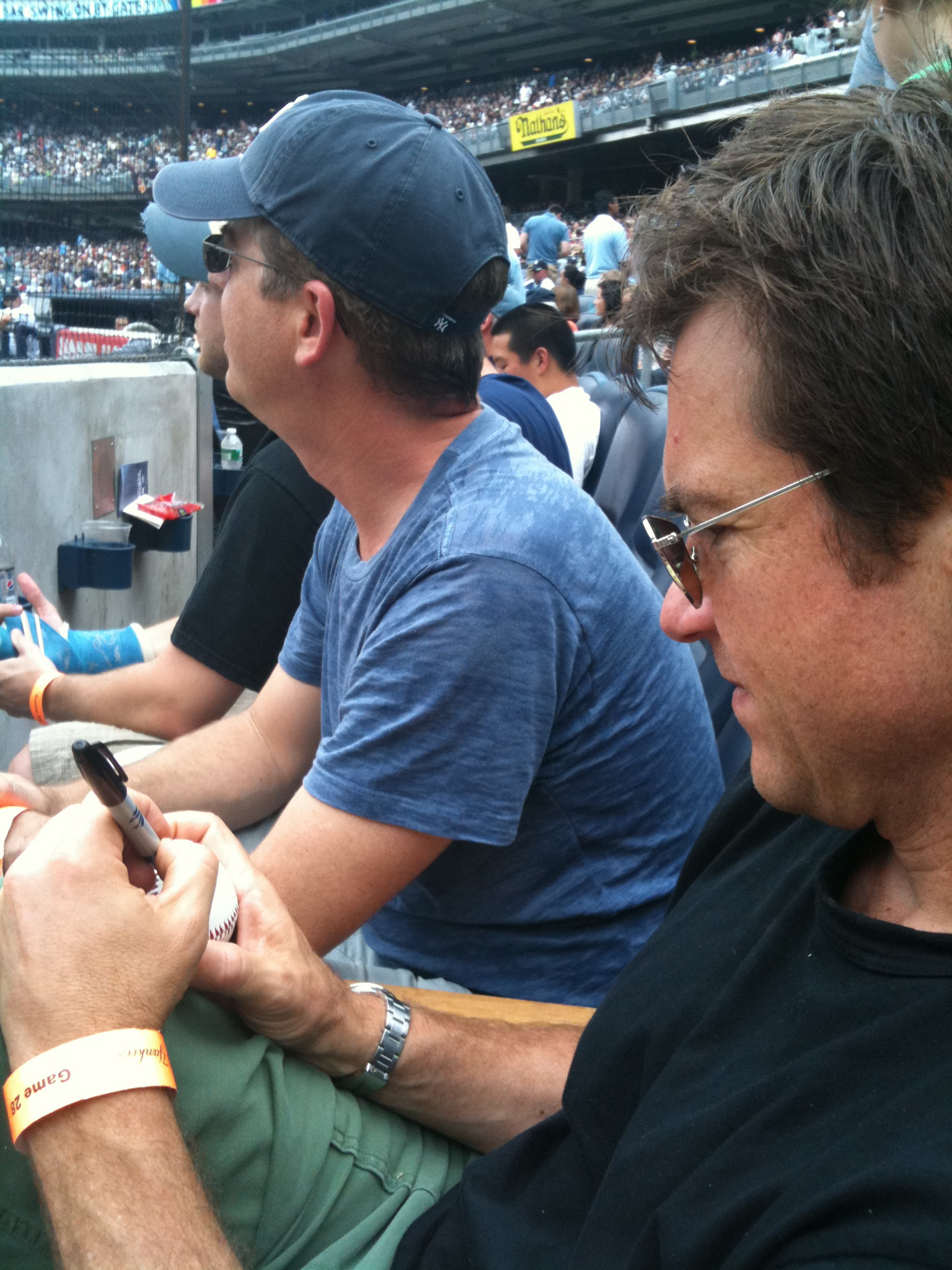
First, a shot of one of my friends at the ballpark today. 

IMG_2435.jpg

Ex-soccer player himself, was happy with the tie, didn’t see anything special in the US-UK game.
Jason Bateman is a Dodger fan, in town to reveal a new online comedy site he will co-populate with Will Arnett (not attending today’s game). Here, Jason, also the Commissioner of his own fantasy league for five seasons, signs a baseball for a fan who obviously no longer cares about the value of the baseball.
A considerable debate preceded this about where exactly he should sign the thing since the store-bought ball appeared to have a logo placed in the traditional “sweet spot.” I suggested that it no longer mattered, providing his signature was not upside-down compared to the manufacturer’s inscription on the ball itself. If you happen to see this ball on eBay with the inscription erased, this photo will serve as the certificate of authenticity.
EXPERIMENTING WITH AN APP
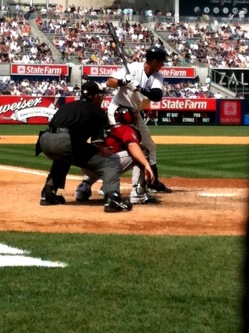
Downloaded this thing “CameraOne” for iPhone – I think the cost was $1.99 – and it gives you a zoom on the phone. It’s a little grainier than I would like, but not by much. Examples:
IMG_2424.JPG
Thumbnail image for IMG_2443.JPG
Derek Jeter at the plate, at the left; the Golden Knights of the U.S. Army Parachute team arriving early.
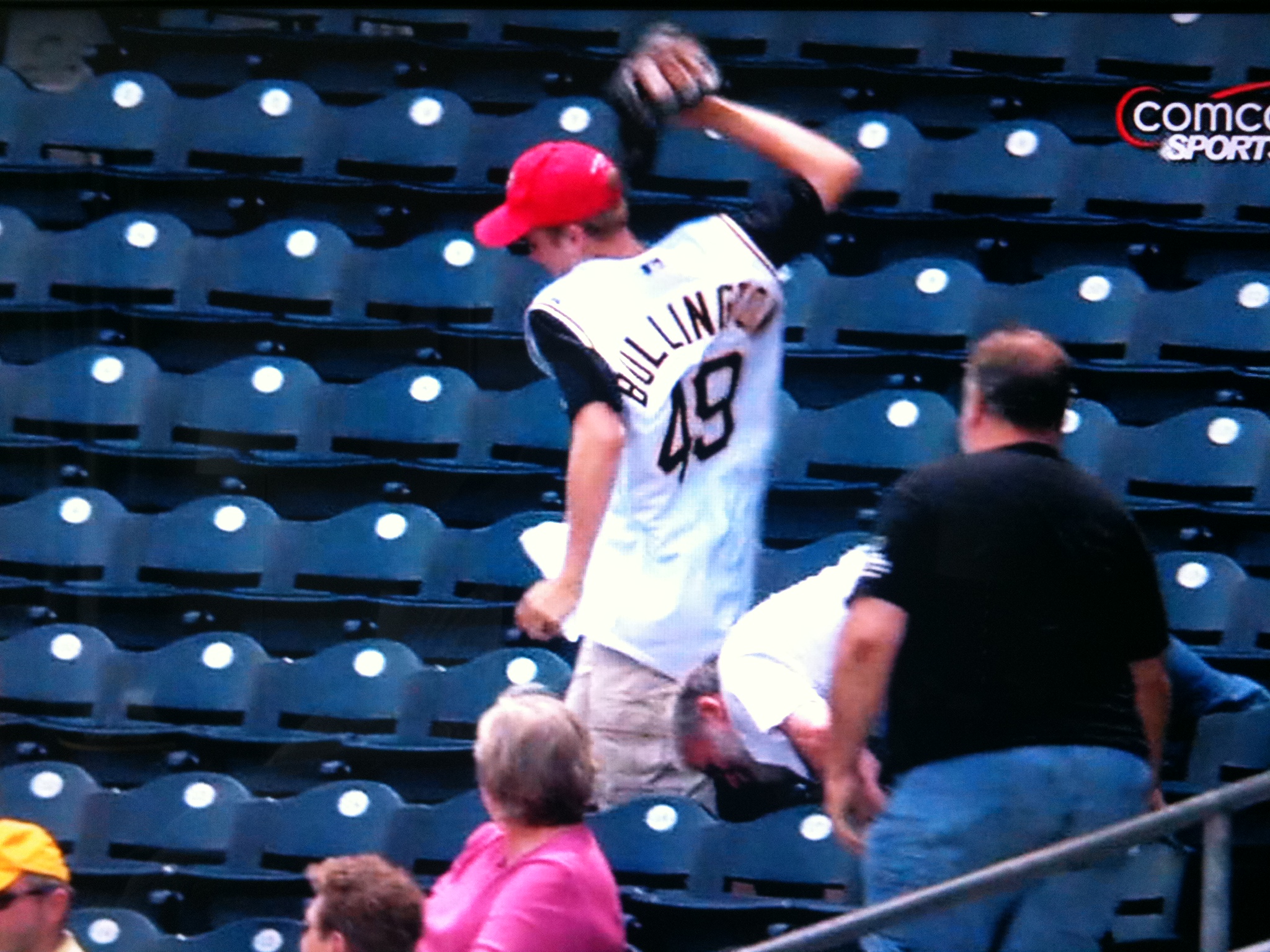
One last image, from last week, a Pirates’ fan missing a foul ball and, in frustration, throwing his glove. He was wearing a shirt representing Bryan Bullington, the first pick in the 2002 draft, who had a lifetime 0-3 record in Pittsburgh. If he’s a relative, that’s one thing. Otherwise, you might want to have a tailor take the lettering off. It’s like going to a Mets’ game wearing a shirt with “CHILCOTT” on the back.
IMG_2413.JPG