Category: Uncategorized
Why Ozzie Guillen Is NOT Protected By The 1st Amendment
You’ve read the remarks by now:
“I love Fidel Castro. I respect Fidel Castro. You know why? A lot of people have wanted to kill Fidel Castro for the last 60 years, but that (expletive) is still there.”
That’s from a subscriber-only article in Time. Ken Rosenthal has written that in the context of how Fidel Castro is viewed in South Florida, the Marlins need to do more than have Ozzie Guillen apologize at his news conference tomorrow, that they need to suspend him for as much as a month.
A predominant response from fans who – correctly, I think – believe we have gotten to the point where we take everything either too seriously or not seriously enough, has been “What happened to Ozzie’s free speech? What about the 1st Amendment?”
Well – what about it?
Ever read it?
Congress shall make no law respecting an establishment of religion, or prohibiting the free exercise thereof; or abridging the freedom of speech, or of the press; or the right of the people peaceably to assemble, and to petition the Government for a redress of grievances.
That’s the whole thing. In case you think there’s a hidden meaning in there somewhere protecting Ozzie Guillen’s – oryour -right to say whatever he wants without consequences from his employers or his community: No.
Translation of the cornerstone of the Bill of Rights, the 1st Amendment to our Constitution to the current mess?
Congress shall make no law abridging Ozzie Guillen’s freedom of speech.
His bosses? They can abridge it all they want.
Ironically, the heavy-handedness of local politicians trying to capitalize on the situation may serve to protect Ozzie. The Chairman of the Board of Commissioners of Miami-Dade wants Guillen to resign, or to be fired. “To say you respect Fidel Castro,” writes Joe A. Martinez, “suggests he also respects dictators such as Hugo Chavez, Daniel Ortega, Adolf Hitler and Sadam Hussein.”
The hell it does.
Ozzie is guilty of praising Castro’s longevity, in much the same kind of way he would praise Jamie Moyer if he threw a 4-hit shutout against the Marlins. But there are third rails, and in South Florida, Castro is viewed as the destroyer of lives, the ruination of the homeland, the man who separated families, tortured opponents, the man who sent would-be refugees to drown or be eaten by sharks, and sent a country back to 1947.
There are survivors, and the relatives of those who didn’t survive, and one of the things they don’t want to hear is that there’s anything good about Castro. And I can’t blame them. You can’t view this exclusively from your own perspective. You need to remember that much of the geographical area the Marlins represent view what has happened to Cuba since 1959 the way Israel views its more belligerent neighbors – or worse.
The usually hip Deadspin was particularly tone-deaf on this:
I’m not Cuban, nor have I ever been to Miami so I don’t know how this played out among that population, but I would just say this…
No, don’t. The 1st Amendment doesn’t protect you either, Bud.
If the Marlins don’t act decisively, one anti-Castro group plans to picket and protest the team until Guillen is out, or Castro leaves office, or both – In which case Ozzie had better hope he has completely misjudged the dictator’s longevity. One assumes a serious suspension would tamp down the fire pretty quickly.
There are a lot of arguments here, but the one to leave out involves wrapping Guillen in the 1st Amendment. It might be nice (or it might be disastrous) if we all had some kind of private immunity from controversial statements, but we clearly don’t.
2012 Previews: N.L. East
11 homers, 44 RBI, and a .769 OPS, in 103 games.
It’s kind of hard to believe that looking at those numbers, or more correctly looking at the loss of those numbers, would lead lots of folks to completely write off the 2012 chances of one particular club.
Those are, of course, the 2011 statistics of Chase Cameron Utley, who may or may not be the second baseman in PHILADELPHIA for part of 2012. Filling a similar role of not-quite-two-thirds-of-a-regular last year, Utley was part of a Phils squad that won its division by 13 games. In slightly fuller part-time duty the year before, Utley’s Phillies won the East by six games. In 2009, his last complete year, they also won by six games. In 2008, his last great year, they won by three.
It’s ludicrous to suggest that the Phillies have gotten better the less Utley has played. But it’s just as ludicrous to suggest that he is somehow irreplaceable. They replaced him fine the last two years, and even when he came back to hit .438 in the NLDS, they still managed to lose with him. But now Utley is a complete maybe, and the Phillies are supposedly dead.
Bolshoi.
The actual argument about the loss of Utley is that a healthy version would have compensated for the real damage done by the absence of Ryan Howard. Yes, he basically can’t hit lefties any more (in 2008 counting the post-season he drove in 52 runs against left-hand pitching; last year, 28, including 0-for-6 against Cardinal southpaws in the playoffs). But he’s still like the big fat kid on the playground: he tends to win nearly all the wrestling matches.
Utley’s presence was ultimately necessary because of Howard’s absence. Hell, they could’ve played him at first and saved a little wear and tear on him. But as immobile as Howard appears as the dawn of a new season breaks, his problem now is largely down to recovery from an infection that sounds suspiciously like a hospital bed sore. If and when it is fully knocked out, he will heal up quickly, and his stamina will recover adequately.
In short, the message to the assumed contending trio of the Braves, Marlins, and Nationals is: you’d better bury Philadelphia while Howard is still out. Because if you don’t, you won’t when he comes back. There’s just too much there there, especially in pitching, especially with the seeming Nostradamus act of Ruben Amaro almost re-signing the destined for injury Ryan Madson only to suddenly pull Jonathan Papelbon out of the hat. If the Phillies get any worthwhile production out of Jim Thome, Ty Wigginton, Juan Pierre and Freddy Galvis, they’ll be good if not great (and surely Galvis is a defensive upgrade at second base).
The three other contenders in this division are hard to sort out, and are probably all overrated. WASHINGTON has no pennant race experience, ATLANTA has too much, and MIAMI thinks it isn’t necessary.
The Braves are the likeliest to provide the challenge. Jair Jurrjens’ incremental velocity loss is a major concern, as are the horrific springs of Randall Delgado and Julio Teheran. So is the prospect that last season they actually burned out – rather than just wearing down – Jonny Venters. There are, however, waves of pitching options, and a strong offense that cannot again crater the way it did last September. I don’t think much should be expected of Chipper Jones, but on the other side of that coin, the Braves may have stolen a Jose Bautista-like player from Cincinnati in last Sunday’s trade for third baseman Juan Francisco.
Francisco has always had a reputation for tremendous power and a throwing arm not exceeded anywhere in the minors. But the Reds had transformed him from prospect to suspect by bringing him up in each of the last three years – and not having him do anything. We all know Dusty Baker’s inexplicable twist of the ’60s catchphrase: Don’t Trust Anybody Under 30. But Francisco may be Baker’s most appalling victim, worse even than what he did to Todd Frazier. Until September 1st of last year, Juan Francisco had started consecutive major league games once in his life. With little to play for down the stretch, Baker gave him a few more shots – three streaks of three starts in a row and three more of back-to-backs. Francisco responded with what was basically a 19-games-as-a-starter sample slash line reading 3/15/.280/.314/.500/.814.
I know straight extrapolations are dangerous it stretches out, but in just 114 games in a theoretical platoon with Martin Prado, Francisco’s line stretches out to 18/90/.280/.314/.500/.814. The kid has a thick body and needs to work harder, but countless are the examples of the underachievers who blossom when somebody has no choice but to play them regularly.
I do not see the Nationals competing offensively unless Bryce Harper ascends early, and all the indications from spring training implied this would be a 2013 event. Desmond and Espinosa can be a valuable offensive tandem but strike out fearfully often, Michael Morse and Adam LaRoche begin the year hurt, and there is still no indication that Jayson Werth’s 2008-10 run was not his peak. The bullpen is very nice and the rotation is probably second in the division, but who has felt the heat, close and late? LaRoche, Werth, Lidge, and the ever-relocating Edwin Jackson.
The problem with the Marlins is that all of their offensive stars – Hanley Ramirez, Giancarlo Stanton, Jose Reyes, Gaby Sanchez, and Logan Morrison – could live up to expectations and the team could still linger around .500. I do not like this rotation. Josh Johnson is overpowering, but though he has been with them off-and-on since 2005, he has only once thrown a full complement of starts. Mark Buehrle is an innings eater but no all-star, and if you’re depending on Anibal Sanchez, Ricky Nolasco, or Carlos Zambrano, you haven’t been paying attention. It is intriguing that 74 percent of the homers hit by Morrison and Stanton last year came with nobody on board, but that rotation and most of that bullpen seems shaky.
As an aside, the Miami experience will be as important at the gate as on the field. If the Marlins underachieve – or achieve and the fans still under-attend – there could be a quick fire sale, or a desperate effort to move the mega-contracts. And this isn’t just about South Florida. It reflects no great insight to realize that the willingness of the state of Florida, and the cities of St. Petersburg and/or Tampa to contribute to a new ballpark for the Rays, is almost wholly dependent on what happens in Miami. If the Marlins don’t draw, there is no other conclusion to reach than that the Rays will almost certainly have to move before 2017. They have developed a winning machine in Tampa Bay, and a loyal fan base, but very few of those fans seem to want to express their loyalty by paying, and fewer still want to pay their way into that nicely redecorated aircraft hangar.
I don’t have the heart to be rude about well-meaning NEW YORK. It is infuriating, knowing how that organization is infused from almost the top, to the very bottom, with earnest, hard-working people, that a team in a smaller market and a younger mega-tv deal spent the winter vacuuming up Albert Pujols and C.J. Wilson, while this club with its own tv channel couldn’t even make a serious offer to Jose Reyes. Worse yet, despite a few bright spots on the horizon, there is no immediate hope of improvement. Barring somebody collapsing above them, the Mets are likely to finish last this year and for several to come.
2012 N.L. EAST FORECAST:
The Phillies hang tough long enough for Howard to return in time to beat back the Braves, Nationals, and calamity-stricken Marlins, in a tight but possibly anger-filled race. The last-place Mets will sparkle on some days and Johan Santana’s comeback will be heart-warming – and then they might still have to deal him off.
2012 Previews: A.L. Central
It will be one of those freaks of baseball nature, not unlike the year the St. Louis Browns won the pennant because all their players were just physically bad enough to not be drafted for World War 2, or the year the Reds won the most games in the National League yet did not make the playoffs. The Detroit Tigers, with probably the worst defensive starting line-up in the majors today – and one of the worst of all-time among serious contenders – will likely blow through the American League Central and could easily start the playoffs as the odds-on favorite to win the ALCS and even The Series.
Consider them, and leave your images of them at bat, back in your mental dugout:
— Prince Fielder at first base: Decent forward motion for a man of his size, and unexpected ups, too. But going after a liner to either side should be accompanied by a public address system announcement of “timber.”
— Ryan Rayburn at second: You need to see the video again of him doing the Jai-Alai bit in left field to send Miguel Olivo’s fly ball over the fence? Here’s the link.
— Jhonny Peralta at short: This is an ex-shortstop turned third baseman and reconverted to short. And he’s the infield stalwart.
— Miguel Cabrera at third: No.
— Delmon Young in left: This will make you hanker for Raburn.
— Brennan Boesch in right: Immobile.
— Alex Avila catching: He’s a gifted receiver but, without Victor Martinez to help him out, the temptation for Jim Leyland to play him 133 more times behind the plate will be huge. His exhaustion down the stretch last year was ultimately disastrous.
You’ll notice I left out Austin Jackson. Obviously he is one of the best centerfielders in the game, not just fast but instinctive on balls off the bat, and in his throwing. But between Young and Boesch (or any of the alternatives) in that of all ballparks, they are asking him to cover a lot of ground.
But of course this is academic. When Salvador Perez and Joakim Soria went down, they postponed any chance of a KANSAS CITY uprising until next season. The Royals needed everything to break their way to offer a serious challenge, and we already know it won’t. They can live without Soria but pulling either Greg Holland or Jonathan Broxton out of their set-up pool will wind up overburdening the rotation. I still think the Royals could manage a second-place finish, but it’ll be distant behind a Tiger offense and pitching staff that are each 50% better than anything else in the division.
CLEVELAND is beginning to understand that if Ubaldo Jimenez did not hit his high water mark at the 2010 All-Star Game, he did so in the “Zander?” commercial with Jorge De La Ros about the bicycle license plates. How they could not see that he had lost command and speed suggests the Indians need to sign up for cable or a dish. That he cost them Drew Pomeranz and Alex White may come to haunt the Indians the way the Mike Napoli deal haunts the Angels. Manny Acta will get everything out of this team, but exactly who is going to make the decision to pull Jimenez out of the rotation?
Sometimes rebuilds can be fun. Consider the rookies and sophomores in CHICAGO: closer-in-waiting Addison Reed, relievers Hector Santiago and Nate Jones, third baseamn Brent Morel, rightfielder (well, hitter in right field) Dayan Viciedo, and, the most intriguing prospect of them all, Manager Robin Ventura. The White Sox will struggle to see .500 but Ventura’s extraordinary equanimity, devious humor, and quiet command will set a tone for quick recovery. Whether the White Sox have enough coming up through the pipeline to make them contenders in the near term is another thing all together.
Before you cast stones at MINNESOTA – be honest. Did you cry “no” when they gave then-recent-MVP Justin Morneau the big money? Did you say it was ludicrous when they gave Joe Mauer his $184,000,000 or did you extol the virtues of the small market team that could somehow afford to keep its hometown hero? You didn’t warn, I didn’t, the fans didn’t, and Twins ownership didn’t. And now we’re all on a possibly-irreversible trip to an AL Central version of the current events in Houston or Pittsburgh: exquisite new ballpark, faithful fans, and a team that can’t even afford to retain a Delmon Young during a season or a rehabbed Joe Nathan following it. It’s grim and it’s a reminder that Cincinnati is one blown-out kneecap away from having to give 51% of the franchise ownership to a suddenly-retired Joey Votto in lieu of paying a suddenly-retired Joey Votto.
AMERICAN LEAGUE CENTRAL FORECAST:
Tigers, with or without a Statuary Defense, should win this division by double digits. The Royals and Indians will fight for second (and fight to stay over .500) and the White Sox will likely come in a few notches under. The Twins may be bad enough for the team to have to put up twelve-foot high fences to keep their most loyal fans from throwing themselves into the Fire Pits at Target Field.
2012 Previews: A.L. West
Imagine for a second this scenario: a New York team wins consecutive pennants. They lose the first World Series to a lightning-in-a-bottle fast-finisher from the other league. They lose the next year to another one-month-wonder despite twice being one strike away from sealing the deal in Game 6. The New York team owner – one of the most famous men in sports – has to decide whether or not to retain his popular, African-American manager after the latter tests positive for cocaine. This was after he built the batting order around a recovered addict, who then falls off the wagon in the weeks before he was to get a nine-figure contract extension.
Can you picture that? It would be Armageddon every day at that ballpark as the media – not just in New York but nationally – struggled merely to decide whether these misceants were to be called the worst chokers of all time, or a bunch of druggies, or the team with the owner who needed to be run out of the game on a rail for letting such tainted underachievement continue. It would be, to adapt Dorothy Parker’s phrase to baseball, a Fresh Hell every day.
Of course, you don’t have to imagine anything here but the geography. This is not the imaginary story of the most controversial New York team of all time. It’s the 2012 Texas Rangers – and only their worst headlines – and in one of the most meaningful and revealing truths about baseball, and sports media, and America itself, they remain one of our feel good stories.
It’s not just New York, by the way. The 180 degree difference in how the New York Baseball Rangers would be treated, would also be true of the Boston Rangers or the Philadelphia Rangers or the Los Angeles Rangers. Regardless of the venue, it’s amazing, and it’s real.
And it’s relevant to a preview of the American League West because it means what is largely the same team can try it again for the third straight year – without Josh Hamilton being traded for Ken Phelps or Ron Washington being replaced by Dallas Green. There are only two notable changes: a real closer in Joe Nathan, and C.J. Wilson being swapped out for Yu Darvish.
The former move seems to reduce the variables; the latter may do the opposite. Darvish is the prototypical Japanese pitcher – with slight deception in the delivery, a mastery of five pitches and about four subtle varieties for each of them, and a rubber arm (at least for awhile). But Darvish is something Nomo and Matsuzaka and the rest are not: he is a Giant. He is 6’5”, 215, meaning he’s bigger than Nathan and Colby Lewis, and at least taller than Josh Hamilton. So the four different fastballs come in as fast as 95.
Watching Darvish against Colorado last week was watching the biggest kid in Kindergarten playfully slapping all the other ones. Half of them fell unconscious to the floor. The others? He missed them and he fell to the floor. The Rockies got their licks in, but in six at bats against him, Cargo and Tulo struck out six times and didn’t look close on any of the swinging strikes. It is almost a given (since we still condescendingly look at even Japan’s greatest veteran stars as our freshmen) that Darvish takes the Rookie Award in the AL. He may take the Cy. He may also go 12-15. The question isn’t whether or not he’ll make American batters look bad most of the time, but whether he might make American pitchers look bad most of the time.
The Rangers have competition in Orange County, but the ANGELS are the most tragically snake-bitten of all teams, and investments like the zillions spent on Wilson and Albert Pujols have always ended in tears – usually the late Gene Mauch’s. Despite the addition of Pujols and the resurrection of Kendrys “Just Shake Hands” Morales, the Cherubs are nowhere near a match for Texas offensively (hell, the ’27 Yankees might not be). The Mark Trumbo third base play comes at considerable defensive risk, and the bullpen remains a series of risky albeit probably good gambles. Ironically, for all that money, the difference-maker for Mike Scioscia might be his fifth starter, either retread Jerome Williams or rookie Garrett Richards, who at times looked lights out this spring.
There might be something to watch in SEATTLE. My affection for Jesus Montero’s opposite field power has been elaborated upon here before. But there is a flock of young hitters around him who might also blossom, and not just Dustin Ackley. Smoak, Carp (hurt), Saunders, Liddi, Gutierrez (hurt), and behind them Catricala and another Fernando Martinez might make the Mariners Wild Card eligible in a year. Probably would’ve helped if they hadn’t traded Doug Fister, because the rotation gets dicey just about the time you ask “Kevin Millwood is still alive?”
My friend Bob Melvin gets his first full year managing again, in OAKLAND. He loves to do it and was born to do it, and if anybody can drag this team back into respectability after its latest re-casting, it’s Bob. Unfortunately, even though he only played 11 games there in his career, Bob might be the best first baseman he has, and that’s a problem. The base hits get thin once you get past the exciting Jemile Weeks and the possibly exciting Yoenis Cespedes. And I won’t write anything long-winded on the latter for fear of being accusedof being Cespedes-sesquipedalian.
Sorry.
It’ll be fun watching the A’s continue their role as baseball’s breeding and/or training grounds for B+ pitchers. Mulder, Zito, Hudson, Harden, Haren, Street, Gonzalez, Cahill, Bailey, Anderson, et al. The new names are De Los Santos, Milone, Parker, and Peacock and maybe baseball can get on the stick and get the A’s into San Jose before they become eligible for the A’s Alumni Association, too.
AMERICAN LEAGUE WEST FORECAST:
TEXAS wins again, with Darvish filling the Wilson vacuum. LOS ANGELES/ANAHEIM/THE OC, afflicted by some calamity, still has enough to claim a wild card. SEATTLE approaches .500, and OAKLAND does better than you’d think.
UNRELATED NOTE:
Love the Braves taking a flier on third baseman Juan Francisco. He may amount to nothing, but he is capable of a Jose Bautista like breakout, and he’s no more of a load defensively than Cabrera or Trumbo. He was dying a slow death in Cincinnati where I believe Dusty Baker never played him two games in a row. Because he isn’t 37.
2012 Previews: A.L. East
AMID all the curiosity and nostalgia about the sudden unretirement of Andy Pettitte, there rested one question that is absolutely fundamental to understanding the 2012 American League Eastern Division race.
Why?
I heard people ask Pettitte about how it happened, when it happened, why he wanted it to happen, how his arm was, how his legs were, how his head was. I heard questions about when Brian Cashman called him and how often and how much he was offered and how much he eventually signed for and why it took him so long and when he’ll be ready.
What I did not hear was a question about why – in the wake of trading the best hitting prospect they’ve produced since Robinson Cano for a starting pitcher, and in the wake of signing a free agent starting pitcher, and with a training camp full of young starting pitcher prospects – why did the Yankees feel they needed Pettitte?
Even at the point when Cashman traded Jesus Montero to Seattle for Michael Pineda (and then incongruously compared Montero to Miguel Cabrera), the Yankees had a surfeit of starting pitchers. CC Sabathia, Ivan Nova, Freddy Garcia, and Phil Hughes were all back (and Bartolo Colon could’ve been). Manuel Banuelos, Dellin Betances, and Hector Noesi were awaiting opportunities. And then Pineda was added. And then Kuroda. And then Pettitte.
I understand no team divides its 162 starts evenly among five men and if you go through a year with only two rotational changes it’s been a blessing from above. But to add so much is to suggest not that you’re worried about injury or attrition, but about the quality of what you already have. I don’t think the Yankees trust Nova, I think they feel Hughes’ moment is passed, I presume they have no faith that the moment will arrive for Banuelos and Betances. And after his flaccid spring, I’m sure they’re wondering if the Pineda thing was a disaster too.
It was.
Jesus Montero probably can’t catch a lick and the Yankees didn’t have first base open for him to move to. But a player like him, with that kind of high ball opposite field power, is far more scarce than a Michael Pineda at his best, let alone a Michael Pineda who didn’t gain velocity in the off-season, only weight. The Yankees seem deliberately intent on ignoring the reality that they are aging dangerously on offense. I realize that part of the solution to that is to free up the DH spot that Montero would’ve filled, by a rotation of the wheezing Alex Rodriguez, the unpredictable Nick Swisher, the aging Derek Jeter, and the calcified Andruw Jones and Raul Ibanez. But it would seem those guys, and the offense, would’ve benefited a lot more from taking days off and letting the kid get 600 plate appearances and 30 homers.
And while my theory of Cashman getting as much pitching protection as he can speaks well to his preparedness for the ever-growing chance of injury or unreliability among his hurlers, there is no similar cushion being built for the line-up. This is a dreadful bench, from Francisco Cervelli (no power), to Eduardo Nunez (no glove), to Jones (no future). And there’s nobody in the farm system to fill the deficiencies before Gary Sanchez and Mason Williams arise during the early stages of the 2016 presidential campaign. There was a guy but they traded him for a starting pitcher so good that they had to talk a 39-year old out of retirement to replace him. Lord help the Yankees if Curtis Granderson hits like he did last September, or if Rodriguez (“he’s in great shape; oh yeah, he was in great shape last year before he broke”) or Teixeira or Russell Martin get hurt. Or Cano. No Cano and they might not be even a factor in the pennant race.
That’s why I’m picking TAMPA BAY in this division, and handily. This is still a popgun offense, although I giggle every time I read somebody rip them for bringing back Carlos Pena to replace folk hero Casey Kotchman. Casey Kotchman had 560 plate appearances last year in Tampa and drove in 48 runs. A first baseman almost has to try to achieve a statistic that pathetic. In any event, Andrew Friedman has upgraded the offense from anemic to serene, improving by small measure at first, at DH, and at short (where Jeff Keppinger is bound to supplant the .193/.223 boys, Sean Rodriguez and Reid Brignac). Desmond Jennings is clearly blossoming into a star, and if B.J. Upton can hit merely .275, he will finally become one as well.
And the Rays have the best pitching staff in baseball. Even if Matt Moore is hyped and James Shields returns to earth and David Price keeps underachieving, they can pull Wade Davis back from the bullpen, and bring up Alex Cobb, Chris Archer, and half a dozen other guys from Durham. If the magic spell that made Kyle Farnsworth a top closer suddenly snaps, they have Fernando Rodney and Joel Peralta and Jake McGee and J.P. Howell to give it a try. The Rays probably have not just the best staff, 1-through-14 in baseball; they may have the best staff, 1-through-28. Who knows: if everything doesn’t go wrong maybe they dangle some of those prospects at mid-season and get some hitting?
The problem in BOSTON last year was pitchers drinking before the games were over. The problem in Boston this year could be fans drinking before they begin. Outside of Adrian Gonzalez and Jacoby Ellsbury there isn’t a player on that 25-man roster about whom there is not one huge question. How soon will Kevin Youkilis’ crazy grip finally irreparably damage his hand? Can Carl Crawford actually face a pennant race? Is Buchholz healthy? Or Lester? Or Beckett?
Most importantly, to paraphrase long-ago skipper Joe M. Morgan, “who is running this nine?” New manager Bobby Valentine, showing my earlier criticisms of him may have been extreme and unfair, wanted Jose Iglesias at shortstop and hard-hitting, rapidly-improving Ryan Lavarnway behind the plate (Lavarnway being the only Red Sox player who didn’t panic down the stretch last year). He was overruled – and he certainly wasn’t overruled by newbie GM Ben Cherington. Years ago Terry Francona, John Farrell, and Theo Epstein came to the realization that Daniel Bard didn’t have the emotional chops to be a starting pitcher, and was best served firing gas out of the pen. They’re all gone, Bard was shoved into the rotation, is flailing just as the former bosses knew he would, and now presumably staggers back to the bullpen as broken goods behind the physically sketchy Andrew Bailey (Mark Melancon might close for them yet).
It’s a mess. It’s a mess that could almost accidentally come together in triumph and bolt into the pennant race, but – and heaven help me I’m agreeing with Curt Schilling – it looks like it is going bad quicker than he and I expected it to. Ah well, maybe they can hire Francona back at some point and he can sift through the ashes and rebuild The Olde Towne Team with an eye towards 2014.
The question in TORONTO is: could it be going good quicker than anybody expects it to? Seven spots in the Jays’ lineup don’t particularly startle you, until you reach the conclusion that the guys occupying them could all, realistically, hit 20 homers apiece this year. This does not include Jose Bautista, or the first full year of The Brett Lawrie, who might become Canada’s first true homegrown baseball hero since The Larry Walker. The Blue Jays might be good for 250 home runs – Adam Lind could easily jump from one of the “other seven” to All-Star status – and the only defensive liability of the bunch, catcher J.P. Arencibia, could soon be supplanted by uber-prospect Travis D’Arnaud.
The Jays will hit and field. Their bullpen – fresh-armed Sergio Santos, protected by the underappreciated Coco Cordero, joining the incumbent Casey Janssen – with Darren Oliver actually finding a team he hasn’t previously played for – is newly solid. The questions are all among the starters. Only Ricky Romero has a resume, but during Toronto’s remarkable spring in dreary Dunedin (I know, I know, spring training stats, but they are 22-4 as I write this), Henderson Alvarez, Brett Cecil, Brandon Morrow, and even Deck McGuire and Kyle Drabek have looked sharp. Dustin McGowan is, in a tradition as old as time itself, hurt again – but perhaps only for a few weeks. If there’s one thing John Farrell knows it’s how to translate pitching potential into success. Just slight success out of the rotation and the Jays could vault into contention.
As to BALTIMORE they seem to be planning to use Wilson Betemit and Nick Johnson as part-time Designated Hitters. End Communication.
AMERICAN LEAGUE EAST FORECAST:
Faint heart never won fair predicting contests. I’m convinced about the winner, and taking a flier on the runners-up. It’s possible one of the Wild Cards comes out of this division but I’m not convinced any more. The Yankees and the Red Sox are not locks, and they are so not locks that I will assume New York will finally suffer the kind of position-player calamity that accelerates its decrepitude. TAMPA BAY is your champion, TORONTO second, NEW YORK third (close), BOSTON fourth, and BALTIMORE should’ve been relegated already.
NEXT TIME…I don’t know, I haven’t written it yet.
Bert Randolph Sugar, 1936-2012
So the story – as I heard it, and as Bert Sugar would’ve told it – goes like this:
There’s this young advertising executive, already climbing his way up the ladder. The 1960’s this is. He works longer than anybody else. He’s at every social event. He’s a lawyer, never practiced, passed the bar – and lord knows it was the only bar he did pass. So this is the kind of palooka who can convince you to give him the buttons off your fly. And he’s that kind of larger-than-life character who can not only sell the advertisers anything, he’s also in creative, he’s also selling the customers – the hoi polloi out in the cheap seats.
Remember that “N-E-S-T-L-E-S, Nestles Makes The Very Best” jingle? That was one of his. Samuel Taylor Coleridge this was not, this “N-E-S-T-L-E-S” – but it sold a lot of chocolate. And our hero is the rising star on Madison Avenue and let me confide in you, my friend, that what you see on Mad Men is like a Sunday Church Ice Cream Social compared to the reality of the ’60s. The motto then was “I’d rather be a good liver than have one,” if you catch my drift.
Well there’s an office party and maybe it’s at J. Walter Thompson and maybe it’s at McCann Erickson. Doesn’t matter. Maybe it’s Tinker, Evers and Steinfeldt – and Steinfeldt was the third baseman with Tinker and Evers and Chance, if you’ve already forgotten, Junior. Anyway, our young hero has a boss who doesn’t like him. Rides him every chance. Sings N-E-S-T-L-E-S at him. Never lets up. Never promotes him. And finally comes the party and there has been more liquor consumed than after Jack Johnson beat James J. Jeffries in Havana on the 4th of July. And unfortunately for the boss, in this equation he’s Jeffries and our kid is Johnson. And the wrong word is said, our kid takes his cigar out of his mouth, and shoves his boss up against the office window.
Now there are two versions of what happens next. A) Boss bounces off the window, glass is cracked, boy wonder’s career is over, or B) — and this is the one you don’t hear a lot — Boss bounces through the window onto the balcony of the high-rise office building, boy wonder’s career is over, and they don’t call the police only because the Boss is more humiliated then hurt.
Great story so far, right?
Well that’s not even the punchline.
The punchline is, Boy Wonder takes his money, says screw advertising, says screw my law degree, I’m going to buy…a boxing magazine. And before it’s all over, after Cosell declines anyway, he’s the best known media guy in boxing, even gets into the Boxing Hall of Fame – and not once does he ever sign a contract with any of the big networks or the big newspapers! He not only knocks the boss into the window, but then he spends the rest of his life doing what he loved, and till the day he dies – **he’s** his own boss!
Here Bert Sugar would’ve laughed and added: “you got time for another story?
The real punch-line was, of course, that the ad exec who pushed his boss into the plate glass window was him – Bert Sugar. Obviously that extraordinary truth made Bert Randolph Sugar my hero. Actually it made him more of my hero. Because when Bert Sugar – who died Sunday at the age of 75 — left advertising, and was struggling along with that Boxing Illustrated magazine, he had to do outside projects. And one of them stemmed from his perception, in the early 1970’s, that the next big thing…was the collecting of old baseball cards.
In retrospect it’s obvious. But back then, the multi-million-dollar Honus Wagner card cost $11,000 and the family of the guy who’d spent the $11,000 tried to have him committed. But Bert saw something the rest of us did not. So he decided to create a book that identified what the cards were and how much they were worth, and it would turn out to be the single biggest thing that launched a billion-dollar industry.
But to compile it, he needed help – cheap help.
His baseball card contact was a great man named Mike Aronstein, and Mike said “Bert, I got just the kid for you.” Which is how I met Bert Randolph Sugar – in 1974 – when I was fifteen years old. And how, sizing me up in my parents’ living room, smoking his ever-present cigar and talking to me like I was not only another adult but another Damon Runyon character, just like he was, he decided I could do it.
The book was The Sports Collectors Bible. I did the grunt work, organizing the checklists, throwing in notes here and there. He gave me a title: Associate Editor. He gave me $250 – I think. Might’ve been less. Most importantly, h gave me credibility. I’d worked on an actual book, while I was in high school. And a hit, one that was so popular he put out four different volumes of it.
Bert moved on. Baseball Trivia books, boxing books, Harry Houdini books. He put out a couple of books featuring reprints of famous baseball cards, thin little paperback editions with the reprints perforated so you could pretend you had a Wagner. He made a fortune. Not one of those cards was his – he borrowed them. The great secret was that Bert Randolph Sugar, who essentially invented the annual price guide, and the phone book-sized checklist book, and the monthly card price magazines, was not a card collector.
In addition to moving on, Bert moved up. He swapped Boxing Illustrated for the far-more-famous Ring Magazine and then when the idiots over there squeezed him out, he went back and took over Boxing Illustrated again, and just last year he’d bought Ring again. But in the years after he gave me my first paying job, Bert Sugar primarily devoted himself to the business of creating Bert Sugar. Same technique as in advertising. To the ever-present cigar, he added the ever-present hat. And the wardrobe, which he described as “The Salvation Army threw up on me.”
And mostly, he added the being there: Every big boxing match. Every baseball hall of fame induction. Every sports news conference, every sports premiere, every sports confirmation, children’s party, or bris. The last time I saw him it was at the premiere for Ken Burns’ 10th Inning. Burt had written another baseball book (The Baseball Maniac’s Almanac) and he made sure to mention it to all of us. A week later there arrived one of Bert’s singular, typewritten letters – and a copy of the book, vivid and peppy and filled with everything he’d learned in advertising and publishing and the ballpark.
Everybody knew him. Everybody. He became the boxing expert, and that was almost a shame because he really knew baseball at least as well, and boxing represented only about a fifth of his interests and only about a tenth of his stories. Remind me to tell you of the day he ordered one case of sets of Kelloggs Corn Flakes 3-D Football Cards and something went horribly wrong and the cases started arriving at his house like – as he put it – the enchanted mops and buckets in Fantasia — and he wound up with at least a thousand of them, filling his garage and his basement, and he used to hand the sets out instead of candy at Halloween or give me five cases each time he’d come over, just to get rid of them – and when years later they wound up being worth 250 bucks a set, he howled in laughter and shouted at me “of course they did! Of course they did! If I’d have held on to them they wouldn’t have been worth ten cents!”
I think I saw Bert at least once, often dozens of times, in each of the last 38 years. It was always the same. For his long ago confidence in the ultimate untested rookie, he would accept none of my gratitude, but if there was anybody nearby, he would express all of his pride.
27 years ago I was unemployed. “When you’re in the city, meet me at Zum Zum’s in Grand Central. It’s my office between twelve and three. At least you’ll get a nice lunch. And you’ll worry less.” I asked him what he was doing with a kind of German fast-food restaurant as his office. “I’m plotting there.” Turned out he was plotting to take over Boxing Illustrated for the second time, which he did. “You’ll be fine, Kid,” he assured me. “Just remember me when you make it big.”
I always have, Bert.
I always will.
Because I have never met anybody else like Bert Sugar.
And frankly, I don’t need to. Because I had the privilege of knowing the original.
The above is adapted from my script of my obituary for Bert Sugar on Current TV’s Countdown. The video is here.
Bryce Mantle?
So as the spring training games begin, Bryce Harper (1-for-2 against the Astros this afternoon) now says “I want to be up here. I want to play, and I want to play in D.C.” This after Davey Johnson was publicly pushing for him to be on the Opening Day roster and General Manager Mike Rizzo confessed Johnson had convinced him to “keep an open mind.” Thus the most amazing question of the spring isn’t about whether or not Harper is going to open the season with the Nationals, nor the one that goes “are the Nats seriously considering it?” The answer is: what happens if it doesn’t work?
The historical “comp” is Mickey Mantle, who worked his way from a wild-armed shortstop in a pre-Spring Training special showcase camp of top minor league prospects for the benefit of Manager Casey Stengel, to the Yankees’ Opening Day lineup in 1951 (batting third, in an outfield also featuring Joe DiMaggio and an even-more prized youngster that spring, 56-game big league veteran Jackie Jensen). The comparison between Harper and Mantle as players is speculative at best, but the useful history might be what happened when Mantle made the Yankees out-of-nowhere as a 19-year old rightfielder – and then failed.
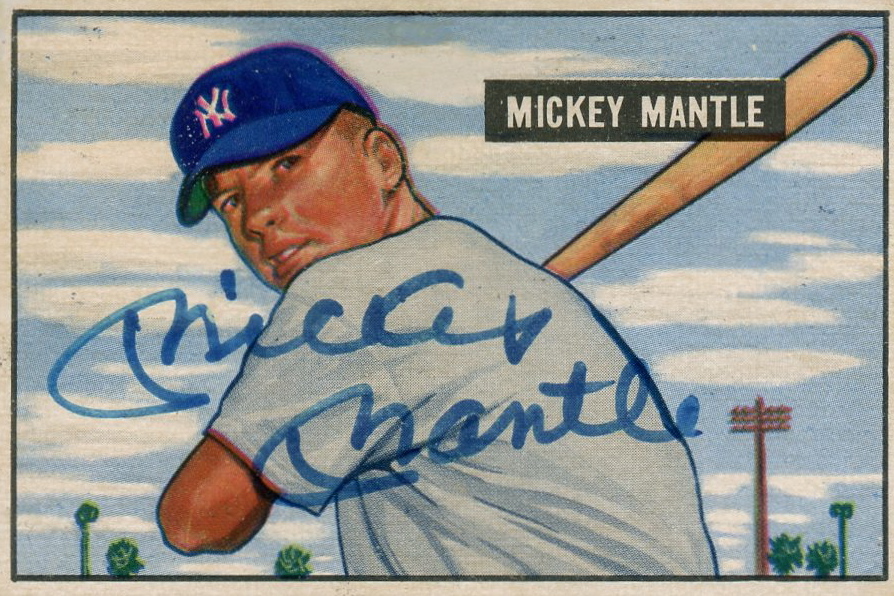 When Mantle was sent down to AAA Kansas City after the game of July 13, his numbers didn’t look all that bad. In 69 games, he’d batted .260, logged nine doubles, five triples, and seven homers, and driven in 46 runs, while stealing seven bases. But American League pitchers had begun to deny him fastballs late in May, and in his last six weeks before the demotion Mantle had hit just .211. The rest is history: Mantle said he got to Kansas City, called his father to say he now doubted he could cut it, was surprised to find his father in his hotel room a few hours later. Instead of the pat on the back he expected, Mickey saw “Mutt” Mantle begin to empty his son’s clothes into a suitcase and tell him he wasn’t a man and he should come back home and join him in the copper mines.
That worked.
Mantle drove in 50 runs in 40 games and returned to the Yankees on August 24th: six homers, 20 RBI, .284 in his last 27 games.
But Mantle’s demotion came 61 years ago. There was no internet, no cable, no tv sports news to think of, no radio call-ins, no blogs. The Yankees who didn’t get sent to the minors that season included Joe DiMaggio, Yogi Berra, Phil Rizzuto, Allie Reynolds, Vic Raschi, Ed Lopat, coach Bill Dickey, and manager Casey Stengel. They were the two-time defending World Champions and, frankly, it is possible that a lot of Yankee fans had no idea for days or weeks that Mantle had even been sent back to the minors.
That will most assuredly not happen if Bryce Harper struggles in the majors – if he bats .211 over 100 agonizing at bats and Mike Rizzo and Davey Johnson decide they have to send him to AAA. The coverage would be intense, uninterrupted, and brutal, and it would not stop the day Harper went to Syracuse or Harrisburg. It would be relentless.
Thus the question isn’t whether or not the Nats are thinking of taking Bryce Harper north or summoning him early in the season. The question is how much time they’ve spent game-planning the worst case scenario.
Dirk Hayhurst Returns
The entire roster is very small and I’m not even confident we have one guy for every position (although we have the beginnings of a pitching staff), but there is no question that if they ever open a Players/Authors Hall of Fame next to the larger one in Cooperstown, Dirk Hayhurst will be a first ballot electee.
And as of today he has two titles to put on his plaque. Out Of My League is now officially published and available in all formats, and without a prescription.
The Bullpen Gospels, his startling and unexpected 2010 debut as an author, told the gritty yet funny and redeeming story of a ballplayer’s sudden realizations that a dream career can still turn into a desperately unpleasant job, and that all but about six guys in his minor league were merely there to provide game-like practice for the actual prospects. It became a New York Times best-seller. If you want my detailed unabashed joy at reading the best baseball book since Ball Four, here is my original post from December, 2009.
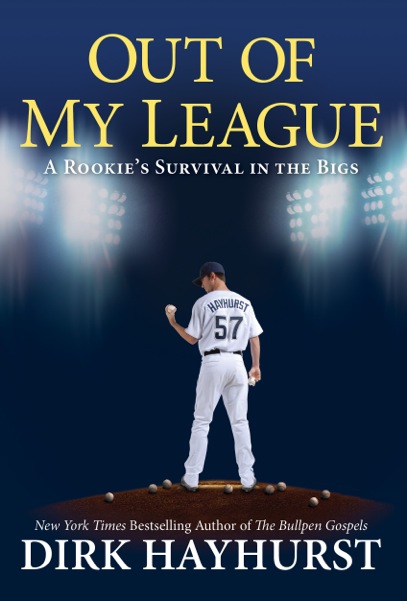 In Out Of My League Dirk’s journey takes him to the majors with the Padres in 2008, and while the experience does not have quite the range of emotions as his first book (that would have required him to produce two baseball versions of Poe’s The Pit And The Pendulum) there are enough laughs and terrors to keep any baseball fan – or just any person – riveted.
Without scooping his story and telling it as my own, Hayhurst goes – in the span of one baseball season and one book – from moments of absolutely certainty that his career will end with nothing more achieved than the faint afterglow of a Texas League Championship, to being the starting pitcher against the San Francisco Giants. The same kind of disillusionment that made The Bullpen Gospels a universal story of handling the sour taste of reality – and one that you also discover to your shock, not everybody around you is bright enough to perceive – continues in the new book.
That this unhappy surprise comes at the major league level makes Out Of My League a touch more heretical, because it dents the fiction that The Bigs are Perfection With Whipped Cream On Top. Just because you’d give your right arm to pitch a game in the majors does not mean that’s a greater sacrifice than giving 20 years of your life for exactly that same singular opportunity. When you think of it in those terms – and Hayhurst forces you to – it suddenly seems less like the childhood dream of fame and success, and more like the scenario in which you get that bicycle you desperately wanted for Christmas, and are promptly directed to spend nearly all of your youth learning how to ride it, with the reward being your opportunity to guide it across a tightrope stretched across the two rims of a bottomless pit.
And still it’s a fun read. Plus, it will explain the hesitation of most modern pitchers. Once you read Out Of My League you’ll understand exactly where that uncertainty comes from: The pitcher staring back over his own shoulder is not always just checking a baserunner’s lead.
Baseball Prospectus 2012
 It hath arrived.
Got it first Sunday at a chain bookstore here and have not dived fully in, but the predictions based on Statistical Reduction and a dozen other complicated formulae cascade out upon you from every page and it’s worth mentioning a few even before anybody’s done a thorough vetting of what they’ve got.
The most poignant of them, perhaps, are the minimalist predictions for the Yankees’ only offensive addition (“his dense hasn’t been good in a decade, and his bat is barely good enough to fill a DH role”) compared to the man the franchise downgraded, degraded, and then forced into retirement:
Player PA 2B 3B HR RBI AVG/OBP/SLG WARP
Raul Ibanez 552 28 3 17 65 .251/.311./.416 1.5
Jorge Posada 376 18 0 13 45 .260/.350/.440 2.1
The predictions were done, obviously, before Ibanez signed with the Yankees and do not account for their intention to sit him against lefthanders. If that brings Ibanez’s predicted Plate Appearances down the 32 percent or so to where the Posada predicted Plate Appearances are, the BP forecast for Ibanez translates to 19 doubles, 2 triples, and 44 RBI.
In short, the stats – and remember this is the predictive formula that got Evan Longoria’s rookie season virtually exactly correct, even though it had nothing but college and minor league data to work with – suggest Jorge Posada would’ve had a better year than Raul Ibanez will have. This underscores a point that has become clearer and clearer to me since the Montero-Pineda trade: Brian Cashman and the Yankees are approaching 2012 in exactly the opposite way they should be. They are not flush with hitting and weak with starting. Their offense is, in fact, getting dangerously old, and the only immediate productivity from their farm system was likely to be more starting pitching (the traded Hector Noesi, plus Manuel Banuelos and Dellin Betances). They did not have a hitter to trade, least of all one that Cashman compared to Miguel Cabrera.
I’ll go into the Yankees’ age problem in another post but the Alex Rodriguez prediction is appropriate here:
Player PA 2B 3B HR RBI AVG/OBP/SLG WARP
Alex Rodriguez 437 18 0 24 66 .279/.377/.525 4.3
Ack.
BP has long been known as a deflator of the balloons of hope. It sees Mike Trout getting just 250 ups this year, with a 4-24-.254/.317/.369 line. Bryce Harper gets the same number of plate appearances, and just 7-26-.239/.304/.383. The rookies it likes best include an unusually large lot of catchers: Jesus Montero (2.7 WARP), Robinson Chirinos (2.5), Ryan Lavarnway (2.3; I agree; Boston hopes this year may rest on whether or not anybody on the “New Sox” has the vision to see it); James Darnell (2.1) and Devin Mesoraco (2.1). The likelies to crash (in terms of WARP falloff) are Jose Bautista, Jacoby Ellsbury, Alex Gordon, Matt Kemp, Alex Avila, and Jeff Francoeur – but even with that it still sees Bautista at 9th in that category in the AL and Kemp tied for 7th in the NL.
What it says about the big Pujols move, and the other transactions, I leave to the hard-working editors and publishers. I’ve stolen enough of their thunder.
As to an evaluation of the book itself, there is a format change. In past years, players were grouped by the teams they were with in the preceding year. In this edition, all those who have moved before the publishing deadline have been put in the sections of their new teams – which sounds great, except when you go looking for Pujols and Fielder you’ll find the former with the Angels and the latter with the Brewers instead of the Tigers. It’s a nice try but ultimately not helpful.
And in what is either a booming typo or a bizarre redefinition, the very last leader board in the book – Rookie Pitchers’ WARP – seems to list last year’s rookie pitchers. Unless I’m missing something, Pineda, Hellickson, Ogando, Kimbrel, Sale, et al, don’t get a second bite at the kiddo apple.
Sampling Baseball Cards Of The Past
OK, look carefully. This is the back of the 1964 Topps baseball card of Mickey Mantle: Now, take a look at the back of this 1964 Topps baseball card of Mickey Mantle: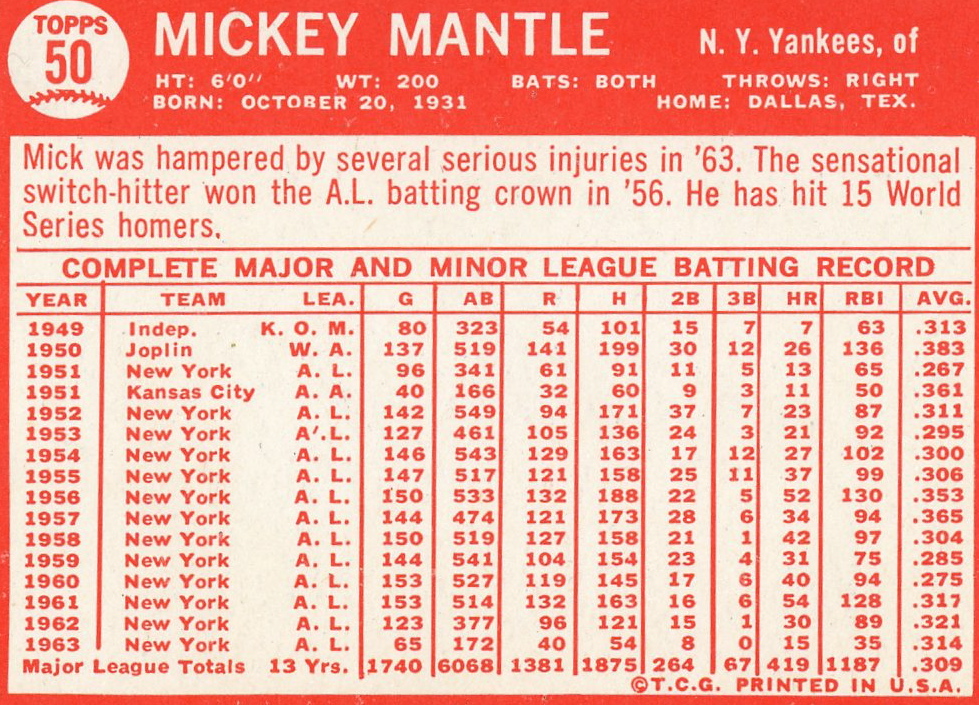
See the difference? I mean, besides the fact that the second card is printed in a vibrant red and the first one is distinctly orange.
It’s in the biography. The first card mentions Mantle’s (then) 15 World Series homers, “breaking a mark set by Babe Ruth.” The second one stops at the reference to the homers. No Ruth. I discovered this literally Sunday afternoon – and I’ve never heard any mention of it before. But if you’re a Mantle collector don’t go nuts and decide you have to go and find this suddenly priceless variation card.
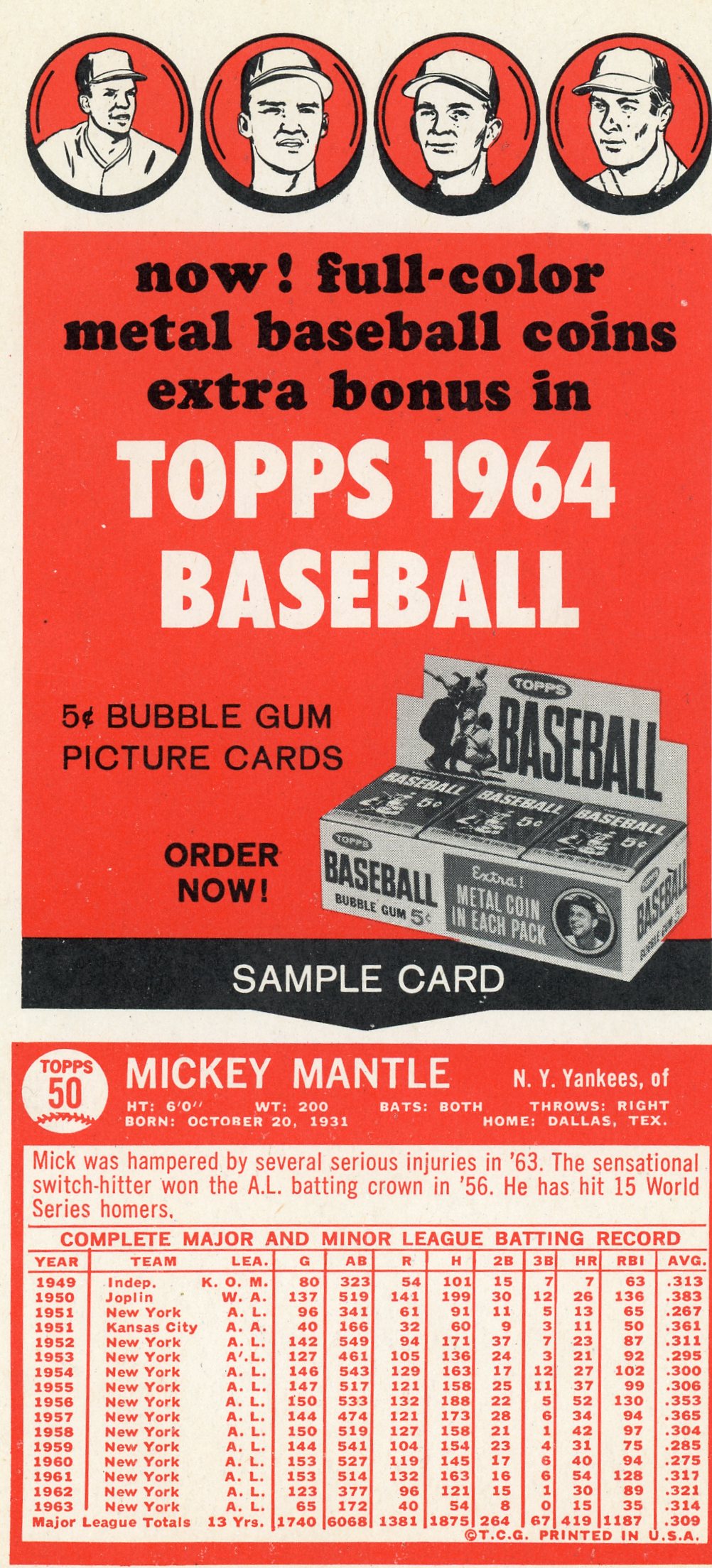 Because it not only isn’t a variation, it’s not even a real card. From 1952 through 1967, Topps produced “Salesman’s Samples” with which to excite candy jobbers and retailers about the upcoming year’s baseball cards.
The one shown here on the left is from 1964, and on the front there are three cards from Topps’ 1964 1st Series (Carl Willey and Bob Friend are the “big” names). On the back, this blood-red pitch for the ’64 set and the special “bonus” – the first set of baseball “coins” Topps ever made.
And then there at the bottom is the variant Mantle card, without the reference to Babe Ruth. Trust me, if two different versions of the ’64 Mantle had been included in the actual set, the scarcer one would cost a fortune.
These Salesman’s Samples are very scarce, too, but it wasn’t until the Mantle biography change jumped out at me did I decide to inspect the others to see if the Mantle change was unique.
It wasn’t. While it doesn’t look like any of the card fronts have been changed, not so for the backs.
 Until 1957, only card fronts appeared on the Samples, so there were no backs to check, but sure enough, there’s a change that very first year.
As shown above, by 1964 Topps had long since realized that you needed some star power, even on the Salesman’s Samples and even just on the back.
After his 61-homer season in ’61, a version of Roger Maris’s card number one is on the back of the 1962 Sample. There’s Mantle in ’64, and the ’66 has a picture of a Sandy Koufax insert on the back.
But in ’57 that message hadn’t gotten through yet, so there he is: that great New York Yankees starting pitcher…Tom Sturdivant?
As the bio suggests, he had a big year in ’56, 16-8, and a complete game six-hit shutout over the Dodgers in the World Series, which kinda got upstaged when Don Larsen went out and threw his perfect game the next day. But the point here is not the bio but the card number.
Tom Sturdivant is not card #25 in the 1957 Topps set. His teammate Whitey
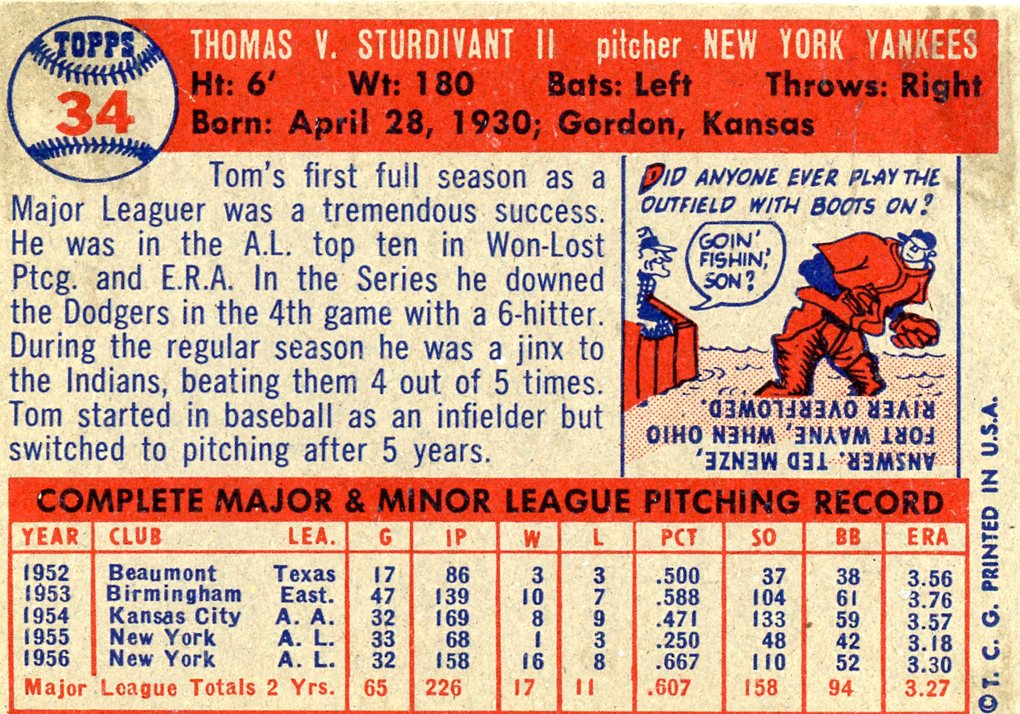
1957 Topps Sturdivant Card
Ford is. Sturdivant is #34, as the shown version of his issued card suggests. You’ll notice also that the cartoon quiz at the right side of the card has been changed from something about home runs in one inning, to a question about playing outfield with your boots on.
Again, not a true variation – the obverse of the Sturdivant back shows the Billy Martin front. I suppose somebody could have cut the cards apart and come up with a weird Martin/Sturdivant #25. If one ever turns up, now you know what it is.
There are two other “Sample” variations that jumped off (once it had occurred to me to start 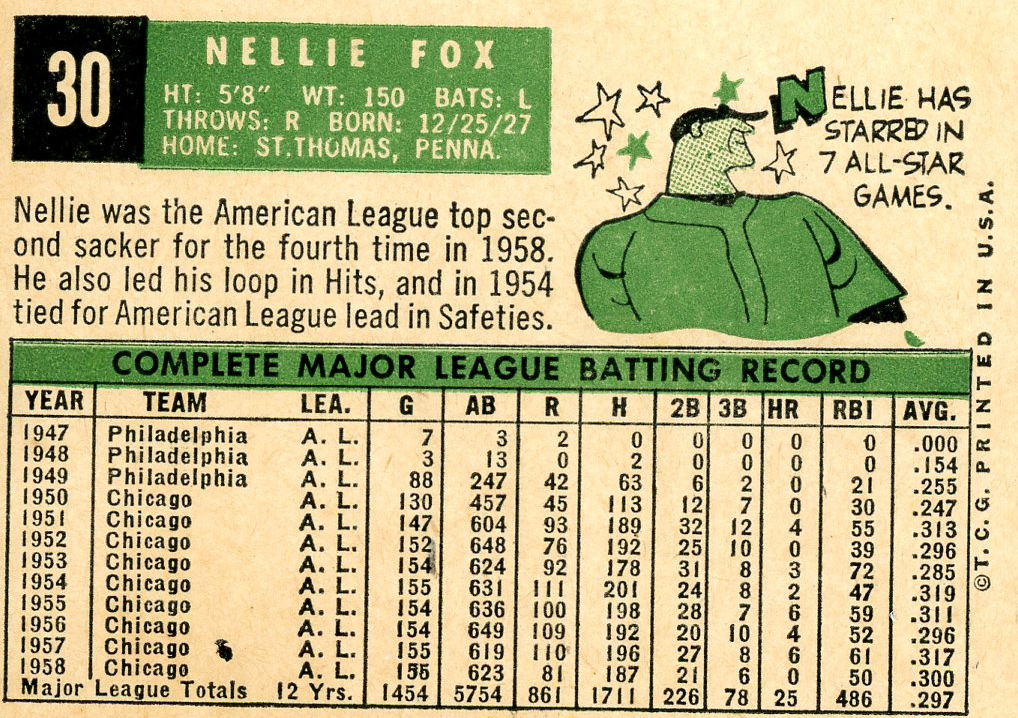 looking for them). I’ll spare you the full 1959 Salesman’s Sample back, but here is the detail on the one card back shown.
It was a pretty good guess on the part of Topps: Nellie Fox would be American League MVP as his White Sox won the pennant for the first time in 40 years.
But the original design for the backs of the 1959 cards (or at least Fox’s) was decidedly different than what Topps wound up publishing.
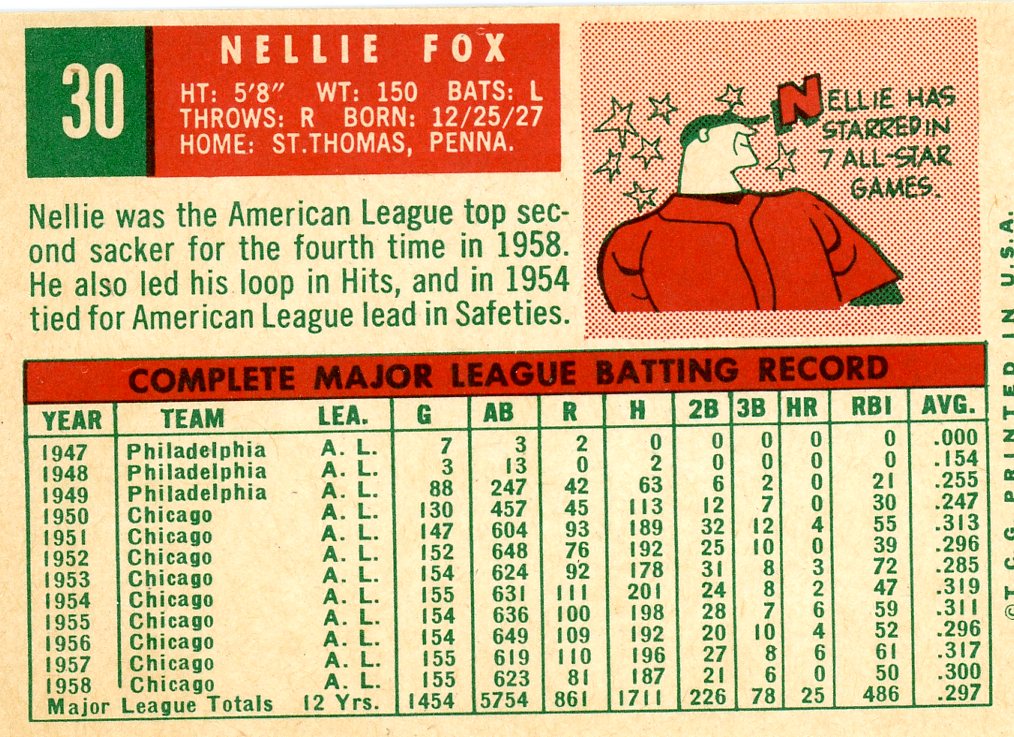 The color design on the Sample card is green-and-black, and quite obviously the color design on the actual issued cards has been dramatically altered to the full Christmas design.
The green “name box” has gone red, the black type in the bio has gone green, and the cartoon is now not just green and black, but red, green, with a salmon pink background.
Still, the other details of the card seem identical both in the preliminary and issued versions.

1960 Topps Salesman's Sample
Not so for 1960. This might be my favorite of the bunch. There was a rationale, even for the changed number of the 1957 Sturdivant, for the inclusion of all the other cards shown here on the Salesman’s Samples. Through 1972, Topps cards were sold in numbered “series,” spaced out over the course of the spring and summer.
All the Sample cards were drawn from the first series – except in 1960. See that nice unspectacular version of #66, Bobby Gene Smith?
He would not be in the first “series” of 1960 Topps cards. Even though they had already mocked up a back for his card,  and evidently made no changes in it other than the by-now traditional color re-thinking, Smith was for some reason bumped from #66 to #194.
In the actual card set #66 is an obscure pitcher named Bob Trowbridge – it was not like there was some urgent need to drop somebody to make room for him. Sadly there are no files hanging around a back room at Topps annotating the arcane decisions about card numbers (though I know one later editor liked to give card number 666 to players who had hurt his favorite team). So we’re on our own figuring this all out.
 Baseball Nerd