Tagged: Baseball Nerd
Sacrifice Fly Double Play?
The McCarver Theorem was just validated again here at Yankee Stadium (go to a game, you’ll always see something, or a combination of things, you’ve never seen before), when Brian Buscher of the Twins hit into a sacrifice fly double play.
After All, His Initials Are D.L.
I think Jayson Stark started this Player “A” jazz. I’ve stolen from him before, I’ll steal from him again.
Player “A” has three homers, 11 RBI, and a .295 average in 23 games (just twelve as a starter).
Player “B” has three homers, 15 RBI, and a .209 average in 24 games (but was up to .294 in his last five games).
And it’s good news that Player “B” won’t go on the disabled list, and will return to his team’s line-up this week, replacing Player “A”?
They are, of course, A) Micah Hoffpauir, and B) Derrek Lee. There may be 44 guys in this country not named Hoffpauir who think it would be worth the Cubs’ while to let Hoffpauir succeed D-Lee right now. I’m one of them. It’s tough to think in those terms of a man who slammed 46 homers just four seasons ago. But considering he’s produced only two full, healthy seasons, since (averaging 21 homers and 86 RBI in each) and with this largely untreated bulging disk in his neck, is not likely to make this a third full season, nor reach those production numbers, it’s time to face the fact that he’s no longer among the game’s elite sluggers.
He hit five homers after July 1st last year. He hit .258 “close and late.” He hit .205 against the Cards last year and .239 against the Brewers. As he slides into his mid 30’s you begin to look around and say, salary considerations included, which teams would happily trade their first baseman for him, straight up?
It can get late early out there at first base. The Cubs might have been serving themselves well to put D.L. on the D.L. for two weeks and see if Hoffpauir has the chops on a daily basis, that he seems to offer sporadically. It’s a damn tough thing to bench a richly-compensated player, and a good guy, and a veteran. But, especially without Aramis Ramirez in the line-up, the Cubs need more than the vague hope that their first baseman will be healthy enough to finish the year with 20 homers and 85 RBI. Hoffpauir may not be the solution – two weeks would’ve given Chicago a better ability to guess.
I just don’t think guessing that D-Lee is going to perform worse, not better, requires very much ability at all.
Manny Being Manny*
* With PEDs.
Managers (Updated)
I’ve mentioned elsewhere that annually, Terry Francona lets me sit with him, on the bench, during a spring training game. This is half out of friendship and half, I think, to remind me how little I actually understand about managing – or baseball itself – compared to the pros.
Rockies + Bullpenwinkle
The Closer Carousel never stops; the only true accomplishment is knowing when it’s going to start spinning dangerously like the merry-go-round at the end of Hitchcock’s “Strangers On A Train,” and if the carny is going to get to the shut-off valve in time or if the entire bullpen is going to get launched in the general direction of the cotton candy machine.

Refund! Refund? Refund!
It is a
compelling story of the rich getting, if not richer, then at least getting
richer discounts.
This week, the Yankees have been pounded everywhere from the New York papers to
the business publication Forbes for offering freebies, two-fers, and especially
refunds, to only
those customers who had paid the stadium’s absolute top season ticket price of
$2,500 a seat.
There is
only one complication. The Yankees aren’t actually going to wind up giving
out any refunds.
This is for the remarkably simple reason that the tickets for which they announced
refunds or credits,
are the ones they weren’t able to sell.
Though the
Yankees are in the most curious of business predicaments – they set the bar too high, the bottom fell
out of the economy, they made a gesture to give back some of their loot (and,
in the process, fill the embarrassingly empty seats), and yet they’re still getting
yelled at – the
Steinbrenners have nobody to blame but themselves. More specifically, they can
chalk it up to an incredible, almost labyrinthine press release issued by an
outside publicity firm, that offered no less than fifteen different responses
and plans to the various ticket prices and locales. The document is slightly
less intelligible than a book of IRS forms, nearly as long, and obviously just
as confusing.
The
standard reporting on this has fallen in line with Forbes’ account: ”The bum
economy managed to turn the famous Legends Suite seats in the first few rows,
priced as high as $2,650 apiece, into infamous symbols of overreaching during a
time when businesses are gun-shy about lavishing money on sports and other
forms of client entertainment. So top seats will now go for $1,250 a pop, with
those who already laid out the bigger money getting a credit or refund…” There
was a snotty burst to the Associated Press from some television guy who’d
bought three of the $850 suite seats behind the plate. “”If they’re
offering only selective refunds, depend upon it: There are going to be
lawsuits. Great, more tickets nobody wants. The silver lining here is that even
more charities are going to be getting even more tickets from me.” The
shoot-from-the-hip complainant was named Olberding or Overmann or something. The
average egalitarian complaint echoed that of my friend Rich Sandomir of The Times: “The Yankees
did not consider giving refunds or credits to fans in nonpremium seats because
Hal Steinbrenner felt only a small number of top-tier tickets were overpriced.”
As it is,
the Yankees are actually not giving refunds or credits to almost any of their
fans. A Yankee source did say that as many as four ticket-buyers – literally, four
customers, in the
suites hanging from the upper deck in left and right fields – would wind up
with some extra perks. But the source added they weren’t certain: it might only
be three
customers.
The
understandable confusion seems to owe to the first subheading (item “A” on a
list of ticket price adjustments that goes all the way to item “I,” then pauses
for a few sentences and then re-starts with another item “A”, and then a “B” that is
followed by sub-subheadings
1, 2, 3, and 4). It reads “the full season Legends Suite and Ticket Licenses in
the first row in Sections 15A, 15B, 24B and 25 will be reduced from $2,500 to
$1,250 per regular season game. All fans who have purchased such full season
Suite and Ticket Licenses will receive, at their choice, a refund or a credit.”
The thing
is, sections 15A and 15B are at the far end of the Yankee dugout – most are
behind the camera well beyond the
dugout – and sections 24B and 25 are their opposites behind the visiting
dugout. The front-row seats in those sections are the equivalent of fourth row
seats in the rest of the park. I’m reliably informed that the Yankees didn’t
manage to sell any of
those seats, so there’s no refund to be had. Reality here reads like something
out of “Catch-22”: you can get a refund on those tickets, but only if you
haven’t bought them. And you can now buy many of those high-end tickets at half the original price, except you can’t, because the Yankees gave them away as make-goods.
So, amid
all the dollar figures, topic lettering, references to sections “15A and 15B,”
the press release had all the clarity of assembly instructions pulled out of a
swing set on Christmas Eve. The team certainly is giving its high-end customers
extra tickets – the ones it couldn’t sell – particularly those wide swaths of
exposed blue leather down the third base line. But that real story of what the
Yankees were doing was buried down in items C, D, E. Those who actually bought
those $2,500 front-row seats would be getting not refunds but a free set of
front-row seats further away from home plate. Buyers of $1,250 seats would get
24 games’ worth of freebies. Buyers of $850 seats would get 8 free games, and 4
more games’ worth in the $500 section, etc.
Speaking as
one of those $850 buyers, I want to make it clear that nobody, but nobody, should feel sorry for us. Once you
are actually paying three or four figures for one ticket to a sporting event, you are
on your own. The first year my father bought season tickets at Yankee Stadium
(1972), four seats to each game cost a total of $1,000, and we only managed it
by canceling all further vacations. Last year, the same four seats cost a total
of $1,000 per game. The
advent of the Amazing Colossal Yankee Ticket Price didn’t exactly sneak up on
any of us, and we could have gotten out at any time – as hundreds, maybe
thousands, did.
But there
was a certain apparent inequity to the way the Yankee ticket adjustment was
framed – an inequity caused mostly by that blasted press release – that the
franchise didn’t deserve. It was not offering a fifty percent rebate to the
highest of the high rollers, and a token handful of tickets to the next group
down. It was giving the people who did buy tickets, all the rest of the tickets
that nobody had bought.
What
remains unaddressed, of course, is the 2010 season. Not mentioned in any of the
coverage of the cutbacks in the Bronx – at least that which I’ve seen – is that
beginning this season, the Yankees instituted multi-year ticket licenses. The
minimum commitment demanded of season seat-buyers at virtually all price ranges
was three years. An inverted sliding scale of maximum annual price increases
accompanied each
deal (the longer you signed for, the less they could raise the price of your
seats each winter), and the paperwork was as thick as a good-sized magazine. No
matter what the economy does, it will be fascinating to see whether the Yankees
try to enforce those price jumps next year, or hope they can just get people to
pay what they agreed to in more halcyon days. Or 75% of that. Or 50%.
Because if they can’t, the most dreaded thing imaginable might happen. The Yankees might send out another one of these press releases.
Answers
Firstly, I believe they may be, in no particular order, Russ Ohlendorf, Justin Maxwell, Micah Hoffpauir, and Jonathon Niese.
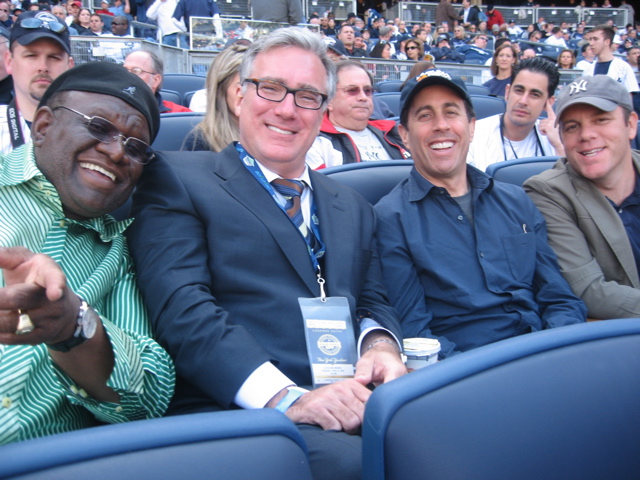
This refers to a photograph from opening day. That is not in fact a Super Bowl media credential around my neck. It is a Super Bowl laniard. Apart from the phenomenal price changes, the biggest switch in the new park is the number of times one is forced to present one’s ticket. So I needed something to carry it in, and that’s what I happened to have lying around.
Keith what’s with the suit? Only baseball suits wear suits to the ball game. Leno or Jason wasn’t wearing a suit. And I bet Yankee Stadium was real quiet after that 14 spot Saturday… Nick C., Countdown (and SF Giants) fan By on April 18, 2009 8:46 PM
Same photograph producing yet another style complaint. Frankly, the only times I’ve ever gone to a game in a suit, I was either doing a broadcast or a report from it, or, as it happened on opening day, I was heading straight down town to do my news show.
Besides which, the suit is ok at the yard once in awhile. Look at the difference it can make if you get to pose for a photo with a few viewers:
Things I Promised Not To Tell
Batting clean-up last night, Micah Hoffpauir of the Cubs
homered to erase Cincinnati’s only lead (off his rival Micah, Owings, no
less), walked, then lifted a sacrifice fly to put his team back in front.
“He’s going to get 350 at bats this year,” Lou Piniella told me as Hoffpauir’s
dominant spring training ended. “A little first, a little left, a little
right.” Lou being Lou, of course, after Hoffpauir showed what he could do with
those 350 at bats, he was due up with the bases loaded and a lefty reliever on
the mound. So Lou pinch-hit Reed Johnson for him, and Johnson promptly struck
out. Sigh.
Pitching Coach Joe Kerrigan never counts chickens in
advance, certainly not in Pittsburgh, but even in the middle of the spring he was
insistent he had been able to help Jeff Karstens and Ross Ohlendorf –
especially Karstens – with arm slots and release points. Are the last two
nights against Florida indicators that he was right, or just the odds breaking
against the Marlins?
The latest Pedro Martinez story – about some vague interest
by the Angels – is probably overblown, to say the least. A National League
General Manager who was incorrectly rumored to be interested, said a month ago
that people sure were getting hopped up over him handcuffing the Dutch team –
during the first week of spring training – and not hitting 90 on the radar gun
as he did so.
So far this year Daniel Murphy has dropped a fly in left to
cost Johan Santana a game, and, last night, after getting picked off by Yadier
Molina, and then deciding that the only way to get past Molina at the plate was
not to slide but rather enact a dance move, managed to slide out from under a
crucial fly ball in St. Louis. The Mets are in awe of the youngster’s plate
discipline but after Murphy’s tight night, manager Jerry Manuel suggested he
needed to relax and admitted “I guess I’m a little concerned.”
Another Cubs note. If you’re wondering how they hope to keep
Rich Harden intact into the second half of the season, yes, they will occasionally
skip his starts or give him extra days off. Kind of like the Chien-Ming Wang
plan. Only without the euphemistic “tune-up in Florida.” And replacing him in
the rotation at some point, more likely with Phil Hughes than Ian Kennedy. But
Wang is just fine – there’s nothing to see here.
A last question. Does it seem to you like the Angels treat
Brandon Wood as if he owed them money? Like they let him up every once in
awhile so he can breathe, before they stick him back under the water?
By the way, the title of this post is facetious – it comes from an obscure reference in the movie “All About Eve.” No actual confidences were violated in the writing of this blog.
FAN OF THE DAY:
Hats off to Ben Erdel. As part of his big night at Yankee Stadium last night, Brett Gardner let one of his Louisville Sluggers fly into the stands. Mr. Erdel and a much younger gentleman both had their hands on the rare souvenir – although only the younger gentleman had just managed to avoid getting hit with the helicoptering bat. Mr. Erdel took the bat, took a few steps, and then thought better of it, and generously did the right thing.
The younger gentleman now has a singular thrill from his first Yankee homestand, exceeding his previous one – being my nephew.
Here is Nephew, Jacob Smith, far left, and his bat, which was not stolen by either Katy Tur or Maegen Carberry.

And here is Mr. Erdel, whose second prize is a blog posting (and a clear conscience, and one happy kid left in his wake). Thank you, Sir.

The Home Run Menace
Don’t be fooled by that alarming statistic out of the new
Yankee Stadium, namely that the Indians and Yankees shattered the record for
the most homers hit in the first four games of a new big league park: 20,
compared to the 16 hit in the bandbox in Las Vegas back when the A’s had to
open up there.
Don’t be fooled. The problem is much worse.
That raw number excludes the two exhibition games the
Yankees played against the Cubs at the start of the month. That raw number
doesn’t address the bazooka-like quality at the new park, of any left-handed
hitter holding a bat. That raw number doesn’t address the variety of weather
conditions in which the homers have been hit.
Through circumstances unlikely to be repeated, I have thus far
attended all the events at the new facility, and thus I can not only
report on the 28 blasts that rocketed out of the place in the first six games,
I can testify to them. Let’s start by noting that 21 of them have exploded into
rightfield (and only a few have “just made it,” pretty much invalidating the
three- or four-foot shortening of the fence at some points, as compared to the
old Stadium). A 22nd was absolutely blasted by Jorge Posada to
dead-center (and it may be awhile before we see anybody do that again).
Two more were fluke jobs against the Cubs by Cody Ransom to
the corner in left. One actually struck the pole. Judging by body language
alone, Ransom’s freak bases-clearing double in the 8th Inning Sunday
against Cleveland certainly appeared to Ransom, and probably to leftfielder
Shin-Soo Choo, as a ball that was curving into the stands, foul, by twenty feet
or more. Choo only sauntered toward the corner. Ransom didn’t even follow the
ball and was staring at the broken bat handle in his hands. From my seat I get
a full view of the third base foul line, from the plate to the wall. I know
that I looked down, convinced the ball was foul, in the seats, and by a lot.
Only four traditional in-the-seats homers were hit to left in the first two exhibitions and four regular season games.
For all the air-gun blasts of Mark Teixeira, Ransom’s
hitting patterns may be the best clue so far as to what’s going on here. There
seems to be a jet stream, left to right, at all times. I speculated here
earlier that it is probably a fabrication of the open-to-the-air ring in the
Upper Deck combined with the open-to-the-air entrances at street level in the
corners, from which the playing field is visible. I think it was bad enough
Sunday that it blew Ransom’s ball, left to right, and fair. I think it’s been bad
enough this month to blow several balls already heading to right, far deeper
than physics should’ve allowed.
This does not discount another juiced ball theory (although
this theory must be incredibly flexible, to explain why juiced balls being hit
to LF aren’t pushing through the wind) and presumably the Posada homer Sunday
would’ve been a clear case of interference, or maybe just a ball caught at the
fence, if the new Stadium measurement was precisely the same as the old one).
It should also be noted, as it was noted here, that as early as the middle of
the Yankees’ first workout in the place on April 2, righty batters like Xavier
Nady were pointing to the seeming jet stream, and trying to go the opposite way
in batting practice. Thus it would seem that the wind currents are either the
only explanation, or, far and away, the most important one.
The question becomes, as Lou Piniella posited it after his
first experience with a wind that scared him as much as the gusts of Wrigley:
“Will it change when the weather does?” Obviously the vagaries of the climate
in April are not equivalent to the contrast between any April day and August.
But of the first six dates here, none have been identical. Review them with me
game-by-game.
1. Cubs-Yankees, Friday April 3: Left-handed hitters Cano
and Matsui take left-hander Ted Lilly deep in consecutive innings. Ransom hits
the LF foul pole off Lilly in the 4th. It’s a night game, the air
heavy and dank, 56 degrees and falling, and it rains starting in the 3rd
inning.
2. Cubs-Yankees, Saturday April 4: It’s now a 1 PM start,
colder, drier, much windier. Alfonso Soriano hits the hardest ball yet to LF
off Andy Pettitte. Then Jeter goes the opposite way off Rich Harden in the 3rd,
and Teixeira touches him in consecutive innings for homers to RF that looked
like the Mets’ Party Patrol shooting t-shirts into the stands. Ransom hits the
fifth homer of the blustery afternoon into the LF corner off Chad Gaudin.
3. Indians-Yankees, Thursday April 16. It’s a beautiful,
sunny day with no excessive wind. 56 degrees – at least ten degrees warmer than
the second Cubs game – and it
feels warmer still. This time Posada (batting righty) takes Cliff Lee over the
wall in center. Damaso Marte gives up blasts to Sizemore (RF) and Martinez (LF).
4. Indians-Yankees, Friday April 17. Now it’s warmer still,
63 at game time. In a 6-5 game, six homers are hit, all into various distant
locales in right, including two by righthanded batters (DeRosa and Jeter).
5. Indians-Yankees, Saturday April 18. Again the temperature
jumps around ten degrees and it’s a preview of summer. We start later in the
afternoon (3:43 EDT) and there are no fewer than eight homers, six to dead
Right and another by DeRosa to Right/Right-Center. Counting the exhibitions, we
are already up to 25 homers in five games here.
6. Indians-Yankees, Sunday April 19. Now the weather
plummets. It’s 17 degrees cooler at game time and a breezy wind makes it feel
colder. And we still get three more homers, two to rightfield.
So basically at this point we have five different kinds of
weather conditions (six if you think Thursday and Friday are radically
different) and the only pattern, based on very skimpy evidence, is that we
might be seeing homers rise as temperatures do.
Uh-oh.
Steinbrenner Stadium Illustrated:
I earlier noted the one major architectural anomaly in the new
place and finally got a decent shot at it. All the other deck facings at each
tier are absolutely symmetrical except this one:

Yep. The official Steinbrenner Box – although he has not yet
been seen in the perch that guarantees occupants are actually about ten feet
“closer” than anybody else. This is to say nothing of the direct view provided
into the Yankee dugout, which can be used to stare daggers at Joe Girardi.
Baseball Photo Of The Week:
Courtesy my friend T.S. O’Connell at Sports Collectors Digest: Nothing less than a photo of the front display at a
Woolworth’s store, apparently in the New York metropolitan area, in the spring
of 1952. He has figured out what would today be the estimated value of what
seems to be 231 unopened, pristine boxes of 1952 Topps Baseball Cards. He has
apparently not even included the value of two partial uncut sheets hanging in
the window, one of which shows a Warren Spahn card, and the other both an Enos
Slaughter and a Duke Snider.
Gaps In My Education:
This is driving me more nuts than usual. I abhor things like
“The Great Yankee Subway Race” – not on any kind of “purity” level, but simply
because people sit there and think there is some legitimacy to the competition
when it’s only an animation. Stories abound of a foolish Yankee employee of the
past who actually thought the outcome was performance-based, or somehow
randomly-generated, and who actually wagered on the outcome, not knowing that
his opponent could simply call up his friend in Scoreboard Operations and say
“Make sure the B-Train wins tonight.” Also, the “B” is the local version of the
“D” train – how could it ever win? And at many times of day the “D” terminates
two stops before The Stadium. Maddening, I tells ya.
But what I want to know is: what is the name of the piece of
classical music which serves as the soundtrack for the “race.” I may have known
it once, but that brain cell is long since hors-de-combat. Anybody know?
Introducing the Baseball Nerd
Phoenix, Arizona
GREAT TRUTH
Do not be overwhelmed by the 15 homers propelled yesterday in Surprise by the Angels and Royals, nor any other offense you see in the Arizona boxscores. An unrelenting 20 MPH wind blew across the fields of the Cactus League. Cars wobbled on highways, at least one canopy was toppled at Camelback Ranch in Glendale, and Randy Wolf pounded the Rangers for two long hits, including a two-run double.
ON THE OTHER HAND
It’s not like the Dodgers managed to turn the wind off as Wolf shut down a Texas lineup that included Josh Hamilton on two hits over six (six strikeouts). The positioning of the otherwise splendid new park the Blue share with the White Sox appears to have been done in the dark. The sun will not let up on the batters; the batters’ eye in centerfield is about half standard size, and the Dodgers’ bullpen is uncovered and does not see shade until nearly sunset. The players have less of a chance of being grilled than do Dodger Dogs.
MISLEADING HEADLINE OF THE DAY: MARTINEZ REJOINS DODGERS
That’d be Ramon Martinez, who celebrated his 41st birthday yesterday by sitting in the dugout of the team for which he won 123 games in the eleven seasons ending in 1998. The former 20-game winner – who set the land-speed record for going from being “The Martinez,” to “He’s Pedro’s Brother” – looked not much heavier than the 165 at which he pitched for the Dodgers’ last champions. He knew nothing of his brother’s chances, silently underscoring the mumbles of the spring: that Pedro’s WBC performance did not resonate, and with his killer fastball down to 90, is unlikely to find a home this year – or at least not a prominent one.
UNLIKELIEST SIGHTING
The skinny blond guy in the Rangers’ uniform staying low-key in the tunnel between the clubhouses and the field was not a minor leaguer summoned to take the road trip in hopes of a late-game at bat. It was actor Owen Wilson, getting into what is apparently his next character – that of pitcher – in his next film, opposite Reese Witherspoon. Coincidentally, Ms. Witherspoon was on The Tonight Show last Wednesday with your faithful Nerd, and offered viewers a bewildering variety of jokes based on the German words “Ausfahrt” and “Einfahrt.”
NERD THRILL
Like the relaxed pace and increased interaction of Spring Training wasn’t thrill enough. This is the start of my 43rd year as a fan, my 43rd year attending games, and my 43rd year of keeping score. On Saturday in Phoenix, I witnessed, for the first time, a triple play. First and second, Oakland’s Bobby Crosby with a solid one-hopper to Ryan Rohlinger of the Giants. Rohlinger unsuccessfully tried to tag elusive Oakland runner Matt Carson, fired to Matt Downs at second for one out, who relayed to Scott McClain at first for another. That’s when it became evident Carson had been called out for leaving the baseline. A double play is, of course, scored by writing the position numbers (5-4-3) and circling them. A triple play requires two circles. Making my first “second circle” was the thrill of the spring
 Baseball Nerd
If I am correct, Bill Sharman was sitting on the Dodger bench during a big argument and the plate umpire–if memory serves it was Frank Dascoli–cleared the bench, meaning Sharman never played in a major league game but got thrown out of one..
You are correct sir, September 27th, 1951, and the very irascible umpire was Frank Dascoli. So Sharman saw a lot of action during his month in the majors, between that and the Dodgers-Giants playoffs. He just didn’t get to appear in any action.
The new stadium is across the street (admittedly a very wide street) from the old stadium. Things can be weird in this city, but major atmospheric changes crossing 161st Street isn’t one of them. I’d say lousy pitching is the more likely answer.
By jbraskin@hotmail.com on April 21, 2009 11:43 PM
This one is about the outbreak of homers at Empty Stadium. The geographical point is correct; several hundred yards north and about a hundred west of the old location should not create a wind tunnel. But this isn’t about geography, it’s about architecture. The wind tunnel is not natural, it’s man made, most likely by the open-air ring in the upper deck (replacing what had been solid wall in the old place) and the giant open-air entrances down the first and third base lines. The new Yankee Stadium is at the mercy of air flow that was walled off across the street. Whatever it is, it seems to remain in effect.
One quick question- is our intrepid blogger wearing his Superbowl XLIII press credentials? And if so…uh…why? Besides the inherent awesomeness, that is? By jeremy.m.chao@gmail.com on April 18, 2009 11:31 AM