For more than 25 years, Dan Patrick and I have had the same debate.
We’ll be talking about the game’s All-Time Greats, and I’ll throw out the names of Honus Wagner or Buck Ewing or Christy Mathewson, or how we need to give Bobby Mathews credit for having won 300 games at a time when most pitchers didn’t last five seasons, and he’ll always say the same thing: “How do you know they were any good? We have no film of them. We don’t know what they did or how they did it.”
I’d point out that you could say the same thing about the Negro Leaguers, or largely about Ty Cobb, and he’d say these were exceptions, and secretly I’d realize at what a towering disadvantage the pre-1920 stars are, and I’d grieve that a man like Mathewson – clearly baseball’s first idol and considered by the old, old timers as being perhaps its first modern pitcher – might eventually be totally ignored.
It saddened me especially about Mathewson, to whom the kids of 1967 was a tangible memory easily obtained from their grandfathers. One of my earliest baseball-related daydreams was of going back in time to see him pitch, possibly alongside my mother’s Dad, the great Giant fan, who never had enough money to go once to the Polo Grounds while Mathewson still weaved his magic there – or even to go before Mathewson died in 1925, after six years of agony from tuberculosis and lungs scalded in a poison gas training exercise in France just weeks before World War I ended.
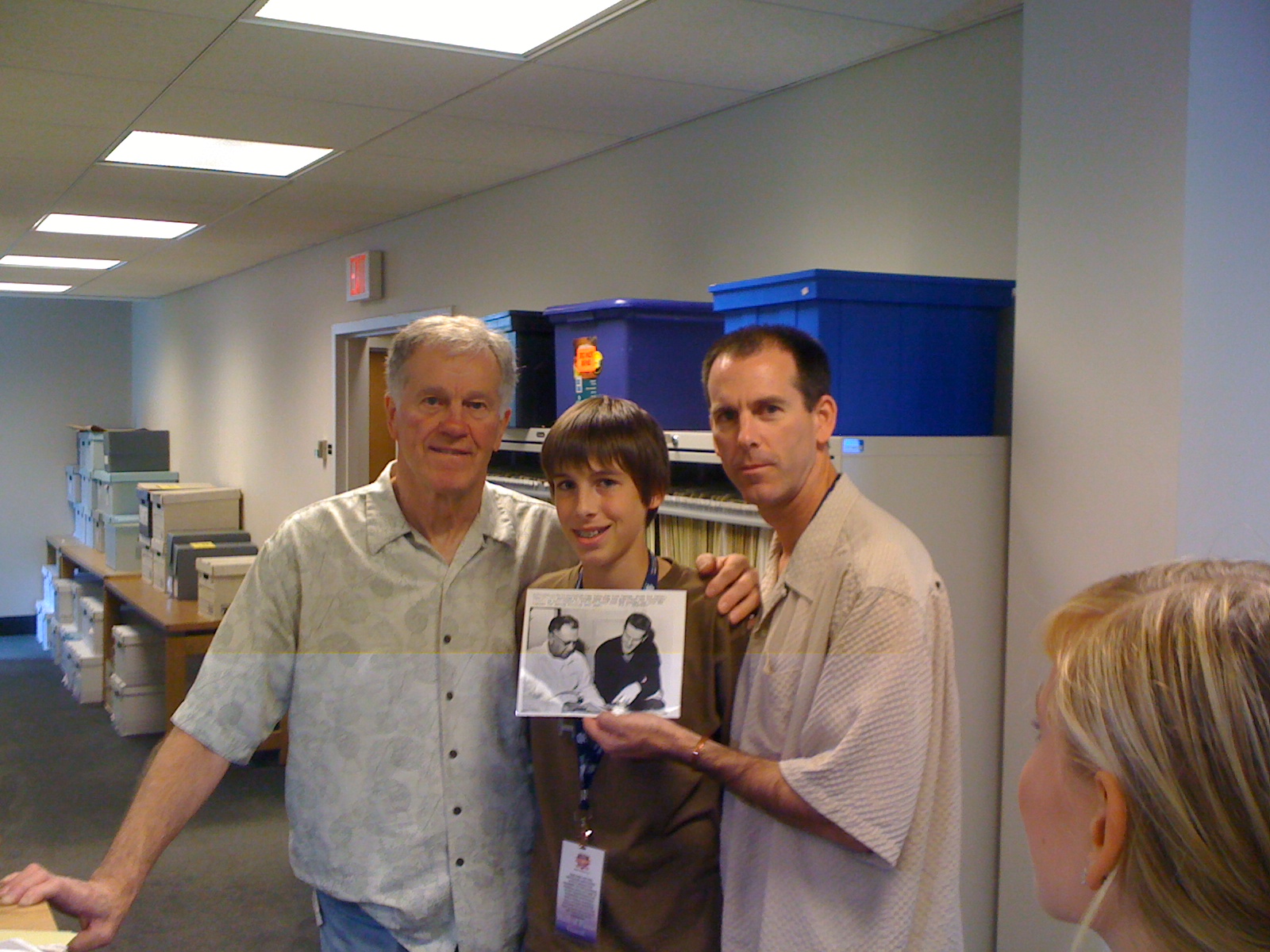
And then I was shown something, in the photo library of the Hall, last week. And I gasped.
There is some film of Mathewson – he’s shown warming up on the sidelines, evidently on Opening Day of 1905, arrogant John McGraw’s decision to put “World Champions” on the uniforms (another nose thumb at the American League), the most evident image. But he’s only tossing the ball and if that’s the way he’s pitched, Dan’s right – he won his 373 games because he managed to last for parts of seventeen seasons and both the pitching and the hitting of the time were unscientific messes. At one point a dog runs around on the field, and at another, Mathewson drops the return throw. If he’s cracking 70 on these “pitches” I’d be mighty surprised.
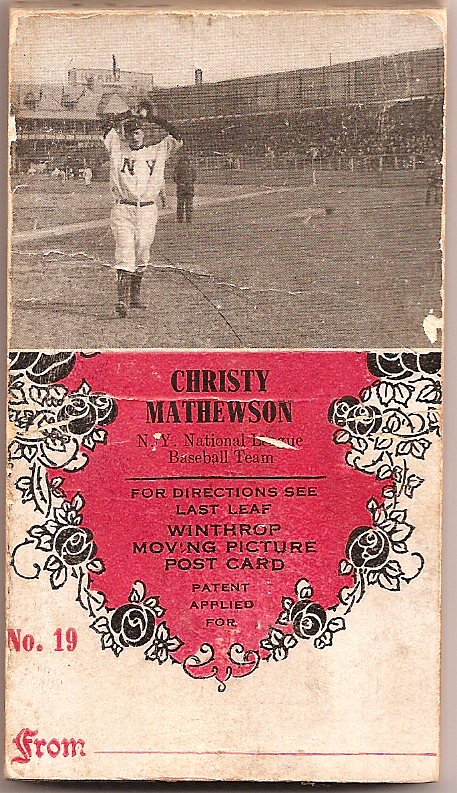
In fact, bluntly, the second or third best “film” of Mathewson in action is from a “flip book” (A Winthrop Moving Picture Post Card, to be precise) – a delightful hand-held series of still pictures from 1907 which when skimmed through with the thumb, create an animated representation of Mathewson’s legendary form. If you grew up on the legend of the hero who died so young and so loved, it can make you tear up. I got one last year – here’s the cover:
It’s wonderful, but even here, he’s just, well, throwing. He’s a professional, to be sure, and his mechanics would make any pitcher jealous, but, again, where’s the beef?
Mathewson was famed for one piece of advice to young pitchers, which would cause him to be banned from the field today, as pitching coaches clapped their hands over the ears of their young charges: Don’t put everything you have on every pitch. Save something for the 9th Inning (that might explain his 435 Complete Games). Still, this is ridiculous. He had to have had something more in the way of exertion or form – in an era of contact hitting when a batter striking out 100 times in a season was likely to find himself in Decatur, Illinois the next year, he led the National League in strikeouts five years out of six and ended with more than 2500. But where was the visual, visceral, proof?
In the basement of the Hall of Fame, that’s where.
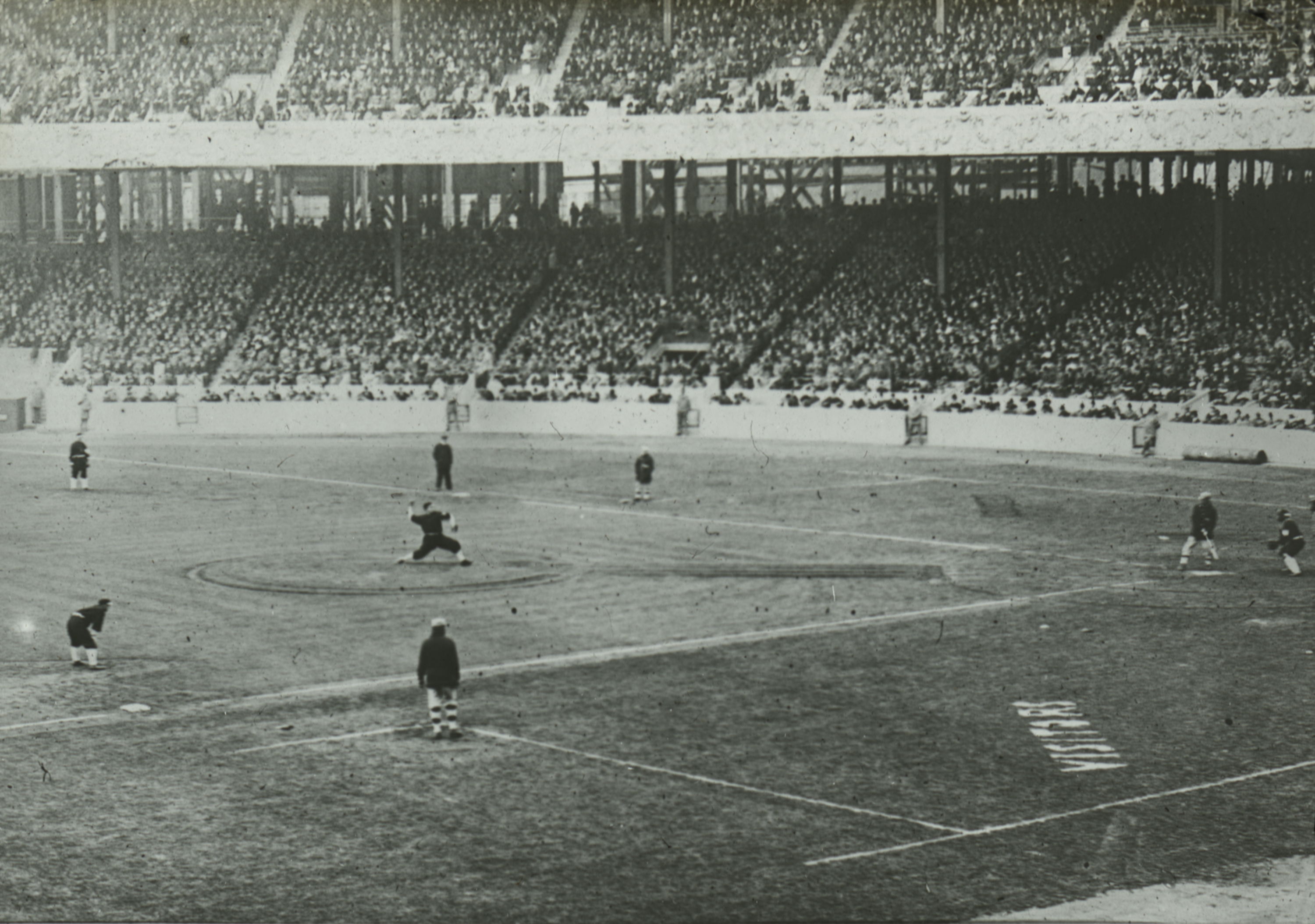
I was handed a series of glass images, each about four inches by five, that were nothing less than the “magic lantern slides” that used to be projected in movie houses, in the pre-newsreel days. You just couldn’t set up film cameras in 1911 and hope to get anything meaningful in the way of action or highlights. But the box camera did the trick.
And there it all was: the key plays of the 1911 World Series, right down to the consecutive home runs in Games Two and Three that earned A’s third baseman Frank Baker the nickname “Home Run,” and first lit the fire in the public’s imagination about the longball. It can be argued that those two dingers – one which tied up the game in the 9th, the other which won one – set the stage for the next century of Home Run Mania, and the constant alteration of equipment, ball, stadium dimensions, and pitching rules that has ushered in era after era of “The Home Run Era” virtually without interruption.
And there was one other image in there that took my breath away. I originally posted a blurry snapshot taken with an iPhone, but the warm and friendly curators took pity on me and sent… this:
Credit: National Baseball Hall of Fame Library, Cooperstown, N.Y.
The figure in the middle of the diamond is Christy Mathewson, and what he is doing couldn’t have surprised me more than if the slide showed that he had his 2009 Lamborghini parked behind home plate.
He is clearly delivering at one of those moments when he would have advised the kids to throw as hard as they could. He is firing. And his delivery is precisely that of the modern power pitcher. His frame, 6′ 1-1/2″, is so low to the ground that the back knee is nearly touching it. He is in classic fireballer position, as aware of the physics of pitching as anybody who has followed him.
In fact, the first thing I thought when I saw that slide was: ‘What’s this picture of him doing mixed in here?’:
Christy Mathewson had Tom Seaver’s delivery. That’s it. That’s who I thought I was seeing in that slide from 1911. Old Dirty Knees Seaver.
Or, if that’s not enough of a reference, let’s say he had a righthanded version of this guy:
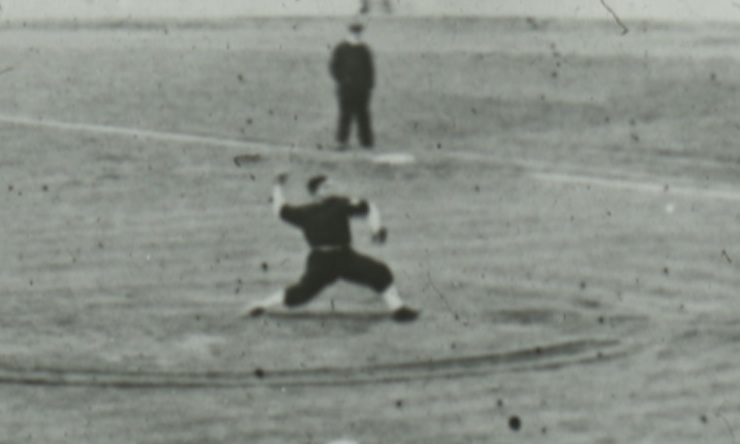
A detail suggests a weird twist to the forearm, which (historians think) was how Mathewson threw his famous “Fadeaway” pitch, believed to have necessitated the same painful twisting of the arm as Carl Hubbell’s screwball (it’s probable Matty’s pitch was a screwball). If this is what it took, it is stunning that he lasted seven seasons, let alone seventeen. The similarities here also gives an almost eerie sense of looking back through time, and being there, just for an instant, as Matty explains to all who would follow him, and all who would wonder about him, just who he was, and why he still counts.
Nice to meet you, Mr. Mathewson.
Credit: National Baseball Hall of Fame Library, Cooperstown, N.Y.







 Baseball Nerd