Category: Dailies

The Philadelphia Spiders?

The Phillies, who have brought new meaning to the phrase “home away from home,” are in St. Petersburg tonight, giving us time to contemplate the insanity of a divisional leader having lost 22 of its first 35 games in its own park. For the record, in the NL East only the Mets are at .500 or better at home, and that 13-22 mark for the Phils compares unfavorably to Washington’s 12-23 home start.

Futility at home always brings back fond Collective Baseball Consciousness Memories of the 1899 Cleveland Spiders, baseball’s all-time worst team, and the last to actually abandon their home city in midseason. Cleveland was the National League’s third most successful franchise during the monopoly years of the 1890’s, but in those days there were no rules about the same people owning more than one franchise. When the St. Louis Browns slid into bankruptcy before the season of 1899, the Cleveland owners, the Robison Brothers, bought that team as well. 
With St. Louis then being a far larger market, and less than three weeks before Opening Day 1899, the Robisons promptly transferred all 20 of the Spiders’ top players – including future Hall of Famers Cy Young, Jesse Burkett, and Bobby Wallace – out of Cleveland. The Spiders, filled with has-beens, reserves, and occasionally local amateurs signed for cameos, lost 20 of their first 23 games, and managed to draw a total of 3,179 fans for their first 16 home games (you not only read that right – less than 200 fans a game – but many contemporary reports suggested that those numbers were padded).

It quickly went from bad to unbelievable, even for the fluid standards of 19th Century baseball. By a July 1st home doubleheader split with Boston, the Spiders were 11-48. It was at this point that the Robisons decided that there was very little purpose in playing any more games in Cleveland. They would perform in front of the home fans (fan) only eight times thereafter, and as a wandering tribe of dispirited players, they finished the year with the remarkable record of 20 wins and 134 losses (9-33 at home, 11-101 on the road, and 0-13 in Cincinnati). Cleveland ended up in twelfth place, 84 games behind first-place Brooklyn and 35 games behind eleventh-place Washington. And of course it got worse as it went along. The Spiders lost 35 of their last 36 games (only one of them played in Cleveland).
Necessarily the Spideys produced some horrific statistics, especially for pitchers. Coldwater Jim Hughey, the staff ace, was 4-30 (and the majors’ last thirty game loser). Charlie Knepper finished 4-22, and Frank Bates, 1-18. Among the position players, Lave Cross is a longshot Hall of Fame candidate (and after suffering as player-manager until June, was ransomed back to St. Louis). Saddest of all, the man who might have been the most talented athlete in the game’s history, Louis “Chief” Sockalexis, was already so far lost to alcohol that he lasted just seven games with history’s worst team, and was dropped on May 14.
Thus at 13-22 at home, the ’09 Phils are already guaranteed to do better than this gothic nightmare out of the pages of the history of baseball greediness.

Five Innings For A Win?

Join me in a hypothetical, starring a manager who has shown a past willingness to use his starters in limited relief on their “throw” days, Bobby Cox.

It’s Javier Vazquez’s turn and Derek Lowe’s throw day (or, if you fear I’m jinxing Vazquez, I think you might be able to flip them). The Braves are up 2-0 with nobody out as Vazquez takes the mound for the two outs in the top of the third inning. He throws an obvious strike, which the ump calls outside. Vazquez detonates and is ejected.
You supply the reason – his bullpen is short, or it’s overworked, or Lowe really needs to work on something in a game situation, or the All-Star break looms and he’s going to get too much rest – but, for whatever purpose, Cox summons Lowe, intending to have him throw no more than 25 pitches. Lowe does so with maximum efficiency, and exits for a pinch-hitter in the bottom of the fifth, the Braves now up 4-0. They win 6-0.
By the rules of scoring, Lowe is going to be credited with the win. The starting pitcher, Vazquez, is, alone among all pitchers, required to finish five innings with an unvanquished lead. Of course we have just constructed the scenario in which two pitchers, both of them starters, have produced nearly identically: Vazquez has thrown 2.2 scoreless, Lowe 2.1. 
Now, obviously, in this case Lowe is literally, if not traditionally, a relief pitcher. But this hypothesis is designed to show a scenario in which merely the act of being the relief pitcher earns Lowe a win, while merely the act of being the starting pitcher disqualifies Vazquez from a win. And it is built to underscore the point: why does this rule exist?
In the He-Man Days of the Complete Game the inference was obvious to us. Starting pitchers who didn’t make it through five were not only not worthy of getting a victory, they were not really worthy of being starters, and should suffer the ignominy of that halfway house that was known as the bullpen. Certainly we have lost nearly all of that bigotry towards the reliever, that he is necessarily a failed starter. If that still existed, it was certainly killed off by the conversions of guys like Righetti, Smoltz, and Lowe himself, from starter to closer (and in two cases, back again).
There was, as I recall from the ’60s, a certain lingering fear that the Five Innings Rule was necessary to protect against a statistical armageddon. You could construct a scenario based on the 1972 Phillies where there is a horrific team with one unhittable pitcher with a rubber arm and the a chance to win 30 games in a season. Why not start him every third day for the last month of the season, and pull him after three innings or the attaining of a lead, whichever came first? Our alternate-universe Carlton could’ve won 30 or 35 that way.
Certainly that fear has to be gone by now. Faced with going down 3-1 to the Indians in the 2007 playoffs or starting Josh Beckett on short rest, Terry Francona bit the bullet and took the former. In their life-or-death battle last September, the Mets had to be talked into letting Johan Santana pitch on three days’ rest rather than four – by Santana. The likelihood of abuse in a world without a Five Innings Rule seems almost nil.
There was certainly also the belief that a reliever coming in for a starter struggling with a lead before five innings had been completed, was probably going to pitch as long, or nearly as long, as the starter. How often is that true?
And I’m not of the opinion that a sudden elimination of the rule would lead to managers yanking starters even earlier – or at least any earlier than a batter or two, usually in the fifth. Ask all 30 managers what one wish they’d ask of a Baseball Genii and I think all 30 would answer “starters going seven every night.”
All these ruminations come from the Mets-Rays game in New York this afternoon. Jeff Niemann of Tampa Bay did not pitch well by any stretch of the imagination (4 IP, 4 BB, 3 H, 2 ER). But he left for a pinch-hitter in the top of the fifth, losing 2-0; they rallied in that inning to lead 4-2. If the Rays had held onto the lead (they did not; Lance Cormier coughed it up) Niemann would have been ineligible for the win even though he was technically the pitcher of record when the runs were scored, and Cormier or one of the others who pitched even more poorly than he did, would necessarily have gotten it.
Just a thought here: is the Five Innings Rule a meaningless vestige of the past? Should it be eliminated? Modified to four innings? Left to the Official Scorer’s discretion?

F-Rod?

Lost in the adventures of Luis Castillo at Yankee Stadium last Friday was the reality that even if Castillo had made a game-ending catch, Francisco Rodriguez would have begun tonight’s Mets game in Baltimore having recorded consecutive saves in which he had allowed two base runners and just escaped with his life.

Tonight he did not escape, and so K-Rod has, in four appearances, one Save, one other clean 9th, two combination Blown Saves/Losses, and one pre-game argument with a guy 35 pounds heavier than him. This is no more evidence that he’s hurt or in pitching distress, than the fact that somebody finally roughed up Trevor Hoffman suggests that Hoffman is in trouble.
But in the superheated atmosphere of New York, both questions will be raised about Frankie, especially in the context of the Mets’ bullpen troubles, which have endured for a decade and proved fatal the last two seasons. The more important issue, of course, is what exactly would the Mets do if there really was something wrong with Rodriguez?  J.J. Putz is out, perhaps until September. Bobby Parnell is a rookie who has been more than challenged by merely the 8th Inning role. Sean Green has been strong for a month, and in ten save opportunities over four big league seasons, he has converted only one of them, and Pedro Feliciano is only four-for-twelve.
Minor league resources? The “Closer Of The Future,” Eddie Kunz, is working set-up at Buffalo, with major league journeyman Elmer Dessens finishing the games.
There are stories that Billy Wagner has found the Lourdes of baseball and expects to be pitching in big league games in 30 days. What kind of story would it be if the Mets really needed him?

Johan Santana Must Be Hurt (Updated With Quotes)

This does not come from Mets sources, and it does not come from ballpark speculation, and it certainly does not come from the player himself, but barring an extraordinary breakdown in the mechanics of the game’s most-mechanically sound pitcher, Johan Santana must be pitching with an imposing injury.

This thought had been in the back of my mind since a fired-up Santana virtually willed the Mets to a victory in Boston, then followed that with a six-walk game against Washington on May 27, and finally his four-homer victory over the Phillies last week. Having now gotten to see Santana from field level during his implosion this afternoon at Yankee Stadium, there is not only the loss of velocity suggested by the radar guns, but he also seemed to have a softer break on his breaking stuff, and he clearly had trouble keeping the ball down. Many of the Yankees’ nine hits would have been swinging strikes on Santana pitches in the dirt, if he was 100 percent. Hideki Matsui’s homer might as well have been hit off a tee.
The one flaw in Santana’s makeup is the gung-ho attitude that has otherwise contributed mightily to the making of a superstar. If you will remember, he just missed single-handedly forcing the Mets into the playoffs last year with one of the great pitching performances in Mets’ history, his shutout of the Marlins on the next-to-last-day of the regular season. 
That was on Saturday. On Wednesday, Santana was being operated on to repair a torn meniscus in his left knee. He had been pitching through its pain for the last month of the season. He had come back from a 125-pitch performance to mesmerize the Marlins, and had done so on three days’ rest.
And all that time, he had been pitching while hurt.
If he’s doing it again, the Mets’ 15-0 loss at Yankee Stadium will have been the least of their problems.
UPDATE, 5:00 PM EDT: Post-game, Santana insisted he has no arm problems nor any other injury (“no, not at all.”). See if you can spot the phrase that might make Mets’ fans doubt him:
“It was a bad day, worst of my career. I’m fine, it’s not excuses or anything, it’s just that today was a tough day.” Was his velocity down? “No, not at all. I made a few mistakes locating my pitches and if you are not able to locate the ball around the plate, that’s what’s going to happen.” No injuries at all? “I had some soreness in my back about a month ago. We battled through it. I had a split nail on my finger. We battled through it.” No lingering effects from either of those small problems? “No, I’m fine. We battled through it. Not a dead arm, not even close.”
AND THE NOBEL PEACE PRIZE GOES TO:

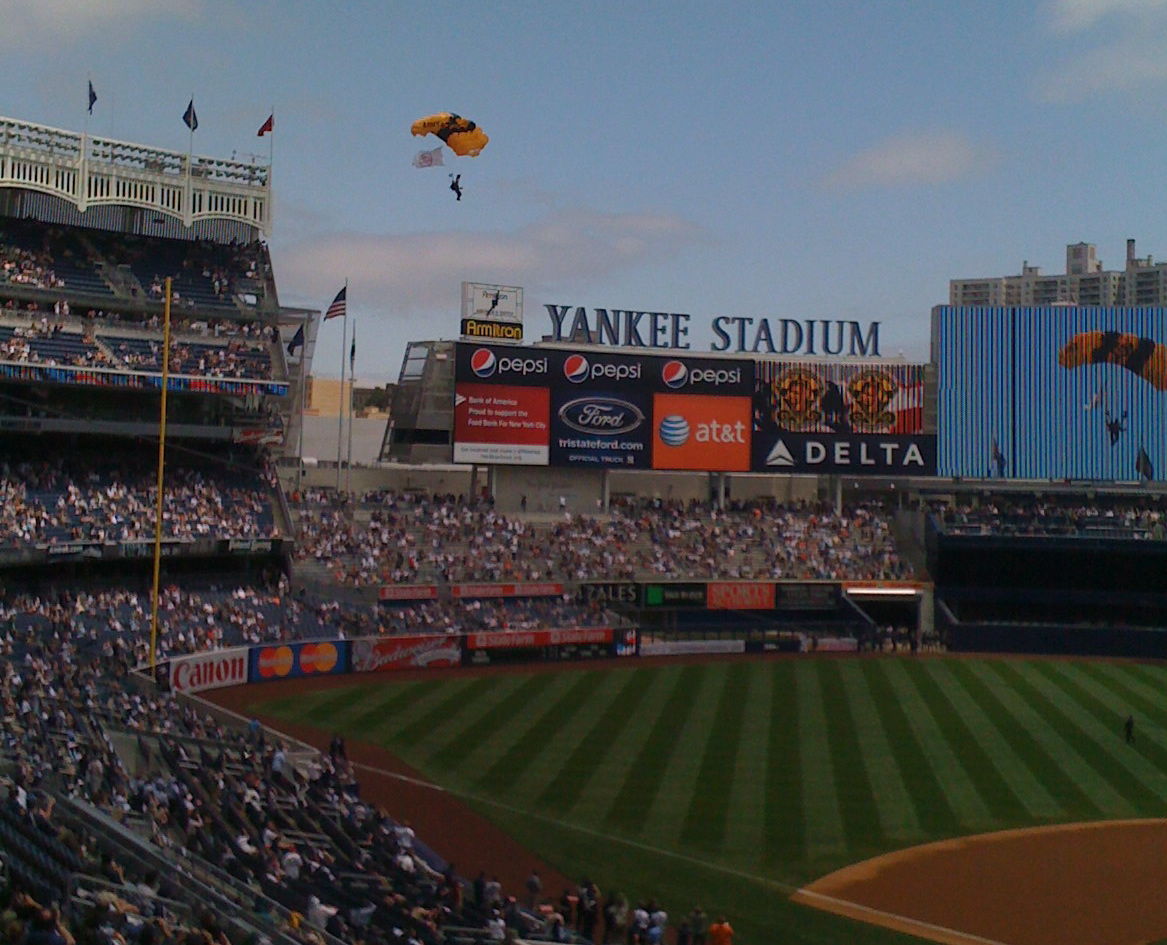
Jose Veras of the Yankees and Mike Pelfrey of the Mets seem to have gotten in between Francisco Rodriguez and Brian Bruney, just in time. Bruney’s remarks about K-Rod’s not-entirely-deserved “L” on Friday had inspired the Met closer to confront Bruney in the outfield during batting practice. K-Rod was giving away at least three inches and at least forty pounds to Bruney… Top Observation from the Mets’ on the new ballpark in the Bronx comes from veteran Mets’ media relations guru Jay Horwitz. Asked what he thought of the place, Jay said, with a tone of mild surprise, “It looks a lot like the old Yankee Stadium.” Told that that was the point, Jay didn’t miss a beat. “Oh, well, then they did a really good job”… whatever comes of Santana, the Mets continued to struggle defensively. Luis Castillo dropped a skydiver:
IMG_0749.JPG

Marquis Performer

If you’ve seen Baseball Prospectus you may have waded through my overly cute introduction – at minimum you know I am awed by the accuracy of the forecasts of the figure filberts. 

But every year, amid the Nostramadus-like exactitude of most of the player line previews, they miss by more than a mile. Last year it was Cliff Lee. This year an early front-runner for the 2009 version is Jason Marquis.
The Rockies’ righthander is now at 8-4, 3.98, 1.34.
BP predicted 6-10, 5.57, 1.61.
This is not to say they could not still come awfully close. The forecast was for 21 starts and 11 relief appearances. Marquis would not exactly have to go up like downtown Chicago in 1871 to go 0-6 the rest of the year, fall out of the rotation after nine more starts, and inflate the ERA by not much more than a run and a half. Manny Parra could offer him instructions.
Still, as I noted in that intro, spooky things do seem to follow when the forecast maximums are reached. Tim Hudson was expected to end up 12-10 last season; he got to 11-7 and then his elbow went blooey. Mr. Marquis is now two wins past where he was supposed to end up. 

Helmets And Closers

It’s 30 years now since the last major leaguer stepped to the plate without a batting helmet, and 38 since the helmet became mandatory. The mandatory earflap celebrated its 25th anniversary last year. But batters have used helmets (or plastic cap liners) since the ’40s, and their invention and use pre-dates even the death of Ray Chapman from a pitch in 1920, to Roger Bresnahan, Hall of Fame catcher of the Giants, in 1907.
Defensively, catchers turned to helmets, then cages. The mid-50s Pittsburgh Pirates wore them exclusively, in the field and at bat, pitchers included. While that idea was abandoned, largely based on the argument that fielders had gloves with which to protect their heads, John Olerud used one to protect his skull – at high-risk for damage after an aneurysm – while playing first base. After the awful death of Mike Coolbaugh, struck by a line drive while coaching first in a minor league game in 2007, helmets for coaches became mandatory last year, and by this one, they had begun to look perfectly normal (no matter what Larry Bowa says).
So, here is a question that popped into my head during a recent game: why don’t the umpires wear helmets? Surely the ones at first and third are at nearly as much risk for being hit by a line drive against which they are gloveless, and helpless, as a coach. The argument, of course, is that umps are trained pros, and it’s not like we’ve seen a frequent problem with them getting leveled. Just as we hadn’t seen one with coaches before Coolbaugh.
For that matter, why don’t we bite the bullet on the next most vulnerable in the equation? The catcher’s body is almost 100 percent covered, the plate ump is well-wrapped, and the batter can arm himself in everything short of cyborg components. Why don’t we mandate helmets for the individuals who are the fourth-closest to the violence of the meeting of bat and ball – the pitcher? We haven’t seen enough pitchers knocked down by return fire? 
The obvious point against, of course, is that most of those pitcher injuries are to the face. Then again, no pitcher has had the opportunity to use “ducking out of the way” as a reaction to a line drive.
And if there is a cosmetic argument (and, face it, the new articulated helmets look laughable), certainly we have not reached the all-time climax of helmet design. They can doubtless be made more ventilated, be lined with sweat-absorbing material, fixed into a more cap-like shape, and generally be redesigned so as to make their wearer look less like the Great Gazoo.
Besides which, why does a batter with a helmet look right, and a pitcher or an umpire with one look less so? 
Because we’re used to it.
NO HELMETS MAY SAVE THEM:

Watching the Nationals first sign, then promote, ex-Royals closer Mike MacDougal, and considering the maelstrom that their bullpen has been, I wondered when Manny Acta would put him into a save position. Friday night, he retired two Mets, including a creaky Gary Sheffield on strikes, on six pitches. Then Joel Hanrahan looked even better in the 9th, yet Acta mysteriously brought his shaky closer back for the 10th, and Hanrahan got lit up like the Capitol Dome.
This is not to portray Hanrahan as Mariano Rivera. But if the man has the tools to do the job and has just done it splendidly — if the question is confidence — get him out of there. Treat him like a real closer (pitch one inning, limit to save opportunities) and maybe he’ll become one. Hanrahan’s previous outing was with the Nationals trailing and the argument that he needed some work was valid, except that that was the day of the San Francisco/Washington day/night doubleheader and this was only the first game. What if Hanrahan had been needed in the second game?
In short, was Acta looking for a new reason to break-up with Hanrahan? Were he and his new pitching coach Steve McCatty setting up Hanrahan to fail? You pull your closer after he looks bad in two non-closing situations?
MacDougal became McCatty’s project in Syracuse and if he succeeds he could mean McCatty has the job long-term. There’s nothing wrong with that, especially if McCatty has helped MacDougal reclaim his career. This is the MacDougal who spent nearly all of last year in the minors, and who was released by the pitching-challenged White Sox a month ago. And you have now destroyed Hanrahan, twice, in nine weeks. 
To whom do you go if MacDougal fails? Joe Beimel? Kip Wells? Julian Tavarez? They’re all in that Nats Closer Alumni Association. Ron Villone? He’s been superb in the Washington bullpen, in a role he has performed for twelve seasons now – during which he has racked up is career total of seven saves.
In other closer flux news: Our fellow MLBlogger and Phils’ correspondent Todd Zolecki insists Charlie Manuel is eternally committed to Brad Lidge. But his colleague Joe Frisaro has a significantly less-ringing endorsement of Matt Lindstrom by Fredi Gonzalez. In that construction, Fredi, who seems to prefer a little chaos in his bullpen, may get exactly that.
True followers of the Phillies, of course, know that as startling as the statistic is — from perfection over a season to six blown saves in two months — Brad Lidge was hardly perfect last year. The true difference isn’t the number of crises he has created, but the number he has created. As Baseball Prospectus pointed out, his BABIP (Batting Average, Balls In Play) went from .300 during his “bad” year in Houston in 2007, to .302 during his “perfect” one in Philly last year. It’s the homer total that swung wildly: from nine in ’07 to two in ’08, to an astonishing seven this year (for comparison purposes, that’s how many homers Livan Hernandez has given up this year). And the BABIP is now .356?
Tab Bamford has a fascinating idea for the Cubs - but it is one entirely dependent on the idea that Chicago cancelled Rich Harden’s rehab start today only because the feng shui in the stadium was all wrong. The idea that an injury-prone starter with extraordinary stuff might be a better closer than a journeyman with loose-control or a set-up man with pressure issues is, as the blogger notes, not exactly unprecedented in Chicago. Lord knows Lou Piniella has been willing to make this move (Kerry Wood) and its opposite (Ryan Dempster) before. 
All of which raises the question: if you’re the Tampa Bay Rays and you have the Red Sox and Yankees to fend off, and you don’t have time to screw around, and you have a healthy supply of starters, and your bullpen has suddenly gone so south that you hesitate to name a permanent closer, why aren’t you using David Price in that role?
BY THE WAY:

If you’re wondering about the last batter to hit without a helmet, it was Bob Montgomery, Carlton Fisk’s long-time understudy with the Red Sox. He, Norm Cash, and maybe a few others, were grandfathered when the helmet rule finally passed. They wore plastic liners inside their caps. Terrific oddity there considering Montgomery was a catcher.
Oy Vey, Oy Vey Oy Vey Jose

Jose Reyes’ injury is a hamstring tear????

No confirmation on this elsewise but Mr. Burkhardt knows his stuff.

UPDATE 9:04 EDT: Now confirmed by a Mets’ statement, via the Associated Press, with the timeline hazy: “(An) MRI revealed a small tear in his right hamstring tendon, a new injury. Reyes will rest for two days and then resume treatment.”