Category: Uncategorized
2013 Previews. NL Central: Maybe You Can Be Weak Up The Middle?
Chicago: The cupboard is not as bare here as widely believed – but it’s close. Firstly, the Cubs have two of the game’s emerging stars in first baseman Anthony Rizzo and shortstop Starlin Castro (when he’s watching the game he’s in). There is also an able and patient management structure, from field boss Dale Sveum through president Theo Epstein. Behind them are three of the higher-potential impact position prospects in infielders Javier Baez and Junior Lake, and outfielder Jorge Soler.
The problem is, the next most interesting thing about the Cubs is the debate over whether they should commemorate the centennial of Wrigley Field next year (to note 100 years since it was built, as Weeghman Park, for the Chicago Whales of the long-gone Federal League) or in 2016 (to note 100 years since Weeghman bought the Cubs and moved them to his stadium).
Because possibly for the next four seasons, Rizzo and Castro and the When’s-The-Centennial question might be the only things to talk about at 1060 West Addison Street. Cubs fans have to hope Rizzo and Castro are still there by the time Baez and Soler (and to a lesser degree, Lake) get there. And they have to hope that some pitching finds its way there, too. Because right now there’s none, other than the intriguing Japanese reliever Kyuji Fujikawa and his counterpart among domestic spelling confusion, Jeff Samardzija.
Cincinnati: Lost in the debate that lingered through nearly the length of this lengthiest spring training – does Aroldis Chapman close, or get moved to the rotation – was the fact that on September 7, 2012 Chapman imploded. He faced seven Astros in the ninth, struck only one of them, gave up four hits (including a three-run homer to Matt Dominguez), and blew a 3-2 Reds’ lead. Three days later he walked three of the five Pirates he faced. Dusty Baker then gave him 12 days off, and although Chapman recorded saves in his last three appearances, he was no longer the untouchable pitcher of the season’s first five months (4 innings, 3 K’s, 3 BB, 1 hit). He then nearly coughed up Game 1 of the NLDS against the Giants (5-1 lead: two walks, two wild pitches, a hit) while following up with clean but irrelevant innings in the losses in Games 3 and 5.
My point is that, as often happens, debate obscures trouble. Any weaknesses Chapman showed in Arizona this spring (5 strikeouts, 4 walks, in nine innings – an opponents’ batting average of .294) could be attributed to the aborted starting experiment rather than something like, say, a pre-critical-mass arm problem.
That Cincinnati has at least one viable alternative in the pen (Jonathan Broxton was lights out this spring) is not the point. Chapman, as starter or reliever, is the pitching centerpiece of a team in a division where the contenders can all hit, and are separated by their mound strength. If Chapman is not the guy he was most of last year, the Reds are down one asset. As it is now, his failure to convert to the rotation means Cincinnati can’t survive any more of the past yo-yo seasons from the likes of Mike Leake and Homer Bailey. If something serious happens to Chapman, Broxton will adequately replace him – but the bullpen depth, which already hits Manny Parra levels surprisingly early, will be taxed.
Obviously the Reds are improved offensively. Shin-Soo Choo is one of the game’s underrated outfielders (career OPS: .847. Matt Kemp’s career OPS? .853 ) and provided his back woes of the last two weeks are transient, will handle both the leadoff spot and centerfield with ease. That’ll give Billy Hamilton a year to learn to play the position in the minors and become a Vince Coleman-like figure in Cincinnati (without so much of the throwing-firecrackers-at-fans part).
But as Chapman goes, so go the Reds.
Milwaukee: That the Brewers think Corey Hart will be back far earlier than the original July/August timeframe is indicated by their willingness to stick Alex Gonzalez at first base – rather than a prospect like Hunter Morris or a retread veteran – in his absence. With Hart’s bat, the Brewers’ new formula – in which at least four of the guys (Aoki, Gomez, Segura, Weeks) are as much about getting on as getting over – can churn out runs. Without him there’s a dead spot in the middle of the lineup and suddenly Ron Roenicke is depending on catcher Jonathan Lucroy to drive in 90 runs.
The Brewers’ starting pitching may have been better than thought even before they ransomed Kyle Lohse from The Island Of Misfit Scott Boras Clients. Yovanni Gallardo is a stud and Wily Peralta will eventually be one, leaving quality needed from only two of the group consisting of Marco Estrada, Mike Fiers, Chris Narveson, and the AAA rotation.
Milwaukee can win this division but all the ifs will have to turn in their favor. Lohse will have to succeed outside of St. Louis, Hart will have to heal quickly and hit hard, and Peralta will have to be ready now. Because the bullpen could be a disaster. John Axford blew 9 of 44 save chances last year, briefly lost his job to a terrified looking Jim Henderson – and there is no depth behind them short of imported lefty specialists Mike Gonzalez and Tom Gorzelanny.
Pittsburgh: With a few breaks the Pirates could leap into contention this season, but if the Brewers need all the ifs to run in their favor, Pittsburgh needs that from ifs nobody’s yet envisioned. It speaks to the degree the franchise has shed its farce label that Russell Nathan Coltrane Jeanson Martin chose to sign up rather than stay with the Yankees; it speaks to reality that only after he rallied with a strong September did Russell Nathan Coltrane Jeanson Martin manage to hit .211 last season.
There’s always something like that with the Bucs. Here they can go and trade off closer Joel Hanrahan for a hatful of Boston prospects and try to turn ace set-up man Steve Grilli into his successor – yet this also means that they are relying on a 36-year old novice closer, who made his major league debut five weeks into this millennium yet in all that time has had exactly 11 save opportunities (five of them last year – three of which he blew).
Andrew McCutchen is a great player and Pedro Alvarez and maybe Starling Marte have the potential to be nearly if not great. Gerrit Cole and Jameson Taillon are living up to the pitching hype. But the Pirates can find a cloud for any silver lining. The same people who chose and developed all five of those men (and Neil Walker too) gave pitching prospect an over-slot bonus of $2,250,000 three drafts ago. Last year they had to convert him to being a first baseman. He hit .213 – as a 21-year old facing 18-year olds in rookie ball. That a draft choice named Stetson might prove to be all hat and no cattle as pitcher and hitter would just about sum up the Pirates.
St. Louis: You know what would be really cool? If Jon Jay could play shortstop and Oscar Taveras could play second base.
Over the last few years the Cardinals have developed a reputation as the Drs. Frankenstein of the middle infield. They’ve tried to make Allen Craig, Skip Schumaker, and now Matt Carpenter into second basemen, each with ineffective if not entirely unhappy results. Now would be the time for one of their creations to rise from the operating table, because the middle infield is the only hole in an otherwise dominant ball club – but what a hole it is.
Carpenter showed some usefulness filling in at first and third last year (and he’s due back to fill in for David Freese at third as the season starts), but there’s no sign he’s a second baseman. And Pete Kozma’s credentials as a defender at short are passable, but the hitting he did down the stretch and in the playoffs last September and October is just about all anybody should expect. The Freese injury may be the happiest of accidents, shuffling Carpenter off second and forcing the definitionally adequate Daniel Descalso into the lineup at second TFN.
Otherwise the Cards are just great. Won’t miss Chris Carpenter or Kyle Lohse. Still producing kid pitchers in clusters (this year’s – after previews last year – Shelby Miller, Trevor Rosenthal, and Joe Kelly), still two or three deep at the back end of the bullpen (Motte’s hurt? Get Boggs and Salas ready). The aforementioned Taveras could step in if (when) Matt Holliday and Carlos Beltran get hurt. Yadier Molina is as good as they get.
So – how much does an offensive hole at short and a defensive hole at second hurt an otherwise impeccably built team? We’ll see. I think the Cardinals can get through the division. After that? Notice what happened to the Tigers when they tried to sneak poor execution past the Giants.
I’ll take the Cardinals in a tight race over the Reds with the Brewers finishing third – and I’m not sure if they’re a factor or not (ask Corey Hart). Pittsburgh’s fourth (maybe challenging for third). The Cubs will finish last.
But one passing thought: what if the Rangers, who have too many middle infielders but not enough outfielders and actually sent Jurickson Profar down, and the Cardinals, who have too few middle infielders but too many outfielders and actually just sent Oscar Taveras down, had the collective cajones to swap Taveras straight up for Profar?
2013 Previews. NL East: Bryce Yourselves.
Having yesterday picked the Giants to surpass the more-talent/less-knowhow Dodgers in the West, we look ahead at the N.L. East:
Atlanta: And now, one of the great personnel questions in baseball history: If you put two underachieving brothers on the same team, in their home region of the country, for the first time in their lives, will they blossom? Can the purely personal premise of sibling rivalry (“Uptons Lead Braves To…”) overcome the undeniably statistical (27-year old B.J. Upton peaked at 22; his younger brother Justin has never been more than an average player when not inside the comfortable dome in Phoenix)?
The Uptons aren’t the only critical new couple in Atlanta. After years of tantalizing spring trainings, winter seasons, and MLB mini-hot streaks, Juan Francisco gets his shot to put up – and the Upton trade brought the Braves a useful righthander to platoon with him in Chris Johnson. Neither of them will make you think of Chipper Jones at his defensive peak, but nor did last year’s version of Mr. Chips. That they will not provide a speck of his leadership is a given.
Pitching is intriguing. Julio Teheran’s almost unhittable spring – climaxing in last Saturday’s six innings of being literally such – could combine with a full-season of Kris Medlen’s nearly unhittable 2012 finish. If so, the Braves could match the Nats arm-for-arm, especially if Mike Minor fulfills his promise. But if Fredi Gonzalez gets three lemons there, the Braves are finished, no matter how well the Uptons do, or Chipper’s successors do, or the bullpen does.
Plus there’s no Brian McCann. It’ll be at least May 1 before his shoulder quiets down and his travails this spring have the ring of one of those season-long things. Even though they let his perennial caddy David Ross walk over the winter, the Braves might have an intriguing Plan B in behemothian rookie Evan Gattis, who can catch, more or less, and lose a lot of baseballs because he seems to hit them into the clouds.
Nevertheless, there are too many “ifs” here. I hope the Uptons prove me wrong – even many of the people who let them leave Florida and Arizona last off-season speak nothing but praise for them as people – but as of today the record gives no reason to suspect they aren’t going to be busts in Atlanta, too.
Miami: Don’t get me wrong – the Marlins, Version Negative 2.0, aren’t going to win very much. But they might not be quite as repulsively bad as we all thought when the State of Florida’s bad bet on Jeffrey Loria’s business acumen predictably came up snake eyes – they might be better than the Mets. This will presumably turn on Miami’s willingness to promote the next great star who will eventually leave the team, Christian Yellich, who hit five homers and drove in 14 in 44 spring training AB’s. If the Marlins try to go cheap and keep Yellich in the minors not until May but until 2014, Miami’s huge holes could sink them completely. If they let Yellich up to join some combo of Giancarlo Stanton, Justin Ruggiano, Juan Pierre and Chris Coghlan, they will suddenly have an outfield nearly on par with Washington and the Phillies. The rest of the team is basically promising catcher Rob Brantly, and Other People’s Pitchers. Literally, outside of Ricky Nolasco, all the starting pitching candidates were underachieving pitching prospects obtained by trade (Alvarez, Eovaldi, LeBlanc, Slowey, Turner).
Far more interesting than the numbers put up by the team, will be those produced by the fans. I argued here last year that there was no chance Miami would suddenly turn into a 35,000-per-night city. Sadly I was right, and now we get to see how many will come to see these Dead Fish, and whether that spectacular new building might see an average as low as 3,500 a night.
New York: It has been postulated that the Yankees have let themselves go to hell because they saw a way to monetize the reality that the Mets just keep getting further away from respectability. One site specializing in such things suggested that New York’s opening day line-up could feature Marlon Byrd playing right and batting third. Last season, Marlon Byrd hit .070 in Chicago and then rocketed to a .320 slugging percentage in Boston and tested positive for a performance enhancing drug. Byrd said he wasn’t using it for that purpose. Man, I hope so.
If David Wright’s injury recurs, the Met infield could be Ike Davis, Justin Turner, Ruben Tejada, and Zach Lutz. The outfield could easily be Byrd (or Mike Baxter) and Collin Cowgill next to Lucas Duda. The latest rebuilt bullpen might be worse than last year’s and the rotation could be the worst since Tom Seaver was a rookie (and could provide similar contrasts for young right-handers who may be all Mets fans have to root for this season: Matt Harvey and Zach Wheeler).
New York knows the Mets are bad; it does not seem evident here that it’s very possible that they’re Worse-Than-The-Marlins-Kinda-Bad. Making things worse, the team’s first five series are against the Padres, Marlins, Rockies, Phillies, and Twins. Thus the Mets could easily be an utterly deceptive 10-6 or even 11-5 before – as the worn-out joke goes – the older kids get out of school.
Philadelphia: If you’re my age, or even close to it, you know the drill. Every morning some part is going to hurt, you just don’t know which one and how badly. Sadly the Phillies remind me way too much of me. Carlos Ruiz’s renaissance turned out to be an adderall-fueled illusion. Ryan Howard still doesn’t look 100%. Chase Utley and Jimmy Rollins are 34. Michael Young is 36. Roy Halladay had frightening moments of deadarmism this spring and it seems impossible to believe that it was only three years ago when we were assured he was the last puzzle piece to the greatest starting rotation in the history of mankind.
In a vast irony, perennial prospect Domonic Brown finally appears to be ready.
Don’t get me wrong: the Phillies could contend for second place here. I mean there are days when I creak less at noon than I did at 9 AM. Of course these only happen once or twice a month.
Washington: I thought this was the best overall team in baseball last year, and after its achilles heel was revealed in the decisive game against the Cardinals, management didn’t just lick its wounds – it invested even more in the squad. I am surely not the first to suggest that when you upgrade your fourth starter to Dan Haren, your first three starters are probably Cy Young candidates. The Nats surely did not need to sign Rafael Soriano as closer; clearly one of the internal candidates would’ve stepped up. But the mantra here appears to be don’t just try to beat everybody else – make sure you kill them.
That ‘don’t just try to beat them, make sure you kill them’ front office scheme? It mirrors words to that effect that Bryce Harper said to me after his first MLB exhibition game in 2011. It is a bit much to ask Harper to be the National League’s MVP, but it isn’t too much to put a bet down on him even at some very short odds. He debuted with all the technical skills, then had his moment of zen against the Phillies on May 6. Cole Hamels tried to put the veteran of seven big league games in his place by hitting him in the back. Moments later, Harper put Hamels in his place by stealing home on him.
Harper gave me his view of life way back in 2011! That is the remarkable thing about Harper that gets lost in the reality that he seems to have been around forever as prospect and mega-prospect and cover boy: he turns 21 next October. He’s fourteen months younger than Mike Trout. From 22/59/.270/.340/.477 – as a teenager – what kind of improvement can we expect this year? Is there a reasonable prediction for how high you go off that launch pad?
And it’s not as if he’s all Washington has. The infield is airtight, and power-packed at every position, and has rookie third baseman Anthony Rendon banging on the door. A healthier Jayson Werth is joined by Denard Span and Harper in the outfield. Catching are the unglamorous but highly-skilled Kurt Suzuki and Wilson Ramos, and as referenced earlier the pitching staff is impossibly deep. Of course for the Nationals, there actually is a hole. The next power arm scheduled to join the Nationals’ bullpen is a fellow named Christian Garcia. He just partially tore a tendon in his pitching arm.
Other than that I don’t see anything missing here. And for those who think the Braves are going to keep pace with them, I disagree. It might be a race for awhile but it’ll probably end with Washington winning 100 games and lapping the field by 10 or more. Take the Phillies for somewhere around .500, and the Marlins and Mets amazingly out of contention.
2013 Previews/NL West: How To Lose A Pennant
Let’s begin the annual dive into analysis, estimates, and hunches, with the National League West:
Los Angeles: In the original classic version of John LeCarre’s “Tinker, Tailor, Soldier, Spy” Alec Guinness as George Smiley corners Bernard Hepton as the treason-enabling Toby Esterhase with a telling colloquy:
Smiley: Ever bought a fake picture, Toby?
Esterhase (smiling): Sold a couple once.
Smiley: The more you pay for it, the less inclined you are to doubt its authenticity.
The Dodgers have the talent to win the National League West twice this year. But they probably won’t win it at all, and that’ll probably unleash a disaster in which the General Manager and Manager both get fired, because they’re sticking to the truth behind that quote. The new ownership will stick with the high-end counterfeits they saddled themselves last year simply because they bought them, and they bought them simply because they cost so much.
1. The Dodgers invested in the useless-in-a-pennant-race Zack Greinke, the untested Hyun-Jin Ryu, and traded for the finished Josh Beckett, and will start them while burying or trading the useful but unspectacular Chris Capuano, Aaron Harang, and Ted Lilly. Among the eight possible Dodger starters, Beckett should be ranked eighth.
2. For two months or more, the Dodgers will attempt to replace the injured Hanley Ramirez with Nick Punto (or maybe Juan Uribe) instead of Dee Gordon. How much must they hate Dee Gordon? It’s remarkable enough that they chose to bet on a journeyman minor league lifer who got lucky last year (Luis Cruz) over Gordon, but to be forced to take a second bite of the apple and still bite your own tongue is amazing. Gordon is young and made lots of mistakes in the field and on the bases, but unlike Punto he can hit Punto’s weight, and unlike Uribe, in the field he doesn’t resemble a potted plant.
3. Brandon League – who has blown 29 percent of his career save opportunities – looks like he’ll be the closer. If my calculations are correct, six of these 84 opportunities have come during pennant races. I realize Kenley Jansen has these disturbing heart problems, but if that’s somehow a factor, how on earth are they letting him out on the field in the first place?
4. This is an Andre Ethier slash line: 23/89/.292/.368/.493, 3.2 Offensive War, -0.2 Defensive War. Those aren’t career numbers, or a forecast for 2013. Those are his stat-by-stat highs since his “breakout” season of 2009, which in retrospect looks like his high water mark. And yet the Dodgers and much of the L.A. media still think him a Golden Child who should be batting fifth. I believe this could be called “The Wes Parker Effect,” which was while I lived there the only portion of the dismissal of Southern California as superficial that I found true. For nearly a decade the Dodgers thought first baseman Wes Parker was it, because he looked like he was it. Graceful, good looks, dashing. His career slash was .267/.351/.375 – and his career defensive WAR was minus three. For a first baseman.
Ethier looks like he’s a great player. He’s not. He was an above-average guy with one pretty good year who is well into his post-age-28 decline and is just not going to get any better now (and have a hard time staying even this good). And he will play every day while Yasiel Puig – the closest thing there is to ‘this year’s Yoenis Cespedes’ – goes to the minors.
5. Even more amazingly, until Carl Crawford is ready to play every day in left field, the Dodgers will have Skip Schumaker and Jerry Hairston Jr fill in, and not Puig. This presumes, by the way, that when Crawford is ready to play he actually will play well, and not be consumed by the panic that destroyed him in Boston. And the Dodgers’ rationales for ignoring in Puig what might be their best athlete this side of Matt Kemp? Incredibly, they are a) blaming Dee Gordon (somehow he forced them to rush him and even though he played terrifically when they brought him up in 2011, because he didn’t last year, that’s a reason to send out Puig), and b) they are crying poverty or at minimum preaching economy. The team that assumed $261,000,000 in Dead Sox contracts on one sunny day last year is actually reported to be worried about Puig’s service time and the acceleration of his free agency and arbitration eligibilities.
Seriously.
#FreeYasielPuig
6. Even if you think this line-up (A.J. Ellis/Gonzalez/M. Ellis/Cruz/Punto/Schumaker/Kemp/Ethier) is actually the best one the Dodgers can put on the field, my old ESPN colleague and figure filbert deluxe David Punto argues that the way Don Mattingly has ordered it will generate about half a run less than it could.
The only threat the Dodgers should face in this division is from themselves. Unfortunately it seems like a mortal one.
Arizona: So apparently Justin Upton, Chris Young, Trevor Bauer, John McDonald, Henry Blanco, Chris Johnson, Sam Demel, Takashi Saito and a bunch of other guys just weren’t the ‘right types’ for somebody in the Diamondbacks’ hierarchy. Kirk Gibson? GM Kevin Towers? Owner and T206 Wagner trimming scandal victim Ken Kendrick? Who knows, and, frankly, who cares?
The purging of players by dint of character or philosophy or whatever may have once been a productive means of shaping a team. But in the modern game, what it gets you is…the Colorado Rockies. I don’t know what personality trait is shared by the incoming Acceptable Diamondback Personality Types like Eric Chavez, Martin Prado, Heath Bell, Cody Ross, Brandon McCarthy, Eric Hinske, Cliff Pennington, Randall Delgado and Didi Gregorius (although everybody likes McCarthy and Ross, nobody likes Bell, and in terms of defensive prospects Gregorius might be the best one in the game). I only know that engineering a line-up based on anything other than talent is madness and usually results in big “Kaboom” sounds and incendiary lightning strikes.
The one pure baseball consideration in the off-season clean-out also didn’t go well. Chris Young (the centerfielder, not the pitcher) was moved in part to make room for Adam Eaton (the centerfielder, not the pitcher). While the latter may not be quite the prospect Arizona thinks him, it was a defensible argument. Until Eaton got hurt.
The team isn’t bad, per se – just ‘meh.’ The pitchers are mostly A.L. refugees (McCarthy, Ian Kennedy, Trevor Cahill, J.J. Putz, David Hernandez, Tony Sipp, the injured Daniel Hudson). There are some pretty good position players here and there but absolutely nobody you’d point to and say “All Star!,” which is an irony by itself given that the coaching staff behind Gibson (Alan Trammell, Matt Williams, Don Baylor, Charles Nagy, and now Steve Sax) is illustrious.
Fortunately when they finish a distant third the Specially-Selected Quality-Character D-Backs will all be good sports about it, I guess.
Colorado: Wanna hear something sad? In my fantasy baseball league, based solely on the NL, we had gone 140 players into the auction with every position player having inspired at least two bids (somebody opens for $1 and then another says $2 or $20 or whatever). Then Todd Helton was nominated.
Crickets.
Todd Helton cost $1 in our fantasy league.
The Rockies’ franchise he represents isn’t that bad, nor that sad. There is a disturbing fragility about its superstars (Cargo, Tulowitzki, and from the in-residence emeritus department, Helton) and just when the franchise seemed to be on the verge of recovering from the same kind of Character First nonsense Arizona will now suffer through, somebody decided to reinvent pitching. It’s well-intentioned (pitching has already been reinvented while pitching staffs have merely been enlarged and categorized) but seems to have incorporated only the worst of the old (four man rotation!) and the most dubious of the new (perpetual pitch counts and Vice Presidents of Pitching Developmental Personnel Evaluation Coordination).
There is this to consider, of course. The Rockies don’t have one outstanding pitcher right now, in the rotation or out of it (maybe Rex Brothers or Rob Scahill will become that, but not yet). And yet you don’t hear about that, do you? You only hear about The Executive Director of Coloradoean Pitching Prowess And Succor.
Clever diversion. It still means last place, but it’s clever.
San Diego: What, exactly, did the Padres get out of trading Anthony Rizzo to the Cubs? Oh yeah, Andrew Cashner (possibly not hurt this year) and outfielder Kyung-Min Na (he hit .155 last year). And, oh yeah, this gave the Pods an excuse to pack Mat Latos to Cincinnati for yet another first base prospect, Yonder Alonso (slugged .393 last year) and crack catching prospect Yasmani Grandal (Team Biogenesis; see you in June).
Occasionally the Pods hold on to somebody whom they should’ve given away for a bag of magic beans (Chase Headley) but, not to worry. He gets injured, the team’s faint prospects for a wild card slide back into the ether, and the happy, becalmed residents of San Diego continue to come out in sufficient numbers to keep this somnambulant franchise alive.
It’s really a shame. Hall of Famers Jerry Coleman, Ted Leitner, and Dick Enberg are among the Padres’ announcers. The impeccable Buddy Black is still the manager. And the weather is soooo nice. Shouldn’t somebody be complaining about fourth place?
San Francisco: OK, I admit it. Even after watching the Tigers melt the Yankees in the ALCS last year I had this sneaking suspicion that a good team with fewer stars but better defense, which could execute on both sides of the ball, might destroy the Tigers in the World Series. And then I looked at the San Francisco lineup and I just couldn’t go with my hunch.
I feel great shame.
Bruce Bochy and Brian Sabean just don’t make mistakes (well, Sabean shouldn’t have run his mouth when Buster Posey got planted in ’11, but I mean more pertinent-to-the-job mistakes). The rotation may get a little thin as early as Tim Lincecum and I’m not convinced Sergio Romo is the long-term answer in the bullpen. But in a doctrinal division, Giants management is non-denominational. The Dodgers throw money at everything. The Padres throw money at nothing. The Rockies tried religious tests. The Diamondbacks got rid of the ‘bad’ guys.
Bochy and Sabean (and coaches Dave Righetti and Mark Gardner) tried…everything. They did not hesitate to go to Plans B, C, D, or E when their Plan A failed. There were five closers last year, and somebody was invested in all the ones who weren’t Romo. Yet they changed, and changed again, and changed again, and finally were willing to go into the post-season with a closer who had pitched in 276 major league games but seen only 23 save opportunities.
The 2010 championship was won by midseason pickups like Cody Ross. 2012’s was sparked by Marco Scutaro and the finally at-home Hunter Pence. Who will make the difference for the 2013 Jints? Somebody Sabean goes and gets in July (although this year there are some actual farm products who could play a role, like outfielder Gary Brown, starter Kyle Crick, or closer Heath Hembree – who looks like one of those walk-the-bases-loaded-then-strike-the-side-out types).
And oh yeah, the Giants have Posey and Panda and the emerging Brandon Belt.
But mostly they’ll get 100% out of what they have while the more talented and monied Dodgers seem intent on getting 50%. I think they’ll have to keep the pedal down all season to beat L.A. and it might still be close around September 1, which is when the Dodgers will fold for good and finish 4-to-8 games out.
Division: Giants, Dodgers in a pennant race second, Diamondbacks not competitive in third, Padres struggling to fourth, pitching-free Rockies fifth.
Tomorrow the NL East.
What I Saw In Arizona. Part Three: The Best New Ballpark
I confessed earlier that my eight days in the Cactus League was my first ever stay there of longer than two days.
What I missed!
Besides the convenience of 15 clubs inside a radius of about an hour’s drive, some of the stadium architecture is remarkable. I saw Glendale’s Camelback Ranch new, in 2009 – terrific. Same for Surprise. The remodels in Phoenix Muni and HoHoKam are strong and comfortable. Goodyear was the only place that didn’t impress me.
And then there’s Salt River Fields at Talking Stick. Simply put: pound-for-pound it’s the best baseball stadium built in this country since Dodger Stadium opened in 1962. Here’s the best view I was able to get that shows all three primary design elements.
First: To the left behind the foul pole is the Diamondbacks’ office building and shop, with the just-slightly-slanted roof that evokes Frank Lloyd Wright’s Taliesin West style that dominates much of Arizona architecture: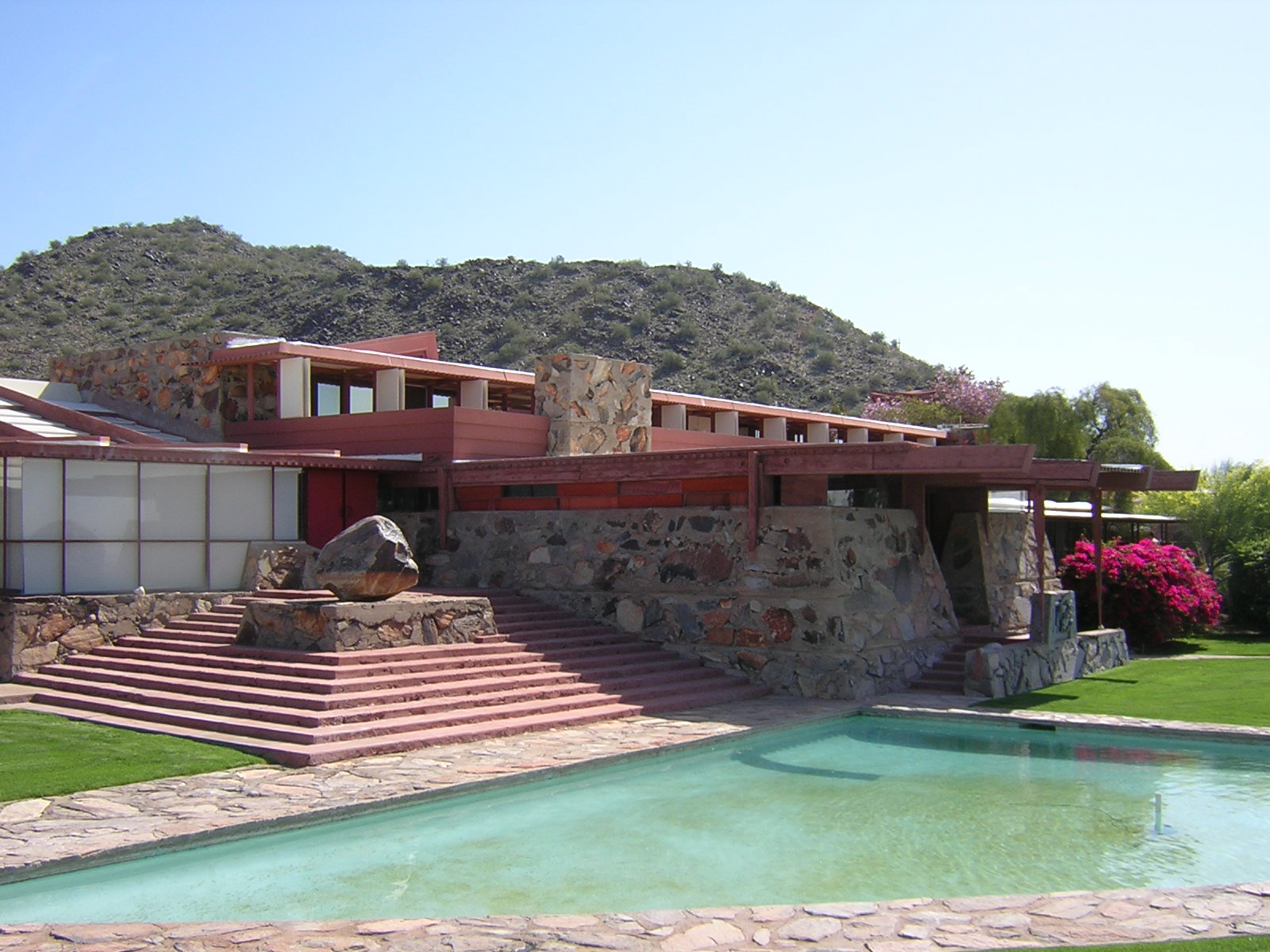
Second: that imperial but still low-to-the-ground Wright style contrasts to the giant stadium superstructure on the right. The oversized ‘upper deck’ looks like it was taken from either the original Wrigley Field in Chicago, or its much more avant-garde namesake, Wrigley Field Los Angeles:
Wrigley Field Los Angeles, around 1930. Most of the baseball scenes in most of the black and white films and tv series up to about 1962 were filmed there, and the Angels spent their first season there before becoming temporary tenants at Dodger Stadium.
Third: Add in the light towers – also unnecessarily tall – plus the steepness of the entire structure that feels almost like Boston Garden and you get this extraordinary impression of grandeur.
I have a question for you about the size of the park. Take a look at another picture: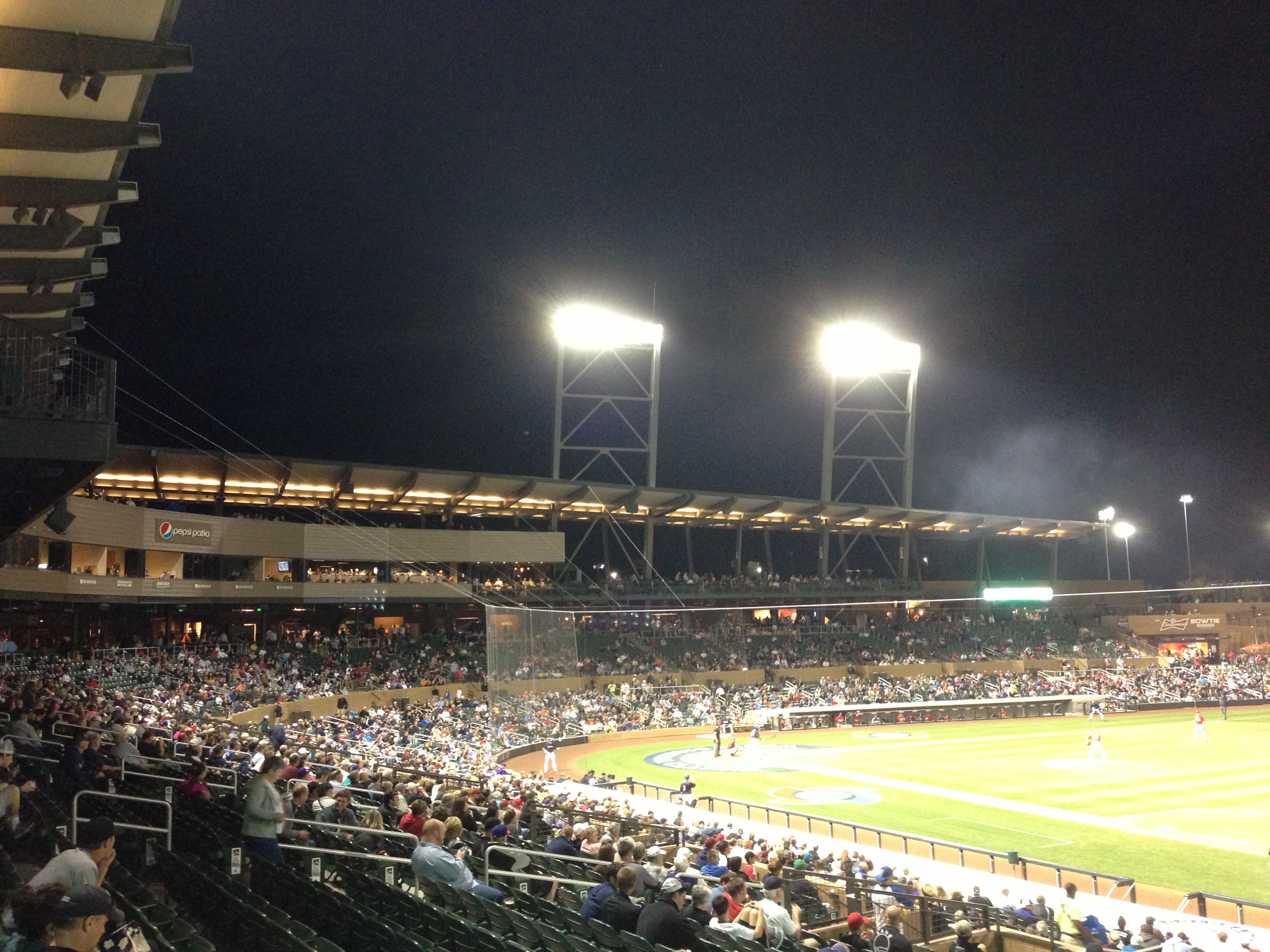
Here’s the question: How many seats do you think this place has?
The correct answer is 7,000. It’s about the same size as every other spring training ballpark but it looks twice as big. It’s imposing and impressive and lends a quality of drama to a Rockies-Royals exhibition game when it’s rainy and 42 degrees.
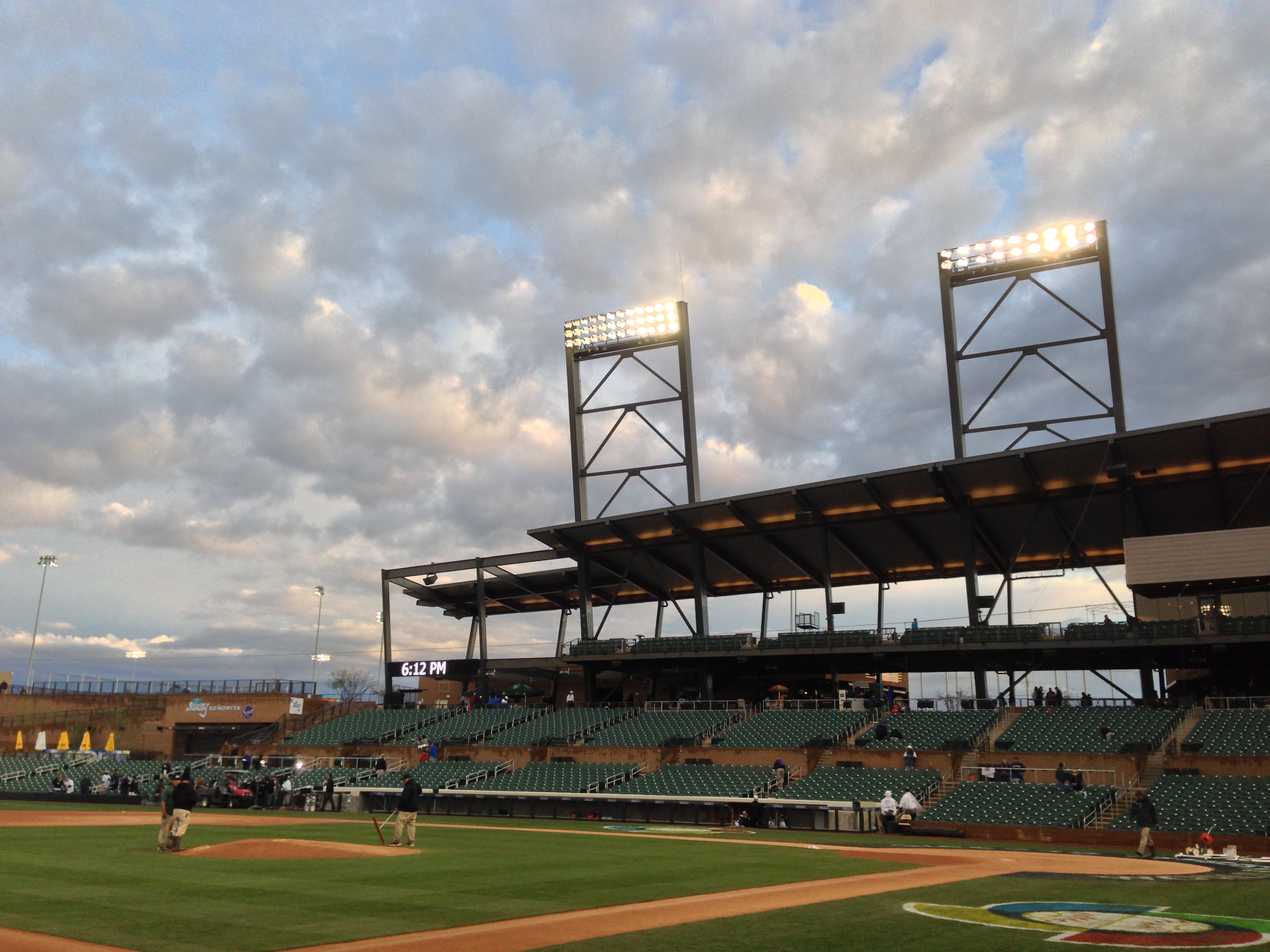
 There is a flaw. The press box isn’t quite right. It’s not the Pepsi sign right behind the plate. That bothers you at first but then you realize it’s just about the only annoying signage in the place.
One more image: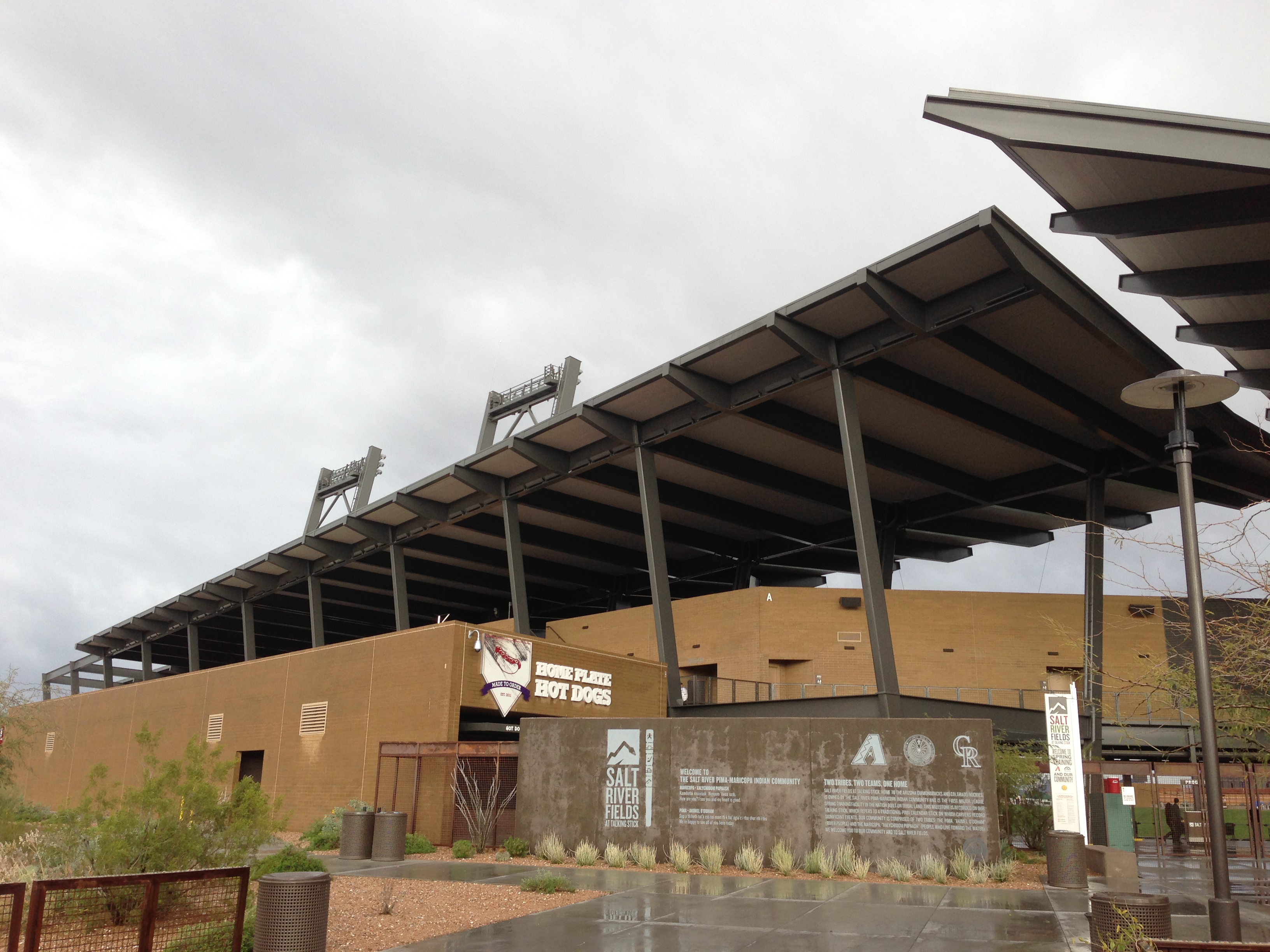 That’s the exterior of the third base side.
I don’t know what else I can say, except that if somebody gave me a team tomorrow – majors or minors – and the money to build it a new ballpark, I’d order one of these, to seat about 45,000.
A separate note: starting tomorrow I’ll begin the annual divisional previews, opening with the NL East.
What I Saw In Arizona. Part Two: Photo Album
I have a few more things gleaned among the cacti to report (besides the fact that Billy Hamilton is the fastest ballplayer I’ve ever seen, and seems to be going faster than freeway traffic).
But first, the photo album from a week in the incredibly convenient Cactus League:
 No, this is not the world’s oldest, saddest boy band. Nor, despite the angles, are Manager Terry Francona of the Indians and President Theo Epstein of the Cubs actually resting their heads on my shoulder (they’d join me in saying ‘thank goodness’). I was privy to witness the reunion of the Men Who Made The Red Sox Great at HoHoKam Park, two weeks ago tomorrow. They’re both among my baseball friends and typically we spent almost no time talking baseball. Also got to see Billy Williams, Dale Sveum, and Brad Mills that day, too (“Nice to see you back with a Major League Team,” I said to Millsy. He smiled and was respectful enough to say nothing, but he looked 10 years younger – as did Tito).

This is not Jackson Browne, though I’ve seen them both in the last 18 months and if the gentleman spotted at Peoria during a Brewers-Mariners game dyed his hair, they’d look like brothers.
That’s Ted Simmons, now an advisor in the Seattle front office, and simply put one of the smartest men in the sport. When Pirates fans harken back to the last winning Pittsburgh team they invoke the names of Jim Leyland and Barry Bonds (and occasionally even Stan Belinda), they don’t mention the last winning GM: Ted Simmons. He was just getting into the rebuilding of the post-Bonds Pirates when he suffered a heart attack during the 1993 season and retired. He’s been a coach and executive since – and that was after his 46.5 WAR (greater than Hall of Famers with careers of similar length like Nellie Fox, Kiki Cuyler, Orlando Cepeda, Ernie Lombardi, and the just-elected Deacon White). Narrow that down to catchers (Bill Dickey 52.5, Gabby Hartnett 50.7, Simmons 46.5, White 44, Lombardi 43.6 – and you occasionally hear Jorge Posada’s name mentioned at 39) and it’s obvious that “Simba” is a Hall of Famer. Despite a career line of .285/.348/.437 and seven .300 seasons, his work was overshadowed by being Johnny Bench’s exact contemporary for 15 years, and then spending nearly all of his last five at DH or 1B.
 Here’s another should-be Hall-of-Famer.
Dale Murphy returned to the game last season in the Braves’ tv booth, and returned to uniform this spring as the first base coach for the USA team in the WBC. One of the older arguments for the Hall was the “wozzy” test – “was he considered for any length of a time one of the top five players in the game?” After two MVPs and a decade as one of the most feared hitters/least feared people in the game, Murph kinda flatlined starting with his 13th season in the majors. But again, WAR puts him in historical context. Lou Brock’s a 42.8, Jim Rice a 44.3, Chuck Klein a 41.5. Murphy: 42.6 – and in this time when one element in the Cooperstown ballot has suddenly taken on added importance (“character”), his was and is impeccable – and generous.
 Here’s another one of my favorite baseball people. This one unexpectedly showed up with the visiting Royals on a frigid night at the Rockies’ facility, Salt River Fields.
When I tweeted this photo I believe I said that I first interviewed George Brett in 1980. In fact, that was when we were first “introduced.” I actually interviewed him in 1976, 1977, and 1978 during the A.L. Playoffs – the “nice to meet yous” came during the 1980 World Series during a memorable and scatological interview about the hemorrhoids that plagued him during the post-season. This might have been the same day I met a mid-level Royals’ executive named Rush Limbaugh (how would you ever forget a name like that). He and Brett remain best friends, and George and I laughed our way through 15 minutes in the KC dugout, which no matter how you diagram it means baseball trumps politics every time. George remembered that ’80 interview of course, but also (to my surprise) recalled that I got to interview him – for Fox – after his election to Cooperstown in ’99.
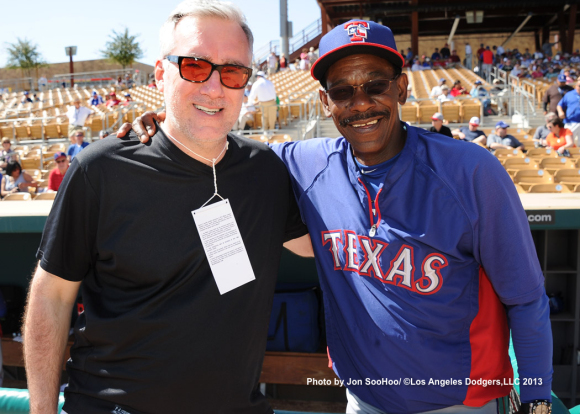
This, of course, is Wash.
All the other guys on the photo tour are Hall of Famers, or should be, or might very will be (Terry Francona needs one more measurable success in his managerial career to cinch a spot – and he’s only 54 – while if Theo Epstein also turns the Cubs around, he’s a lock).
The first person to tell you he’s not getting to Cooperstown – surely not as a player – is the ever-affable skipper of the Rangers, Ron (.261/.292/.368, ten years, one as a starting player) Washington. But few figures in the sport are greeted with greater affection, by his players and rivals alike. Just to amp this shot up a little bit, check out the copyright. That’s Jon SooHoo, who I’ve known ever since I was a local sportscaster in LA and who has shot 30 years of incredible images on behalf of the Dodgers.
There were many other men I’m proud to call friends who I didn’t trouble for photos: Vin Scully, Bob Uecker, Bruce Bochy, Bob Melvin – the average was about three a day, and it emphasized that while we get swamped by scandal and controversy and stats and new-age stats and boasting and showboating, the game is about good people whom you get to know and cheer for, for a very long time.
But occasionally, even in middle age, you make new acquaintances. While I summarize my thoughts for a future post, take a look at this, which might be – pound-for-pound – the best baseball stadium built in this country at least since 1962:
What I Saw In Arizona. Part One: Billy Hamilton
I have never seen a faster baseball player than Billy Hamilton.
This is not a statement constructed out of great insight. But it is one that requires attendance, and it mainlines into a conversation I had with the former National League outfielder and coach Gary Varsho the day after Hamilton led me to my conclusion.
Varsho, now an Advance Scout with the Angels, was noting – more in sadness than in anger – the diminution of the Advance Scout in this age of video and digital file-sharing and 24/7 television. He noted that nearly everything of value he can tell his employers about the team they will next face is the stuff they don’t show in the broadcasts, or cut out of the videos. Or worse: it’s stuff they can’t show. Varsho cited the example of a prominent MLB catcher who falls into ruts of repetitive pitch-calling. You have to experience it, complete with the trips to the mound, the foul balls, the repetitiveness, that three days of in-person baseball drags you through. The guy just won’t follow a curveball with two consecutive fastballs. Just won’t.
And this is where Hamilton comes in. I’ve seen the television coverage and the videos (though you have to admit, slo-mo might depict a beautiful running form, but you can’t tell if the guy has the speed of Billy Hamilton or George Hamilton). But the context of being there is the magic wand.
The Angels’ facility at Diablo Stadium in Tempe is perpendicular to a fast-moving highway just beyond the right field fence. Almost inevitably, your attention occasionally drifts from the field to the ceaseless droning of thousands of cars and trucks all going around 65 for three hours. But when you manage to balance the two you suddenly have an unexpected bonus: you have an idea of how fast the players are running compared not to each other but compared to highway traffic.
I don’t mean it literally of course. But the constant motion is actually an excellent optical framework, and, bluntly, it makes some of the guys I saw that day like Zack Cozart and Mike Trout look kind of slow (I’m not insulting somebody by saying they look slower than a BMW doing 65, am I? Nor saying they look slower than a rookie with the Reds?).
Billy Hamilton did not look slow. He hit a grounder moderately hard toward Mark Trumbo of the Angels at first base, and that’s when it happened. Hamilton took one step out of the batters’ box and he was not merely at his full speed, but he looked competitive with the cars moving side-to-side in the distance. This extraordinary acceleration was also evident to Trumbo. His fear could be smelled in the press box. One bobble and he’s dead, one hesitation and the routine out becomes a close play.
For whatever reason, Trumbo hesitated. He couldn’t accelerate as Hamilton did and wound up frantically shoveling the ball to his pitcher for a 3-1 putout by a step. And Hamilton was running just as fast in that last step as he was in his second one out of the box. He looked like he could survive – at least in the slow lane – with the cars on the freeway.
I have not only never seen anybody faster, but I’ve never seen anything like it.
Last Saturday I would see the Reds’ bench coach – my friend, the former great Giants shortstop – Chris Speier. I asked him if he’d ever seen anybody definitively faster than Hamilton. He could think of no one. “Especially in terms of his acceleration. By the second step,” he began. I interrupted him and told him the freeway story. “Exactly,” he said with a laugh.
Speier warns there are all kinds of rough edges here. Hamilton is clearly not an intuitive shortstop and will doubtless never see anything other than emergency service there again. But his instincts in the outfield are good and developing quickly. Speier is more worried about the deleterious ancillary effects of Hamilton’s speed. “He still thinks he can position the bunt at the very last second, or swing at the very last second.” In other words, Hamilton thinks he handles the bat with the same accelerative ability that his legs provide. He can’t.
But of course we can only see that in person. Which is why we have bench coaches – and why we need more Advance Scouts. And why there are still things in baseball that have to be seen to be believed.
Like Billy Hamilton’s speed.
Jim Thome And Other Friends
SCOTTSDALE, ARIZONA – He has checked out and gone home so the statute of respect towards fellow hotel guests has expired, I guess.
I arrive at my hotel here the other night and the place is spread out enough that they recommend that you let them throw on to a golf cart for transport to your room, not just your bags – but you. And we go about 20 yards in the darkness when a big, broad guy with short hair sort of steps in front of the cart and the bellman/driver says “excuse me” and the fellow turns around and sort of stares for a moment before saying “Oh! I’m sorry. I kinda froze there for a moment,” and with a genuine laugh, hops out of the way. And he looks really familiar and while I’m staring at him I realize he’s staring at me and our light bulbs go off simultaneously and as I say “stop the cart for a second,” he smiles.
Jim Thome.
“This is where I’m staying while I’m unsigned,” he says with another patented Jim Lunchpail Thome laugh. I say back to him “this is where I’m staying while I’m unsigned,” and we trade career anecdotes and I ask about the Yankees and he says “I doubt it.” And we try to figure out if we first met in 1993 or 1994 and he says he’s working out but otherwise he’s pretty much by the pool each day and I should try to find him when I get back from the ballpark each afternoon. And I joke about how I nearly made his latest free agency academic by running him over with a golf cart and we say good night.
And Thome, who is easily the most universally respected player in the game, is still unsigned despite Twins rumors and Yankees rumors and the reality that somebody should sign him with an idea of convincing him to manage them in a year’s time because the other players think he’s pretty much the epitome of professionalism and knowledge. I think he knows he can’t play in the field any more but that would still let him fit in at Yankee Stadium because lord knows almost none of them can field any more either.
Thome was how my Cactus League jaunt began but the amount of additional quality human beings whom I’ve known forever that I’ve again been able to spend time with exceeds all my previous spring training trips. In the Angels’ camp it was Mike Scioscia (28 years) and executive Tim Mead (28 more), and from their opponents the Reds, writer Hal McCoy (about 10). At the Mariners’ facility it was consultant – and should-be Hall of Famer Ted Simmons (33 years), and manager Eric Wedge (20 years) and our traditional greeting of “Happy Birthday” (we share one; he’s much younger), and the announcers Dave Sims (32 years; we both worked for Charley Steiner in the 1981-82 timeframe) and Rick Rizzs (12). Rick was nice enough to ask me to come on his broadcast for an inning. Then I found out it was after Bob Uecker of the Brewers (36 years) was going to come on for an inning and as I said to Rick on the air: “I thought you liked me.”
At Wednesday night’s Team USA exhibition I got to visit with manager Joe Torre (32 years) and first base coach – and another guy who is a no-brainer Cooperstown pick – Dale Murphy (30). And today in Glendale it was the Texas staff: manager Ron Washington (10), coach Dave Magadan (11) and coach Dave Anderson (30 years ago this month I interviewed him at Vero Beach when we thought he might be the next Dodger rookie-of-the-year – “boy were you wrong,” he said, again). Upstairs I had a great chat with Rick Monday, who I’ve known for 33 years as everything from a player to a World Series star to a rival sportscaster when he was on Channel 11 every night in LA at exactly the same time I was on Channel 5.
To top it off, of course, was my annual visit with Vin Scully. I readily admit that it took me nearly three years to screw up the courage to introduce myself to him – and I was on local tv in LA during all that time – and when I finally did he said he was relieved, because he thought I’d done something to offend him. I’m sure Vin is not the saint we all portray him as, but that’s really just a hunch because nothing I’ve ever seen him do suggests otherwise. The self-deprecation never ends; even today his first words after hello were “thank you.” I said you’re welcome and then asked him what I’d done. He said “thank you for writing that excellent and kind blog about the Piazza interview.”
Ohhh, yeah. That was nearly a month ago and that was what he wanted to talk about. We batted back and forth the singular personality that is Mike Piazza, but mostly he was talking about friendship and support, and I mentioned that this was the kind of loyalty his kindness and patience engendered, and that I knew I spoke for many when I said I felt like it was our job to fire the arrows when he was attacked – especially when it was as unjustified and as inexplicable as it was in poor Piazza’s self-destructive book. And then there were the usual friendship questions that I invariably suddenly realize are being asked and answered by the Babe Ruth or William Shakespeare of his field and I remember why it took me three years to stop shaking long enough to say hello back in 1988.
So I know Vin for 25 years now – and remember that this represents only about 40 percent of the time he’s been bringing you Dahhh-ger base-ball. And if you wonder how much of a self-starter you can be as you begin your 64th year at one job, Vin and I visited for maybe ten or fifteen minutes and then he had to pre-record something for his broadcast and when I looked back in his booth after that he had begun his daily ritual of scribbling and reviewing notes for the game ahead. The exhibition game. The exhibition game on a drowsy Thursday afternoon. The exhibition game three weeks before the season begins. And he would continue to do so for at least an hour.
Talk about a role model.
Later in the week here I’m going to formalize what shallow insights I’ve been able to glean from the games I’ve seen (hint: Billy Hamilton) but for now I’m thinking of everybody that Spring Training provides me the opportunity to see again, from Thome to Scully.
That’s fifteen men who I’ve known for a total of 390 years. And every moment of that time, with every one of them, has been a privilege.
It’s been a pretty good trip, huh?
Is Spring Training In Florida Doomed? (Revised)
TEMPE, AZ – Say you’re a Mets fan.
It’s ok – even in the hypothetical, you only have to remain such through dusk next Monday.
You’ve cobbled together a five-day weekend starting this Thursday and you are determined to spend it with your beloveds in Spring Training. Do you like the way this relaxing trip sounds? A two hour and fifteen minute crack-of-dawn flight to Orlando and then the drive down to St. Lucie (or to Ft. Lauderdale and then the drive up to St. Lucie) in hopes of making first pitch of the home game against the Marlins on Thursday, then to a hotel somewhere, then the 100-mile drive to Lakeland for the Friday matinee against the Tigers, then either a new hotel or another 100 miles back to St. Lucie for the Saturday home game against the Astros, followed by the blink-of-an-eye 40-minute jaunt to Jupiter for the Sunday with the Cardinals, and then another 100 miles to Lakeland to see the Tigers again there, where it starts raining in the 4th, by which time you’d already seen all of the Tigers you wanted to see anyway and the Mets are now off on Tuesday and even if you stayed in Lakeland for a sixth day the nearest game is nearly an hour away in Orlando?
You like this?
Any chance you would prefer the four-hour flight to Phoenix where your hypothetical Mets have joined the 15 other teams in a Cactus League in which the longest ballpark-to-ballpark trip is an 80-minute drive? Where if even if your team was on the road for the entirety of your trip, you could easily find decent enough accommodations in almost guaranteed rain-free environment so that your total time in the car for the five days combined is less than just one of those 200-mile roundtrips to Lakeland? Where if you’d suddenly seen enough of the Mets – or if they simply took a day off – there would still be as many as six other games to choose from, all of them around the metaphorical corner?
These three guys have now each relocated to Arizona for Spring Training. Taken Monday in Mesa: Mgr. Francona of Cleveland; a pasty white guy; President Epstein of Chicago Nat’l.
In Arizona, it’s a struggle to remember which highway you’re supposed to take for each of the 28-minute drives to the ten different parks. In Florida, it’s a struggle to drive to almost any of them in time for first pitch.
The other day, Florida Governor Rick Scott reportedly asked for five million dollars to spend on preserving his state’s increasingly fragile Spring Training ecosystem. Unless he finds a way to move his cities closer together (or at least the teams they host), he might as well ask for fifty million – it won’t make much difference. With their new mini-Fenway beginning its second year of use, the Red Sox are seemingly ensconced in Ft. Myers until further notice, but the second newest park in the Grapefruit League is the Phils’ successor to Jack Russell Stadium in Clearwater – and it’s now a decade old. The Pirates play in a lovely, historic, old school park in Bradenton – that moves a little in the wind. There’s surely nothing wrong with Steinbrenner Field in Tampa, but compare it to any of Arizona’s new facilities – especially the palace the Dodgers and White Sox share at Glendale – and it looks a little shopworn and inconvenient.
Arizona, for decades the ugly sister in the Spring Training family, married well. When the Cubs jilted HoHoKam Park in Mesa for yet another new facility down the road scheduled to open next year, Oakland jumped at the chance to upgrade from Phoenix Municipal, into which they had slid when the Giants upgraded to Scottsdale. As of today the A’s are happy to be lame ducks for 2014 while HoHoKam is remodeled (with some seats removed) and then commit to at least 20 and as many as 30 years in the place the Cubs no longer want.
Arizona has one notable drawback. Excepting the Arizona Fall League, the Spring Training facilities are of almost no use here after April 1 (unless there are large groups of people you don’t like who you’d like to torture by forcing them to sit outside in three-digit temperatures). There is no equivalent to the Florida State League. There is no particular mandate for this, of course. You certainly could start one. Arizona used to field Phoenix and Tucson teams in the PCL without taking any more dramatic health steps than installing misting devices at the Phoenix games.
It would seem Florida is hanging on mostly by dint of tradition. After a quarter century of meanderings
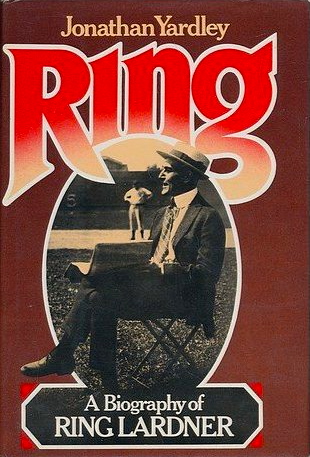
My favorite Spring Training photo, from Jonathan Yardley’s great bio of the legendary writer Ring Lardner, at Cubs’ camp, probably in Pasadena or Catalina, CA in the 1917-25 era
through places like New Orleans and Atlanta and resorts in Texas and Hot Springs, Arkansas, most of the major league teams were settling into the Sunshine state just as real estate boomed in the ’20s. But there was always a “western” component, and in fact only nine of the 30 big league clubs have never held camp in Arizona (or at least California in the pre-Dodgers/Giants days).
Not counting World War II, when travel restrictions saw the Dodgers training at Bear Mountain in New York and the Reds in Bloomington, Indiana, the Chicago Cubs haven’t trained east of Mesa since 1916 (for the record, that was in Tampa, and the Cubs spent part of WW2 in pre-Larry Bird French Lick). There are six clubs – most of whom would surprise you – that went back to Florida after the experience. The Cardinals tried California in the ’20s and the Pirates were in San Bernardino, California, as late as 1952. The Astros began life as the Colt .45s in picturesque Apache Junction, AZ, in ’62 and ’63, and the Orioles held four of their first five camps in Arizona. The Red Sox were in Scottsdale from 1959 through 1965 and – as part of a stunt in which they swapped camp sites with the Giants for one season – in 1951, the Yankees trained in Phoenix.
Unless you’re a Northeasterner driving to the Tampa area to see the Yanks, Phils, Sox, or Jays, there is no longer any real advantage to having your team play its exhibitions in Florida rather than Arizona. However, more reasonable and realistic concerns exist for the fans who are left behind. The Reds-Cubs exhibition at HoHoKam on the 26th won’t be on radio in Cincinnati until 10 PM that night. On the other hand, it’s doubtful any young Yankee or Red Sox fans are catching those 1 PM weekday exhibitions from Dunedin. More over, instinct suggests that a kid with a tepid interest in baseball who fights his way home from school on a snowy March afternoon to find himself able to watch an entire exhibition game from the glorious glare of Arizona starting at 4 PM Eastern might become a fan for life, and maybe a future Spring Training voyageur.
Don’t get me wrong. I went to my first Spring Training 41 years ago in Ft. Lauderdale and it still grieves me that the Yankees don’t play there any more. I love McKechnie Field in Bradenton, and I brooded when the Dodgers abandoned Vero Beach for ‘Zona and left the footprints of Campy and Jackie and all the rest to be rediscovered by future baseball archaeologists. But since 2006 I’ve tried to do the day game/night game doubleheader thing at least once each spring in Florida and only about half the time did I make first pitch of the nightcap. Here I’ll have enough time between each game for an actual dinner.
Besides which tradition isn’t always as big a deal as us traditionalists make it out to be. The Texas Spring Training circuit was viable if not vibrant for nearly twenty years ending about 1941, with the Braves, Cardinals, and Tigers all taking turns as the home team in San Antonio. I mean, I don’t see anybody mourning the fact that the Phillies moved out of New Braunfels in April, 1939. They were heading for Florida because it just made more sense there. Just as it makes more sense for them (or more realistically the Pirates, Cardinals, Astros, and Twins) to head out here now.
The “Crushing” 1998 Vin Scully/Mike Piazza Interview Isn’t That Crushing
Mike Piazza has written a new book in which he claims that Dodgers fans turned against him during his ill-fated contract negotiations in 1998 because Vin Scully asked him about it during a Spring Training interview.
“He wasn’t happy about it. And Scully’s voice carried a great deal of authority in Los Angeles…The way the whole contract drama looked to them (the fans) — many of whom were taking their cue from Scully — was that, by setting a deadline and insisting on so much money, I was demonstrating a conspicuous lack of loyalty to the ball club. I understood that.”
As he started the season poorly at the plate, “Vin Scully was crushing me,” Piazza concluded.
The ‘crushing’ 1998 Scully interview on my alma mater KTLA is available online. Watching it, it can only be hoped that Mike hasn’t seen it, and had it (mis)interpreted for him by someone who has since been treated for paranoia or at least crippling – maybe the right word is crushing – tone deafness.

(C) KTLA
“We’re visiting with Mike Piazza, and I’m sure neither one of us would like to talk about it, and yet the millions of people out there watching are interested in it, it is a big story, so consequently we have to address it. And that is, you’re down here, playing out the last year of your contract, coming up hopefully for you will be a multi-year multi-million dollar contract. Is that on your mind?”
Crushing.
Piazza answered generically about trying not to think about it and being blessed with a great family and agent. Twice he said he hoped “it’d just take care of itself.” He went to nearly every cliche except ‘Employees Must Wash Hands.’
Then Scully went for the kill:
“Well to be honest, you know, the outsiders, myself and all the other fans, we pick up a newspaper: ‘Piazza issues an ultimatum,’ and you say ‘whoa! What is that all about?”
While branding himself just a fan, Scully has actually done something that a fair reporter does (and so it is rarely seen or heard or done). He offers Piazza the opportunity to say that the characterization as an “ultimatum” of the timeline he set for the Dodgers to sign him to a new deal – a very fair thing for Piazza to do with free agency seven months away – was inappropriate or incorrect.
Piazza will have none of it. He doesn’t criticize the reporting, he doesn’t criticize the Dodgers. He gives it the old c’est-la-vie: “We basically just made clear our intentions that for me, I mean, I made all along that I would love to work things out with the Dodgers. We didn’t mean it to be threatening, we didn’t mean it to – unfortunately it comes out that way sometimes – but again, I stated I would love to be a Dodger for my whole career and I hope we can work things out and again that remains to be seen. If for some reason I happen to be a free agent at the end of this year I hope the Dodgers are the number one team that’s interested. So, again those things, unfortunately sometimes get a little bit misconstrued in the paper and they come out maybe a little bit aggressive but for me again, I try to be very professional about it and realize my job is on the field and my representative, what he does is his job, so I have to trust him on a lot of things.”
Scully, Question Three:
“Sure. Well ultimatum is a heavy word. That’s the kind of the thing, ‘if you don’t do this, we bomb you.'”
Here that stinker Scully goes again, giving Piazza a chance to say it’s not an ultimatum, that he doesn’t want the thing to drag through the season and potentially ruin 1998 for him, or the Dodgers, or the franchise for the next decade (or, as it proved, all of the above).
But instead of taking this second opportunity to paint himself in a good light, Piazza again tries to have it both ways. Instead of saying ‘it’s not an ultimatum,’ or ‘I don’t think of it as an ultimatum,’ or ‘the Dodgers have unfairly leaked this to make me look bad,’ or even ‘Vin, you’re being unfair to me,’ he again tacitly accepts the term: “Well, again, that wasn’t the intention at all, we just wanted to make clear that for me, again, I basically came up through this organization and my intentions are to work things out and it remains to be seen. But again, as far as I’m concerned, it’s done, it’s over with, I’m here to play baseball, I’m signed to play through this year and I’m going to go out there and give 110% as far as not short-changing myself, the fans, or the organization. And everything else, again, remains to be seen.”
Ah, but that’s when Scully absolutely destroys Piazza.
“Absolutely. And well said.”
At this point Scully literally turns the interview to the question of Piazza’s knees, and then how many stolen bases Piazza had in 1997, and the next we hear of this almost milquetoast chat, it’s fifteen years later and this – not Piazza’s intransigence in negotiations nor the lunkheadedness of the Dodgers’ then-new owner Rupert Murdoch – this Scully interview is what induced Armageddon at Chavez Ravine.
Scully was understandably mystified. “As God is my judge, I don’t get involved in these things,” he told The Los Angeles Times. “I can’t imagine I would ever put my toe in the water as far as a player and his negotiations.
What Piazza was trying to do in the interview, of course, is exactly what he has so belatedly and unfairly accused Scully of so many years later. He was trying to influence Dodger fans. He wanted them to rally to his side. He wanted them to help him pressure the team to give him the money (now a ridiculous-sounding $105 million over seven years – $15,000,000 a season). He didn’t want to issue an ultimatum, but he wanted them to think there was an ultimatum dictated by circumstances and he had done all he could to avoid it and would continue to do so and gee don’t the Dodger Dogs smell good?
Again, one hopes Piazza hadn’t seen the interview and simply had it recounted to him by somebody who didn’t get it. You know: somebody who doesn’t understand English. That Piazza had a totally hit-and-miss record with, and understanding of, the media (if asked in 2000 to identify the most cooperative MLB star and the least cooperative one, my answer each time would’ve been “Mike Piazza”) suggests otherwise.
The sadness here is that until the release of his new book, Piazza’s exit from Los Angeles had been seen as one of the sharpest downhill turning points in the years between Kirk Gibson’s homer and the day the franchise was wrested away from Frank McCourt. If Dodgers fans did have it in for Piazza – because of Scully or their frustration or the shape of his mustache – they quickly turned. For nearly all of the last fifteen years he had been viewed as the victim in the equation, and his departure as an unnecessary and uncorrectable mistake.
Until, that is, he went and blamed Vin Scully, of all people, and forever made it look like Rupert Murdoch was the good guy in all this.
Why The $92,000 Baseball Card Isn’t Really A Baseball Card
I have been inundated on twitter and even by email for weeks with questions (specifically “did you buy it?”) about a 19th Century baseball photograph that sold at auction yesterday in Maine for $92,000.
No, I didn’t. It’s not really a baseball card.
Before I explain that seemingly odd statement – I mean, it’s a picture of what was then a major league baseball team, it’s on cardboard, and the French term for what it is includes that country’s word for ‘card’ – let me mention that I don’t disrespect anybody who disagrees with my conclusion, and that the idea of which items from the pre-1886 era are cards and which aren’t is very fluid and very open to interpretation.
So that having been said: this ain’t a card:
 It is a great image of the 1865 Brooklyn Atlantics, who were then competing in the very loosely organized and intermittently professional National Association of Base Ball Players, which preceded the first semi-organized professional league, the National Association (1871), and the first truly recognizable modern league, the National League (1876).
This is the only second copy of this, er – thing – known to have survived, and the other is in the Library of Congress. That its ‘cardness’ is open to debate is evident even from the quotes provided to the Associated Press by the auctioneer of the thing, David Thibodeau, who said…
“It’s more of a piece of photography than a baseball card, but it’s considered by many to be the first baseball card just by the fact that it was distributed by the team. It kind of set the stage for baseball cards after that.”
But Mr. Thibodeau also said…
“The key piece of this is not only that it’s a baseball card, but that it’s a wonderful piece of Americana.”
I can understand his confusion. I have friends who, like me, are specialists in 19th Century cards who think this is clearly a card, and others who don’t. Obviously I fall into the second category, as does one of the foremost experts in the field who told me last month he certainly would like to have it, but not if it was going to cost very much.
I’ll get to the cost in a moment, but first, the what-is-it part.
In the middle of the 19th Century, if you visited somebody – especially if you went to their home and they were out – you were expected to leave your “calling card.” These were ornate ancestors of the modern business card and while they could be art-like, they were as limited as the business card is today. Then came a big change.
Photographs were cumbersome things to make and distribute until 1854, when French photographer Andre Disderi developed a method to take eight of them on a single plate. Whereas previously if you wanted eight pictures of yourself, you had to pose for eight separate shots and have them developed eight separate times, with Disderi’s system you still had to pose eight times, but they could all be developed and printed simultaneously. Later improvements allowed for those eight poses to be reproduced again and again, cutting the cost and cumbersomeness of production even further.
Soon, the cost of a photographic card of yourself was not much more than the expense of an ordinary calling card. Thus, the French version of the card – the carte de visite – was adorned with an image. If you had any money, you had stacks of picture cards of yourself to hand out on all occasions. Photography studios soon began to clean up not just by custom-producing cards for individuals, but by creating and selling poses of celebrities. The tipping point in France was the Disderi cartes of Emperor Napoleon III, which he began to sell in 1859.
So by the 1860’s – and certainly long before the 1865 Brooklyn Atlantics posed for the photograph that sold for $92,000 on Wednesday – there were cartes de visite that were used like today’s business cards, and others that were collectibles. There are cartes de visite (CDVs) of everybody from the heroes of the Civil War to John Wilkes Booth…to baseball players (I’ll correct myself to the spelling of the day: base ball players).
The nit-picking part here is that the definition of a “baseball card” has always been a card or similar item depicting a player or team that was designed to help sell another product. As late as 1980 there just weren’t many cards made just for the sake of making them. They were means of advertising, they were the stiffeners in the packs of cigarettes, they were sold with slabs of taffy, they were found in boxes of cornflakes, they doubled as tickets, and most recently they were used to raise one particular manufacturer’s bubble gum above all others. There was also always a sense that there had to be at least a couple of different cards, of similar design, sold by or on behalf of one manufacturer and constituting a “set” for a photographic baseball image to be a real “card.”
If these two criteria – multiple cards, advertising intent – were not used and met, it literally meant that anything anybody ever made showing a baseball scene was a baseball card. That would be mean every photograph was a card, and every newspaper engraving, and in theory every drawing done by every kid since the first ball player was mistake for a hero.
So, the 1865 Atlantics carte de visite, while a great item, doesn’t meet the standard definition of a baseball card.
Even if it did it would be far from the earliest known card. There were six different photographic cards issued in 1863 that simultaneously:
A) advertised a tournament featuring the Brooklyn Excelsiors playing the famed New York Knickerbockers in the “Grand Match At Hoboken” along with two cricket competitions;
B) served as admission tickets to the matches; and
C) cost extra because the photographs were designed to be saved as souvenirs.
Those are baseball cards. The records of how many were sold even survives: 150 of future Hall of Famer Harry Wright, 57 of a player named Crossley, 47 of another named Hammond, and 11 of Harry’s father Sam. A fifth card later surfaced showing the Wrights together, and two different poses of Crossley are known.
Cards-as-tickets haven’t been repeated too often in the 150 years since (the White Sox did it in the early ’60s). So if you want something more recognizable, you move to the Peck & Snyder cards, issued over three years to advertise Peck & Snyder Sporting Goods stores (and available for other such enterprises to print their ads on, as well). The “set” begins with the 1868 Brooklyn Atlantics, continues with the first overtly all-professional team, the 1869 Cincinnati Red Stockings, and moves on to the 1870 Troy Haymakers and Chicago White Stockings.
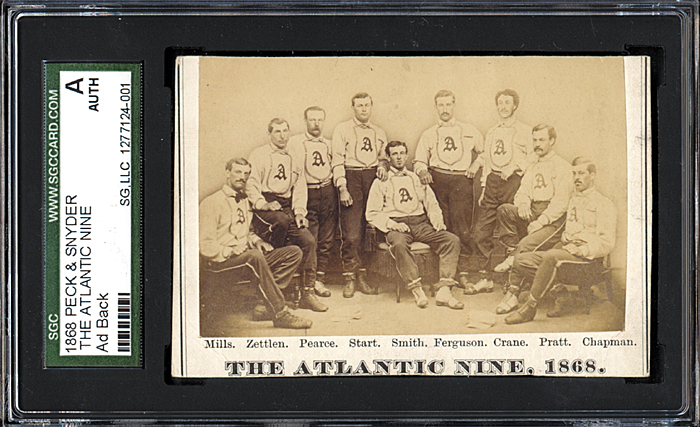
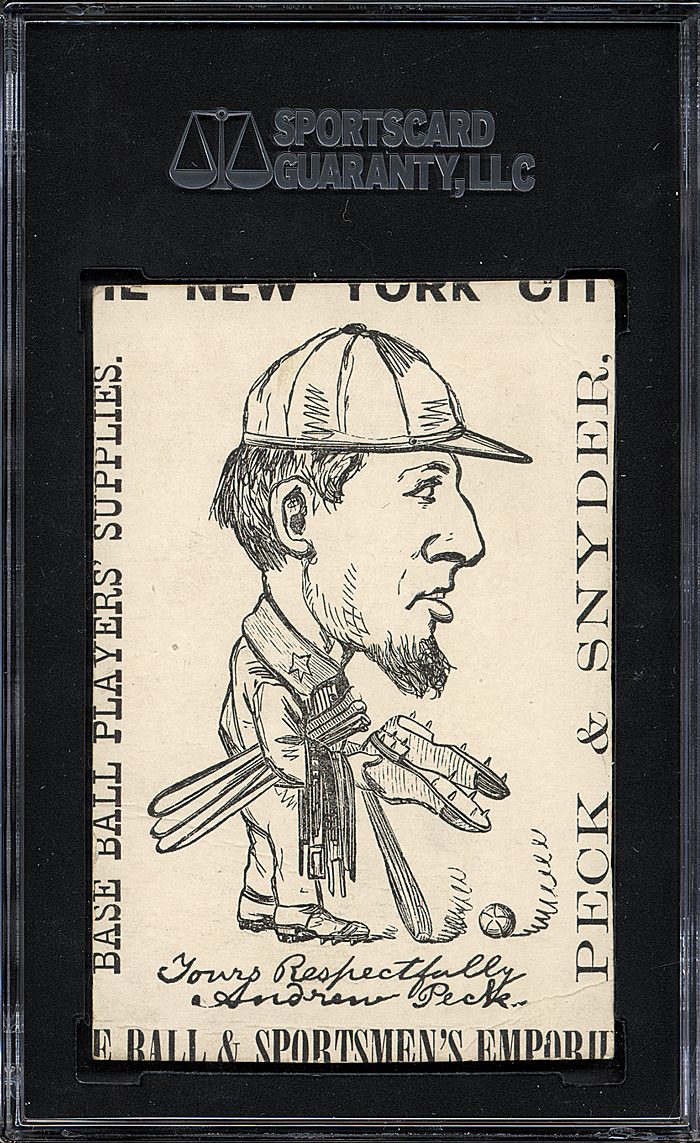 That’s the 1868 Peck & Snyder Brooklyn card, front and back. See that guy “Pearce”? He was essentially baseball’s first shortstop, and he should be in the Hall of Fame. He and first baseman Joe Start – and a couple of the other guys – are also in the 1865 Brooklyn picture about which we’re talking here.
Interestingly, the truly big idea for baseball cards, the seemingly obvious one – make lots of cards of lots of different players – was still nearly 20 years in the future when Mr. Peck let himself be caricatured on the backs of those team cards. 1886 was the breakthrough year, with Goodwin Tobacco (“Old Judge Cigarettes”), the Hall Photography Studio, and an anonymous manufacturer that left room for local cigar stores to stamp their ads on the cards, each made multiple-card sets of players of the New York Giants, and the Charles Gross Company began a marvelous two-year issue featuring the New York Giants and Mets and also both Philadelphia teams, the Athletics and the Phillies. A year later, Goodwin saw the potential bonanza and issued fairly cheap photographic cards of literally hundreds of players in overlapping issues that would see some guys issued on 17 different cards over the 1887-1890 seasons. Goodwin and other tobacco companies also went high-tech with beautiful color lithograph cards of the great players of the time (along with other athletes) later in 1887. The rest, through fits and starts, has been one of the more astonishing industries in American history, still going strong since 1886. Or 1865. Or 1863.
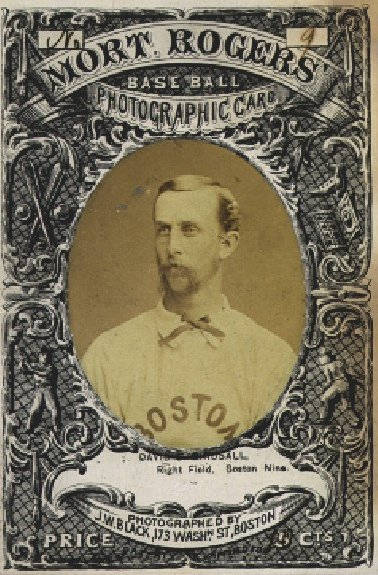
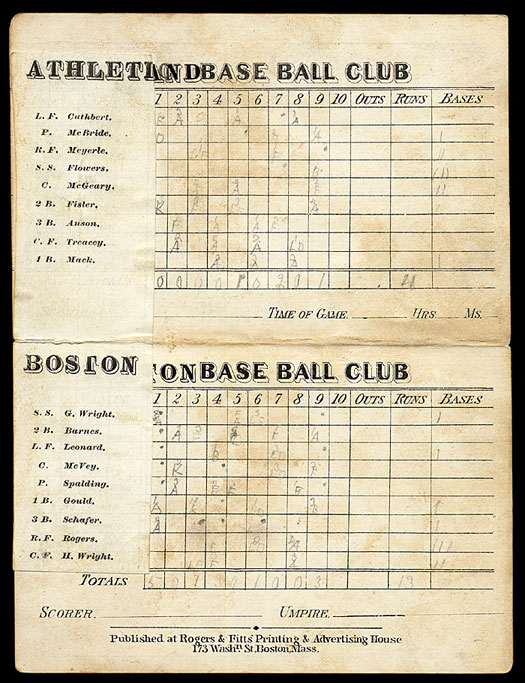
Those who might have thought of making cards of individual players could conceivably have been scared off by the experience of Mort Rogers, a former player who got the idea of selling scorecard/programs at the games of the Boston Red Stockings in 1871. He produced startlingly beautiful folded cards that had photographic portraits of players on the front, an ad on the back, and a scorecard in the middle. He apparently lost his shirt. A similar enterprise was tried almost simultaneously with those Troy, New York Haymakers of 1870 and 1871.
 Finally, a note about the $92,000. That’s a lot of money for anything, let alone a baseball card, but it isn’t extraordinary. At least one card has sold for $70,000 in the last month (one of those 1886 Old Judge New York Giants) and prices in that range are not uncommon for the scarcer cards in the 1886-87 Gross set (“Kalamazoo Bats”) and the 1887-90 Goodwin Old Judge series.
 Baseball Nerd