Category: Uncategorized
Gary Carter, In Memoriam
It was 1988 and I was in my second month as the sports director of the CBS television station in Los Angeles and I was suddenly in desperate trouble.
The Dodgers were hosting the Mets in the National League Championship Series, I was doing the obligatory live sportscast from the field, and our prearranged interview with Orel Hershiser had suddenly blown up, five minutes to air, because manager Tom Lasorda had called a sudden team meeting. Orel was almost red with embarrassment but as I told him then, I wouldn’t have even thought about getting mad at him.
I don’t think Hershiser and I got animated or anything, and frankly I didn’t think anybody had even heard his friendly regrets, nor my friendly acceptance. But apparently Gary Carter of the Mets had been running past us, or something, as we spoke. Because as I turned around to try to figure out which of the Mets we might appeal to out of desperation, he was ten feet away and closing ground fast. He introduced himself – as if I wouldn’t have known who he was – and reminded me we had once done an interview while I was with CNN – as if I’d forgotten it. In point of fact, the first time I ever got paid to write about baseball players, the first time, was writing up the biographies on the backs of a set of baseball cards highlighting the stars of the International League in 1974, including the great catching prospect of the Memphis Blues, Gary Carter. I had known about him, and in a sense covered him, since I was fifteen years old. And Gary Carter was trying to pull my live shot out of the fire. “We’re supposed to be hitting,” he said. “But if Orel had to bail out on you, and you’re stuck for an interview, I can help you out.”
Just like that. Overheard that a guy he barely knew was in a spot, and he managed to shuffle a few things around – an hour before a game that helped decide whether or not his team would go to the World Series.
Because of this odd notion of his thatallof us on the field contributed to baseball’s success – not just the ones wearing the uniforms – some players called Gary Carter “Camera.” The premise was, he always knew where the camera was, and whether or not it was on him. In point of fact, I think his ceaseless cooperation with the media actually wound up hurting him in the Hall of Fame voting, as I think it has hurt Dale Murphy. The writers are afraid that voting in a guy whose geniality towards the media was legendary, but whose credentials could be interpreted as Hall/Not Hall, might look like favoritism.
We even talked about it in a tv interview in 2001. Of course he dismissed the idea. He was frustrated by being passed over for election, but still upbeat and enthusiastic, and he told me that if somehow his cooperation delayed or even prevented getting into Cooperstown, so be it. He wouldn’t have changed his attitude just to get another award, even if that award meant baseball immortality. As it was, Gary Carter had to wait until 2003 to get in to the Hall.
Today, after months of agonizing and dispiriting struggles with brain cancer, Gary Carter, a great catcher and leader and hard-nosed figure on a baseball field, yet simultaneously an aggressively nice man off it, passed away. And I am not ashamed to say it has left me in tears.
The Batter Who Ran To Third
This morning I got a fun tweet from a reader:
Reading @KeithOlbermann’s BBNerd Blog, remembered a dream I had where I was @ a ball game and the batter broke and ran 4 3rd.
That was no dream! It was a past life experience!
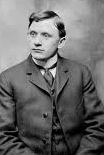
Jim St. Vrain
Baseball historians have never been entirely comfortable with saying with absolute certainty that this happened, but the anecdotal and circumstantial evidence suggests that on April 27, 1902, Chicago pitcher Jimmy St. Vrain – the youngest player in the majors – grounded to Pirates’ immortal shortstop Honus Wagner and as the astonished Wagner threw to first, St. Vrain ran to third.
Davy Jones of the 1902 Cubs told the late historian (and top economist) Larry Ritter the story and Ritter put it in his seminal book The Glory Of Their Times (which you must buy now if you have not already done so):
He was a left-handed pitcher and a right-handed batter. But an absolutely terrible hitter — never even got a loud foul off anybody.
Well, one day we were playing the Pittsburgh Pirates and Jimmy was pitching for us. The first two times he went up to bat that day he looked simply awful. So when he came back after striking out the second time Frank Selee, our manager, said, “Jimmy, you’re a left-handed pitcher, why don’t you turn around and bat from the left side, too? Why not try it?”
Actually, Frank was half-kidding, but Jimmy took him seriously. So the next time he went up he batted left-handed. Turned around and stood on the opposite side of the plate from where he was used to, you know. And darned if he didn’t actually hit the ball. He tapped a slow roller down to Honus Wagner at shortstop and took off as fast as he could go … but instead of running to first base, he headed for third!
Oh, my God! What bedlam! Everybody yelling and screaming at poor Jimmy as he raced to third base, head down, spikes flying, determined to get there ahead of the throw. Later on, Honus told us that as a matter of fact, he almost did throw the ball to third.
“I’m standing there with the ball in my hand,” Honus said, looking at this guy running from home to third, and for an instant there I swear I didn’t know where to throw the damn ball. And when I finally did throw to first, I wasn’t at all sure it was the right thing to do!”
The story sounds great, it has a quote from Wagner, and Jones’s eyewitness account. The only problem is, as noted here, while Jimmy St. Vrain pitched against the Pirates on April 27, but witness Jones didn’t join Chicago until May 13. St. Vrain was only in the bigs for 12 games, so there isn’t a lot of wiggle room. He did start again against the Pirates in Pittsburgh on May 30 before returning to the bushes, but as most historians note, you would think something as bizarre as a batter trying to run the wrong way around the diamond would’ve been mentioned in the usually labyrinthine newspaper articles of the time – but the Jones story is the only contemporary account.
40 Years Of Steve Carlton
It remains, in short, the most amazing season a pitcher has put together since at least Sandy Koufax, and very probably since long before him. And now, Steve Carlton’s 1972 campaign, when he won 27 of his rotten team’s 59 games, dates to 40 years ago.
So much has been written about Lefty’s work that it is amazing to consider that an extraordinarily relevant detail is usually omitted from the recounting – one that makes winning 46 percent of one team’s entire supply of victories all the more remarkable.
Steve Carlton did it in a strike-shortened season.
The first sport-wide in-season strike in American history would in later contexts seem so brief as to be almost quaint. But when Opening Day was pushed back by a week forty years ago, and each team lost between six and nine games, it was traumatic – and it contributed to the distinct possibility that Carlton missed an opportunity to win 30 games.
The Phillies were to open in St. Louis on Friday, April 7 – 43 days after they had obtained Carlton straight-up from the Cardinals for Rick Wise – and were then to return for the home opener and an additional game against Montreal beginning April 10. They should’ve been in Chicago on April 14th, but that was the last of the six games which were wiped out, simply cancelled with no attempt to squeeze in make-ups nor compensate for the havoc of imbalanced schedules that would, among other things, largely decide who won the American League East that year.
One speculates about a small alteration in a large swath of history at one’s peril. Just because the guy got caught stealing does not mean the team would’ve scored two runs when the next batter homered. They could’ve pitched to him differently or they could’ve hit him or the guy standing safely at second at just that moment could’ve invoked a Rapture of some kind. Contemplating Carlton opening up against his erstwhile Cardinal teammates on April 7th instead of against the Cubs on April 15th is rife with hypothetical disaster. He might have hurt himself there, or begun the path to a bad habit, or not faced the right batter he challenged in just the right way to uncover the keys that led to his marvelous season. For all we know, if the players hadn’t struck and the games hadn’t been cancelled, Steve Carlton might’ve lost 27 games for the 1972 Phillies.
But it is deliciously intriguing to note that Carlton won all four of his starts against the Cards in his first season out of their uniform. With Phils’ skippers Frank Lucchesi and Paul Owens adhering pretty rigidly to a four-man rotation, Carlton would’ve pitched in the second home game against the Expos on April 12 – and of course Carlton also won all of his starts (three of them) against Montreal in ’72. But if the original schedule had been observed, that would have pushed his third start from April 15 against the Cubs to April 17 against the Cards, and it probably would have denied him the chance to start the last game before the All Star break. Thus if you buy any of the argument that the strike “cost” Carlton, it probably cost him one start and the most his theoretical full season should’ve netted him was 28 wins instead of the actual 27.
Of course, since we’re down the What-If rabbit hole, the real fun comes when we look at the 14 starts Carlton did not win, in route to 27-10.
The first stunning overarching truth about Carlton’s 1972 season was that he did it almost all by himself. He lasted through 30 Complete Games, and only three of his 27 wins were saved by other relievers. For contrast, when Bobby Welch won 27 for the 1990 A’s, the sport had already changed so much that all but seven of those wins had saves (19 by Dennis Eckersley) and Welch threw just two CG’s – both shutouts. Incredibly, Carlton blew the lead in one of his own non-win starts five times during 1972, and could only blame the tissue-thin Phillies’ bullpen for one other defeat snatched from the jaws of victory. Amazingly, Carlton endured a five-game losing streak beginning May 13th. His own error was the fulcrum in a 3-1 loss to the Dodgers and Claude Osteen at home that night, and the other games in the skein saw Carlton surrender at least three earned runs. The streak ended with a no-decision exactly a month later when Carlton helped cough up his own 5-0 lead to the Reds. Johnny Bench and Julian Javier homered in the 7th, but it was still 5-3 Phillies when Joe Morgan doubled off Carlton to lead the 8th. Reliever Chris Short let the inherited run score, and then Hal McRae touched him for the game-tying homer to start the 9th. The Phils would lose it in the 10th.
There were four occasions when just slightly more offense from the Philadelphia bats might’ve gotten him another win or two. On June 16th in the Astrodome he struck out a dozen and gave up just six hits and four walks in ten innings, but the Phils could do nothing with Don Wilson and Tom Griffin, and Dick Selma lost it in the 11th on a walk-off homer to Jimmy Wynn. On August 21st, Carlton again did marathon work without a win: 11 innings of seven hit, two run ball. He struck out 10 more, but the Phils turned nine hits and a walk off Phil Niekro into just one score, and Carlton’s 15-game winning streak was snapped. At Shea on September 24th, he gave up a lead-off homer to Tommie Agee and then watched John Bateman throw away a squib in the 8th, setting up the game-deciding sacrifice fly by the very non-immortal Lute Barnes in a 2-1 defeat (one of seven career RBI in a cameo career by the Mets’ second baseman).
But the best bet for another Carlton win probably came at Candlestick on July 15th. Carlton struggled through five, and was trailing 4-0 when Joe Lis pinch-hit for him. In the seventh, the winds changed and Phillies scored eleven off the Giants, and Bucky Brandon would vulture the win.
In short, we all knew as it happened that Carlton was creating something none of us had ever seen before. Just how special it was is only becoming clear now, with 40 years to ponder it.
The Heritage Of Alex Gordon
As a follow-up to the 10th annual “Topps Pack Opening Day,” I was studying the 2012 Heritage proof sheet by pals there were nice enough to provide. A familiar face showed up:
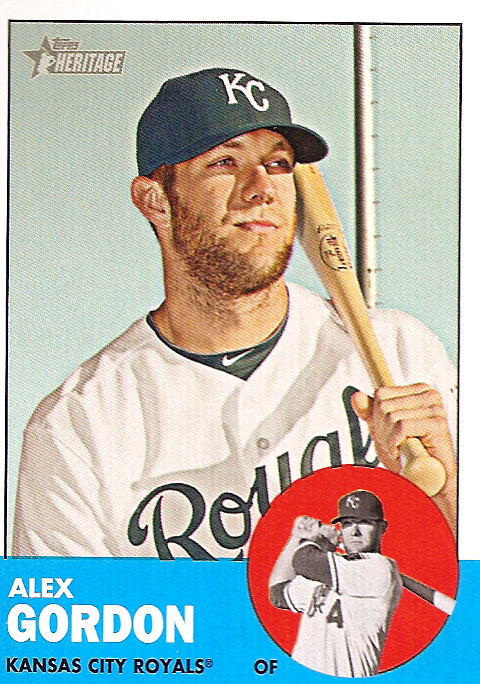 Last year, after a lot of hard work and a willingness to change what he had done all his life, the former collegiate superstar finally lived down his reputation as a man most famous for one of his baseball cards, and is now “just” a top flight hitter on what might quickly become a tremendous offensive machine in Kansas City, and this is “just” what his 2012 Topps Heritage Card #51 is going to look like.

2006 Topps #297 Alex Gordon
Even most non-collectors remember the brouhaha six years ago at this time when cards of Gordon appeared in the 2006 Topps and 2006 Topps Heritage sets – even though the MLB Players Association had recently codified the rules about who could and couldn’t be in big league card sets. It was comparatively simple: if you hadn’t already played a major league game, you couldn’t be included in a major league set. Topps, either accidentally (or many critics say, deliberately) got confused because that one rule meant Gordon – with 0 major league games under his belt – was eligible to be included in one of its brands, Bowman, but not eligible for its two others, Topps and Topps Heritage.
Gordon cards were made for all three sets and the MLBPA screamed bloody murder and just before the sets were released, the cards were supposedly pulled out of the packs of Topps and Heritage. The regular Topps set was released first, and cards of Gordon with a two-inch square hole in the middle started appearing in the packs (a ‘punch’ of some sort being used to destroy the inner portion of the cards while they were still on the uncut sheets, and the sheets were still stacked at the printers’). Not long after, full versions of the card appeared, some of them in packs shipped to PXs at American Military Bases in Germany.
If you think the thing with the Skip Schumaker “Squirrel” card is crazy, it pales in comparison to L’Affaire Gordon. I bought a few of the cards at four-figure prices on eBay, on the premise that this was the first regular Topps card ‘pulled’ from circulation since at least 1958. I was actually accused of being some sort of shill for the thing, because I consult on Topps’ retro issues; in point of fact I learned about the card’s scarcity on ESPN’s website, weeks after it came out. Topps estimated that maybe 50 to 100 of the Gordon cards got out, and maybe an equivalent number of ‘cutout’ cards. In the spring, however, a longtime dealer friend told me he’d been offered a large quantity of them. “I can get you 500 of them if you’ll pay the price.” Needless to say, I didn’t. As of this writing, there’s exactly one of them on eBay, but I’m confident that the number in circulation is closer to 1,000 than it is to 100.

2006 Topps Heritage #255 Alex Gordon cutout card with two "fragments"
Weeks later, Topps Heritage hit the stores and sure enough, the #255 Alex Gordon appeared – but only in cutout form. This frame-like card still shows up at times, although only a few of the fragments from the cutout parts ever hit the hobby.
You can see from the little Frankenstein-like assemblage of parts here that there must’ve been a third “fragment” there bearing Gordon’s face. This was the only time Topps ever actually issued a jigsaw puzzle kind of card (although they experimented with a set of them in the early ’70s – and it bombed). One wonders if somebody opened a pack of 2006 Heritage and found these little pieces of junk without realizing what they were, and tossed them.
In any event, six years and five Alex Gordon Topps Heritage cards later (2008, 2009, 2010, 2011, and 2012), a full uncut version of the #255 2006 Heritage has never turned up. But I think it’s time for me to confess that I have one – sorta. We end as we began, with the fact that Topps indulges my long-standing fascination with their production process by donating the occasional proof sheet or printout to my Unintentional Museum.
So, for awhile now, I’ve had a paper proof version of the uncut 2006 Heritage Gordon. You’ll notice it looks different than the issued card – the proofs had red outlines, a “Rookie Card” logo, and the position designation had not yet been coordinated with the original abbreviations from the 1957 Topps set on which the Heritage cards were based. But, if you’ve ever wanted to see what the ’06 Heritage Gordon was supposed to look like… Ta da:

2006 Topps Heritage #255 Alex Gordon Proof (from the Keith Olbermann Collection. Ok, Obsession)
10th Annual Topps Pack Opening Day
For years, as part of my moonlighting as an unpaid consultant for Topps Baseball Cards, I have engaged in a ritual involving a few company executives and a few (brand new) boxes of that year’s Topps set. The first box to come off the production line is ceremonially opened, either on television or at Topps HQ, and then we quietly pillage through whatever’s available pack-wise.
Today we turned it into a happening.
This started when I ran into my colleague and fellow collector Greg Amsinger at MLB Network two weeks ago. Greg is giddy enough about cards that I once almost distracted him from a Yankee Stadium live shot by advising him that my collection included three Honus Wagners. When the Topps gang and I set the “ripping of the first packs” for today, I asked if I could invite Greg along.
Ka-boom.
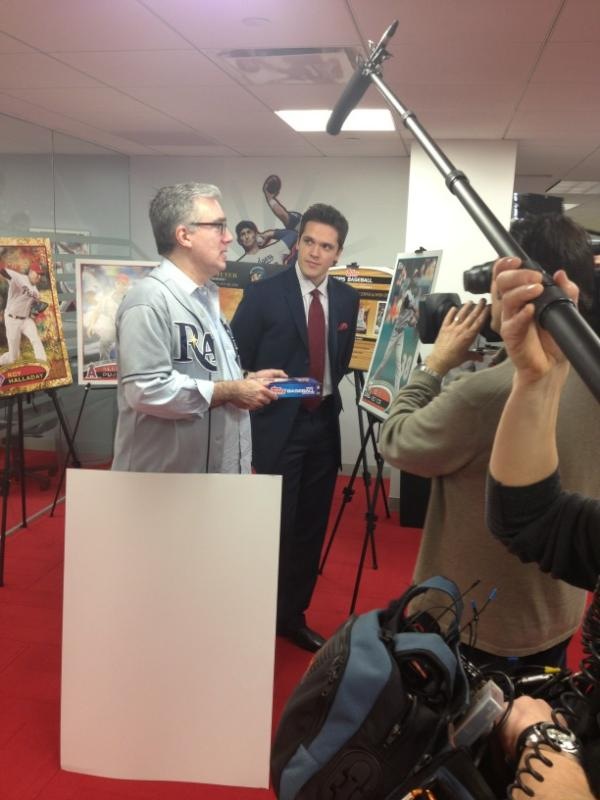
Next year, maybe we'll televise it
Greg brought a camera crew, Topps put up a display including blowups of the cards of Pujols and Reyes in their new unis and the one-of-a-kind gold card inserts, they assembled the entire 2012 Baseball Production team, I dressed up in my Matt Moore First Win Game-Used uniform, they fitted up a conference room full of unopened boxes, and pizza, and I had to give a little speech, and half of the staff snapped photos on their phones and their tweets out even before I finished talking (insert your own joke here; I actually had to be brief for a change as I’m still under doctor’s orders to not try to ‘project’ with some severely strained vocal cords and throat muscles).
Suddenly we went from four guys sitting in a room going “nice shot of Braun” to a veritable orgy of pack opening. It felt like snack time at Willy Wonka’s Chocolate Factory and I must say, for something that was made ‘bigger’ than in years past at least in part to utilize the presence of a tv camera, this organically and spontaneously turned into a really fun ninety minutes in which the pride of the employees – to say nothing of the imminent promise of spring and another MLB season – were in full bloom.

A veritable orgy of pack opening (or what my room looked like in 1967)
Before we get inside the packs, and a really exceptional effort by Topps this year (to say nothing of a sneak peek at their next issue, 2012 Heritage) a couple of fun images.

For some reason Greg didn't want to take Pujols back to the office
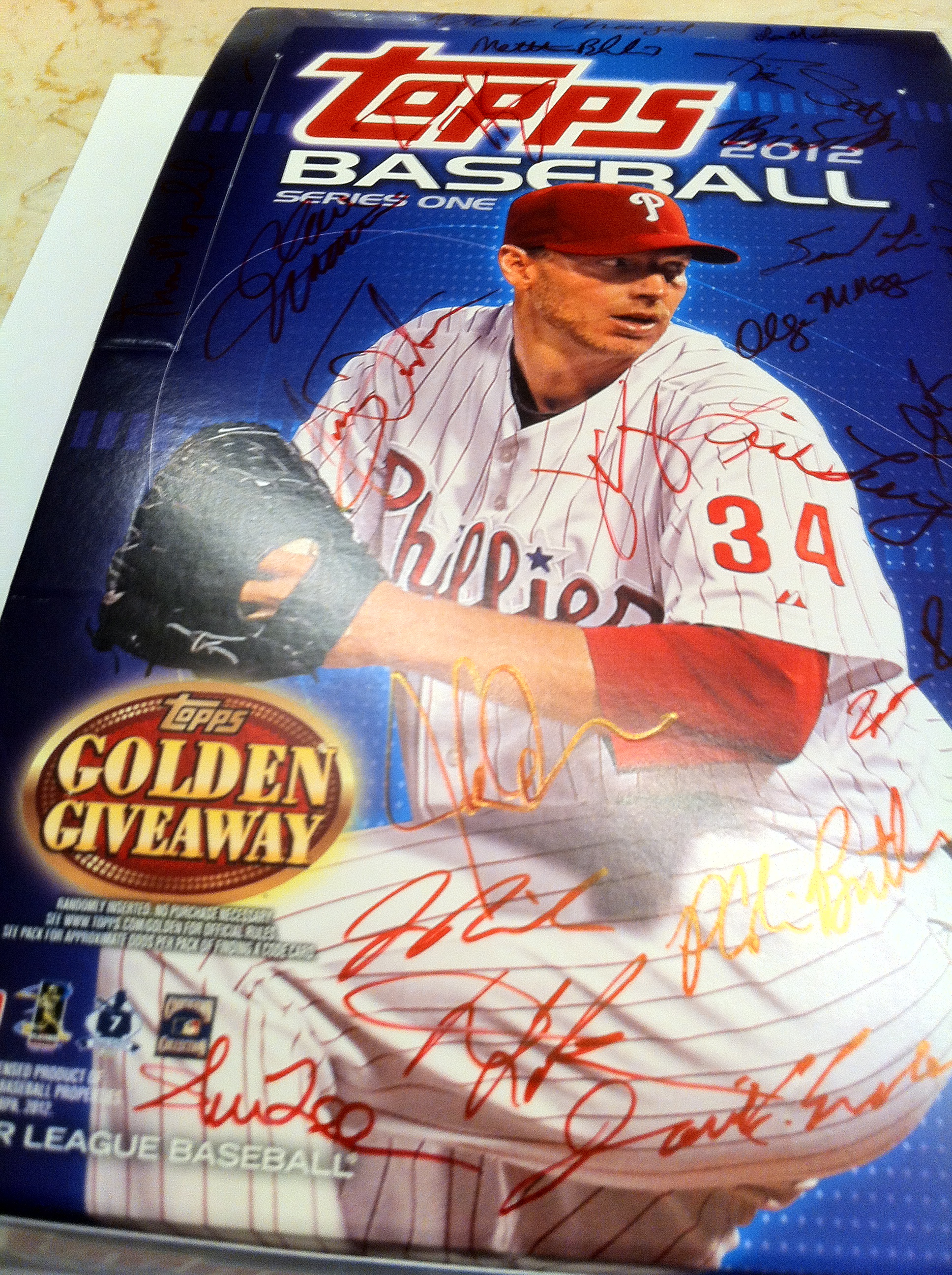
Why shouldn't cardmakers sign card boxes?
The Topps production team all signed the first box that was part of the ceremonial presentation depicted above. They do it at aircraft factories and they do it on the first production runs at Apple – so why not? And on the right is that display I referenced complete with the Pujols and Reyes blow-ups. I have no idea how poor Amsinger, Cardinal diehard that he is, got past this graphic testament to the fact that Albert has surrendered his legacy in St. Louis and is now tempting the curse of Almost Every Angel Free Agent Contract Ever (Amsinger, when I pulled a Mark Trumbo card today: “It should say third base on his card. Where else is he going to play for them?” Me: “First. After you-know-what happens.” Amsinger: shakes head dolefully).
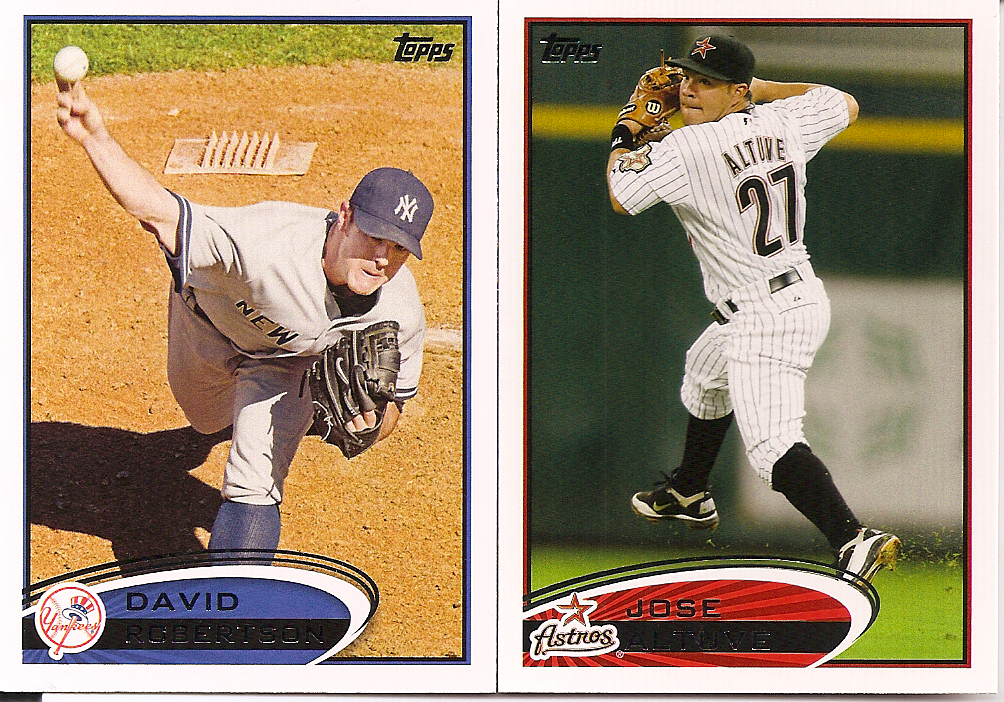
A leap in photography
Over the last few years, Topps has been steadily improving the photo quality of their base set, but this year a great leap has been made. The photos are better sized and framed, more interesting, more innovative, and with the ever-increasing improvements in the mechanics of photography, crisper and more compelling. The embossing makes the names difficult to scan but the shots here of David Robertson and Jose Altuve are really terrific and virtually every square quarter-inch of the card frame is filled and filled cleanly. There’s a design decision here, visible in the Altuve card, to sacrifice the tip of his left foot to minimize dead space – and I think it works wonderfully.
And then come the fun cards. There are SP’s (single prints, if you’re not a collector – cards that you know going in are much scarcer than the regular 330 cards) that include Reyes and Pujols sent by the magic of computers into their new uniforms. When you consider that as late as 1990 Topps was still airbrushing the caps of traded players – literally hand-painting logos over the original one, not on a photograph, but on a negative measuring 2-1/2 x 3-1/2 inches) – let’s give the computer a round of applause.
The flatfootedness in the Reyes card makes it a little clunky but it gives you a pre-Spring Training hint at how the new Miami uniforms are going to visually ‘feel’ once the rechristened club takes the field.
Two years ago the theme of the SP’s were the Pie-In-The-Face celebrations, mostly enacted by the Yankees’ A.J. Burnett. This year the premise is celebrations and mascots, and in the case of the former, particularly the Gatorade Bath:

145 Butler (l.) and 145 Butler SP
Butler, caught just as the orange goop explodes but before he’s lost under it, is a classic card. But, to my mind, the SP version of Mike Morse’s card 165 and its suspension-of-the-wave is an instant All-Time Great:

I betcha it hits Wilson Ramos
But 48 hours after the cards reached dealers and collectors, most of the publicity has surrounded the short print of #93 Skip Schumaker.

For the record, those are Schumaker's left foot and ankle
The Cardinals’ second baseman is said to be ticked off – and I happened to see Kevin Millar, serious for the first time in months, take unnecessary umbrage at the St. Louis Rally Squirrel squeezing Schumaker  out of frame – but remember, for every one of those cards, there are several hundred of the regular one on the right here. Happy? Nice boring five-cent card compared to one that’s rather crazily being bid up to more than $200 on eBay?
Players take the baseball card photo a lot more seriously than they would have you believe. Several inscribe cards bearing particularly unflattering pictures with notations about how much they hate the photo. On occasion players won’t even sign their cards based solely on the choice of image.
The real trick for the Schumaker SP 93 will be not to get the player to sign it – he’s noted for a good heart, I’m sure the charity possibilities will be raised to him and he’ll sign a bunch. The problem is going to be getting that Squirrel to sign the card. Incidentally, the squirrel isn’t a Topps first; a card of “Paulie Walnuts,” a squirrel who occupied a foul pole at Yankee Stadium, was issued in 2007.
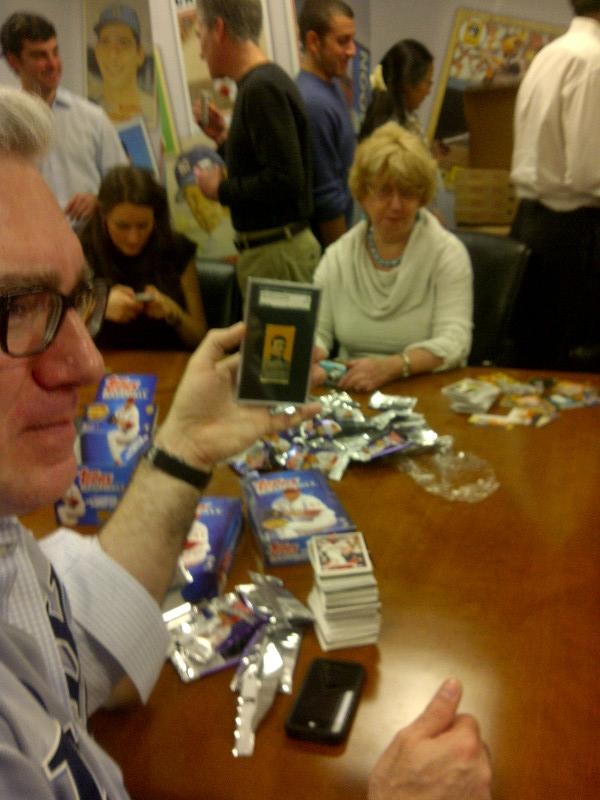
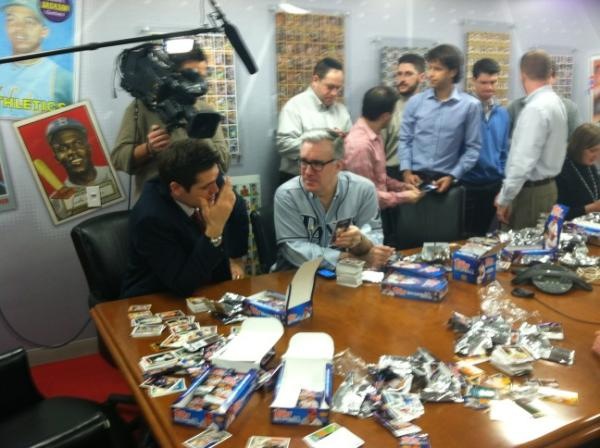 I promised a preview of Topps Heritage 2012 and that’s coming – but one more aside first. I thought I’d pay off the day I scared Greg Amsinger with my Wagner boastfulness by bringing the famed T206 scarcity to Topps to link up the past and the present. He didn’t know it was coming, which is why he’s been caught mid facepalm on the right.
And lastly, Heritage. They’ve done another meticulous job matching up the set celebrating its 50th anniversary, the vibrant 1963 design, in which the glowing colors of ’60s Topps were first evident: 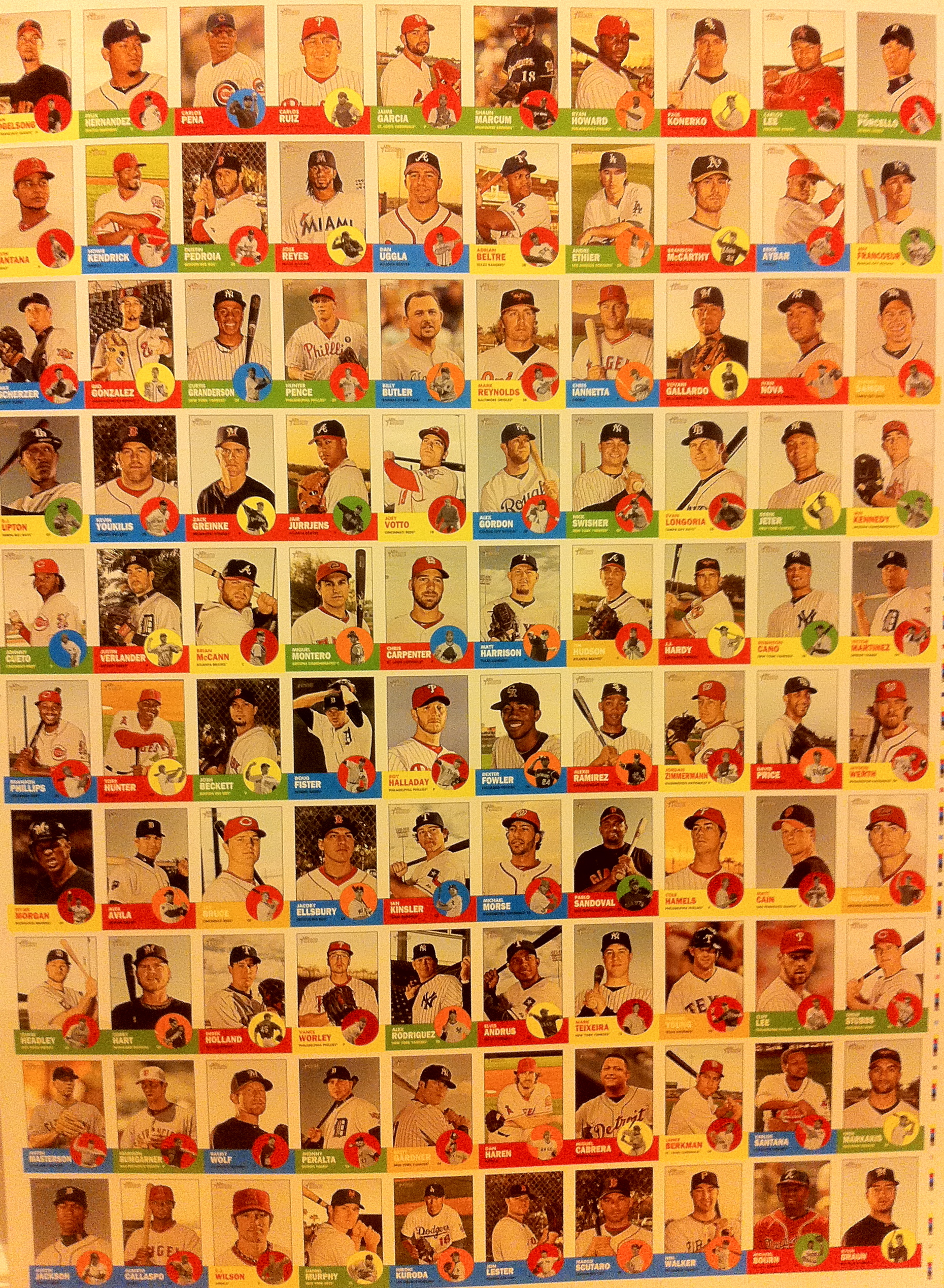 A lot of star players on this sheet – and forgive the waviness of the photo: it’s a sheet.

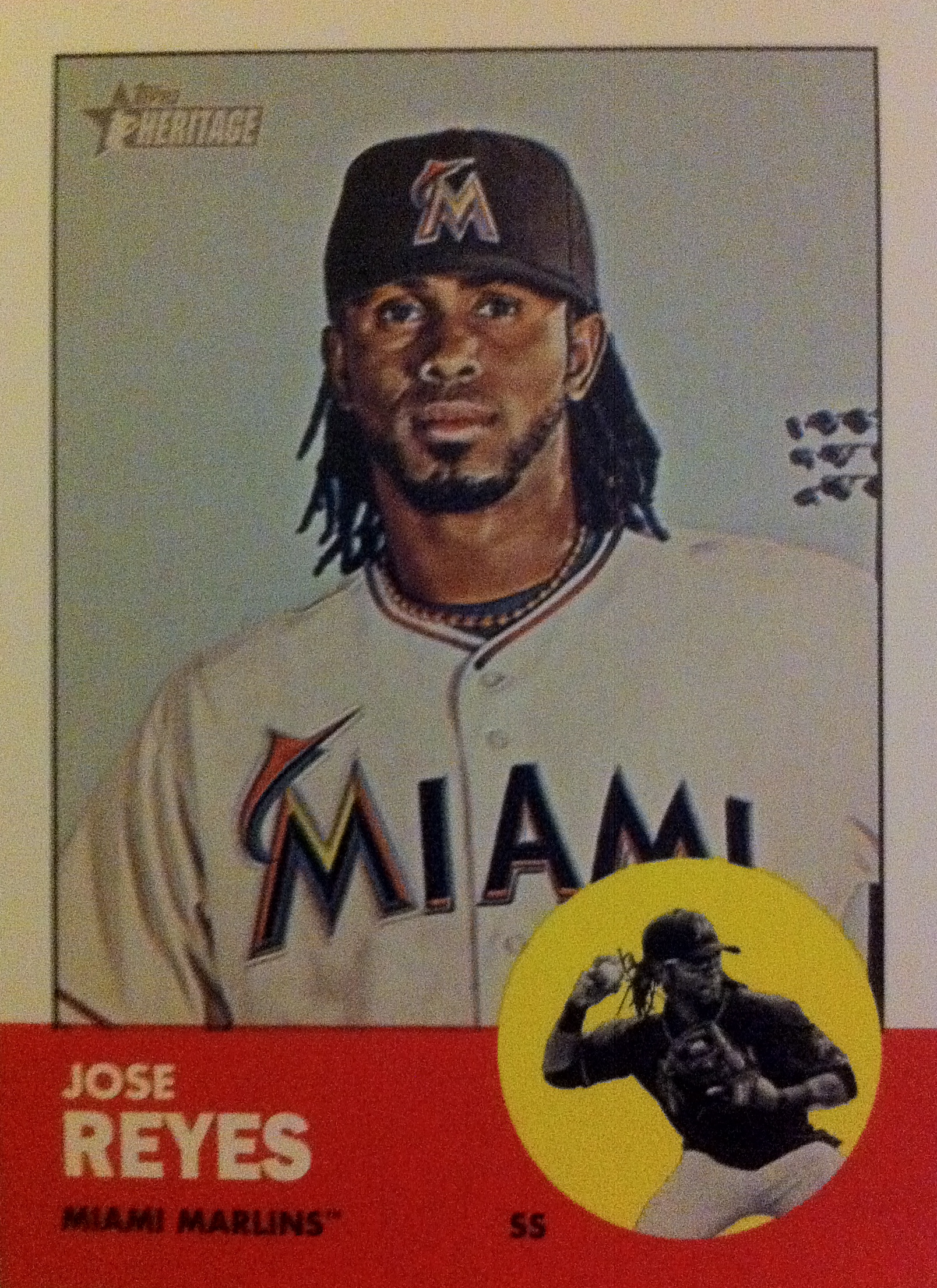 Two cards in particular jumped out at me: Reyes again in what looks like a photo actually shot at the news conference announcing his move to Miami (although that could easily be a little misdirection) and C.J. Wilson in Angel garb.
One note on deadlines: Chris Iannetta is shown with the Rockies in the Topps set, but has already been updated to his new Angels’ uniform in the Heritage issue.
Kiss Your Astros Goodbye?
Three good reads today, one of them among the best and most moving baseball-related pieces I’ve read in a long while.
Firstly, the Houston Astros may change their name (again). Last time they did this, from the Colt .45s to the Astros in 1965, they got involved in a drawn-out lawsuit over the use of the name. So, what next, the Houston Streets? The Houston Hellos? This would work for the rabidly diminishing franchise: The Houston We-Have-A-Problems.
Multiple tributes around the net for the late Andy Musser, Phillies’ announcer and one of the greats of local television in that city. For a time in the ’70s Musser was in such demand that he did the local CBS station sportscasts in Philadelphia on weeknights, and the ones in New York on weekends. Terrific pro, whom I had the pleasure of meeting several years ago. He began by courteously telling me how much he loathed my politics but admired my skills, and I told him I’d been a fan since I was a kid and politics weren’t going to change my opinions. The rest was laughs and kind words – and evidently that was the story of his life.
Lastly superb piece by Tom Dinard on one of the favorites of the Yankees’ media relations’ department, Stefan Wever, and the extraordinary life he’s led in the thirty years since his one and only appearance in a major league uniform, a single start for the 1982 Yanks. Take the time to read it all – well worth it. There aren’t a lot of color images of Wever in a Yankee uni — here’s one:
Montero-Pineda: No Big Deal?
The reaction to the Pineda-Montero trade is unanimous: Everybody seems to believe it was a hugely significant deal, but a ripoff of biblical proportions. Unfortunately, I have yet to read consecutive analyses saying who did the ripping.
My concern is the other part. Ever the contrarian, I am not convinced this is an epic trade, nor a rip-off. I’m not convinced by either of these guys.
I suppose the confusion originates with the similarly disparate conclusions about Montero’s ability to survive on the major league level. Before he hit the Bronx last September there was no middle about him. He was either the next great slugger and at least a sufficient catcher, or an overrated stumblebum whose ceiling might be Jake Fox.
I don’t think September cleared things up for us. He drove in a dozen runs and slugged .590 in 61 at bats, and showed the kind of jaw-dropping opposite field power off the middle-to-high fastball that seems to appear only once per decade. But as the Yankees cruised towards the division title amid the Red Sox collapse and a Rays surge that could never have threatened them, they trusted Montero to start exactly one game behind the plate. He wound up catching thirteen more innings in two other games and four of five baserunners stole off him. He did not impress defensively.
Nevertheless, the real question mark should be how New York used him – or didn’t use him – in its post-season cameo. Yes, Jorge Posada got on base eleven times in 19 plate appearances (five singles, four walks, a hit batsman, and a triple) but he didn’t drive in a single run and six of his eight outs were whiffs. It is intriguing that only one of the hits, only one of the walks, and the lone HBP came in the two Yankee wins (9-3 and 10-1 wins no less). Posada’s fireworks were mostly empty calories. Montero, meanwhile, appeared only in the rout portion of the latter and went 2-2 with an RBI.
The Yankees also just traded a bat when the forecast for their 2012 production is not optimistic. Alex Rodriguez slowed to a crawl last year, Curtis Granderson vanished in late August and Russell Martin long before that, Nick Swisher was all over the place, and there is only one Robinson Cano. I realize Joe Girardi envisions the DH spot as a place to park the fading Rodriguez or the beaten-up Swisher on a given day but this “keep ’em fresh” use of the DH implies that the batters you’re going to use there are still of value. To me, the Yankee batting order got almost spasmodic in the second half of last season and a great young power-hitting bat in its middle would be far more useful than another young starting pitcher.
That is, if the Yankees really believed Montero was a great young power bat. I’m convinced that for all of Brian Cashman’s comparisons of Jesus Montero to Miguel Cabrera and Mike Piazza, he has decided that there is some grave flaw not just in his glove but in his bat. Cash was reportedly ready to trade Montero to Seattle for Cliff Lee in 2010 but balked at trading Montero and Eduardo Nunez (this was confirmed for me last summer by another Major League GM). Cashman has been surprisingly willing to trade this supposed blue chip prospect for whatever the drooling Mariners would surrender. It was suggestive enough that he seemed to value Nunez more highly than Montero. And now, if he just traded a Cabrera or a Piazza for a Michael Pineda, he’s an idiot – and I don’t think he’s an idiot.
And I’m giving Pineda the benefit of the doubt here. I was first astonished by this guy’s potential during a throwaway appearance at the end of a televised Mariners’ game late in spring training 2010. His spectacular start to 2011 was no real surprise to me, and I’m assuming even though they cuffed him up for three earned on five walks and three hits in five innings at Seattle on May 27th, the impression was left on New York brass that this was one of the coming mound stars of the game. After all, before that start at Safeco, Pineda had been 6-2, with 61 K’s in 58-1/3 innings. He’d only given up 46 hits and only twice had walked more than two men in a game.
Pineda went 3-8 thereafter.
He was still good in June, and what followed could very easily have been exhaustion – except he had managed 139 innings pitched in the minors in 2010 and 138 two years before that. This was not totally foreign territory. And yet he collapsed at the All-Star Break:
GS IP ER BB K HR W L ERA WHIP G/A OA
Before 18 113 38 36 113 10 8 6 3.03 1.04 0.84 .198
After 10 58 33 19 60 8 1 4 5.12 1.38 1.38 .236
Look, a 1.38 WHIP is not going to kill you, not with the Yankees. Consider that for all the disappointment the second half tacked on to his rookie season, Pineda got run support of 5.16 for the season (Derek Lowe/Dan Haren/Chris Carpenter territory). The Yankees gave all of their guys a lot more help: Ivan Nova 8.82, Freddy Garcia 7.49, A.J. Burnett 7.19, CC Sabatha 6.98, and Bartolo Colon 6.41.
But there is another disappointing set of splits to consider. Pineda not only did better in the pitcher’s paradise that is Safeco, but he did better in a supremely bizarre way.
Michael Pineda’s home-road splits:
GS IP ER BB K 2B 3B HR W L ERA WHIP G/A OA
Home 12 77 25 28 82 3 0 9 5 4 2.92 1.01 0.92 .182
Away 16 94 46 27 91 21 2 9 3 4 4.40 1.17 1.05 .234
Do you see it?
Michael Pineda surrendered only 12 extra-base hits at home, exactly one a game. On the road, he gave up 32 of them, exactly two a game. The homers are the same but the doubles helped to kill him.
Another stat to throw at you. His BABIP (for the un-SABRized, the opponents’ Batting Average on Balls hit In Play) was .258. That was the ninth lowest in the majors last year, and while having the ninth lowest opponents’ batting average on anything would intuitively be a good thing, in this case it ain’t. The BABIP for all pitchers combined was .291, which implies that on as much as thirteen percent of the outs Pineda got on balls the hitters hit, Pineda was lucky they were outs. Low BABIPs (or high ones) tend to correct themselves over the course of a season, or from one season to another, which is as good an explanation for his opponents’ actual batting average to jump by .038 after the All-Star Break as is “he got tired at 113 innings.”
There are a lot of numbers in here, but between Pineda’s second half (and road) woes, and the Yankees’ remarkable unwillingness to put Montero on the spot in the playoffs, I infer that this wasn’t a rip-off, and it wasn’t a trade of future Hall of Famers – that it might have just been the trade of a couple of high-ceiling but deeply flawed ballplayers.
Name Dropping Herman Long
Had the pleasure of joining Brian Kenny on MLB Network’s Clubhouse Confidential yesterday (more on that below) and as we batted back and forth the necessity of electing Gil Hodges to the Hall of Fame, Brian mentioned that if he gave me a chance I could drop a lot of 19th Century Cooperstown-worthy players. I had time to say only “look up Herman Long.”
I’ll detail his Hall credentials in a moment. But first: for all of the weird HOF elections of the first 75 years, he is in the middle of the weirdest. Take a look at the results from the first-ever Veterans’ Committee vote, conducted in 1936:
- Buck Ewing 39.5 Votes, Elected 1939
- Cap Anson 39.5 Votes, Elected 1939
- Wee Willie Keeler 33 Votes, Elected 1939
- Cy Young 32.5 Votes, Elected 1937
- Ed Delahanty 21.5 Votes, Elected 1945
- John McGraw 17 Votes, Elected 1937
- Old Hoss Radbourn 16 Votes, Elected 1939
- Herman Long 15.5 Votes
- King Kelly 15 Votes, Elected 1945
- Amos Rusie 11.5 Votes, Elected 1977
- Hughie Jennings 11 Votes, Elected 1945
- Fred Clarke 9 Votes, Elected 1945
- Jimmy Collins 8 Votes, Elected 1945
- Charles Comiskey 6 Votes, Elected 1939
- George Wright 6 Votes, Elected 1937

Herman Long in an 1888 Old Judge card, while with the minor league Chicago Maroons
So there were 78 ballots, 60 different players got votes, half of them eventually wound up in the Hall, but the guy who got the eighth most, who finished ahead of 23 future Hall of Famers, not only never made it but never again got significant support? I mean, in the 1937 Veterans’ Committee ballot, Long got one vote.
Something is very, very strange here. I mean, while we think of the stars of the 19th Century and the early 20th as having played in some kind of baseball version of the Pleistocene era, consider who the 1936 voters were. If this were January, 1936, Bob Costas would’ve made his NBC baseball debut in 1907, I would’ve covered my first World Series in 1900, Peter Gammons would’ve broken in with The Boston Globe in 1893, and Tim McCarver would’ve started with the St. Louis Cardinals in 1883.
In short, the 78 members of the Veterans Committee of 1936 saw most of the antediluvian names on that ballot play either professionally or as kids (let’s just play with that again: if this were 1936 I’d have seen my first MLB game in 1891 and I believe Peter’s first would’ve been in 1882). These guys thought of Herman Long in the same breath with the most famous player of the 19th Century (King Kelly), the man who won 59 games in one season (Hoss Radbourn), and the man who played or managed 14 pennant winners (John McGraw). For further context, there were six players to whom the first Veterans voters gave exactly one vote each, who wound up in Cooperstown and to some degree in the baseball public’s awareness, like 342-game winner Tim Keefe and the inventor of the curveball Candy Cummings. And Herman Long got 15 times as many votes.
So who was this guy?

Derek Jeter is the Yankee shortstop now, but Long was the first. His 1903 Breisch-Williams baseball card; the photo shows him from Boston circa 1899
Herman Long was the great shortstop of the Boston Beaneaters’ dynasty of the 1890’s. He produced four consecutive years of an OPS of .800 or higher, had two 100-RBI seasons, six 100-Run seasons, and in a time without home runs, he hit 91 of them over 13 seasons including a dozen in each of two years. He stole 537 bases (that’s still 30th all-time) and scored 1,456 runs (77th all-time). In that measure of what an individual player’s offense and defense was “worth” to his team, “WAR,” Long finished with 44.6 (his Hall of Fame teammate, third baseman Jimmy Collins, finished at 53, and his Hall of Fame teammate, centerfielder Tommy McCarthy, finished at just 19). And despite having made more errors than anybody else in history, he has the 122nd best Defensive WAR+ among all position players ever. Boston’s two spurts – at the beginning and end of the 1890’s – produced five pennants and Long was the shortstop on all of the teams.
His nickname was “The Flying Dutchman.” When they began to use it late in the 1890’s for a kid named Honus Wagner, it was a tribute to Herman Long. More trivially, he would later play only 22 games there, but he was the first shortstop of the New York Yankees (then the Highlanders).
Is Long a Hall of Famer? I’m not sure. But he was considered the 8th best player among the “Old Timers” in 1936, and then fell into a black hole. It wasn’t even a matter of public scandal or diminished rotation – Long had been dead since 1909. He certainly merits consideration.
Remind me to tell you later about Bobby Mathews.
SPEAKING OF OLD TIMERS
Returning to the topic of my visit to MLB Network, if you didn’t know, that’s where my erstwhile employers MSNBC were headquartered from 1996 until October, 2007. I worked in this very building from September of ’97 through December of ’98, and then again from February of ’03 until we moved out. Yesterday was my first day back and it was mind-blowing. Baseball invested a reported $54,000,000 to upgrade the facility with rebuilt studios and state-of-the-art technology.
But they changed almost nothing else.

Look! They took down the MSNBC logo!
Not the carpets. Not the desks. Not the chairs. Not the make-up rooms. Not the cubicles. Not where the large clusters of desks are. Not the cafeteria. Not the offices. Not the office door plates. Not the “Employees Must Wash Hands” signs in the bathrooms.
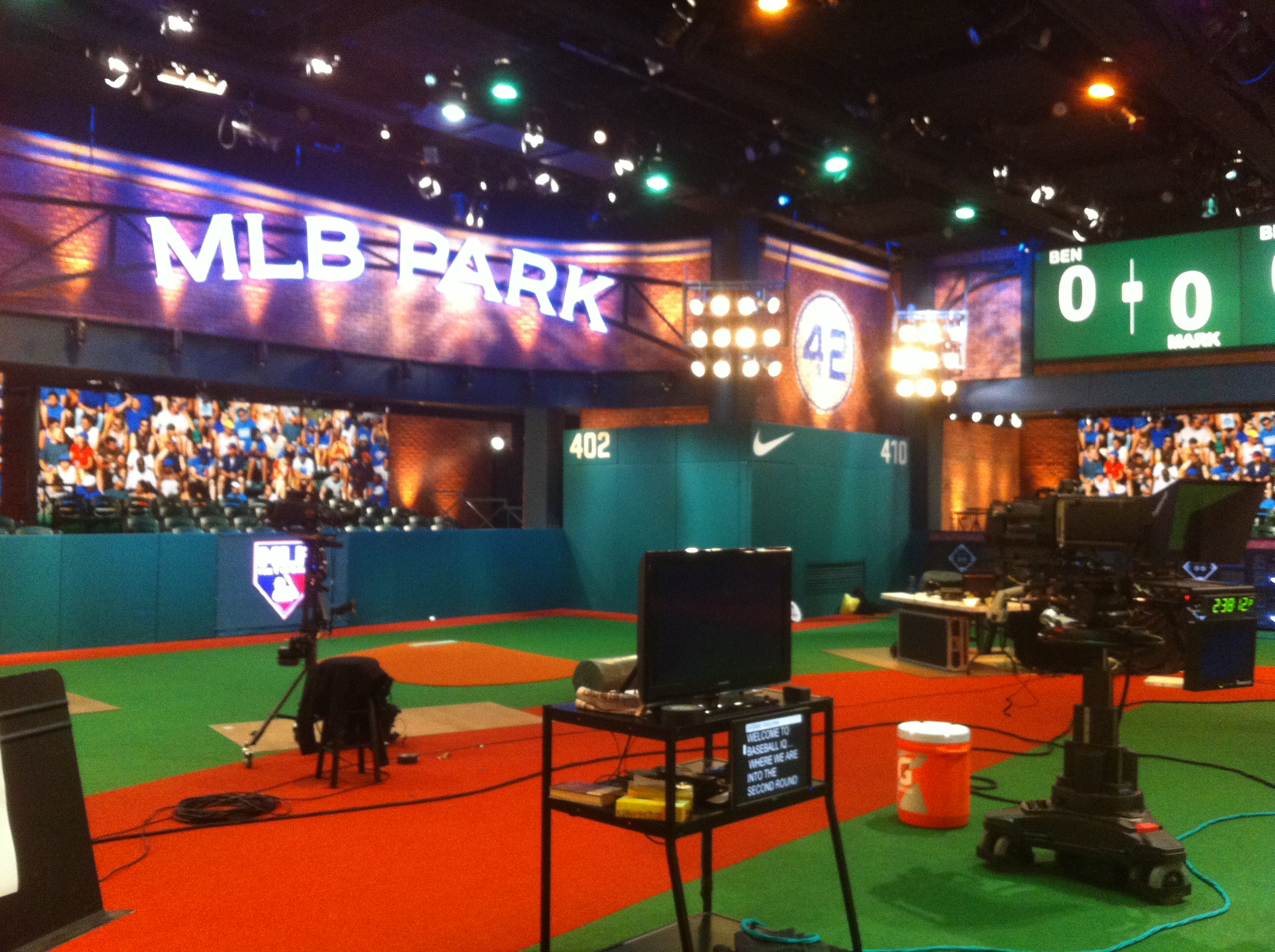
The MSNBC great rotating "anchor desk" was somewhere around Second Base
Going into it was like one of those dreams you’ve probably had where you walk into some place totally familiar to you – your childhood home, or where you live now, or go to work, or school – and in the middle of it your unconscious has placed a nuclear reactor or a jungle or something else utterly incongruous, without changing even one other thing.
You think I’m kidding? My old offices, the one from 2003 and the one from 1997, are still offices, with the same doors, windows, nameplates, and televisions. The newer of them is occupied by an old colleague of mine from Fox Sports named Mike Konner, and to my amazement I found that on what is now his wall was a poster from MSNBC’s 2004 Campaign Coverage. I remembered this one distinctly, because there was controversy over some of the people shown in the back row (somebody wasn’t under contract, or somebody was left out, or something), and the thing was immediately replaced by a revised version with somebody else’s body swapped in. As I saw it hanging on Mike’s wall I remembered I had left the rare “uncorrected” version in a pile of junk when I left.
So why was it on Konner’s wall? I asked Mike where he found it. “It was here when we moved in. In a pile of junk.”
Every time I think of him saying that, I laugh. The poster has been in that tiny office since 2004. 
Too Bad Nobody Has Danny Tartabull’s Home Number
20 years ago today, at 6 PM Eastern Time, a variation of the theme then used for SportsCenter played, a pre-recorded greeting from some tv guys ran, then a man named Tony Lamonica gave the afternoon’s NBA and NHL scores, and then Tony Bruno, Chuck Wilson, a gifted team of producers, and little old yours truly signed on ESPN Radio for the first time. And as much as any of us did to launch what was The Worldwide Leader’s first real venture outside television, the network in fact owes its chops to…former MLB outfielder Danny Tartabull.
Just five days earlier I had been sitting in the sun on the balcony of my home in Beverly Hills, planning even more sitting in the sun to fill the three month interregnum between the end of my duties as sports director at KCBS-TV in LA, and my scheduled start on the 11 PM SportsCenter at the end of March, when the phone rang. It was my agent telling me that my new bosses were premiering their new enterprise on Saturday and Tony and Chuck were great and the staff was great but good grief they’d decided to try to do seven hours a night of interviews and score updates starting on Saturday and they had no third host and nobody in Bristol had any real radio experience other than Charley Steiner and he was too busy and please, please, please, could I just fly back and do the opening two weekends and then go to Hawaii?
I calculated quickly. I knew that if I saved his heinie on this one, my new boss John Walsh would always think of me as a team player.
Yeah, that’s exactly the way that worked out.
The first night was grueling and claustrophobic (we were broadcasting from what had been ABC Radio’s studio at the 1984 Winter Olympics in Sarajevo; it barely fit three people at a time and when the update guy came in one of us hosts had to leave – or in the ever-entertaining Bruno’s case, lie on the floor under the desk). But by the second night we began to hit a stride. The big non-game news of the weekend was the heavy pursuit of the top remaining free agent in that winter’s baseball market (31/100/.316/.990 OPS) and producers Bruce Murray and John Martin had lined up several guests from the teams Tartabull was reportedly about to visit with.
I can’t remember the details but I think we had gotten the hint earlier in the evening that one of those meetings had been unexpectedly postponed. But I remember clearly that then-Rangers Manager Bobby Valentine was a live guest some time around 8:00 ET and I asked him about my understanding that he was heading out to the airport in the morning with Texas management to pick up Tartabull and show him the Metroplex. “Not any more,” said Bobby-V. “The thing just got canceled. I’ve got the feeling he’s just signed with somebody, and from what I gather, it’s an east coast team.” Suddenly we had a real story to chase, and we began putting on anybody we could from baseball to give us whatever scraps of information they had. I remember specifically the late Lou Gorman, still General Manager of the Red Sox, rather forlornly confirming that he too had had a Tartabull meeting canceled and that if Tartabull had signed with an east coast team, it wasn’t Boston.
I took several of the segments off to work my baseball contacts via the phone. I had a pretty good one with a strong connection to Tartabull who said he could confirm that Tartabull had indeed decided on a new team, but he hadn’t been able to get to his own source who would definitively knew who it was. So for several hours – and remember we stayed on the air until 1 AM Eastern – we could only report that “ESPN Radio has learned Danny Tartabull has decided which team he’s going to sign with.” A pretty good start for a journalistic operation not yet two days old, but frankly, missing a couple of vital details.
By now you’re thinking: Good old Keith, tooting his horn about a crappy story he played a minor part in breaking 20 years ago. Actually, no. Because what followed was one of the dumbest moments of my life, one of those times when, like Elmer Fudd in the Bugs Bunny cartoons you feel yourself turning into a giant Tootsie Roll Pop with a wrapper reading “SUCKER.”
John “Chief” Martin, Tony, Chuck, other staffers, and I, continued to bang our head against the Tartabull wall for hours. Finally, some time around 11 PM John – a friend of mine since I was 20 years old – said, almost rhetorically, “It’s just too (expletive) bad nobody has Danny (expletive) Tartabull’s home (expletive) number.”
That’s when I went all Elmer Fudd Sucker.
“Um, Chief?,” I said to him, defining the term ‘sheepishly.’ “I have Danny’s home (expletive) number. It’s in my address bo0k in my bag, if you’d just hand me my bag.”
My last two years at KCBS in Los Angeles had coincided with the network’s first two years carrying the Game of The Week, and the post-season. While the television schedule destroyed kids’ access to the sport in most of the country, on the West Coast it meant World Series games almost always ended before 9 PM. Our local station used to make a fortune putting on long, and I must say, pretty damn good, pre- and post-game shows for the Playoffs and World Series. And each post-season we’d invite active players in as co-hosts. MLB Network’s Joe Magrane got his start that way. Wally Joyner and Rick Dempsey joined me one year. And so, just three months earlier, had Southern California’s own Danny Tartabull.
And I’d forgotten that we’d swapped numbers.
I kept getting his answering machine. Finally, just as our final hour of ESPN Radio began, he picked up. Unfortunately I was literally in the tiny, bathosphere-like studio, trying not to be heard as Tony and Chuck updated the audience on all we knew of the Tartabull Drama. “Well, if you’ve eliminated the Mets and the Phillies and the Red Sox and the Rangers,” Danny said through laughter, “then who do you think is left?” I said I had apparently become so stupid that for four hours I had forgotten I had his phone number, so he better just tell me. “Pinstripes. Team wears pinstripes.” I reminded him the Expos wore pinstripes. “Are you coming to Ft. Lauderdale for spring training? Then you’ll see me in the home dugout.” We did a bit of a verbal kabuki about the length of the deal and the approximate financial terms, then I tried to pitch him on going on the air and announcing it himself and he said he knew I was crazy but he didn’t think I was that crazy, but that we could report it from sources close to Danny Tartabull. I congratulated him and we hung up.
Moments later I had the opportunity to go on the radio network and announce that we’d learned Danny Tartabull had agreed to a whatever-year contract for approximately alotta million with the New York Yankees. The story was quickly quoted by the Associated Press, and made it out in time to reach the front page of USA Today. And most importantly for the network’s future, my future partner Dan Patrick and his then co-host Bob Ley had to re-tape part of the late Sunday edition of SportsCenter which would play all night and all the following morning. And when Bob originally wrote “ESPN has learned…” management was quite specific with him. “No. You have to say ESPN Radio has learned…” to which an unnamed tv producer moaned, “Oh, great, now we have to worry about being scooped by them.”
No good deed goes unpunished. Goosed by the publicity that the Tartabull story got us – as clean a scoop as I’ve ever been involved with – we started picking up affiliates and credibility. And when I had fulfilled my promise to management to stay for the first two weekends just to get Radio started, they came back to me and said ‘How can you leave now? This is your baby, too.’
So instead of going to Hawaii for two-and-a-half-months, I went back to Los Angeles for two weeks to pack up my place, and return to Bristol to enjoy the height of its most Hawaii-like month: February!
The Steinbrenner Door
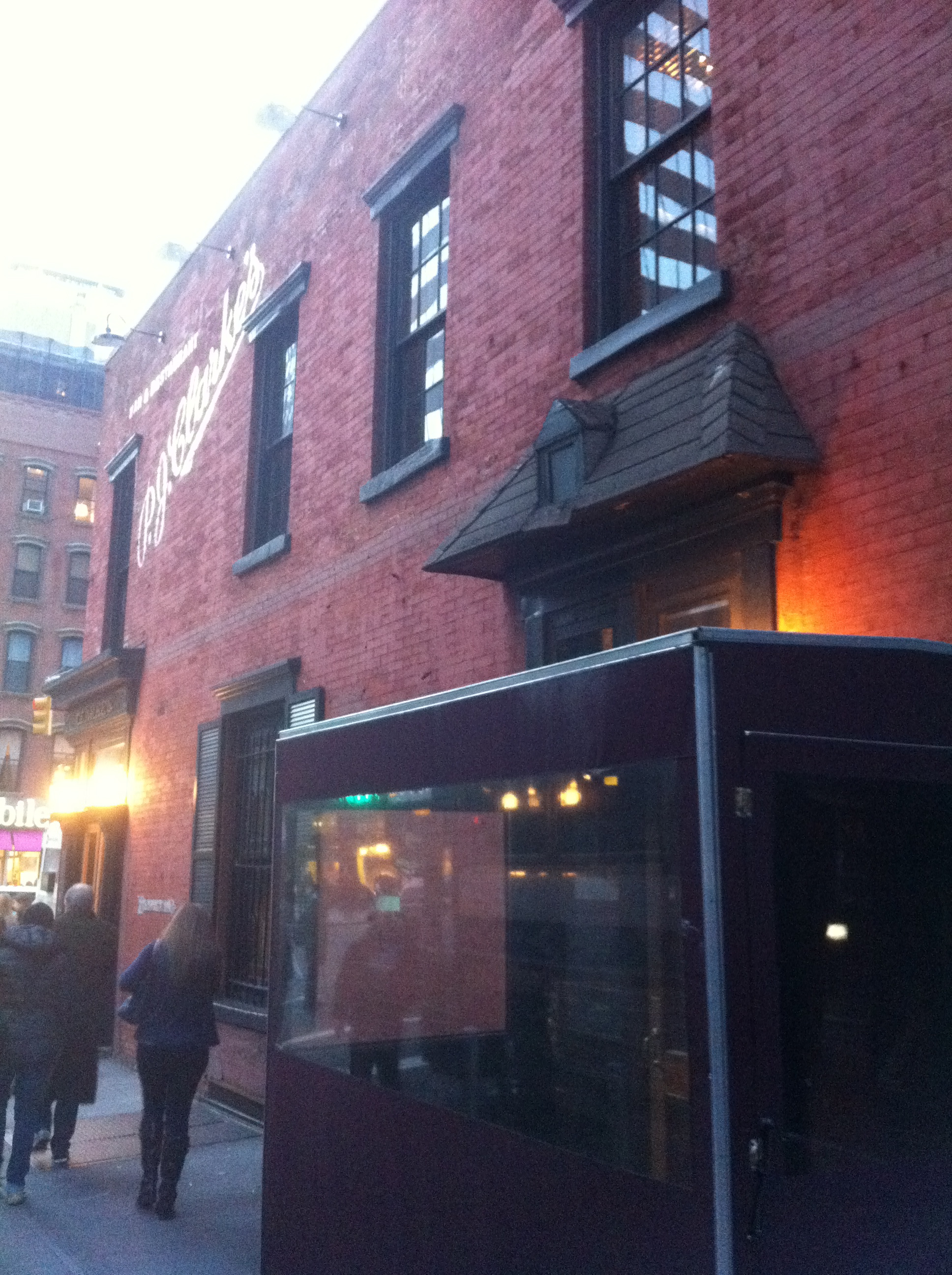
55th Street Entrance To P.J. Clarke's, "The Steinbrenner Door"
So I’m a kid reporter, see? It’s 1981, I’m almost exactly two years into my professional career and I’m covering the almost annual Baseball Strike for a national radio network, RKO. It’s a first class operation but the sports department is a little small. The new man is a producer named John Martin, I’m the middle staffer handling weekend anchoring and weekday reporting, and our boss…is Sports Director Charley Steiner.
In the middle of that awful summer, in which stories about unemployed baseball peanut vendors alternated with partial scores of the Atlanta Chiefs-Edmonton Drillers NASL games as lead stories on the weekend ‘casts, Charley caught wind of a rumor of a secret meeting in which a group of dissident baseball owners were to meet with Commissioner Bowie Kuhn. George Steinbrenner was foremost among them, and he was not happy with the fact that the owners of the Cincinnati Reds could shut down his money-printing factory in the Bronx, and he and the unidentified insurrectionaries had an ally in Kuhn, who wanted the strike over, pronto.
This was about all we knew about the rumored meeting. Ultimately it meant little to the outcome of the strike, but at that time it seemed like the first major breakthrough towards settlement, and Charley wanted to know when the meeting was, and who would be there, and he wanted to be standing outside when it all happened. And with the major wire services and top baseball writers absolutely whiffing on ferreting out the details, Charley decided to have his “kids” get the scoop for him.
Which is where The Steinbrenner Door comes into play.
I happened past it the other day. It is the 55th Street side entrance to one of New York’s most famous bars, P.J. Clarke’s, which has stood in one form or the other at the corner of Third Avenue since 1884. It was already a landmark when I lived at the exact opposite end of the same block – at 55th and Second – from 1980 to 1984, and when the aforementioned John Martin worked in the high-rise “Carpet Center” that went up around Clarke’s when the owners refused to let them demolish the joint in 1971. That a friend of John’s father worked the bar at Clarke’s, and that John worked next door and I lived 45 seconds away meant we never paid at Clarke’s, and that necessarily meant we always went to Clarke’s. Ironically, not long after this story took place, Steinbrenner bought a stake in Clarke’s, and the family may own it still, and I like to think he bought me all those beers.
So back to the story of the Steinbrenner-Kuhn meeting. Somehow somebody deduced the 48-hour window in which the meeting would occur, and Charley had John and I come in to work the phones all day, to try to get the specifics. Chaz gave me a huge break hiring me for my second job, and he and I got along fine at ESPN and have become very good friends in the years since he moved on to announce first the Yankees and then the Dodgers, but he was a strident employer. I mean, my regular weekday shift started around 2 PM and John’s around 9 PM and I think he had us both in there at 10 AM. And we called. And we called, and we called, and we called. We called everybody in baseball we knew, and soon we were calling everybody in baseball we did not know.
Eventually, sometime around 9:30 PM, I said to John: “At this point, we might as well just dial numbers randomly. I’m going home. If Charley wants to fire me, tell him that’s great, but it still won’t help him find out when this meeting is that apparently nobody in the world knows of.” John snorted a laugh and off I went.
RKO’s offices were in the famous WOR Radio Building at Broadway and 40th – exactly the perfect walking commute to a home on the East Side. There were a thousand routes back to my apartment, but nearly all of them ended with me on the Southeast corner of 55th and Third. But because I had spent the whole day banging my head against Charley’s wall, I needed to pick up some pizza on the Northwest corner of the intersection. And the way the traffic lights worked out, the “Walk” sign then sent me to the Northeast corner – and Clarke’s.
The various “no ideas” and “who the hell are yous” from my day of fruitless phone calls pursuing the Kuhn-Steinbrenner meeting were still echoing in my head when, from the middle of the walk lane, I spied the not unfamiliar sight of a limo parked near the side entrance to the legendary bar. Nor was it a surprise to see that side door open up and a bright light spill on to the pavement.
It was, however, a shock to see George Steinbrenner, replete with a natty ’80s tux, step out onto the street. My mind made a thousand calculations: Could I actually boldly go up to the Yankee Boss and ask him where the meeting was? Would bodyguards materialize and squash me? All these thoughts vanished when I heard Steinbrenner stop at the limo and speak – shout, in fact – back towards the still-open door.
“Eddie! Hey, Eddie?”
A balding head peaked out of Clarke’s. It was Edward Bennett Williams, the notorious Washington lawyer and then the owner of the Orioles.
“Eddie!,” Steinbrenner squawked. “What time is our meeting with Bowie tomorrow?”
I couldn’t believe it. Steinbrenner had just confirmed the meeting, and Williams’ attendance. I froze and tried to meld into the brick wall of Clarke’s, or, at minimum, disguise my RKO Radio Network Jacket with the big logo on the front and the even bigger one on the back. I tried not to drop the box of pizza.
Edward Bennett Williams sighed, took a step on to the street, and shouted “9:30, George. We meet there at 9:30. You, me, and Eddie Chiles.”
Now Williams had just told me that Chiles, the owner of the Texas Rangers, was joining the cabal with Kuhn to try to force the owners to end the strike, and that the starting bell would ring at 9:30. But I still didn’t have the answer Steiner wanted: Where were they meeting?
Steinbrenner again started to climb into the limo only to freeze again. “But where are we meeting?”
As I held my breath, Williams sighed again. “Jesus, George, do I need to pin it to your coat? Bowie’s condo! On Park Avenue!”
By this point I thought I was dreaming. Or that I had gained the ability to force others to conduct conversations by telepathy.
Now Steinbrenner was getting frustrated at Williams. “Where on Park, Eddie? I don’t have it memorized!”
Williams promptly barked out a number and a cross-street, and time returned to full-speed. I ran down the block, balancing the pizza box against my hip, and burst into my apartment and called Steiner at home. “Found it, Charley,” I said as calmly as possible. “9:30 tomorrow morning: Steinbrenner, Edward Bennett Williams, Eddie Chiles of the Rangers, at Bowie Kuhn’s condo at (whatever) Park.”
There was a moment’s silence, and then Charley (who was nearly as cantankerous a boss as I was an employee), quietly said: “I’m impressed. How did you find that out?”
I summoned all the nonchalance I could muster: “Oh. I just ran into Steinbrenner at Clarke’s.”
 Baseball Nerd