Ted Kennedy And Baseball

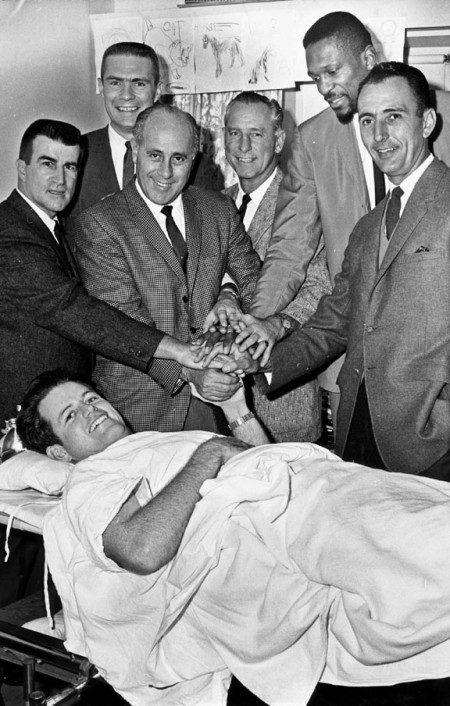
Just a quick trip back in time, to 1964, after the late Senator had broken his back in a plane crash, in route to accepting his nomination for his first full term. Two of these figures are instantly recognizable – the one at the far left has chops particularly relevant here… try to ID them all before reading the caption below.

Russell-Pesky-et al.jpg

Got him yet?

One more line and the quiz ends, regardless.

Johnny Pesky – just before or just after his two-year tenure as Red Sox manager ended; legendary Celtic star and then announcer Tom Heinsohn, coach-GM Red Auerbach, coach-GM (and 20-year star center) Milt Schmidt of the Bruins, and Heinsohn’s teammates Bill Russell and Bob Cousy.

Russell – who basically does not do interviews unless he truly wants to – came on with us after the Kennedy Funeral service in Boston, which is not at all a tribute to the interviewers, but rather to the man whose funeral he attended this morning and early afternoon – who just happened to have thrown out the ceremonial first pitch at Fenway Park this April. And that is baseball history, too. Kennedy’s grandfather, Mayor John “Honey Fitz” Fitzgerald threw out the first pitch at the first Red Sox opening day ever at Fenway, in 1912.

Told Ya So

From this blog on June 18th:


Johan Santana Must Be Hurt

This does not come from Mets sources, and it does not come from ballpark speculation, and it certainly does not come from the player himself, but barring an extraordinary breakdown in the mechanics of the game’s most-mechanically sound pitcher, Johan Santana must be pitching with an imposing injury.

This thought had been in the back of my mind since a fired-up Santana virtually willed the Mets to a victory in Boston, then followed that with a six-walk game against Washington on May 27, and finally his four-homer victory over the Phillies last week. Having now gotten to see Santana from field level during his implosion this afternoon at Yankee Stadium, there is not only the loss of velocity suggested by the radar guns, but he also seemed to have a softer break on his breaking stuff, and he clearly had trouble keeping the ball down. Many of the Yankees’ nine hits would have been swinging strikes on Santana pitches in the dirt, if he was 100 percent. Hideki Matsui’s homer might as well have been hit off a tee.

The problem, of course, is that all pitchers from Little Leagues to Jamie Moyer start hurting after the 50th pitch of the season and never really stop hurting. With experience comes the ability to push the threshold outwards. As Santana proved last year, shutting out Florida just days before surgery, you can go mind-over-matter on such things.

Often it’s even worse. The impediment to effectiveness can come before the pain. This was the middle of June; Santana now says he first felt discomfort in the elbow just before the All-Star break. It is certainly plausible, given that he’s had chips cleaned out of that elbow before, that he had stiffness or just a minor loss of his usual functionality, in the joint, long before it began to really hurt.

And thus this has been one of the few truly amazing Mets seasons. The opening day line-up in Cincinnati:

Reyes, ss (all but officially done for year)

Murphy, lf (failure to field there, moved to first, failure to hit there)

Wright, 3b (concussion, assumed to be back next week, don’t assume)

Delgado, 1b (out since May, might make it back for a token appearance)

Beltran, cf (out with an endless bruise, might have a cameo yet)

Church, rf (traded to Atlanta)

Schneider, c (to disabled list, back, in a platoon with non-roster invitee Omir Santos)

Santana, p (done as of August 25)

Relieved by Green, p (totally inconsistent)

Pinch-hit for by Anderson (released days later)

Relieved by Putz, p (just shut down, possibly for the year)

Relieved by Rodriguez, p (at key moments, utterly inconsistent).


Were that not amazing enough, the host Reds produced the following line-up:

Hairston, LF (now with the Yankees)

McDonald, CF (to the minors, just recalled)

Replaced by Dickerson, CF (back to the DL)

Votto, 1B (to the DL)

Phillips, 2B (inexplicably healthy)

Bruce, RF (out in July, presumably for the season)

Encarnacion, 3B (hurt, traded, hurt after he was traded)

Hernandez, C (hurt, moved to 1B to replace Votto, hurt again, might make it back this year)

Gonzalez, SS (to Red Sox)’

Harang, P (out for the year after my injury, the emergency appendectomy)


Major League Name-A-Likes

Already this year we’ve seen Frank Francisco pitch for Frisco of the Texas League, and had reason to invoke Johnny Podres of the Padres, and mention that the first draft choice of the Mets was a fella named Matz.

Some of them are desperate stretches, but you can in fact come up with at least one player whose name suggested they should’ve played with a particular city or team monicker across his chest (and even some who did).
Alphabetically by franchise:
Arizona: Of course, it’s pitcher Steve Phoenix from the A’s of 1994 and 1995.
Atlanta: They get the all-time great in this bizarre category, former Reds and Padres’ outfielder Angel Bravo.
Baltimore: Probably the closest is ex-Cub third baseman Kevin Orie, unless you like Ossie Orwoll, the fifth starter of the ’28 A’s.
Boston: Since none of the big leaguers named Fox have ever been nicknamed “Red,” you have to go with a washed-out mega-prospect who was once… Ted Cox, Red Sox. That or ex–outfielder Daryl Boston.
Chicago A.L.: Two deadball era stars fit best here, Pitcher Doc White (who actually pitched for them), and A’s outfielder Socks Seybold. Current Giants’ backup catcher Eli Whiteside gets honorable mention.
Chicago N.L.: You could look to 19th Century second baseman Cub Stricker, but I’m much more inclined to pick the spring-training-only ex-manager of the Red Sox, Mike Cubbage.
Cincinnati: It says something that nobody nicknamed “Red” has ever appeared for them in a post-season game. But pitcher Red Barrett made cameos with the ’39 and ’40 N.L. champs.
Cleveland: No-brainer. Former Red Sox pitcher Reggie Cleveland.
Colorado: Of all the players with the first name “Rocky,” the one most closely mirroring “Colorado Rockies” has to be “Rocky Colavito.” If Mets prospect Jose Coronado makes it, he’d have to be considered.
Detroit: Got to be Tigers’ 1957-58 manager Jack Tighe, although, interestingly, in the latter stages of his career when he was Detroit’s player-manager, Ty Cobb’s team was often spelled “Tygers.”
Florida: Marlin Coughtry, ’60s infielder, or Marlin Stuart, ’50s pitcher.
Houston: Rockies’ closer Huston Street or venerable catcher and pinch-hitter Tyler Houston.
Kansas City: A 1945 Giants’ pitcher named Roy Lee, or Mets and Jays pitcher Roy Lee Jackson.
Los Angeles A.L.: You can reuse Angel Bravo; I’d rather try 1972-73 Royals pitcher Norm Angelini.
Los Angeles N.L.: Who else but 1912 Reds’ third baseman Johnny Dodge?
Milwaukee: Lots of real-life Brewers; Tom of the Red Sox, maybe Jim of the Dodgers.
Minnesota: The Canseco Twins?
New York A.L.: Gotta go with the second baseman of the champion St. Louis Browns of the 1880’s, Yank Robinson. I can, though, recall my delight in 1976 when a reliever made a cameo in the Bronx and became Jim York, New York.
New York N.L.: Until draftee Matz makes it, their patron saint has to be Lenny Metz, infielder of the 1920 Phillies.
Oakland: How about the Cardinals’ outfielder of the early teens, Rebel Oakes?
Philadelphia: The ultimate one-team name-alike Dave Philley played 18 years in the majors, and for a dozen games in 1960 he was actually “Dave Philley of the Phillies.” He had previously played for the A’s in their original home, making him “Dave Philley of Philly.”
Pittsburgh: Either infielder Gaylen Pitts of the ’74-75 A’s, or pitcher Jim Pittsley of the ’95-99 Royals.
St. Louis: Ex-Cardinal outfielder Jose Cardenal is good. Cup-of-coffee 1963 Houston pitcher Conrad “Randy” Cardinal is better.
San Diego: Johnny Podres, of course, although 1941 Indians’ outfielder Buck Frierson is a good back-up.
San Francisco: Ah, if the Rangers would only swap him for Brian Wilson. He could be Franklin “Frank” Francisco, San Francisco.
Seattle: The toughest of the bunch. We have to settle for ex-Giants and Twins pitcher George Maranda.
Tampa Bay: You might go with ex-Expo Razor Shines, or bring in relievers Chris and Ken Ray.
Texas: Tim Raines? Wayne Granger?
Toronto: You could choose Vida Blue, or Joey Jay, but I like Jay Bruce. Doesn’t that sound good? Jay Bruce of the Blue Jays?
Washington: Last year’s feel-good career minor leaguer who made the Cardinals, Rico Washington. Also you could use ’60s pitcher Jim Nash for a weak homonym. 

Somebody Signed Strasburg On Saturday

Absolutely love this. Over the weekend, when things looked bleakest for Your Washington Nationals, a respected baseball writer with a fantasy league team revealed he filled a vacant roster spot with Stephen Strasburg. The punch-line is: it’s not a keeper league…What I don’t get: ownership of Billy Wagner at 0.6% in ESPN leagues and 6% in CBS leagues. He was in uniform at CitiField tonight and unless his arm falls off after a bullpen session tomorrow, he’ll be activated by Friday. How many contenders could use him, at the comparatively low price the Mets would ask – and wouldn’t teams like the Cubs, Marlins, Phillies, and maybe even Rays, contemplate using him in at least some save situations?…Gaby Sanchez came out of the New Orleans game early tonight and headed to join Florida. It seems implausible that he isn’t there to replace either Nick Johnson at first, or go to third and let Jorge Cantu move back to first – but the Marlins have already done bizarre things this year, like the last time Sanchez came up and didn’t play, and the fact that they’ve left Cameron Maybin in the Coast League even as he dominated it, just to make sure he wouldn’t become a “Super Two” arbitration guy…And the Brewers did let Mat Gamel come up and largely rot on the bench, setting him back a season’s development…Bizarre statistic that might not even qualify as such, maybe it’s just a coincidence: The Mets were 7-4 with ex-Rockie Cory Sullivan starting in left. They have now put him into a platoon with Angel Pagan in centerfield and when Sullivan starts there, the Mets are 1-3…While some agonize over the lack of a no-brainer Rookie Of The Year among N.L. hitters, there’s nothing wrong with just giving the trophy to Tommy Hanson…Atlanta also might earn the reverse equivalent of the Comeback Player Award: Kelly Johnson went from one of the majors’ premiere speed-and-power second basemen, to the victim of lingering injury, to Martin Prado’s backup, to going hitless today in a spot start while all around him were pounding Max Scherzer…Some in the Mets’ front office say they were told, but do not believe, that their first-round draft choice Steven Matz pronounces his last name “Metz.” Matz of the Mets is close enough, and Matt Helm, the seventh-rounder signed by Arizona, had a fictional counterpart in a ludicrous Dean Martin James Bond ripoff movie in the ’60s…Lastly, most politically incorrect joke in New York: they were really worried about David Wright after he got beaned Saturday because he couldn’t answer the traditional simple questions during the neurological work-up at the hospital. Then it turned out the doctors weren’t that baseball-savvy and had asked him to name the Mets’ starting shortstop, centerfielder, and first baseman.

David Wright Update

erry Manuel tells the Media at this hour that he does not think David Wright lost consciousness although he saw Wrights eyes go back and forth in his head but heard Wright tell everybody Im all right – but they have no update on his examination yet. Manuel is convinced there was no intent on the part of Matt Cain; that the book on David is to pitch him up and in and that he did not talk to Johan Santana about what appeared to be a retaliatory throw behind the back of Pablo Sandoval an inning after Wright was hit. Baseball has its unwritten rules, he said. He did not disagree that Wright would certainly miss time but did not say the problems with Ryan Churchs post-concussion syndrome would influence how gingerly he would handle Wright.

Last Met Standing

had not seen David Wright since early July and we had not had time for more than a quick hello since before the Met injury plague had hit its apex. He is the proverbial good fellow and very little of his rookie-year enthusiasm has yet worn off and he greeted me with a warm handshake. How, I asked him, do you like being the last Man standing? he laughed and corrected me: Last MET standing. we then talked about the ludicrousness if the criticism of the Mets for not having replacements for all the fallen. if we had anybody three quarters as good as Beltran, hed have been starting for us, wouldnt he? Wright then said he still couldnt get over the sheer volume of injuries (there were nine Mets on the DL as the day began). And then two hours later he lay in a heap in the batters box here at CitiField and the place was utterly silent. Fortunately he made it off the field on his own power, walked to and through the clubhouse, and climbed into the ambulance that took him to his CT-scan rather than being lifted into it. As a past recipient of a concussion I can tell you it is a good sign that his motor skills seemed unaffected and his walk confident but it might be of some concern that he was breathing as heavily as he was. Of course lost in the equation of the batter hit flush above the ear with a fastball is the terror – and even less frequently cited is the awful sound – like having your head inside a ringing churchbell for a minute or more. Updates as available.

Something Happened To Him

The very first entry in this blog was about the spring training work of a young relief pitcher, so impressive that it inspired home plate ump Tim Tschida to come over to the pitcher’s bench and say it was the most remarkable thing he’d seen all spring. Daniel Bard had not only struck out the Tampa Bay side, but he had cleared 100 MPH four times, and, according to Tschida he had put one in each corner of the strike zone. 

“How can you resist the temptation to take him north?,” I asked Terry Francona. The Boston manager laughed. “He’s still so young. If something happened to him, it could be crushing. But you’ll see him by summer.” 
Tonight here at Yankee Stadium, something finally happened to Bard. 
Brought in to protect Boston’s lead after 31 innings without a run and 36 without an extra base hit, having logged a save, five holds and 42 strikeouts in his first 30 appearances, the rookie instead surrendered a blast to Johnny Damon, who seemingly began to swing as the ball left Bard’s hand. With all false modesty aside, I then turned to one of my oldest friends, ESPN Radio Network Senior Director/Executive Producer John Martin and said “if Damon can time him, Teixeira can time him.” Teixeira promptly timed him into the upper deck. 
And now Francona has more to worry about than being swept four games here and falling six-and-a-half out. He has to deal with Daniel Bard’s first “something” – his first big league loss – a pivotal moment in the kid’s career and his team’s season.

The Greatest Cooperstown Find (Updated)

For more than 25 years, Dan Patrick and I have had the same debate.

We’ll be talking about the game’s All-Time Greats, and I’ll throw out the names of Honus Wagner or Buck Ewing or Christy Mathewson, or how we need to give Bobby Mathews credit for having won 300 games at a time when most pitchers didn’t last five seasons, and he’ll always say the same thing: “How do you know they were any good? We have no film of them. We don’t know what they did or how they did it.”
I’d point out that you could say the same thing about the Negro Leaguers, or largely about Ty Cobb, and he’d say these were exceptions, and secretly I’d realize at what a towering disadvantage the pre-1920 stars are, and I’d grieve that a man like Mathewson – clearly baseball’s first idol and considered by the old, old timers as being perhaps its first modern pitcher – might eventually be totally ignored.
It saddened me especially about Mathewson, to whom the kids of 1967 was a tangible memory easily obtained from their grandfathers. One of my earliest baseball-related daydreams was of going back in time to see him pitch, possibly alongside my mother’s Dad, the great Giant fan, who never had enough money to go once to the Polo Grounds while Mathewson still weaved his magic there – or even to go before Mathewson died in 1925, after six years of agony from tuberculosis and lungs scalded in a poison gas training exercise in France just weeks before World War I ended.
And then I was shown something, in the photo library of the Hall, last week. And I gasped.
There is some film of Mathewson – he’s shown warming up on the sidelines, evidently on Opening Day of 1905, arrogant John McGraw’s decision to put “World Champions” on the uniforms (another nose thumb at the American League), the most evident image. But he’s only tossing the ball and if that’s the way he’s pitched, Dan’s right – he won his 373 games because he managed to last for parts of seventeen seasons and both the pitching and the hitting of the time were unscientific messes. At one point a dog runs around on the field, and at another, Mathewson drops the return throw. If he’s cracking 70 on these “pitches” I’d be mighty surprised.
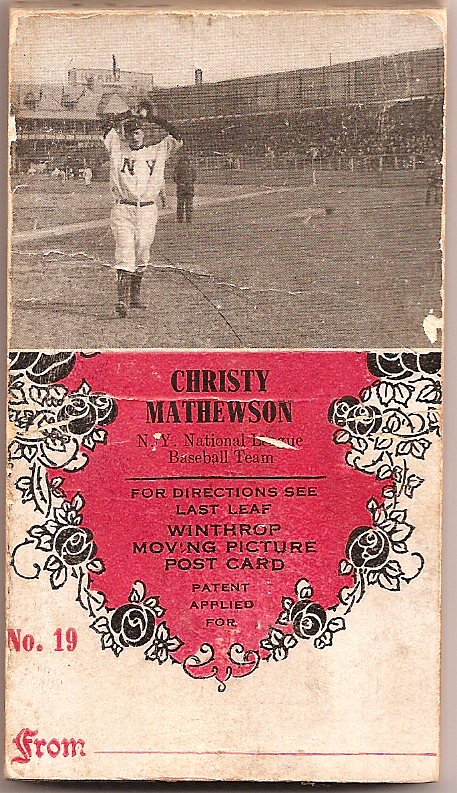
In fact, bluntly, the second or third best “film” of Mathewson in action is from a “flip book” (A Winthrop Moving Picture Post Card, to be precise) – a delightful hand-held series of still pictures from 1907 which when skimmed through with the thumb, create an animated representation of Mathewson’s legendary form. If you grew up on the legend of the hero who died so young and so loved, it can make you tear up. I got one last year – here’s the cover:
Matty1907.jpg
It’s wonderful, but even here, he’s just, well, throwing. He’s a professional, to be sure, and his mechanics would make any pitcher jealous, but, again, where’s the beef? 

Mathewson was famed for one piece of advice to young pitchers, which would cause him to be banned from the field today, as pitching coaches clapped their hands over the ears of their young charges: Don’t put everything you have on every pitch. Save something for the 9th Inning (that might explain his 435 Complete Games). Still, this is ridiculous. He had to have had something more in the way of exertion or form – in an era of contact hitting when a batter striking out 100 times in a season was likely to find himself in Decatur, Illinois the next year, he led the National League in strikeouts five years out of six and ended with more than 2500. But where was the visual, visceral, proof?
In the basement of the Hall of Fame, that’s where.
I was handed a series of glass images, each about four inches by five, that were nothing less than the “magic lantern slides” that used to be projected in movie houses, in the pre-newsreel days. You just couldn’t set up film cameras in 1911 and hope to get anything meaningful in the way of action or highlights. But the box camera did the trick.
And there it all was: the key plays of the 1911 World Series, right down to the consecutive home runs in Games Two and Three that earned A’s third baseman Frank Baker the nickname “Home Run,” and first lit the fire in the public’s imagination about the longball. It can be argued that those two dingers – one which tied up the game in the 9th, the other which won one – set the stage for the next century of Home Run Mania, and the constant alteration of equipment, ball, stadium dimensions, and pitching rules that has ushered in era after era of “The Home Run Era” virtually without interruption.
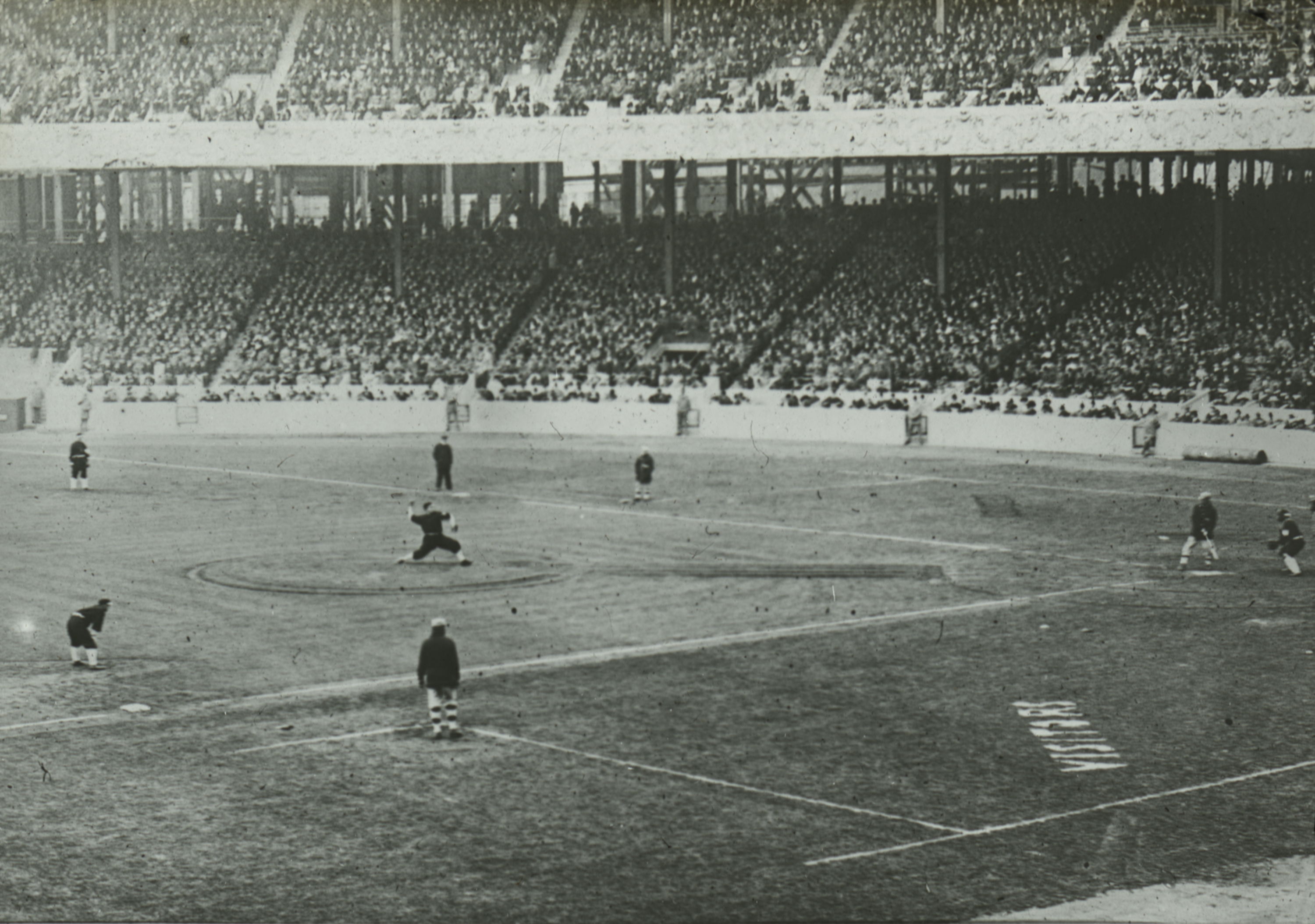
And there was one other image in there that took my breath away. I originally posted a blurry snapshot taken with an iPhone, but the warm and friendly curators took pity on me and sent… this:
Mathewson Christy 348-65d_Act_PD.jpg
Credit: National Baseball Hall of Fame Library, Cooperstown, N.Y.
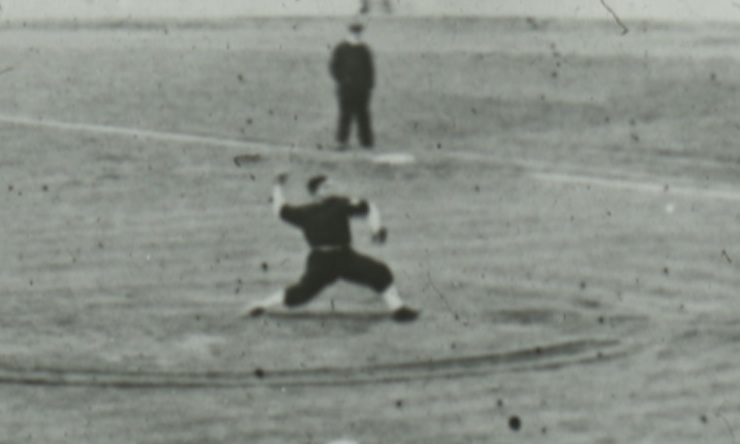
The figure in the middle of the diamond is Christy Mathewson, and what he is doing couldn’t have surprised me more than if the slide showed that he had his 2009 Lamborghini parked behind home plate.
He is clearly delivering at one of those moments when he would have advised the kids to throw as hard as they could. He is firing. And his delivery is precisely that of the modern power pitcher. His frame, 6′ 1-1/2″, is so low to the ground that the back knee is nearly touching it. He is in classic fireballer position, as aware of the physics of pitching as anybody who has followed him. 
In fact, the first thing I thought when I saw that slide was: ‘What’s this picture of him doing mixed in here?’:
Seaver.JPEG
Christy Mathewson had Tom Seaver’s delivery. That’s it. That’s who I thought I was seeing in that slide from 1911. Old Dirty Knees Seaver.
Or, if that’s not enough of a reference, let’s say he had a righthanded version of this guy:
Koufax.jpeg
A detail suggests a weird twist to the forearm, which (historians think) was how Mathewson threw his famous “Fadeaway” pitch, believed to have necessitated the same painful twisting of the arm as Carl Hubbell’s screwball (it’s probable Matty’s pitch was a screwball). If this is what it took, it is stunning that he lasted seven seasons, let alone seventeen. The similarities here also gives an almost eerie sense of looking back through time, and being there, just for an instant, as Matty explains to all who would follow him, and all who would wonder about him, just who he was, and why he still counts. 
Nice to meet you, Mr. Mathewson.
MattyCropped.jpg
Credit: National Baseball Hall of Fame Library, Cooperstown, N.Y.
Self-Congratulations And Another Gem From The Hall

Nate McLouth, since his trade to the Atlanta Braves:

.263/.344/.433/.777, 6 HR, 19 RBI, 9 SB, 34 R

Andrew McCutchen, since McLouth was traded, and he replaced him in Pittsburgh:

.293/.349/.488/.837, 6 HR, 31 RBI, 9 SB, 37 R

This blog, from June 3, 2009:

Did Pirates Upgrade In Center?

Don’t get me wrong about Nate McLouth. Great guy, hustles, works hard, busted his butt at an All-Star Game, better than anything the Braves had in their outfield before tonight’s trade. I’m just not convinced Pittsburgh didn’t improve its line-up by replacing him with Andrew McCutchen….The key to this trade is that McLouth’s replacement does not come from it. McCutchen, who arrives in Pittsburgh as McLouth’s equal in speed and outfield skill, probably more than his equal for batting average, and eventually capable of producing 75% of his power, nearly made the majors out of spring training. The Pirates were sorely tempted to damn arbitration and take him north – that’s how authoritative a hitter he looked in Florida.

I do not see McCutchen keeping up homer-for-homer with McLouth and the RBI margin seems out-of-joint. But the point is, you’d be hard-pressed to criticize the Pirates for this trade – and this wasn’t the trade.


It was not McLouth for McCutchen, it was McLouth for Charlie Morton, Gorkys Hernandez, and Jeff Locke. Also, to this point, the first guy out of the minors in the haul for McLouth, Morton, is 2-3, 3.72, with three quality starts out of eight (and three out of his last five) and the number is so low because he left injured after one inning in his first, and was pulled after five and about a 90-pitch limit in two others. In short, he’s started eight times, pitched well six, pitched startlingly well, twice.

Two months is a pretty good sample size. This is not to say the Braves made a mistake dealing for McLouth. But the Pirates came out more ahead of the roster shuffling then did Atlanta, and the difference is likely to grow with time.

BACK TO COOPERSTOWN:

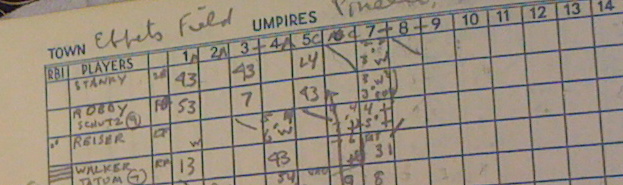
Spent three days, all told, in the library, in the photo archive (actually a giant room with 25,000 images, kept in cold storage, including the original images from Addie Joss day in Cleveland in 1911 – you’ve seen them – the American League All-Stars with Walter Johnson and Cy Young and Nap Lajoie, and Ty Cobb in a Cleveland uniform). I hope to illustrate something remarkable from the photo vault in the next few days, but in the interim, another special something from the scorebook collection:

IMG_0917.jpg

This is the 1947 book of veteran New York baseball writer Tom Meany – his bibliography is a couple of pages worth and he ended up as PR Director of the Mets. And that’s Jackie Robinson’s debut game. Closer:
IMG_0917.jpg
That’s him, batting second: “Robby.”
Better still, on the preceding pages, Meany shows he was at the final Dodger exhibition games, including Robinson’s last with Montreal against the Dodgers, and then two exhibitions at Ebbets Field for the Dodgers, against… the Yankees.

Recommended Prospects, Recommended Reading (Updated)

Funny that with all the big names moving before the deadline, the number of primo prospects was actually pretty low. I was particularly unimpressed with what the Indians got for Cliff Lee (and Ben Francisco) although I am only about ten percent insufficiently skeptical to address the Lee deal as I did the McLouth one – that the trading team was selling a guy, if not at peak value, then at the last moment he would be seriously overvalued, and were doing well to get anything hopeful back.

Having said that, if you still consider Justin Masterson a prospect and not a full-fledged major leaguer, he was clearly the most gifted of all the players given up for “the names.” A year from now, when Brad Penny and John Smoltz and who knows who else are Red Sox memories, Boston would not have parted with him, and not just because of his pitching gifts. The Sox are astounded by his quiet leadership, an almost unheard-of quality for a pitcher. He doesn’t rant, he doesn’t yell, he doesn’t slap his glove against his thigh, and nothing bleeds from his sock. He just inspires his teammates to feel more secure about their talents and accomplishments, and their prospects for winning the game. Terry Francona will miss him, maybe not today, maybe not tomorrow, but soon, and for the rest of his life.
And ironically, given how they are howling in Pittsburgh over the exiling of McLouth, then Jack Wilson, then Freddie Sanchez, the head-and-shoulders pick for the top pure-prospect traded against the deadline was the guy the Bucs got for Sanchez, pitcher Tim Alderson. Harkening back to the Johan Santana/Yankees post here, the rule of thumb is that half of all pitching prospects fail. That would ordinarily discourage the ever-discouraged Pirate faithful. However, Alderson and Charlie Morton are both front-of-rotation, ace-of-staff prospects. If one makes it and the other turns merely into a righty Jarrod Washburn, they’ve done awfully well – and this assumes that very little else from the McLouth or Wilson trades bears great fruit, which is not necessarily a correct assumption.
One more deadline note. The amazement at the Adam LaRoche/Casey Kotchman trade itself amazes me. The Red Sox made a similar acquisition in 2004, a glove-first, low-power starting first baseman, about whom everyone said “where they gonna play him?” His name was Doug Mientkiewicz and the point was, his window as a starting player was pretty much over, as is Kotchman’s. He will never hit enough. So you keep the defensive whiz as your back-up and pay for it by spending the middling slugger with the middling glove. The only complication this time is that the Boston backup on those days when Victor Martinez is playing first, is a fellow named Youkilis, and he’s no slouch.
BRIEF UPDATE NOT WORTHY OF ITS OWN POST

The Rangers sent Frank Francisco out on rehab to AAA. To Frisco of the Texas League. Making him Frank Francisco of Frisco.
Nearly as good as Johnny Podres of the Padres, Jim York of New York, or Ted Cox of the Red Sox.
READ – IN FACT, YOU’RE DOING IT NOW!

Three books to endorse with high praise and the caveat that I’m mentioned in one, and two of them are written by friends. I write as a guy who was once the country’s only nationally-published reviewer of baseball books (who once gave the second edition of The Baseball Encyclopedia a panning for some awful typos) so finding three I like at one time is quite a feat.
First there’s Marty Appel’s Munson: The Life And Death Of A Yankee Captain. When a book reveals details of a man’s life to his own family, it’s a pretty good book. I am duly impressed both with the research effort and the clarity of Marty’s work, and the attempt to recreate that sad day 30 years ago tomorrow when Munson’s death shocked baseball. It is not happy reading, but it is worthwhile reading.
I think Ron Darling may have written (let’s broaden it out to all of them who didn’t go to Yale; even co-written) the best book by a pitcher since Kirby Higbe’s HIgh And Inside. Ron’s is called The Complete Game and it takes a novel approach: a pitch-by-pitch, thought-by-thought recitation of key innings of key games, nearly all of them his own, throughout his long span in college and major league ball. Apart from taking you inside an entire team’s thinking as the pitches succeed each other, Ronnie also underscores what is to me the most underrated skill among elite athletes: Memory. Nearly all of the microscopic detail (what he was thinking between the third and fourth pitches, to the third hitter, in the fifth inning, of his thirteenth start, etc) was pulled from his recall and simply verified in the record books. He rolls the details out the way Gordie Howe once rolled out each shot he took in a Detroit Red Wings-New York Rangers game, 27 years after he played it. A great read, and very well written.
Almost not at all written is the third suggestion: Chris Epting’s The Early Polo Grounds. This is 181 pre-1925 photos taken at the legendary home of The New York Giants and it borders on time travel, even if the captions aren’t always complete (a date of an October, 1910, photo is disputed by the author because the Giants didn’t play in that year’s World Series; he seems not to have known that in those days the Giants and Yankees regularly played post-season series for the “Championship of New York”). Having just spent hours in the photo vaults of Cooperstown looking at all the photos of the fabled ballpark, I can say that this collection rivals that part of the Hall’s from the 20th Century – plus, they won’t arrest you if you try to take it home.