Tagged: Keith Olbermann
Hey Hey!
Thank God.
A year too late for him to enjoy it, 30 years past the day he should’ve been selected, the Baseball Hall of Fame Veterans’ Committee has finally elected the most deserving candidate not in Cooperstown, Ron Santo.
For those who doubt, here is my statistical analysis of the five leading playing candidates:
The simplest tool for judging a player against his contemporaries is, I think, the most overlooked one – exact comparisons, from a guy’s debut season through his final year.
Awards are useful, especially as an indicator of greatness – in Ron Santo’s case, the five straight NL Gold Gloves 1964-68 pretty much confirm his defensive prowess – consider the one from 1964, when Cardinals’ third baseman and defensive hero Ken Boyer was MVP, but Santo still won the Glove.
The hardware is nice. But statistics are better.
In short, in his era, from when he came up with the Cubs in 1960 through his last year with the White Sox in 1964, Ron Santo was one of the top ten hitters in all of baseball.
Santo was fifth in RBI in his era.
Santo was ninth in Runs in his era.
Santo was tenth in Homers in his era.
Santo was tenth in Hits in his era.
There are 17 players besides Santo on these four lists of the top ten offensive producers of the 1960’s. Only four men on all four lists: Aaron, Frank Robinson, Billy Williams – and Santo. Even the three men who are only on three lists, compared to Santo’s four, are all in Cooperstown already.
Needless to say, only one other full-time Third Baseman (Brooks Robinson) shows up on any of the four lists – and he, only twice. Part-timer Killebrew is on three of them: handily ahead of Santo in one (HR), behind Santo in another (R), and just two spots and only 74 RBI ahead of him in the third.
You can’t ask more of a man than to produce those kinds of numbers against his direct contemporaries: what he did while he played, compared to what everybody else did while he played, is all that he can be judged on. But it focuses exactly where a player stood against his peers.
By the way, if you want to be more generous to Santo, and judge him from his first full year as a regular (1961) through his last year as an everyday player (1973) he looks better still: he holds at fifth in RBI, but moves up one spot each in Runs (eighth), Homers (ninth), and Hits (9th).
I had Gil Hodges second.
Again, what he did in his time tells me what I need to know. Here is a list, updated through May 5, 1963 – the date Gil Hodges played his last game in the major leagues.
All-Time MLB Home Run Leaders (RH Batters):
1. Jimmie Foxx 534
2. Willie Mays 373
3. Gil Hodges 370
4. Ralph Kiner 369
5. Joe DiMaggio 361
6. Ernie Banks 340
7. Hank Greenberg 331
8. Hank Aaron 307
8. Al Simmons 307
10. Rogers Hornsby 301
By the way, on the all-time homer list, lefties and righties both, Hodges had just been knocked out of 10th place, by Mays (373 to 370). The game changes. Still, it is extraordinary that Hodges’ home run performance measured against all his contemporaries and predecessors, is pretty much ignored.
Hodges’ career spanned 20 calendar years, but he only played regularly from 1948 to 1959. In “his” era, Hodges was second in MLB in homers (344, to Duke Snider’s 354), second in RBI (tied with Berra at 1136, behind Musial’s 1226), fourth in Runs, and seventh in Hits. Hodges is often dismissed as a “Home Park Homer Hitter.” In fact in his ten years at Ebbets Field he averaged only 4.60 homers a year more in Brooklyn than on the road. For comparison, Duke Snider, in the Hall since 1980, averaged 4.56 homers a year more in Brooklyn than on the road.
It is also of note that Hodges hit 27 or more homers in eight consecutive seasons, drove in 102 or more runs seven years in a row, and the first baseman on two World’s Champions and four more NL champs.
Haven’t even mentioned Hodges the manager (1969 Miracle Mets) nor Hodges the Man (I have never, ever talked to anyone who knew him who didn’t revere him.
Third on my list? Luis Tiant. Bill James hit the nail on the head: Luis Tiant is Catfish Hunter with poorer marketing.
Statistical doppelgangers are often either coincidental, superficial, or irrelevant because the players are of different historical eras. Not Hunter and Tiant. They pitched side-by-side in the same league for fifteen seasons, in the same division for six, and were teammates for a year. And they look like twins in a dozen key stats:
Statistic Hunter Tiant
Starts 476 489
Complete Games 181 187
Shutouts 42 49
Innings 3449.1 3486.1
Home Runs 374 346
Wins 224 229
Losses 166 172
ERA 3.26 3.30
Run Support 4.30 4.46
20-Win Seasons 5 4
Sub 3.00 ERA Seasons 5 6
‘Wins Above Team’ 20.2 20.6
That’s right: Tiant made 13 more starts, won five and lost six more games, threw seven more shutouts, and finished with an ERA 0.04 higher, than Hunter. Otherwise, they share a virtually identical statistics.
Where they deviate leaves open the question of which was the better pitcher. Tiant had 404 more strikeouts, but 150 more walks. Hunter twice led the AL in wins, which Tiant never did. Tiant twice led it in shutouts, which Hunter never did. Tiant twice led it in ERA, which Hunter did once.
Hunter’s big advantage? He made 22 ALCS and World Series starts to Tiant’s five. He was seen on the biggest stage, by fans and reporters alike, for seven of eight Octobers. Tiant had only one shot at such impact.
Beyond the Hunter comparisons, in the match-him-against his era numbers, Tiant was ninth in wins, tenth in K’s, twelfth in ERA, 1964-80 (even though in five of those seasons he did not make even 20 starts).
And there is one more remarkable and overlooked statistic. Two of Tiant’s six sub-3.00 ERA seasons were actually sub-2.00 ERA seasons. Since 1920, only 29 pitchers have had a seasonal ERA under 2.00. Koufax did it three times, and the other four did it twice: Roger Clemens, Greg Maddux, Pedro Martinez – and Tiant.
Fourth – and he’s right below Tiant – is Minnie Minoso. He’s kind of damned by the overall quality of his play: superb at a lot of contradictory things, not extraordinary at any one of them:
Who were the top five hitters during Minnie Minoso’s 13 seasons as a Major League regular, 1951-63? Keep it to the guys who averaged at least 475 at bats a year and here’s the headline: one of them was Minnie Minoso.
Highest Batting Average 1951-1963 (Minimum 6175 AB)
1. Stan Musial .319
2. Willie Mays .315
3. Richie Ashburn .309
4. Harvey Kuenn .307
5. Minnie Minoso .299
Note please, that performance included eight .300 seasons. It’s impressive stuff, but below is my favorite Minoso stat:
Highest Slugging Percentage 1951-1963 (Minimum 6175 AB)
1. Willie Mays .588
2. Stan Musial .543
3. Eddie Mathews .535
4. Minnie Minoso .461
5. Harvey Kuenn .417
The slugging number is especially astounding given that Minoso only hit 184 homers in those 13 years (28th in the era). Without being a real longball threat, he still places 8th in total bases in the span, and 9th in RBI.
Most Runs Scored, 1951-1963
1. Mickey Mantle 1381
2. Willie Mays 1258
3. Eddie Mathews 1220
4. Nellie Fox 1142
5. Minnie Minoso 1130
Seeing my point here? Pick a category, and Minoso shows up on it:
Most Stolen Bases, 1951-1963
1. Luis Aparicio 309
2. Willie Mays 248
3. Maury Wills 236
4. Minnie Minoso 205
5. Billy Bruton 193
Minoso is also fifth in hits in the era, second in doubles (behind Musial, ahead of Mays), fourth in triples, led the A.L. in hit-by-pitch ten times, won three Gold Gloves – and all this even the color line and circumstance kept him from becoming a major league regular until he was at least 28 years old.
My fifth guy out of the group is just a notch below. I love Jim Kaat and I think he belongs (as does Tommy John). I mentioned contemporaries Hunter and Tiant looking separated-at-birth. Jim Kaat and Robin Roberts are unlikely statistical twins who overlapped by only seven full seasons:
Statistic Kaat Roberts
Starts 625 609
Innings 4530.1 4688.2
Wins 283 286
Losses 237 245
Strikeouts 2461 2357
Walks 1083 902
ERA 3.45 3.41
10+ Win Season Streak 15/15 16/17
Roberts got to Cooperstown quickly because of the fact he reeled off six consecutive brilliant seasons, and despite of the fact that after the age of 28, only once did he finish more than three games above .500 in his final eleven seasons.
By contrast, Kaat won 18 as a 22-year old, slumped for a year, then starting in 1964 reeled off 17, 18, and then 25. Eight and nine years later he would produce consecutive seasons of 20 and 21 wins. As Bill James pointed out, if like Roberts, Kaat had bunched his great years instead of scattering them, he might’ve been elected in the ‘90s. As it is, he is still 31st all-time in victories — eighth all-time among lefties:
Wins, Lefthanded Pitchers:
1. Warren Spahn 363
2. Steve Carlton 329
3. Eddie Plank 326
4. Tom Glavine 305
5. Randy Johnson 303
6. Lefty Grove 300
7. Tommy John 288
8. Jim Kaat 283
9. Jamie Moyer 267
10. Eppa Rixey 266
11. Carl Hubbell 253
12. Herb Pennock 241
There are only eight active lefties with more than 100 wins, and of them, only CC Sabathia (176) is younger than 32. Kaat is also 10th in strikeouts by lefties. Kaat’s victory total has been criticized as “padded” by his five years as a reliever and spot starter. But subtract those seasons and his career won-lost improves to 261-217, he remains in the top 10 among lefties, and still has better won-losts than Ted Lyons and Eppa Rixey (and is just behind Red Faber).
Lastly, the 16 consecutive Gold Gloves are almost a cliché. We don’t stop to think that the first of them was won when Kitty was 23, and the last when he was 38 – and that the streak stretched through five presidential administrations and three expansion drafts.
Just to show my math, here are the Homer, Runs Scored, RBI, and Hit lists from ’60-’74 that back-up Santo’s greatness:
Most RBI, Majors, 1960-74:
1 Hank Aaron, 1585
2 Frank Robinson, 1412
3 Harmon Killebrew, 1405
4 Billy Williams, 1351
5 Ron Santo, 1331
6 Brooks Robinson, 1217
7 Willie Mays, 1194
8 Willie McCovey, 1190
9 Carl Yastrzemski, 1181
10 Orlando Cepeda, 1164
Most Runs Scored, Majors, 1960-74:
1 Hank Aaron, 1495
2 Frank Robinson, 1390
3 Billy Williams, 1306
4 Lou Brock, 1303
5 Willie Mays, 1285
6 Carl Yastrzemski, 1240
7 Pete Rose, 1217
8 Vada Pinson, 1177
9 Ron Santo, 1138
10 Harmon Killebrew, 1131
Most Homers, Majors, 1960-74:
1 Hank Aaron, 554
2 Harmon Killebrew, 506
3 Frank Robinson, 440
4 Willie McCovey, 422
5 Willie Mays, 410
6 Billy Williams, 392
7 Frank Howard, 380
8 Norm Cash, 373
9 Willie Stargell, 346
10 Ron Santo, 342
(Note: 11th was Orlando Cepeda, 327)
Most Hits, Majors, 1960-74:
1 Billy Williams, 2505
2 Hank Aaron, 2463
3 Brooks Robinson, 2459
4 Vada Pinson, 2455
5 Lou Brock, 2388
6 Pete Rose, 2337
7 Roberto Clemente, 2318
8 Willie Davis, 2271
9 Carl Yastrzemski, 2267
10 Ron Santo, 2254
(Note: 11th was Frank Robinson, 2220)
Calvin Schiraldi: Sportsman
Frankly, MLB Network’s special 25th Anniversary commemoration of the 1986 World Series which premiered last night, could have been 7 long highlight “packages” with only my friend Bob Costas merely introducing them, and I would’ve enjoyed it.
But something unexpected happened. The players who joined Costas and Tom Verducci were Mookie Wilson of the Mets, and Bruce Hurst and Calvin Schiraldi of the Red Sox. Wilson has long been a source of reflective information on the dramatic series between the Mets and Red Sox.
Hurst proved himself erudite and frank – just as he was as a player, who was never an “easy” interview but always an insightful one. Several times he responded – reluctantly but bluntly – to particularly outlandish and unsupported comments about his teammates from 1986 Red Sox manager John McNamara, who seems to have settled in to an emeritus stage devoted to blaming the players for his erratic managing, especially during Game 6.
Costas, Wilson, Hurst, and Verducci were fine. But Schiraldi was a revelation.
He, of course, was the star-crossed Boston closer, former college teammate of Roger Clemens, and an ex-Met prospect all too familiar to his old teammates, who had struggled in the ’86 A.L. Championship Series and managed to help give back a World Series win though he retired the first two men, and had two strikes on the third, in the bottom of the final inning. It is nearly almost literally true that the last time Schiraldi was heard from publicly, he was staggering off the field at Shea Stadium, a 24-year old with his future behind him. He had seemed, at best, far from confident, and, at worst, shattered. Schiraldi would be exiled to the Cubs in 1988 and would be out of the majors in 1991.
For the first hour or so of the program Schiraldi, his once-boyish face now covered in a graying beard, wearing a strange sweatshirt and clashing with the impeccably dressed Hurst, seemed terse to the point of embarrassment. There was a kind of cringe factor growing as the game-by-game recollection of the Series moved inevitably towards his nightmare in Game 6.
But this time, Calvin Schiraldi starred.
He revealed that before Dave Henderson’s homer gave the Red Sox the lead in the top of the 10th Inning, he had been told that he had pitched to his last batter, that somebody else would throw the bottom of the presumably still-tied frame. He didn’t say it until provoked, but anybody who has ever played sports, or covered them closely, or just experienced a high-adrenaline environment, suddenly understood what happened. Having thrown two innings in the tensest environment possible, Schiraldi had been told to gear down, that he was “done.”
This is, of course, the moment during the horror film where you the viewer think the carnage is over and you’ve survived – the “placing the flowers on Carrie’s grave” moment, just before her hand shoots out of the ground to claim you. Physiologists will tell you it is not a purely psychological phenomenon. The energy and the adrenaline abate. And when it turns out Carrie is reaching out – or the manager says “Calvin, now we’ve got a two-run lead, go back out there and wrap this up” – when you reach for that energy, it’s not there – and you are on your own, and on your own against Carrie.
The show’s insight could’ve ended there with Schiraldi giving an explanation (but not an excuse) for what happened during the last 0.2 of the 2.2 innings he pitched that night. But then came something transcendent. He was asked how he felt now about the game and the series and he, presumably unknowingly, defined the true value of sports.
Schiraldi said he was obviously unhappy at the outcome of the game and the series, but he would not change the experience if it meant changing who that night made him become. That’s when Schiraldi revealed the meaning of his unusual sweatshirt. For more than a decade he’s been the baseball coach – and a teacher – at St Michael’s Catholic Academy in Austin. And the things he learned in the majors, particularly in Game 6 of the 1986 World Series, have formed the core of his value and coaching systems.
He’s used that inning to teach kids about sports – and life.

Calvin Schiraldi (L) with Bruce Hurst on MLB Network's 1986 World Series Special
You have to hear him say it, to truly appreciate it. The MLB retrospective on the ’86 Series runs again tomorrow and Sunday afternoons at 1 PM ET. Find a way to watch, because 25 years later, Schiraldi has had an impact that merely getting the last out could never have afforded him.
NL Central 2012: Ryne Sandberg Versus The Cubs?
Fascinating that the St. Louis Cardinals have asked the Phillies for permission to interview their AAA manager Ryne Sandberg – and received it.
For the second consecutive year, Sandberg will not get the managing job with the team for which he starred. When new Cubs’ President Theo Epstein outlined his minimum standards for the next manager (experience as a major league skipper or coach) it essentially eliminated Ryno from consideration because his stints with the Phils last spring and last September do not formally rise to that level.
Yet oddly, the Cardinals are happy to at least kick the Sandberg tires. I’m not sure what it proves, but it would seem to suggest that the division of thought on Sandberg’s managerial potential may now split into those who have seen him, the Hall of Famer, willing to ride the buses of the Midwest League, and those who have actually employed him to manage their bush leaguers. Everything I heard as of March, 2010, was that the Wrigley Field job was likely to be Sandberg’s whenever Lou Piniella left. But by August, when Piniella really did leave, the Cubs had soured on Sandberg and no longer thought him viable. Off he went to the Phillies, and now they are willing to let him talk to a National League rival, and there hasn’t been a peep about Sandberg even getting a promotion to the Phillies’ major league coaching staff. Even stranger, is that before he took the Phils’ offer last winter, Sandberg interviewed for the equivalent job in the Boston system – with Theo Epstein, the same man who’s ruled him out in Chicago.
I’m reminded of Babe Ruth’s quixotic hope that the Yankees would make him their manager (they’d seen him do that with his teammate, Bob Shawkey, who had only one season managing in the minors before he got the job in New York in 1930). Perhaps the more apt comparison is Gary Carter’s campaign to get the Mets to consider him for any of their last few managerial openings.
If Sandberg doesn’t get the St. Louis job, the Cubs-Cards rivalry might still be ratcheted up by the inclusion of Terry Francona in the mix. While Epstein has said a few polite things about possible Chicago interest in Tito, the Cardinals are scheduled to interview him tomorrow. I still think St. Louis is leaning towards LaRussa’s third base coach Jose Oquendo (although I would have considered it more than “leaning” if they had brought Oquendo back into the dugout as bench coach), but it would be a fascinating dynamic if Francona got the Cardinal job and was pitted against his old cohort Epstein in Chicago.
Besides the headline names, the Cards and/or Cubs seem interested in a lot of the same men the Red Sox are interested in: Rangers’ pitching coach Mike Maddux, former Brewers’ interim skipper Dale Sveum, and Phils’ bench coach and ex-Reds and Pirates’ interim manager Pete Mackanin. If you want to follow all this on a day-to-day or even hour-to-hour basis, your best resource is the terrific MLBTradeRumors.Com site, which is a clearinghouse for every local newspaper story, every significant radio interview, and every last damn tweet on anything moving in the majors. It puts the ESPN’s and SI’s sites to shame.
So stay tuned to the prospect of Sandberg or Francona in St. Louis, and if you’re a Cub fan again tearing out your hair about Ryno, consider this Cooperstown fact. These are the Hall of Fame players who, since 1900, went on to manage “their” team: Honus Wagner (Pirates), Ty Cobb (Tigers), Walter Johnson (Senators), Tris Speaker (Indians), Nap Lajoie (Indians), Eddie Collins (White Sox), George Sisler (Browns), Rogers Hornsby (Cards and Cubs), Fred Clarke (Pirates), Jimmy Collins (Red Sox), Frank Chance (Cubs), Johnny Evers (Cubs), Joe Tinker (Cubs), Frank Frisch (Cardinals), Pie Traynor (Pirates), Mel Ott (Giants), Bill Terry (Giants), Gabby Hartnett (Cubs), Ted Lyons (White Sox), Joe Cronin (Senators and Red Sox), Lou Boudreau (Indians), Dave Bancroft (Braves), Yogi Berra (Yankees), Eddie Mathews (Braves), Red Schoendienst (Cardinals), and Tony Perez (Reds). That’s 26 guys, who managed a lot of years, yet won only 18 pennants among them — and 13 of the 18 were as player-managers and four of those were by Frank Chance. In other words, of the other 25 hometown heroes who later managed, they could collectively amass only five pennants as non-playing skippers.
You Can Rely On ESPN: They’ll Always Let You Down (UPDATED)
There is a reason ESPN has been gradually losing its status as the go-to television outfit for baseball.
It is not just the attempt to turn Baseball Tonight into some sort of summer-time version of the college football pregame show. It’s not the seeming pairing of every actual baseball expert like Buster Olney with an info-challenged sidekick like Wendi Nix. It’s not the ludicrous and already jab-pencils-into-your-eyes repetitiveness of John Kruk’s segments on the “best seats” in each stadium, each of which make the asinine features Steve Lyons used to do for our pre-game show at Fox look like doctoral theses. It’s not even the cancellation of the lumbering Sunday Night game telecast in favor of a new program that I think is called Bobby Valentine’s Three-Hour Autobiographical History Of The World.
I mean, seriously, another week of this and I’m sending Sherpas out to search for the bodies of my friends Orel Hershiser and Dan Shulman. I only hope they are out there somewhere, doing the really good two-man-booth broadcast of which they’re capable, to an audience of St. Bernards and Yetis.
Those are just symptoms of the reason ESPN has turned itself into a distant No. 2 in the battle with MLB Network. The disease is: ESPN is no longer invested in baseball and no longer trusts it to carry its own weight. And this didn’t just start when MLB Network came on the scene with its necessary advantages of being the in-house outfit permitted to carry basically anything it wanted, almost any time it wanted. I can recall that in the middle of the “nuclear winter” of 1994-95, the Rangers traded Jose Canseco to the Red Sox. Canseco was no longer the incumbent MVP, but he had just been voted “Comeback Of The Year” and still had five 20+-homer seasons to go. The Canseco trade, instead of getting at least some of the attention it merited, was buried in a little tag-on feature at the end of SportsCenter called “News And Notes.”
We all know what the network, and that show, are about these days – promoting other ESPN products and reducing sports to merely another form of entertainment living somewhere in the neighborhood where Mariah Carey’s twins matter more than the Minnesota Twins. There’s nothing wrong with that neighborhood, just don’t impose it on actual sports fans.
But ESPN’s disconnect from baseball is now part of its DNA. It may in fact be the case that the last things that really tethers true baseball fans to the Worldwide Leader are its game broadcasts (especially for those deprived of access to MLB Net), and what had been an efficient and sometimes innovative baseball fantasy game. But even that latter slender thread is fraying. A few seasons back the computer program somehow “lost” more than a week’s worth of the daily roster juggling for literally tens of thousands of fantasy players, screwing up countless leagues and strategies. And now this weekend, the system by which ESPN manages the only “content” thing it is required to stay on top of – which real-life players are hurt, and which ones have been called up to the majors – collapsed.
Pablo Sandoval of the Giants broke a hamate bone and early Saturday was placed on the disabled list. As anybody who’s ever played fantasy baseball knows, an injury like that is mitigated only by the opportunity to place Sandoval on your disabled list and add another player to replace him in your line-up. In some leagues, you can do that instantaneously: as soon as a player gets hurt, you can rush to your computer, place Sandoval on your disabled list, and “pick up” his replacement. In others, the process occurs via scheduled “waivers,” which can be daily, or every few days, or weekly. But whatever the process, it’s possible to put Sandoval on your disabled list only after ESPN has put him on its disabled list, and as of Sunday evening, more than 24 hours after the Giants put The Panda on the shelf, the ESPN computer geeks had failed to do so.
For Sandoval’s thousands of “owners” – and by the company’s own stats he is “owned” in every single one of the leagues it operates – they are thus not only deprived of his services and the opportunity to replace him, but conceivably could have sat there in frozen and agonized horror while other owners in their league got to his potential replacements first. A call to ESPN’s fantasy “help” line revealed this disturbing fact: the phone operator said the game managers never updated disabled list eligibility over the weekend, so Sandoval would likely not be made DL-eligible before Monday. If it hadn’t happened by then, the operator helpfully suggested, they could write up a “ticket” and see if the problem could be corrected in the next few days.
When I was at ESPN, the then managing editor John Walsh used to forcefully remind us that all the research data on the constancy of the audience produced the same stark data: they were the most loyal in television, and planned to remain loyal for ever more – unless somebody came along and offered them a better product. Leaving a few thousand fantasy players remembering the weekend “ESPN” became a four-letter word may not seem like a back-breaking straw, but combine it with the soliloquies of Bobby V and the knowledge that the network’s key games will soon enough get trundled off to the backwaters of ESPN2 to provide space for football exhibitions – to say nothing of the existence of a truly superb 24-hour product from MLB Network – and you can almost watch the loyalty dissolving before your eyes.
You know what? MLB Network doesn’t offer its own baseball fantasy league product. I wonder what would happen to ESPN’s baseball audience if it did.
Update: two hours after I posted this, guess what happened? Somebody at ESPN’s Fantasy Games outfit…placed Kung Fu Panda Sandoval on the official computerized Disabled List.
The Proverbial One Legged Butt Kicking Contest
Logan Morrison of the Florida Marlins (@LoMo on Twitter) and yours truly (@KeithOlbermann on Twitter) are both out with left foot injuries. His is a sprained arch plus ligament damage to the top of his foot. Mine is a stress fracture on the top of my foot. He’s in a hard cast till next week, on crutches; I’m in a soft cast, on a cane.
The outfielder who got off to such an outstanding start was one of my wisest acquisitions for my fantasy team, and I was honored to be able to thus name the squad in memory of his late father, as I named it last year after my late father.
Needless to say, with all these coincidences, naturally we have somehow managed to challenge each other to make the cliche come to life: the proverbial one-legged men in the butt-kicking contest. We have exchanged challenge photos:
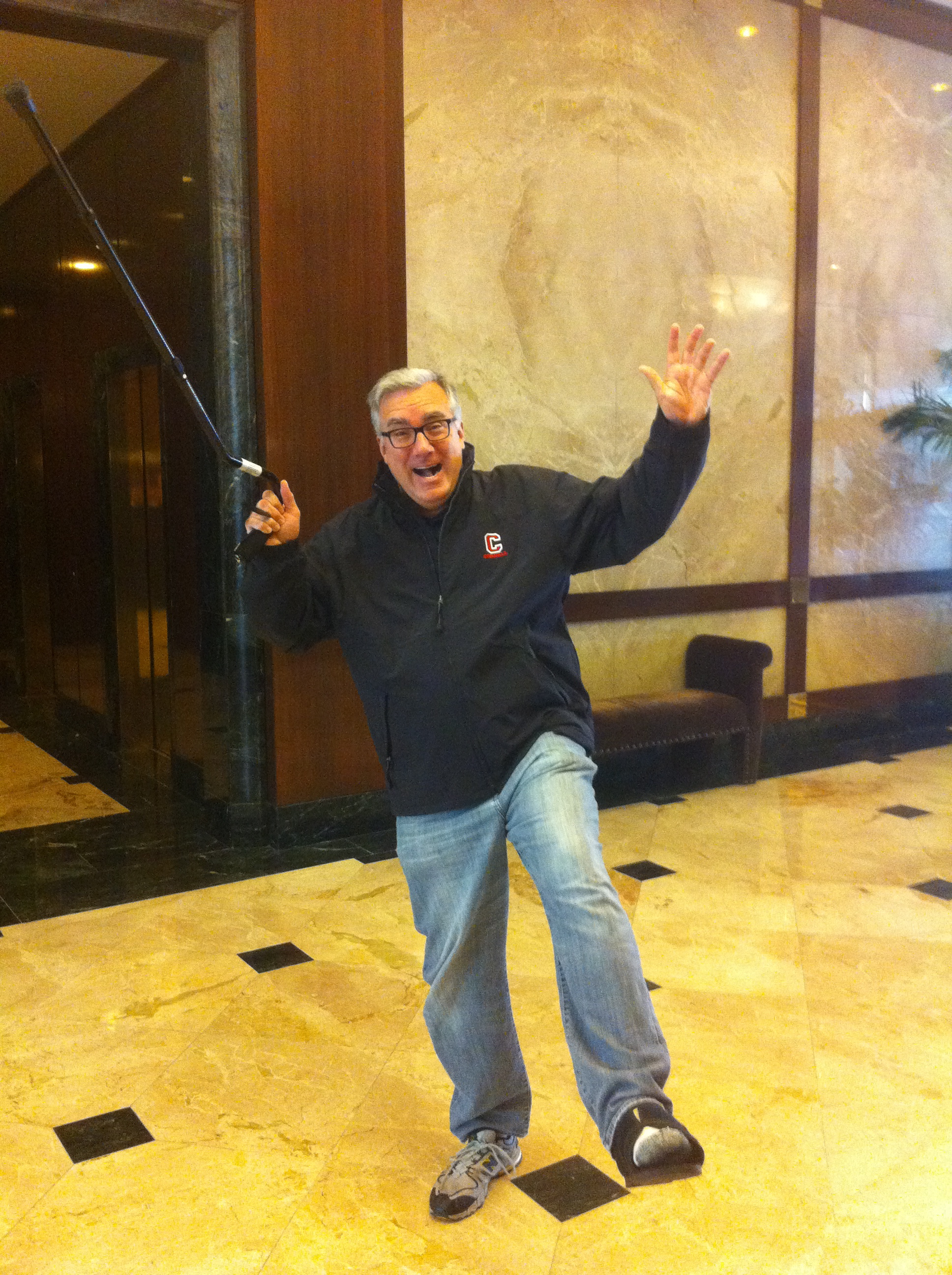 To which Mr. Morrison has responded:
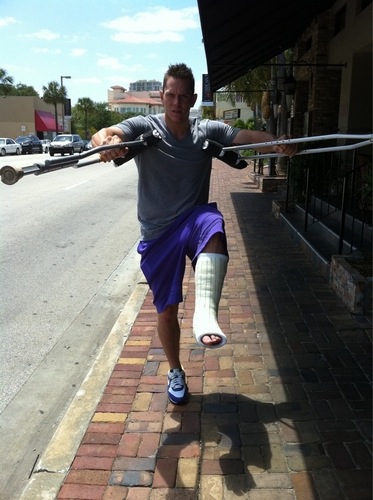 Frankly, I’m betting on him. Better stance, far better balance, and the cast is a huge advantage over my surgical shoe.
2011 Previews: N.L. West
We have yet to reach the two-week mark of the season so I suppose a preview is not utterly absurd. It is often useful to watch one of the teams in person that you thought might be good, before going out on a limb for them. Just watched the Rockies spit out consecutive infield errors and some dilatory work in the rightfield corner here in New York in one inning, and I don’t need to see any more.
Arizona: Buster Olney’s ESPN “insider” column noted, accurately, that Manny Ramirez’s next-to-last round of PED use in Los Angeles may have altered the careers of then-Diamondbacks Manager Bob Melvin and General Manager Josh Byrnes. When the juiced-up Manny led the Dodgers past the Snakes in ’08, it led to Byrnes firing Melvin in ’09, and then the team firing Byrnes in ’10. In fact Manny may have caused Arizona to screw up its whole franchise: they’re down to starting Gerardo Parra, Melvin Mora, Russell Branyan, and (at least for a time) Willie Bloomquist. The rotation actually has a little spark, particularly in Daniel Hudson, and it is possible closer J.J. Putz might not injure himself this year. But this team isn’t going anywhere. Thanks, Manny.
Colorado: there is much to revel in here but the fundamentals are not among them. Carlos Gonzalez and Troy Tulowitzki are joys to behold (and they nearly collided in the 8th inning tonight – that could’ve been $237,750,000 down the tubes – Tulo sometimes forgets he’s not alone out there), Ubaldo Jimenez is a staff ace if not necessarily the victory-machine he seemed to be last spring, and Dexter Fowler may yet be a star. But the rest of this club is pretty pedestrian and none of its cusp talent in the minors is yet ready to contribute.
Los Angeles: The Dodgers seem gradually to be back towards the ’60s all-pitching and defense teams. The Loney/Uribe/Furcal/Blake infield might be the least menacing quartet in the game and if the Dodgers are satisfied with Tony Gwynn, Marcus Thames, Jay Gibbons and, for all I know, Sweet Lou Johnson in left, they are the only ones. Given that contention requires Don Mattingly to succeed in his first shot at managing anywhere and Matt Kemp doesn’t freak out and Jonathan Broxton doesn’t blow up and the McCourt Divorce doesn’t get worse, I’m not optimistic. Three out of four, sure. All of them?
San Diego: In insulting the Dodger infield I forgot the Padres: Brad Hawpe, Jorge Cantu, Orlando Hudson, Jason Bartlett, and Chase Headley. Fortunately the outfield is just as weak and the Pods’ main power threat might be Kyle Blanks, who has been on the disabled list for a year. Sadly, gifted skipper Buddy Black’s shining moment was before the collapse last year. Now, A-Gone is; the rotation has vanished; and all that is left is a bullpen from which they must trade at least Heath Bell just in hopes of restocking the fridge. This could be a truly grim year.
San Francisco: The Giants would have to screw up – and badly – to not repeat in this division. Brian Sabean would have to do the exact opposite of what he did last year and trade away key components and I’m not betting on it. But I must say this: the Giants are rapidly becoming one of the most disliked teams in baseball – and not just because of the silly boastfulness of the ring ceremony and the rest. No World Championship team has ever been feted by fans who have been worse winners than have the 2010 Giants. I mean Red Sox Nation didn’t gloat this much like this after ’04. It’s understandable that a franchise that saw that much frustration and even peril might continue to celebrate for years to come, but there is a reason they coined the phrase “act like you’ve been there before.”
Overview: 1. San Francisco, 2. Los Angeles, 3. Colorado, 4. San Diego, 5. Arizona. I don’t think this is much of a race. he only ones who are.
National League: I like the Marlins for the wild card, drawing (and being quartered by) the Giants. Braves over the Reds in the other, Braves over the Giants in the NLDS. Red Sox over the Braves in the World Series – yes, I’m sticking with that although the Tampa Bay prediction looks weak with the injury to Longoria having deranged their batting order (I like Sam Fuld but I do not think he is your 2011 AL MVP).
2011 Previews: A.L. West
Let’s check in first on “Signal-gate”…he’s baaack…
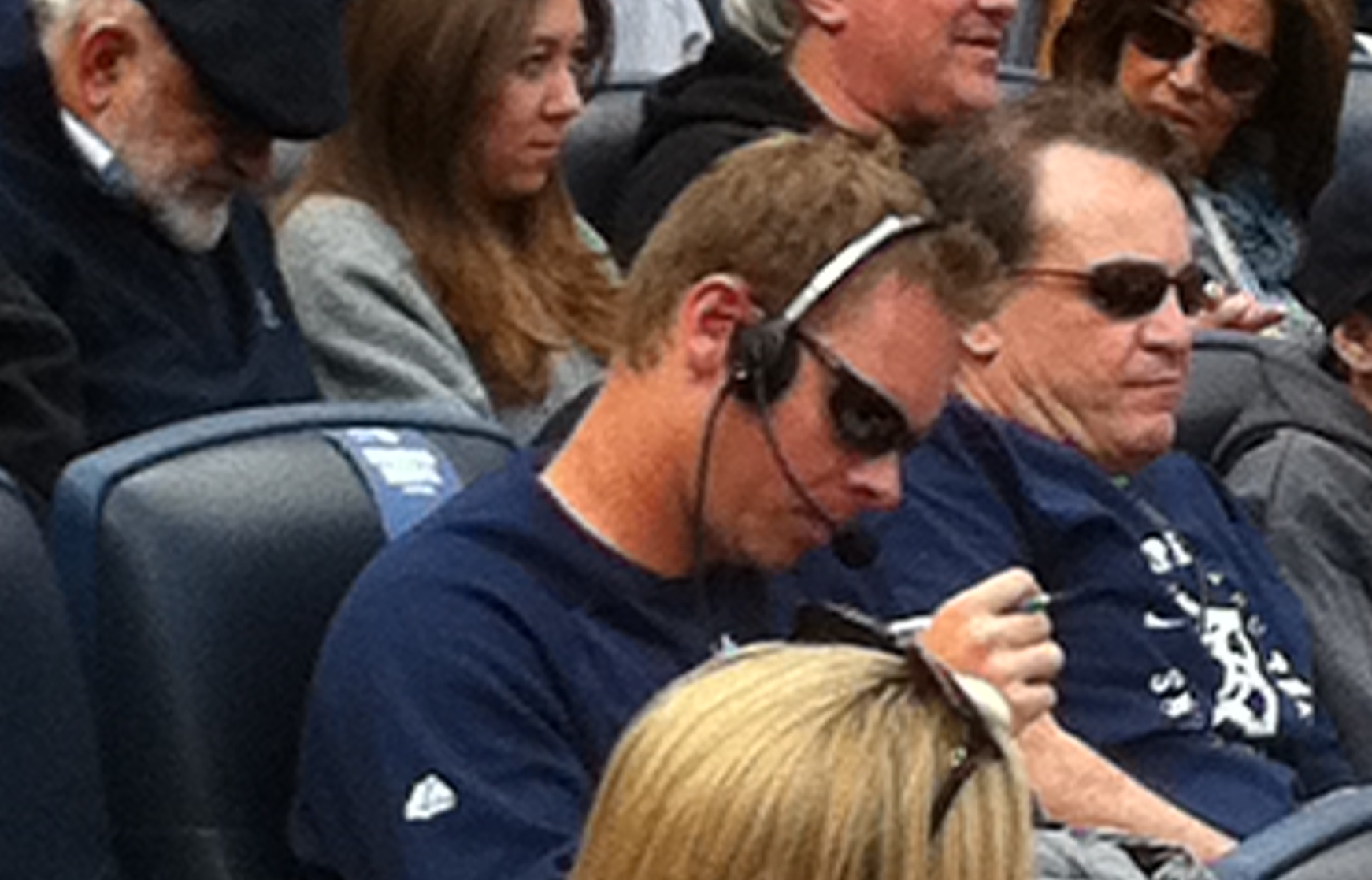 Brett Weber, the Yankees’ coaching assistant, was nowhere to be found Saturday after my little tweeted photo of him giving hand signals to Alex Rodriguez in the on-deck circle landed in the Commissioner’s Office. But for Sunday’s finale against Detroit, the former minor league pitcher was had returned to the third row back of the plate at Yankee Stadium. I didn’t stare at him – when I don’t give away my seats to Make-A-Wish I am there to watch the game – but I saw no signals today and only one player (Rodriguez) even looked fleetingly in his direction. MLB reportedly accepted the Yankees’ explanation that he was only indicating pitch speed on Opening Day because the team’s stadium scoreboard gun was busted.
That indeed explains Opening Day. It does not explain a different series of signals directed by Weber to Yankee on-deck hitters last year (especially Rodriguez). (By the way – and barring more developments, I promise to leave this trivial incident alone, but if you’d like to read a reasoned, calm blog about the response to it, here you go).
Now, having picked the Red Sox and Twins, and the Rays for the Wild Card (that’s right, they’re 1-and-8 among them – with only 477 left to play), let’s finish off the A.L. predictions:
Los Angeles: This once dynamic team is rapidly falling back into the ranks of The Dullest Place On Earth Angels of the ’80s and ’90s. There are two brilliant starters in Dan Haren and Jered Weaver, and a brilliant outfield (although if you’re going to add a gigantic salary, you reach for Vernon Wells?). But until Kendrys Morales comes back there is nothing else to distinguish this team, except for the shocking inadequacy of the bullpen (who knew Brian Fuentes could have meant so much?). I mean, even The Rally Monkey seems to have outlived his usefulness.
Oakland: Every season has a boutique, insiders’ favorite, and this year it’s the A’s. And I don’t see it. Mind you, I love this rotation and in particular Gio Gonzalez, but I am not impressed by a batting order that has allegedly been improved by adding David DeJesus, Josh Willingham, and Hideki Matsui at 3-4-5. You cannot win every game 3-2.
Seattle: And you especially can’t win them 0-2. There is a scenario in which Erik Bedard ransoms his talent from the depths of injury, and the rookie Michael Pineda blossoms, and the two of them and Doug Fister form a rotation with King Felix that puts Oakland’s to shame. But, even then, whence the offense? Ryan Langerhans is starting in centerfield. Ryan Langerhans has a lifetime .228 batting average and is just four years removed from batting .167 over 210 at bats with three different teams. Tom Wilhelmsen has made the bullpen after five years off, bartending.
Texas: Here is the most under-reported statistic of the 2010-11 off-season. The Rangers lost a pitcher who made exactly 20 starts for them, won 7, and lost 8 – and they were then promptly declared rudderless and hopeless for 2011. I am not suggesting that that is what Cliff Lee would’ve done for Texas this year (4-6 in the regular season, 2-0 in the Division Series, 1-0 in the ALCS, 0-2 in the World Series) but that is exactly what he did for them last year. Ten separate Texas pitchers won as many as Lee did for them during the regular season of 2010, including Dustin Nippert. Would things have been better for them if they’d re-signed him? Yes. You know what else would help? A farm full of Nolan Ryan clones. I’m sorry, there are no other significant downgrades here from a team that absolutely beat up the Rays in the ALDS and the Yankees in the ALCS and should’ve given the Giants a far better fight in the Series, and the additions of Adrian Beltre and Mike Napoli make a potent line-up even moreso. I don’t see them being challenged – unless Josh Hamilton breaks in half.
OVERVIEW: 1. Texas, 2. Oakland (distant), 3. Los Angeles (a good run for 3rd), 4. Seattle (not as bad as last year). The Lee panic and the Lee reality are two different things. You want to worry in Texas? What exactly would happen without Hamilton?
LEAGUE OVERVIEW: Gotta stick with Boston, which if I’m right about the Rays and the Card (although with Evan Longoria out, I very easily may not be), would presumably draw the third-place record which I am guessing is Minnesota’s. Thus it’s Texas-Tampa again and I like Texas this time, with the Red Sox finally stopping them in the ALCS.
2011 Previews: AL Central
With the fans of the 0-2 Red Sox and 2-0 Yankees having all taken the wrong instructions from these starts, let’s move into the Central:
Chicago: There are a lot of good players on this team. In fact, in a remarkable evenness ranging all the way from the bullpen to the outfield, the average White Sox player is above-average or better. Just – with the exception of Adam Dunn and Paul Konerko – not very much better. There are two men, coincidentally the team’s doubleplay combination of Gordon Beckham and Alexei Ramirez, who are on the verge of stardom. If they achieve it, if they take the cliched next step, the White Sox can compete in the division. If not, this is a team that is indeed just above-average, and bound for nothing better than second place.
Cleveland: Three unheralded stars (Carlos Santana, Shin-Soo Choo, Chris Perez), the very good Asdrubal Cabrera, and filler. Quite awhile ago the Indians stopped taking competing seriously. The ’90s saw the Kenny Loftons et al locked up early and often (in the model since successfully copied in Tampa), but the ’00s saw ownership refuse to spend the money early enough to keep the Cliff Lees and CC Sabathias, and to have clearly also not spent it on careful study of the prospect yields when that talent had to be moved (quick: who besides Matt LaPorta did they get for Sabathia? Who did they get for Lee? And it’s not enough to say, ‘yeah but they got Santana, Choo, and Perez for almost nothing’ – Lee and Sabathia should have produced at least two blossoming stars each). And this decade seems to be the time of refusing to promote prospects when the season was still fresh and up for grabs. Even when placeholder Jason Donald went down with injury, the Tribe refused to promote third base stud Lonnie Chisenhall. And an approach like that gets you not just mediocrity now, but mediocrity later – when Chisenhall leaves anyway, by trade or free agency.
The answers, by the way? Sabathia produced LaPorta, Matt Jackson, Rob Bryson, and Michael Brantley. For Lee it was Donald, Carlos Carrasco, Jason Knapp, and Lou Marson. Not acceptable.
Detroit: The Tigers should have as much pitching as they have confidence. Brad Penny is the Number Two Starter? Brad Penny, who had a 5.61 ERA in his 24 starts in the AL in 2009? One also has to doubt Phil Coke’s ability to return to starting (the Yankees traded him because lefty hitters – especially those who saw him more than once – seemed to solve him), and there is the continuing non-afterglow of Rick Porcello. Justin Verlander and Max Scherzer are studs, but Penny’s placement at #2 implies some lack of confidence in Scherzer, who might still be one of baseball’s best starters. There is also a certain creakiness here: Carlos Guillen is hurt, Magglio Ordonez is a question mark, and the major investment in the off-season was in a catcher who cannot catch: Victor Martinez. I am not excited by the Tigers and in the first two games in New York there was a certain sloppiness to their play in the field – particularly by shortstop Jhonny Peralta and sub second baseman Will Rhymes – that must have Jim Leyland ready to break up the furniture.
Kansas City: If lightning were to strike and present the Royals with some kind of Cup-A-Soup Five-Pack of instant starters, they might actually be competitive. There is a decent infield with improvements coming up at the corners by mid-season, and the all ex-prospect outfield of Alex Gordon, Melky Cabrera, and Jeff Francoeur. But there are no Cup-A-Soup Five-Packs of instant starters (even if Aaron Crow and Mike Montgomery were to step into the rotation tomorrow).
Minnesota: The Twins’ main competition in this division is their own health. If Justin Morneau and Joe Nathan do not fully relapse (and a Nathan partial relapse would be neatly covered by Matt Capps) and no other star comes acropper, I don’t see Minnesota being severely tested. The infield is stronger with Danny Valencia at third and the guy I’d bet on as of tonight for ROTY (Tsuyoshi Nishioka) at second, and the rotation deep enough to move the aptly named Kevin Slowey to the bullpen. There is much more of a gap between the Twins and the rest of the division than conventional wisdom suggests.
OVERVIEW: 1. Minnesota (in a comparative romp); I’ll go for the Beckham-Ramirez growth spurt to make it 2. Chicago and 3. Detroit. The Royals will put up a valiant fight, but it’s got to be 4. Cleveland and 5. Kansas City.
2011 Previews: AL East
Did pretty good last year: picked five of the eight post-season teams, including the Rangers and Giants. So, a little late, let’s get started on the 2011 forecasts with the American League and the East:
BALTIMORE: The Orioles have a lot going for them, not the least of which is information I couldn’t have known until tonight. Brian Matusz’s injury forces their hand on young lefty Zach Britton, who drew the most oohs-and-aahs in Florida as he mastered veterans like they were platoon guys in the Eastern League. For the Orioles to be anything more than a Cinderella team, Britton, Jake Arrieta, and Brad Bergesen will have to form a “Baby Birds” rotation as effective as the Milt Pappas/Jack Fisher crowd of 50 years ago – but less likely things have happened. The O’s have a confused but deep bullpen, and a powerful line-up that also presents an airtight infield defense if Derrick Lee and Brian Roberts can stay healthy. J.J. Hardy was described in Florida as “re-born” and Vladi Guerrero is still hitting anything that doesn’t hit the mascot. It’s also Buck Showalter’s Honeymoon Year – his second season in each job (1993 Yankees, 1999 Diamondbacks, 2004 Rangers) has seen a playoff contender grow out of almost nowhere.
BOSTON: I need to tell you about this? The Red Sox added two ex-closers to the bullpen, have a line-up with six potential All-Stars in it, and Mike Cameron on the bench? And that in my night in their dugout in Fort Myers last month, the focus of the stars was cheering everything that the then-struggling Jarrod Saltalamacchia did? There is just so much depth that unlike last year the team could contend even with a star – or maybe two – falling to injury. Adrian Gonzalez and Carl Crawford are also tremendous teammates, not merely tremendous talents. Buster Olney said it best, in mime. He put one hand by his belt to indicate the other 29 teams. He put the other at his neck: “The Red Sox are here.”
NEW YORK: The aforementioned Mr. Olney tracked the end of the Yankee dynasty to Game 7 of the 2001 World Series, but this kind of overlooked the fact that they made the post-season in eight of the next nine years, reached the Series twice, and one once. This is the year the whole dynasty ends. Alex Rodriguez is healthy again and poised for an epic campaign, and there is no reason to doubt Cano or Teixeira. But otherwise I’d rather have Baltimore’s lineup. Or Toronto’s. The treatment of Jorge Posada (he can’t even be the back-up catcher? Not even the emergency back-up catcher?) and the reliance on such late-round fantasy fodder as Russell Martin, Andruw Jones, Eric Chavez, Freddy Garcia, Bartolo Colon, and maybe Kevin Millwood is just startling. What? Juan Acevedo and Scott Erickson weren’t available? There is always the chance that Derek Jeter is right and everybody else is wrong about his deterioration at bat and in the field. On consecutive at bats in the second inning on Opening Day, a Miguel Cabrera screamer cleared Jeter by at least ten feet yet he jumped anyway as if unable to judge its height; then, a pretty ordinary liner by Victor Martinez nearly took his glove off. It seemed prophetic. I cannot see this team in the post-season, and none of its prospect-saviors: Banuelos, Betances, Brackman, or Montero, are ready yet.
TAMPA BAY: One of the explanations I heard for Austin Jackson’s blossoming in Detroit last year was that they put Johnny Damon’s locker next to his. This year he’s supposedly tutoring the gifted but so-far underachieving B.J. Upton. You’ve already heard the story of Manny Ramirez – hearing either the call of the clock or of the diminished paycheck – volunteering for spring training road trips and extra work in left. You know that Dan Johnson can produce the same kind of power/low batting average at first that Carlos Pena did. You have noticed the Rays’ rotation is as young and as deep as anybody’s this side of Philly (and might have improved with Matt Garza clearing space for Jeremy Hellickson). But Tampa is being written off because Joe Maddon and Jim Hickey have to fabricate a whole new bullpen. The readily forgotten reality is that they had pretty much done the same thing in 2010, with just as unlikely a cast. The key men: the closer Rafael Soriano (Atlanta), the 8th-inning guy Joaquin Benoit (hurt in the minors), and the lefty specialist Randy Choate (minors) had all been elsewhere in ’09. They are not likely to have the wire-to-wire reliability of a Soriano, but there is no reason why Kyle Farnsworth and Joel Peralta shouldn’t hold the fort until Jake McGee or Brandon Gomes is ready. The Rays are not in Boston’s class – who is? – but they are Wild Card-worthy.
TORONTO: Like Baltimore, rookie manager John Farrell has an airtight batting order with 20-homer power at every spot in the line-up, and a rotation and bullpen that could be heaven or hell. I prefer Baltimore’s starters to Toronto’s, but Farrell’s unique background of college head coaching, major league talent development, and major league pitching coaching, might enable him to get more out of the Jays’ mix of what I think is an overrated Ricky Romero and a cast of dozens. It is simply tough to imagine a team hitting as many home runs as the Jays will and still finishing last.
THE FORECAST: I don’t think the top two spots are at issue. Boston wins, the Rays probably take the wild card. The question becomes whether the Yankee collapse, and the Oriole and Jay growth spurts, happen rapidly enough to unleash Steinbrennarmageddon in the Bronx: the Yankees finishing last. I suspect we will see them occupy the basement long enough for the kind of good old-fashioned accusation firestorm and managerial firing speculation that used to make 161st Street the Bronx Zoo. But I do not think both sets of birds will fly with equal success. I may have Toronto and Baltimore switched here, but I see it: 1. Boston, 2. Tampa Bay, 3. Baltimore, 4. New York, 5. Toronto (and the last three, very close indeed).
Bryce Harper: “I Want To Kick The Crap Out Of You”
 “Gonna remember that first RBI for a long time?,” a reporter asked Bryce Harper.
“‘Scuse me?” Harper deadpanned up from his seat in front of a locker in the visiting clubhouse at George M. Steinbrenner Field.
The reporter tried again: “Are you going to remember that first RBI?”
“Did I get an RBI?” Harper’s act had reached its end and he smiled broadly. “Just kidding! Yeah.”
It had come in the 8th inning of a sloppy 10-8 Washington victory over the Yankees, off the prototypical AAA pitcher, Romulo Sanchez. But the single to right made the loudest sound of any ball connecting with any bat all day, and it was probably not coincidental that rightfielder Colin Curtis then bobbled it.
It’s not as if they’re going to put a plaque up to indicate it happened, although it was noteworthy that when Harper went into the game in the bottom of the 5th, as he jogged out to right, the other team’s crowd applauded loudly, as they did for his two plate appearances, as they did when he first emerged on the on-deck circle.
The first ribby also inspired remarkable perspective on comparative quickness. We will each have our own perspective on October 16, 1992. It was the day of the book party for Madonna’s $50 book of naked pictures of herself. The next day, Tom Glavine would four-hit Toronto to open the World Series. It was three weeks until Bill Clinton’s first presidential election. I had already been working at ESPN for ten months, Derek Jeter had already played 58 games in the minor leagues, and one of Harper’s current Washington teammates, Matt Stairs, had already played 13 games in the major leagues.
 Harper said, with full sincerity: “It takes awhile.”
He was referring, of course, to the “30 to 40 at bats to get yourself ready,” during spring training – and not the seemingly lightning route that has put him in a major league camp at the age of 18 years and not even five months.
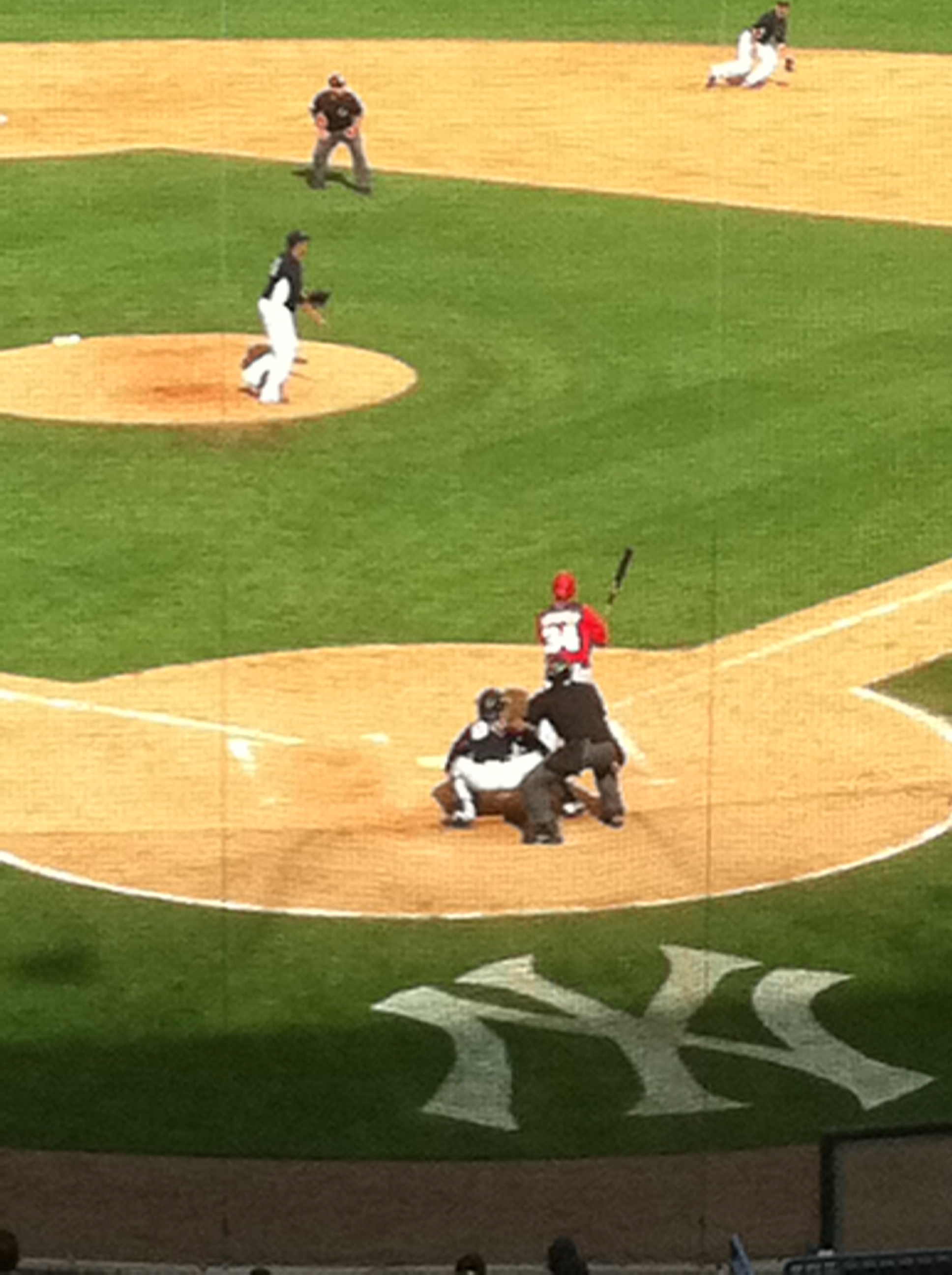
That route seems to challenge the expectation that Harper will have seen three Spring Trainings before he appears in a big league game that counts. It is noted that at this time in 2013 he will still be a young 20 year-old and that’s quick enough. Except the ball explodes off his bat and his adjustment to the outfield has already been such that he was as proud of starting a relay that nailed the Yankees’ Austin Romine at third base as he was of the RBI hit (shown to the left in what you’d say is a crappy photo, until you realize it was taken from the distant press box with an unaided iPhone).
Many newly-official men have looked like star big leaguers at 18. To go back to placing Harper’s birth in perspective, the ill-fated Yankee phenom Brien Taylor had already struck out 187 guys in his first 161 innings of pro pitching the day Harper was born. But it is hard to believe the Nats would arbitrarily slow down his pace through the minors to stick to an artificial deadline of 2013, because it isn’t just Harper’s physical game that’s so impressive.
His attitude is also already pretty well developed. Harper was asked by the small crowd of reporters around his cubicle what he thought of playing in a packed stadium festooned with Yankee self-promotion, and he admitted it was “awesome” to have shared a field with Jeter and Alex Rodriguez and CC Sabathia and all the rest. He said “awesome” twice and added Nick Swisher to the pantheon of impressiveness, which should make Swisher say funny things later on.
But then Harper was asked if he’d said hello to any of these Yankees (even Swisher, who was almost 12 when Harper was born). “No. I don’t really care to say hi to anybody over there. I stick over here.” I wondered if that was humility or competitiveness. “You try to beat ’em. That’s what I am. If we’re off the field? Hey, I’ll go and say hello. You can be my best friend off the field and I’ll hate you on the baseball field. That’s how I am…on the field, I want to kick the crap out of you.” (By the way, here’s Dave Sheinin’s version of this in The Washington Post, including the very relevant detail that Harper grew up around Las Vegas as a Yankee fan).
One game, one portentous spring training, one killer instinct, and one exhibition game RBI do not mean you should step directly into the majors at 18. But they do tend to support the idea that suggesting it is theoretically possible at 19 is not at all crazy.
A LITTLE PHOTO TOUR OF (MY) SPRING TRAINING OPENER:
Take a nice deep breath:
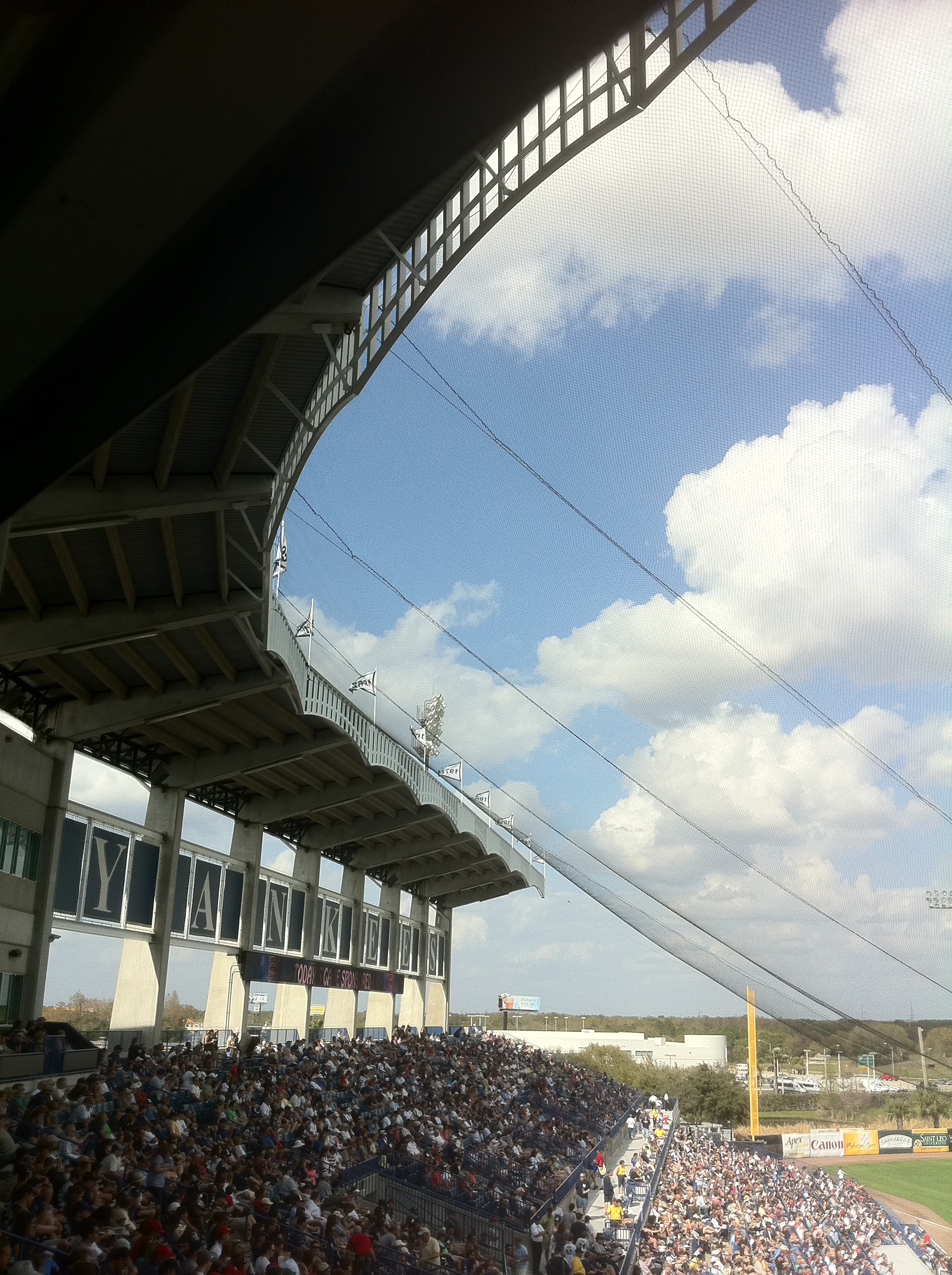
An almost-forgotten pre-game ritual: The visiting team taking infield (and outfield) practice. The catchers are Derek Norris and Jesus Flores, the coaches Jim Lett and John McLaren. When I asked Washington manager Jim Riggleman about this, he said there was nothing better for a team before a game. “But on the road, the groundskeepers look at you like you’re crazy! ‘Get off our field!'” It looked to both of us like none of the Tampa groundskeepers had been alive the last time a big league team taking infield on the road, which may have gone out with Earl Weaver:

And best of all, the scorebook comes out of hibernation:

 Baseball Nerd