Category: Dailies
More Haircuts Of The Now Rich And Famous
If you didn’t see part one please feel free to enjoy Bruce Bochy, Joe Maddon, and Omar Minaya as minor league players, while we move on to a couple of more fun flashbacks.
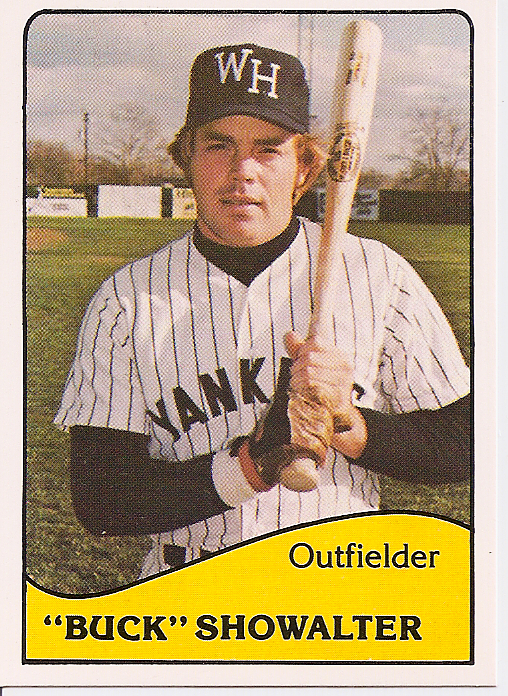
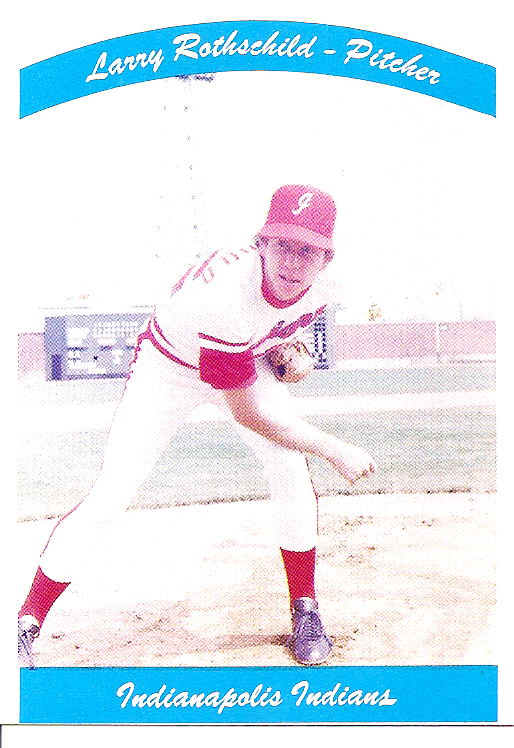

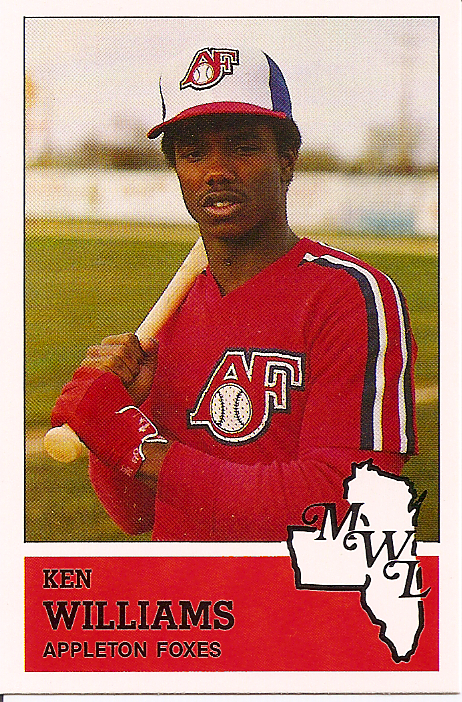
 these are the men who did the dealing. You would’ve seen plenty of Kenny Williams in the majors in the ’80s, and just four years after his stint with the ’83 Appleton Foxes, he had an outstanding season in center for the White Sox. Mike Rizzo, GM of the Nationals, drafter of The Strasburg and The Harper, was a far more obscure figure. This was the middle of his three seasons in the California Angels’ farm system, as a utility infielder. The ’83 Peoria Suns were pretty good, all things considered. Wally Joyner would make his pro debut (but isn’t in the set) and join Devon White, Mark McLemore, Bob Kipper, and a couple of others.
Cooperstown Path Cleared For Steinbrenner, Miller
George Steinbrenner is now eligible to be elected to the Hall of Fame as early as this December.
Hall of Fame Board of Directors Restructures
Procedures for Consideration of
Managers, Umpires, Executives and Long-Retired Players
(COOPERSTOWN, NY) – The National Baseball Hall of Fame and Museum’s Board of Directors has restructured the procedures to consider managers, umpires, executives and long-retired players for election to the Hall of Fame.
The changes, effective immediately, maintain the high standards for earning election to the National Baseball Hall of Fame. The voting process will now focus on three eras, as opposed to four categories, with three separate electorates to consider a single composite ballot of managers, umpires, executives and long-retired players.
“The procedures to consider the candidacies of managers, umpires, executives and long-retired players have continually evolved since the first Hall of Fame election in 1936,” said Jane Forbes Clark, chairman of the board for the National Baseball Hall of Fame and Museum. “Our continual challenge is to provide a structure to ensure that all candidates who are worthy of consideration have a fair system of evaluation. In identifying candidates by era, as opposed to by category, the Board feels this change will allow for an equal review of all eligible candidates, while maintaining the high standards of earning election.”
The Hall of Fame’s Board of Directors includes:
|
Jane Forbes Clark (chairman) |
Robert A. DuPuy |
Jerry Reinsdorf |
Allan H. “Bud” Selig |
|
Joe Morgan (vice chairman) |
William L. Gladstone |
Brooks C. Robinson |
Edward W. Stack |
|
Kevin S. Moore (treasurer) |
David D. Glass |
Frank Robinson |
|
|
Paul Beeston |
Leland S. MacPhail Jr. |
Dr. Harvey W. Schiller |
|
|
William O. DeWitt Jr. |
Phil Niekro |
G. Thomas Seaver |
|
· Eras: Candidates will be considered in three eras — Pre-Integration (1871-1946), Golden (1947-1972) and Expansion (1973-1989 for players; 1973-present for managers, umpires and executives).
· Candidates: One composite ballot of managers, umpires, executives and long-retired players will be considered in each era. The Expansion Era ballot will feature 12 candidates, while the Golden and Pre-Integration era ballots will feature 10 candidates. Candidates will be classified by the eras in which their greatest contributions were recorded.
· Electorates: A Voting Committee of 16 members for each era will be appointed by the Board of Directors annually. Each committee will be comprised of Hall of Fame members, major league executives, and historians/veteran media members. Any candidate who receives at least 75% of ballots cast will earn election to the National Baseball Hall of Fame.
· Frequency of Elections: An election will be held annually at the Winter Meetings. The Eras will rotate, with the Expansion Era Committee to vote onDecember 5, 2010 at the Winter Meetings in Orlando, Fla. The Golden Era committee will meet at the Winter Meetings in 2011 and the Pre-Integration Era Committee will vote on candidates at the 2012 Winter Meetings.
· Screening Process: The BBWAA-appointed Historical Overview Committee will devise the ballots for each era. The Historical Overview Committee currently consists of 10 veteran members: Dave Van Dyck(Chicago Tribune); Bob Elliott (Toronto Sun); Rick Hummel (St. Louis Post-Dispatch); Steve Hirdt (Elias Sports Bureau); Bill Madden (New York Daily News); Ken Nigro (formerly Baltimore Sun); Jack O’Connell (BBWAA secretary/treasurer); Nick Peters (formerly Sacramento Bee); Tracy Ringolsby (FSN Rocky Mountain); and Mark Whicker (Orange County Register).
· Eligible candidates:
· &n
bsp; Players who played in at least 10 major league seasons, who are not on Major League Baseball’s ineligible list, and have been retired for 21 or more seasons;
· Managers and umpires with 10 or more years in baseball and retired for at least five years. Candidates who are 65 years or older are eligible six months following retirement;
· Executives retired for at least five years. Active executives 65 years or older are eligible.
Timetable for Upcoming Elections
DATE
|
ACTIVITY |
WHO |
|
October 2010 |
The Expansion Era (1973-1989) ballot is devised and released.
|
The BBWAA Historical Overview Committee.
|
|
December 2010
|
Meeting and Vote on Expansion Era (1973-1989) ballot at the Winter Meetings.
|
A Committee of 16 individuals comprised of Hall of Fame members, veteran writers and historians, appointed by the Board of Directors. |
|
July 24, 2011 |
Induction of Expansion Era Committee selections, if anyone elected.
|
|
|
October 2011 |
The Golden Era (1947-1972) ballot is devised and released.
|
The BBWAA Historical Overview Committee.
|
|
December 2011
|
Meeting and Vote on Golden Era (1947-1972) ballot at the Winter Meetings.
|
A Committee of 16 individuals comprised of Hall of Fame members, veteran writers and historians, appointed by the Board of Directors. |
|
July 29, 2012 |
Induction of Golden Era Committee selections, if anyone elected.
|
|
|
October 2012 |
The Pre-Integration Era (1871-1946) ballot is devised and released.
|
The BBWAA Historical Overview Committee.
|
|
October 2012
|
Meeting and Vote on Pre-Integration Era (1871-1946) ballot at the Winter Meetings.
|
A Committee of 16 individuals comprised of Hall of Fame members, veteran writers and historians, appointed by the Board of Directors. |
|
July 28, 2013 |
Induction of Pre-Integration Era Committee selections, if anyone elected.
|
|
Hall Of Fame…Coaches?
As the Hall of Fame induction looms, something I heard on a Cardinals’ broadcast the other day inspired me to hit the books. The gist of the discussion, which was dead serious and included not even a hint that the view might be a little skewed by some homerism, was that while there weren’t any coaches in Cooperstown, and there was no mechanism for electing any, obviously Dave Duncan would be elected, and just as soon as possible.
7 – John Schulte, Yankees, 1936-19477 – Jim Turner, Yankees, 1949-19585 – Mel Stottlemyre, Mets, Yankees, 1986-20004 – Mike Gonzalez, Cardinals, 1934-19463 – Johnny Sain, Yankees, Tigers, 1961-19683 – Joe Becker, Dodgers, 1955-1963
The others with as many as two? Duncan (1989 A’s, 2006, Cards), Galen Cisco (1992-93 Jays), Ron Perranoski (1981, 1988 Dodgers), Larry Shepard (1975-76 Reds), Wes Stock (1973-74 A’s), Dick Such (1987, 1991 Twins).
6 – Leo Mazzone: Glavine ’91 ’98, Maddux ’93 ’94 ’95, Smoltz ’964 – George Bamberger: Cuellar ’69, Palmer ’73 ’75 ’764 – Dave Duncan: Hoyt ’83, Welch ’90, Eckersley ’92, Carpenter ’053 – Joe Becker: Newcombe ’56, Drysdale ’62, Koufax ’633 – Bill Fischer: Clemens ’86 ’87 ’913 – Ray Miller: Flanagan ’79, Stone ’80, Drabek ’903 – Claude Osteen: Carlton ’82, Denny ’83, Bedrosian ’873 – Johnny Sain: Ford ’61, McLain ’68 ’693 – Rube Walker: Seaver ’69 ’73 ’75
fire you? Becker went to St. Louis in 1965 and the Cubs in ’67 and did pretty well with Bob Gibson and Fergie Jenkins in those places, but evidently not well enough.
And Curt Flood, Too
Great column by Bill Rhoden of The New York Times on what could be perceived as the interlocking Hall of Fame candidacies of George Steinbrenner and Curt Flood.
A few months before his thirty-second birthday, with twelve wonderful seasons behind him as the brilliant center fielder of the St. Louis Cardinals, Curt Flood was traded to the doormats of the National League, the Phillies. And he said no. He said you don’t have the right to ship my butt anywhere you please – not after I’ve given you a dozen years of my life. And he stood up against the establishment – and whatever you think the players have done to the game in the last twenty-five years, what the owners had done to the players for the 100 years previous was a million times worse. And Curt Flood refused to go, and he sued, and it cost him his career. This wasn’t some fringe guy; through 1969 he had 1,854 hits — all he needed was seven more average seasons to get to 3,000 — he’d batted .293 (only six guys outdid him and five of them are in the Hall), he’d slugged .390 (that was ninth best in the era), he’d had six .300 seasons, two seasons with 200 or more hits, he’d won seven straight Gold Gloves, and he’d been on three pennant winners and two World Champs. And he gave it all up. The man got exactly thirty-five more at-bats in his life. No million-dollar contract, no free agency, not even a job as a first base coach somewhere. He even lost the lawsuit – but he paved the way for the freedoms and salaries and rewards that those who followed enjoy to this day. He was thirty-two – and he gave it all up for a principle. The least he deserves in a plaque in Cooperstown.
In point of fact, as I once suggested on ESPN while Curt Flood was still alive, every player should have given him 1% of their salary.
Joe Torre Is Not An Un-Person
“You remember some of those despotic leaders in World War II, primarily in Russia and Germany, where they used to take those pictures that they had taken of former generals who were no longer alive, they had shot ’em. They would airbrush the pictures, and airbrushed the generals out of the pictures. In a sense, that’s what the Yankees have done with Joe Torre. They have airbrushed his legacy. I mean, there’s no sign of Joe Torre at the Stadium. And that’s ridiculous. I don’t understand it.”
McCarver has apologized for the imagery (you hate the Yankees? Fine. The “rooting for the Yankees was like rooting for U.S. Steel” is stern enough, we don’t have to bring Hitler and Stalin into this). But he sticks to the contention that the Yankees have “airbrushed” Torre from their history and should have retired his number by now.
Let’s address the number first. Torre has been gone for only two-and-a-half seasons. Nobody else has been assigned his old uniform number 6. In examining the retirements, the Yankees have shelved fifteen numbers representing sixteen players (both Yogi Berra and Bill Dickey wore number 8). Mariano Rivera’s 42 will be automatically retired upon his departure from the Bronx, in keeping with the baseball-wide retirement of the number to honor Jackie Robinson in 1997 (and doubtless Rivera will get his own ceremony since he’s clearly earned it).
Fourteen of the sixteen honorees were, at the time of their uniform retirements, either still working for the Yankees, out of baseball, or deceased. When Casey Stengel’s number 37 was put away for good in 1970, it had been a decade since he had last managed the Yankees and half of one since he had last managed the Mets. He still had a largely ceremonial vice presidency with the Mets and still suited up for short stints during spring training. Berra was managing the Mets when the number he and Dickey was retired in 1972. By then Yogi, too, had been away from the Yankees for a long time – eight years.
There is some logic in delaying, especially for individuals still living. I found what is in retrospect a hilarious blog post from September, 2007, declaring that the Yankees would “surely” be one of three teams to retire the number of a veteran player: Roger Clemens. Yeah, and don’t call me Surely.
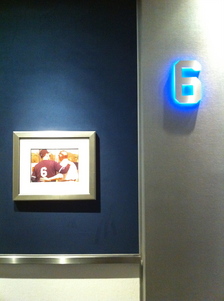
Turns out there are 21 photos of Torre on display at the new Stadium. One of them is just Joe and Steinbrenner, giant-sized, at one of the park’s street entrances. I saw a couple of others of note tonight in the Bronx, in my first visit since McCarver’s remarks. This would be the entrance to Suite Number 6 down the first base line. The motif is pretty straight forward for each suite – a series of photos of the Yankees who wore each number, even a list of them in the alcove just outside the door. And the pride of place in terms of photography goes to the odd image you see at the left. In fact, let’s get a little closer and see just who that particular Number 6 happens to be: 
I’m not sure who that is with him, but that would be Joe Torre on the left. And the idea that he is somehow being dissed by being shown back-to-the-camera denies the purpose of the photograph: each suite emphasizes the Yankees who have worn that number.
Off point, no, I do not believe there is a Suite 91 featuring nothing but photos of Alfredo Aceves.
Now, the image above is a small, untitled photo, correct? Doesn’t emphasize Torre’s vast contributions to the remarkable streak of four titles in five years? Try this, from the main concourse of the stadium, behind the ground level seats, down the left field line.

Prime location? Two beer stands and a men’s room?
Each Yankee championship team is remembered with a three-photo display. It starts with 1923 in the farthest corner of Right Field and then moves chronologically back towards the plate and out to Left. And who are the guys in the farthest right panel?

That’s right: the late George Steinbrenner, Rudolf Giuliani, and dressed for a very cold parade day from 2000, Joe Torre.
I’ll repeat myself here. I’m a fan and friend of Tim McCarver’s, and Joe Torre is my oldest baseball friend. I’ve even worked with them both. And I know the Yankees could have done better by Joe, and his exit was unceremonious and poorly-handled by the club. I would also argue that the Yankees are the most self-important, overly-serious franchise in overtly pro sports (I can think of about 27 college programs that would at least give them a run for their money).
But Timmy was just wrong, in style and in substance. Neither literally nor figuratively have the Yankees excised, erased, airbrushed nor Memory-Hole’d Joe Torre. Doubtless the day will come soon, perhaps even while he’s still managing elsewhere, that they will formally retire the number and give him the big ceremony he deserves. To see a conspiracy in the fact that the day has yet to come is, at best, to overreact.
A Hairstyle Is Temporary; A Baseball Card Is Forever
What you are going to see here will disturb you.
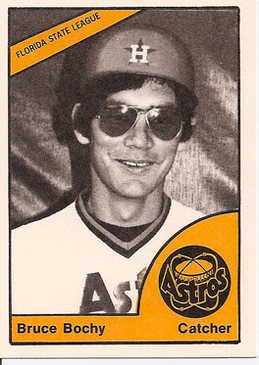 This is not the late Hunter S. Thompson, wearing a giant old Houston Astros’ batting helmet. Nobody took a look at this picture and said “Oh boy, the Gonzo Journalist sure looks vaguely like Giants’ manager Bruce Bochy when Boch was 22 years old.”

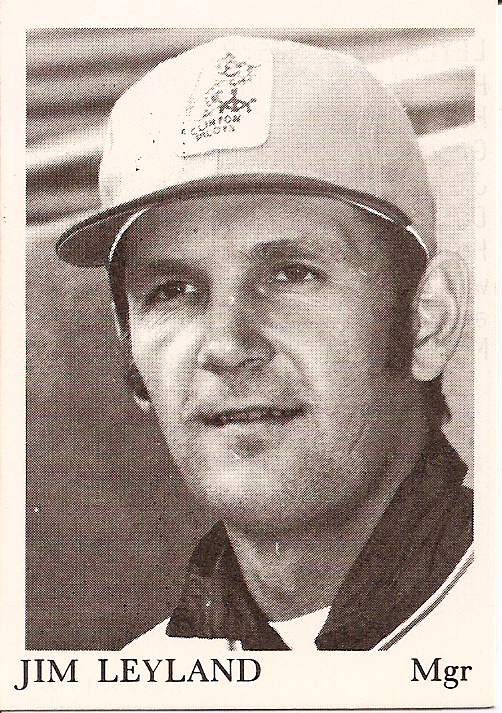
major task that year seems to have been trying to get that mustache to grow in. The correct answer is eight (Reynolds, the late Ivan Calderon, Darnell Coles, John Moses, Donnell Nixon, Edwin Nunez, Jim Presley, and Brian Snyder). There was also Rick Adair, now pitching coach of the Mariners, plus the Timbers’ manager ex-big leaguer Bill Plummer, who would skipper Seattle in 1992, pitcher Jeff Stottlemyre (whose brother and father have both pitched and coached in the majors) and catcher David Blume, now a scout for Toronto. With all that talent, it’s not surprising Wausau won 84 and lost just 48 and won their Division and the Playoffs. The full set of these A-ball players of 29 seasons ago can still be found in the $20-$30 range. Harold Reynolds, whose
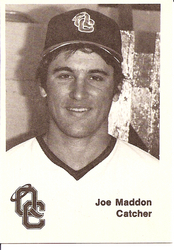
ens help us) and post an assortment later. As long ago as 1969, he was the first to make and sell new cards of old players. He challenged the Topps major league monopoly with his SSPC sets of 1975-78. He made the first reprints. He was the first collector to turn into a veritable card magnate (TCMA was, nominally, “The Card Memorabilia Associates”; in fact it was the initials of Mike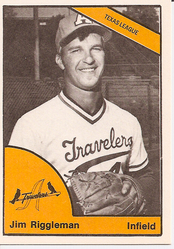 and his original partner, Tom Collier). Sheets in which to display your cards? Mike’s idea. These minor league sets? Mike. Regular “card shows,” a slickly-produced professional looking magazine, a company that did nothing but buy the rights to, and print up, stacks of player photographs for autograph sessions? All Mike.
A Little More On George
The most surprising part of my interview with Joe Torre tonight was his revelation – which he had first mentioned at his late afternoon news conference at Dodger Stadium – that he spoke to George Steinbrenner on July 4th to wish him a happy birthday. They had, evidently, a fairly long conversation, and that fact underscores a quality about Steinbrenner’s penultimate illness which lent it the makings of something akin to a Greek Tragedy.
Quick Plug
I dont generally do this, but if you want to pop over from the All-Star Game, Ill be joined by Joe Torre and Ken Burns to recall and reflect upon the life and death of George Steinbrenner – the two segments will begin about 40 minutes past the hour on Countdown.
George Steinbrenner, 1930-2010
I mean this with no disrespect and with no touch of humor: Only George Steinbrenner could pass away on the morning of – and thus overshadow – baseball’s All-Star Game.
Like A Good Piece Of Art
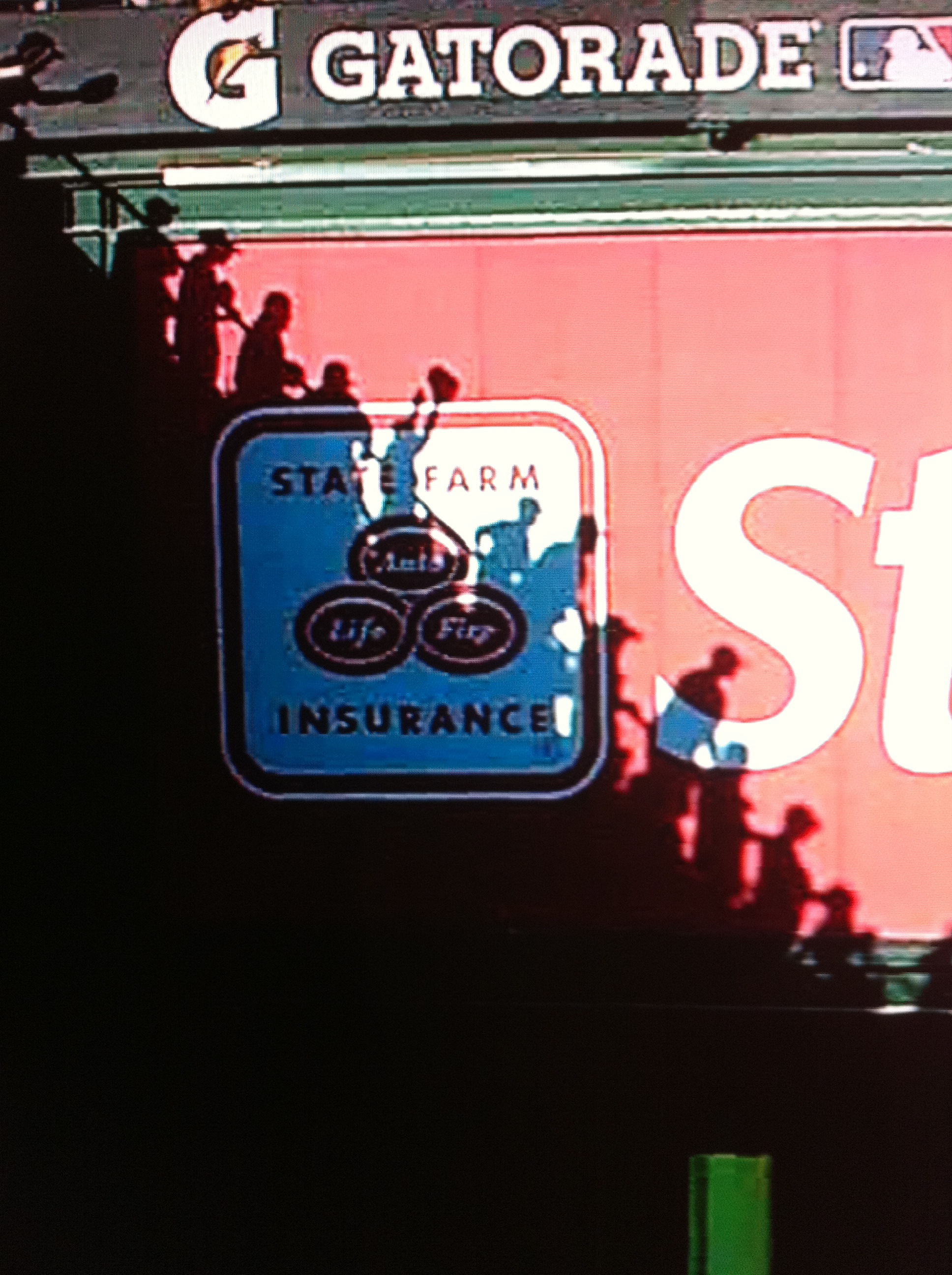
This is not intended as an insurance advertisement, just a freeze from ESPN’s coverage of the Home Run Derby that struck me as bordering on art: the shadowed silhouettes of fans in the right field bleachers at Angel Stadium during David Ortiz’s ups.
 Baseball Nerd

