Category: Uncategorized
Jeter’s Chances Of 3000th Hit At CitiField Wane
So I was sitting there beating myself up: of course nobody gets an MRI the same night they sustain an ordinary injury, every doctor wants to wait for the swelling to go down on anything and everything. But you cannot posit this, even with the caveat that it’s a conspiracy theory and you don’t necessarily believe it.
Besides which, I told myself, the math just didn’t work. The stint on the disabled list was long, but it wasn’t long enough. They couldn’t possibly be deliberately putting him on the shelf for a minor or non-existent injury just to delay his milestone to make sure it happened at home and not on the road, because the day after he was eligible to be activated they’d be playing in New York all right – but in the wrong ballpark.
The Yankees were not faking or exaggerating Derek Jeter’s injury just to make sure he got his 3,000th base hit in Yankee Stadium and that they could sell to a memorabilia-addicted public everything up to and including a commemorative Mason Jar full of air from the ballpark during the moment he got it.
They couldn’t be; Jeter was eligible to return from his strained right calf on Thursday, June 30, and he could resume play that day against Milwaukee, and then move into CitiField needing only six hits or less with three games to play against the Mets, and the Yankees would rather return the franchise to the league than to let Jeter achieve his milestone in Queens and not the Bronx. Of course it wasn’t a conspiracy! They’d have to come up with some additional story that Jeter might not be ready to be activated on June 30.
Well, looky here: tonight an additional story that Jeter might not be ready to be activated on June 30.
Frankly, if he’s late by six games in coming off the DL, he misses the last game of the Yankees’ Milwaukee game, and the entirety of the Mets’ series, and the first two games of the subsequent series in Cleveland. Bring him back on July 6 and maybe he gets a knock or two or three (but not six) there, and he walks back into the Stadium with four games against Tampa Bay and still needing six hits or fewer.
Obviously, they do conduct MRIs on injuries in the hours after they occur. Even at night. But to my mind those tend to be for serious head or spinal injuries. Just a year ago, when Jimmy Rollins of the Phillies strained his calf on Opening Day (in the early afternoon no less), the Phillies waited until the next day to get his MRI done. But Jeter had his the same night as the injury and before sunrise it was evident he was going on the DL and missing the long road trip and golly if he couldn’t come back right on time he couldn’t possibly set the record at CitiField, and if he couldn’t come back within six or seven days, he couldn’t possibly set the record in Cleveland but would have a damn good chance of doing it at Yankee Stadium.
For the record, these are other important Derek Jeter dates: Sunday, he turns 37 years old. And if this is a really serious strain, and he misses three weeks more than originally expected, he’d be back on Friday, July 22, when the Yankees begin a 10-game homestand.
The truth is out there.
The Nightmare Of Perpetual Inter-League Play
Buster Olney of ESPN.Com has just posted a very good piece about a story I first heard a week ago, one that could shatter the concepts of the American and National Leagues as we know them.
As I heard it, the Bud Selig-driven committee investigating realignment was spending most of its time discussing moving one team from the National League into the American League to create two 15-team leagues. The obvious implication of those odd numbers is that from the first day of the season to the last, there would always be at least one inter-league game being played, every day – from the first celebratory week, to the final climactic days of the pennant race.
What a bunch of crap.
Olney’s sources apparently divined this scheme after the Commissioner’s group began preliminary discussions about it with the union. I had merely heard about it during its owners-only stage. His additional details include the suggestion that the 16th NL team switching to the AL might be the Astros (to give them an all-Texas rivalry with the Rangers; in fact the Marlins and Rays could probably better use this benefit), the possibility that divisions would be eliminated altogether and each league’s 15 teams would simply vie for five playoff spots (hey, great, more crap – your opportunity to buy tickets to see a 13th-place team, or, if you’re really lucky – a battle between both 13th-place teams!).
The divisional system introduced in 1969 is troublesome enough – it broke the tradition that the pennant race really determined the best team, because each team played every other team the same number of times. But it became necessary once the leagues got beyond 10 teams, for the reasons hinted at above. In the 1890’s, when the National League stomped out both the upstart Players’ League, and then its former rival the American Association, major league baseball became one league of 12 teams. Hope dies early in a 12-team league. On this date in 1899 – June 11 – ten of the twelve teams were 8-and-a-half games out or more. Last place Cleveland was already 26 games out of first place and would end the year a whopping 84 games behind the pennant winner.
The divisions are a necessary evil, but inter-league play is an unnecessary one, and making it a virtually daily part of the menu would make a joke out of the pennant races. As it is now, how you do in inter-league pretty much determines whether or not you’ll win anything. And how you do in inter-league pretty much depends on who you play in inter-league. And who you play in inter-league pretty much is determined by which match-up will draw the most fans or the most tv viewers.
When Selig rammed inter-league play through in 1997, it still wore a fig-leaf that at least within divisions, each team would have the same inter-league opponents. The A.L. East would play the N.L. East one year, then the N.L. Central the next, then the N.L. West the third. This was abandoned as soon as the fervor swelled around Mets-Yankees, Giants-A’s, White Sox-Cubs, Dodgers-Angels, etc.
Right now inter-league opponents are selected for marketing reasons, and give some teams decided advantages over rivals in their own divisions. This new proposed system could make that disparity even greater. Unless there is some intention to reduce or scatter the current twice-yearly Festivuses of inter-league (and when has baseball ever reduced anything?) in a roughly 26-week schedule with approximately 52 “series” a year, each team in a 15-team league would probably go from playing six inter-league series a year to as many as eight or nine. By definition, some teams would get an easier schedule than others. By definition, the likelihood that the World Series teams would’ve met during the regular season increases – further flattening the bubbles in that champagne.
Inter-league has been interesting and novel in some cases (Yankees-Mets was thrilling, then interesting, and is now routine) but it has adversely affected what the pennant races mean, and it has been a nightmare for National League teams used to defending against eight-man batting orders. Just as it’s time for the concept to be discontinued or reduced, MLB is – naturally – looking to increase it.
Why not just give the teams with the top national tv ratings a first-round playoff bye?
Huddy Meets Honus
You probably could not make up an All-Star team of them, but you might stock a couple of rosters, with active major leaguers who have a true interest of some kind in the history of the game. Adam Lind is an expert on Brooklyn Dodgers’ ace Carl Erskine, the other hero from their hometown of Anderson, Indiana. After a couple of generations of disinterest, nearly all players revere the memory of Jackie Robinson and the Negro Leaguers before and after Robinson broke the color barrier. Manager Joe Maddon of the Rays sat in the dugout on a sweltering day last summer at Yankee Stadium to watch the entirety of the Old Timers’ Day ceremonies and game.
You can include Tim Hudson of the Braves on this list. The veteran pitcher not only has a commendable knowledge of the history of the teams for which he played (coincidentally the only three-city franchises in the game: the Braves and Athletics), but also a reverence for the Hall of Fame that particularly extends to its original inductees. So after a couple of years of talking about it, it was my pleasure yesterday to arrange for this:
Huddy knew the history of this Relic – the 1909 Honus Wagner card, hardly the scarcest baseball card (not even the scarcest one in that series), but handily the best known. Hudson was able to explain to several others on the bench the history of the American Tobacco card set (known to collectors as T206) and why there are, at most, 100 copies of the Wagner known.
He studied it carefully, asked about the trimming of the card’s borders, the scrapbook residue on the back, some of the other key cards in the set, and how I happened to come by it (how else? I bought it. I’ve been collecting this set since I was 11 years old, and as soon as I became a really overpaid adult I reverted to being a really over-excited teenager and was able to scratch off the last T206 on my want list).
I have to confess I was genuinely surprised by the interest in the card in the Braves’ dugout. Even Chipper Jones was shocked to see it. I’ve known him since he was a rookie and his sangfroid – his amazing calm in the most charged-up of circumstances – was once illustrated when in the middle of a conversation with me his back once went into full spasm and he basically pitched over into his locker. All he did was say “And you know what else? I think I’m going to have to have this back looked at.” Yesterday, even Jones’ eyes widened at the sight of The Wagner.
Some were even more effusive. Phil Falco, the Braves’ Strength Coach and himself a collector (autographed ’57 Topps Football cards are his joy), arch-collector and Media Relations Director Brad Hainje, and broadcaster Joe Simpson were closer to the dropped-jaw stage. I only wish I had done this last year: Bobby Cox would’ve loved to have seen that card.
Incidentally, remind me to explain some time why I don’t believe either the theory that the card is scarce just because Wagner objected to his likeness being used to sell cigarettes, or even the alternate one I proposed nearly 30 years ago that as one of the few players of his era who was aware of the value of his own likeness he was actually holding out for money. I have lately come to believe that the timelines don’t add up, and that to some degree the rarity of the Wagner card was deliberately created, or at least enhanced, by the manufacturer.
For now, just seeing baseball players gape at a baseball card was a great deal of fun.
Mickey Manto Saw Jose Bautista’s Success
 I first told this story last fall as Jose Bautista crossed the 50-home run plateau and was victimized by assumptions about PED’s or corked bats or, I don’t know, deals with the devils. With the Jays’ slugger now having crossed the 20-home run plateau before the first of June I think I should tell it again.
I used to run into Jeff “Mickey” Manto all the time when he was the journeyman infielder (he played in 11 major league seasons and changed teams 10 times; he once went from Boston to Seattle and back to Boston in one season; he played for 15 minor league teams). Manto averaged 26 games per stint in his big league career, so whenever I’d see him on a field somewhere one of us would say “uh-oh – about to change uniforms again.”
So on March 3, 2007, I stepped off a flight from New York and went directly to the Pirates-Yankees exhibition game in Tampa and who’s the first person I see? Pirates batting coach Jeff Manto (naturally, it was his last year on the job). I asked him what he could tell me about his Pirate hitters that I didn’t know; who I should watch for; who might surprise me.
He pointed at the guy in the batting cage. “If we can get him to replicate his swing three days in a row, Jose Bautista could hit 25 homers a year. In fact, I think he could hit 40. He is just so easily frustrated when it doesn’t go right that he blames himself and forgets what he’s learned. Or ignores it. But of all these guys I have, if you want one of them who will eventually do something special in this game, I’d pick him. I wouldn’t be very surprised.”
Bautista had 569 at bats last year in Toronto and ended at 54-124-.260. If you took his rates of production during his first four full seasons and gave him 569 at bats each year, he’d have averaged 20-73-.238 – so the power was there; this was not Brady Anderson coming out of nowhere. As I noted last year, until George Foster suddenly hit 52 homers for the 1977 Reds, his career high for blasts was 29 – and he was already in his seventh season in the National League. Cecil Fielder spent four years unable to crack the line-up of the Blue Jays, topped out at 14 homers, went to Japan for one year, and came back to hit 51 for the 1990 Tigers.
It is a rare thing to see a slugger grow from good to great – but it’s not impossible. So lay off Bautista. And if you see Jeff Manto (now the minor league hitting instructor for the White Sox) say hi for me, and congratulate him on his prescience (oh and the other kid he really liked back when he was his first manager in the minors, some guy named Ryan Howard), and tell him the Pirates shouldn’t have dumped him as battng coach, nor should they have dealt Bautista for catcher Robinzon Diaz.
Exactly What The Mets Need
So it’s official now: The Wilpons have found a minority investor who is willing to fork over $200,000,000 for 49% of the Mets’ franchise – but unless the terminology is deliberately misleading, no final say over a team that the majority investor just mentioned the other day was “bleeding cash” and could lose $70 million this year.
So…now the team is going to bleed some of the new investor’s cash? Did $34 million of David Einhorn’s still-unapproved investment just go sliding down the proverbial rat hole before they could get him his new souvenir jersey with his name on it, right above the number “49%”?
And after what was thought to be a solid if lunkheadedly-run ballclub turned out to be in economic quicksand due to its association with the supposedly fabulous investment mega-money making genius Bernie Madoff, is it smart for the Wilpons and the Mets to now get into bed with a supposedly fabulous investment mega-money making genius David Einhorn?
Yankees-Mets Notes And Photo Day
The Yankees are seemingly focused on Derek Jeter’s pursuit of 3,000 hits. Not getting as much play: his slugging percentage is worse than all but one other Yankee hitter. Not all but one other Yankee regular – all but one of the other 14 guys who have come to bat for the team all year. Jeter is being “outslugged” by 71 points by Brett Gardner and by 33 by Jorge Posada, who is being treated in the Bronx as if he is a ghost…
The only one behind Jeter? Nick Swisher (.303 SA). And yet the manager says “we know Swisher will hit.” We know no such thing. Until last year he had never put together consecutive good seasons in the majors. And incidentally he still has more extra-base hits than Jeter. So does Justin Turner of the Mets – in one-third the plate appearances…
We haven’t even gotten to On Base Percentage. Simply put there is no excuse for Jeter to be leading off. None. He’s at .316. That’s tied for 242nd in the big leagues (that’s a wildly inflated number – it includes everybody in the majors. Nevertheless, among those in his neighborhood are Angel Sanchez of the Astros, Ronny Cedeno of the Pirates, and Jason Bartlett of the Padres. Nobody is trying to pretend they haven’t been offensive disasters. People read stuff like this from me about Jeter and wonder what I have against him. The answer is nothing. He’s a hall of famer and I’ve been stunned by his consistency and clutch play since I was at ESPN – that’s how long he’s been doing what he’s been doing. But they should’ve made him manager or general manager or team president last year – or at least should be planning to do so the day he gets his 3,000th hit.
Remember…this is the franchise that once released Babe Ruth…
The Mets have very quietly built a bullpen out of other teams’ spare parts. Jason Isringhausen has been lights out since coming back, Rule V draftee Pedro Beato’s scoreless streak wasn’t interrupted by his DL stint, and so far, Nationals refugee lefty Mike O’Connor has been untouchable. The secret to the Mets’ disastrous collapses of 2007 and 2008, and the miserable seasons since, has been the startling truth that the relief corps has never been as good as it is right now…
The Yankees appear to be dealing with the resurfacing of an old problem. First it was Ruben Sierra showing the kid a great time, late at night, after night games. Exit Mr. Sierra. Then his running-mate was Melky Cabrera. He was a late-inning game-winning machine in 2009. Nevertheless, exit Mr. Cabrera. Now it is a spare outfielder supposedly escorting the should-be MVP to see the bright lights of big league cities. The should-be MVP is hitting .275. There are rumblings that it may soon be Exit Mr. Spare Outfielder…
Speaking of exits, it may be hard to believe this, but my understanding is that Sandy Alderson, doing all due diligence to try to revive the team from Queens, has asked almost every club what they might give him for every one of his key players. You can forget the Jose Reyes talk: the Mets and the MLB caretakers working unobtrusively with them know they must re-sign Reyes. There are intriguing answers when the Mets say “Ike Davis” and, surprisingly, “Jason Bay and Carlos Beltran.” The answers offered when they say “David Wright” are stunningly low. The rap is simple: perfect public face of a franchise. Wonderful teammate. Great guy. Productive hitter and deft fielder. Durable. And not to be relied upon in the clutch. The yield for David Wright might be less than the yield for Carlos Beltran (FYI absolutely none of this comes from Sandy Alderson or anybody in the Met front office)…
Not to re-stir an old pot but Alex Rodriguez still looks to Yankee coaching assistant Brett Weber’s third-row seat from the on-deck circle. You remember Brett, right?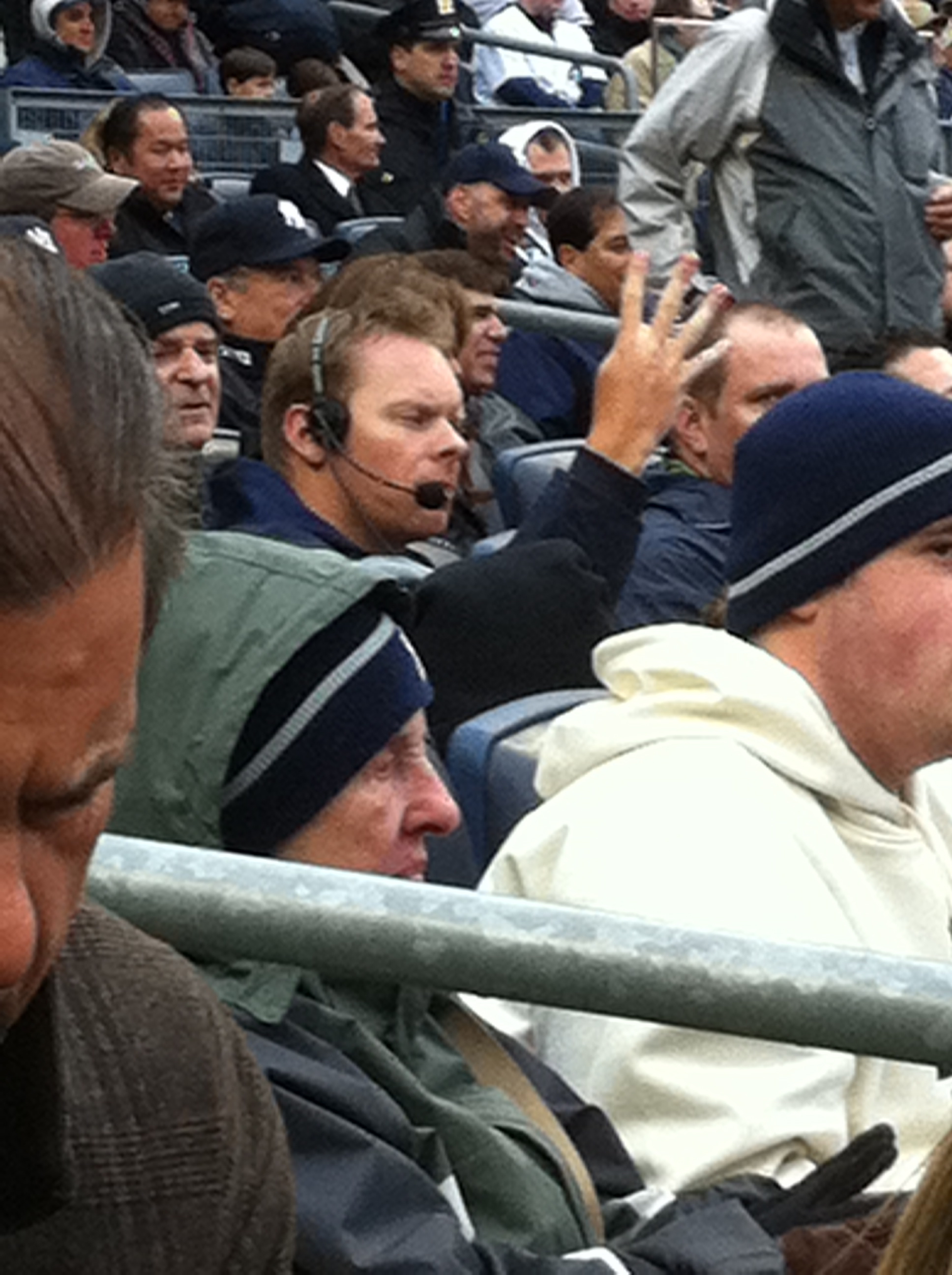 But Brett isn’t always in his seat. He was, Friday. He wasn’t, last night. And it’s possible I’ve missed it, but I have not seen him throw a signal at A-Rod or any other Yankee, or wiggled any fingers, or held up a sign, or even as much as looked back. He may have taken an order for fries in that headset for all I know, but from what I’ve seen, he has not violated communications rule C4…
“WE TALKED ABOUT FEET”

LoMo. Talking Feet
As we look at the rogues’ gallery of baseball friends with whom I’ve posed this season, the touching saga of how Twitter brought together an underrated Marlins’ outfielder and a guy with a similar foot injury (me) is in the papers today, right here. LoMo portrays a certain raunchiness in his Twitter feed. I don’t want to hurt his street cred, but he’s also a polite and thoughtful guy. As is Andy Samberg from SNL, with whom I had the pleasure of sitting through the last of the Yankees-Red Sox games. Delightful sequence of pitches during a Swisher at bat. The first of them is lined straight back and bounces off the screen right in front of me. Mr. Samberg laughs appropriately. The next one is lined straight back and bounces off the screen right in front of him. His laugh is delayed by only about a second. He shouts “Swish! What the heck? I was an A’s fan!”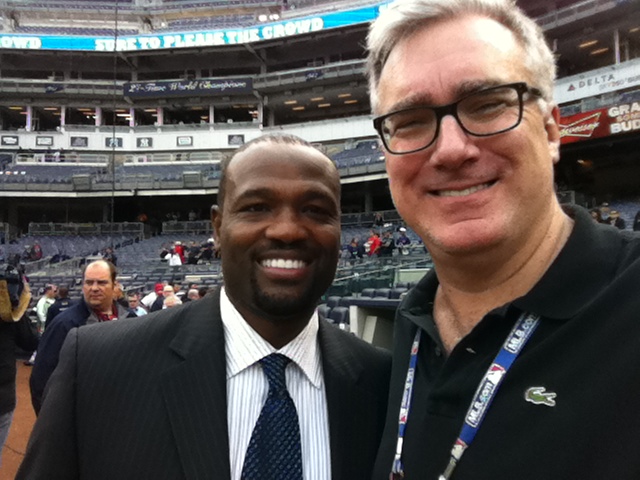 You know this fella. Interviewed Harold Reynolds in, I think, 1987 or 1988. Worked with him at ESPN in 1996 and 1997, most memorably at the Jackie Robinson Game. Continues to anchor – in the more literal sense – the studio work at MLB Network, although Mitch Williams, Dan Plesac, Joe Magrane, all the other analysts and all the hosts have helped create the best TV start-up I’ve ever seen.
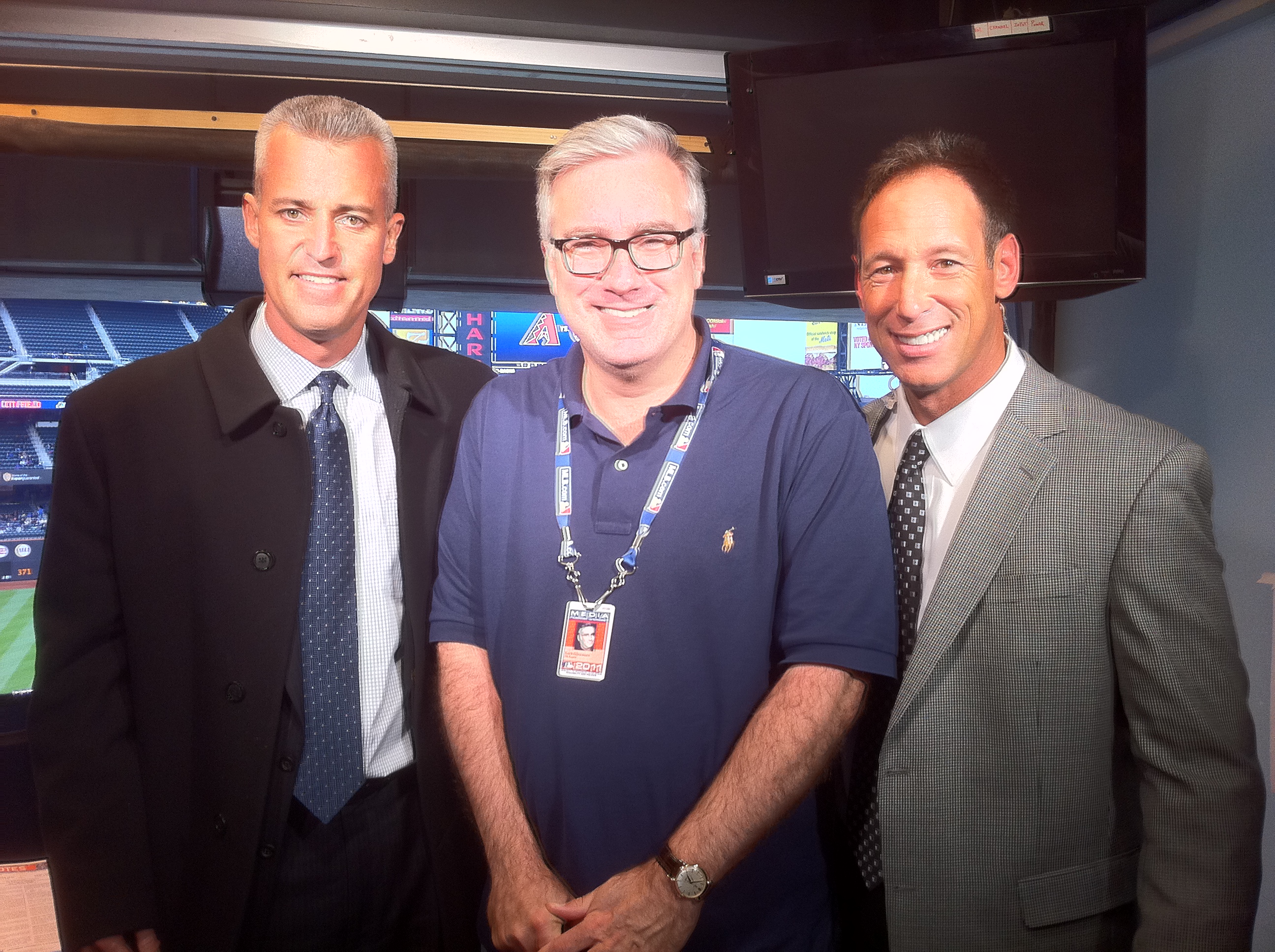
Studio lights make Daron Sutton and Luis Gonzalez look odd. Me? I always look odd
- I was a photographer when I met Mr. Yost. We believe this was circa 1872.
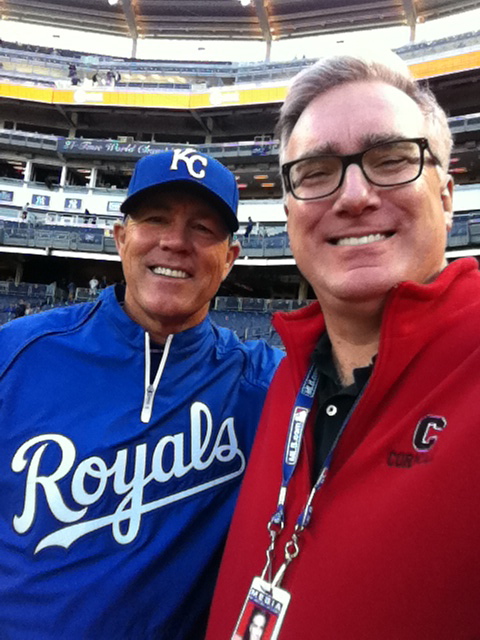

Tim Wakefield and I are 19 years removed from the interview in which he called me "Mr. Olbermann."

Adam Lind of Anderson, Indiana
Mr. Thome and I are 92 between us


- Mr. Myers says this was only his third baseball game
Either Of These Guys Look Familiar?
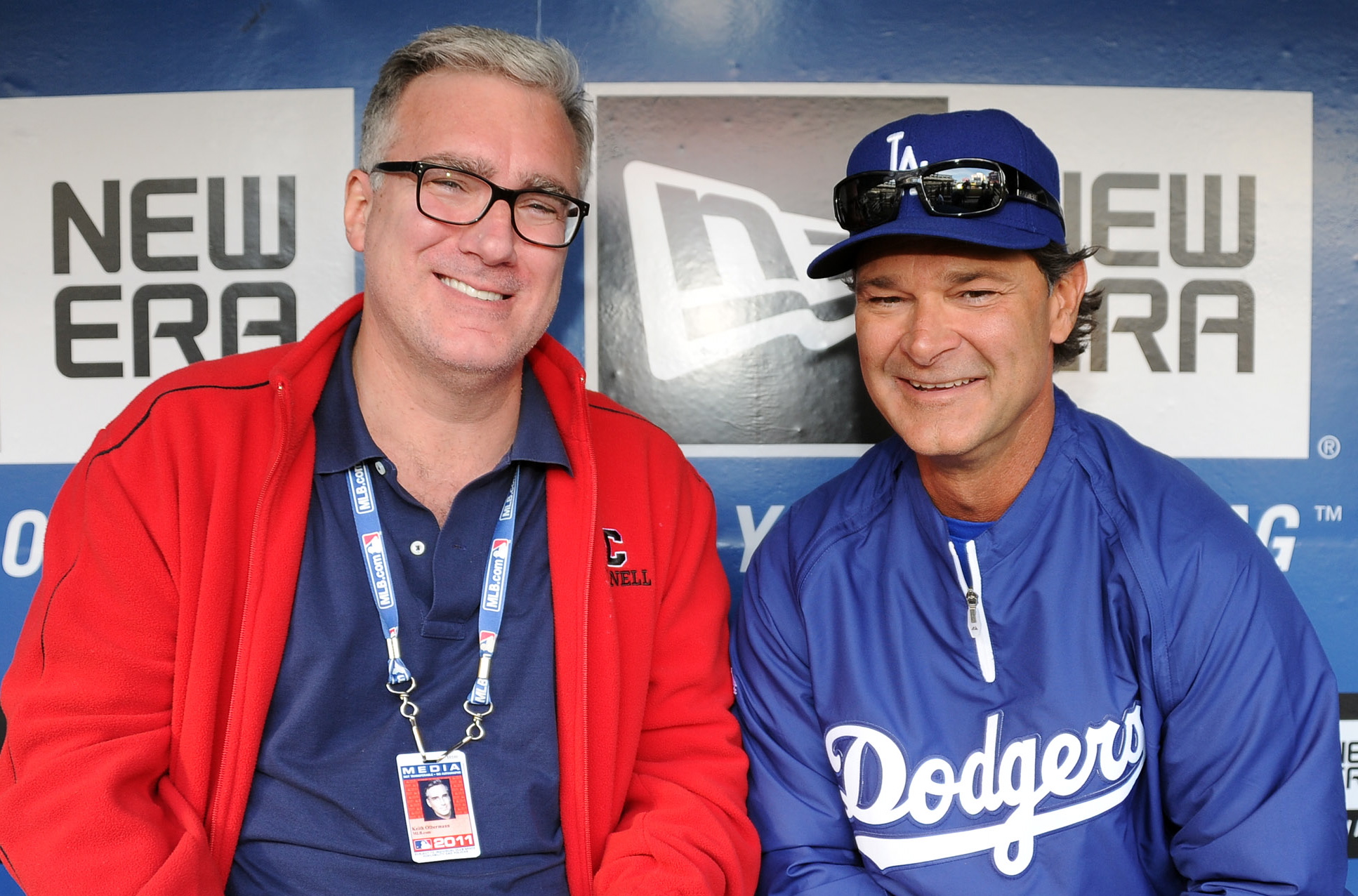
(c) Jon SooHoo, Los Angeles Dodgers
The first time I interviewed the gentleman at the right, he was a week shy of his 22nd birthday, and I was just past my 24th. We each had bad mustaches and dark hair. Several things have occurred since.
- The Dodger uniform does still look a little strange on Don Mattingly, but it’s the same smile and the same generosity of time. Trivia about our 1983 interview for CNN: it was on Opening Day, and I chose him because it was his first. My other interviewee was the late Bobby Murcer, because it was his sixteenth.
- Also, at that point, Mr. Mattingly wore uniform number 46, and had already experienced the first of eleven managerial firings that marked his career of thirteen years (plus seven games in 1982). By contrast, Mattingly became a coach in 2004 and spent seven years doing it – all under one manager.
You Can Rely On ESPN: They’ll Always Let You Down (UPDATED)
There is a reason ESPN has been gradually losing its status as the go-to television outfit for baseball.
It is not just the attempt to turn Baseball Tonight into some sort of summer-time version of the college football pregame show. It’s not the seeming pairing of every actual baseball expert like Buster Olney with an info-challenged sidekick like Wendi Nix. It’s not the ludicrous and already jab-pencils-into-your-eyes repetitiveness of John Kruk’s segments on the “best seats” in each stadium, each of which make the asinine features Steve Lyons used to do for our pre-game show at Fox look like doctoral theses. It’s not even the cancellation of the lumbering Sunday Night game telecast in favor of a new program that I think is called Bobby Valentine’s Three-Hour Autobiographical History Of The World.
I mean, seriously, another week of this and I’m sending Sherpas out to search for the bodies of my friends Orel Hershiser and Dan Shulman. I only hope they are out there somewhere, doing the really good two-man-booth broadcast of which they’re capable, to an audience of St. Bernards and Yetis.
Those are just symptoms of the reason ESPN has turned itself into a distant No. 2 in the battle with MLB Network. The disease is: ESPN is no longer invested in baseball and no longer trusts it to carry its own weight. And this didn’t just start when MLB Network came on the scene with its necessary advantages of being the in-house outfit permitted to carry basically anything it wanted, almost any time it wanted. I can recall that in the middle of the “nuclear winter” of 1994-95, the Rangers traded Jose Canseco to the Red Sox. Canseco was no longer the incumbent MVP, but he had just been voted “Comeback Of The Year” and still had five 20+-homer seasons to go. The Canseco trade, instead of getting at least some of the attention it merited, was buried in a little tag-on feature at the end of SportsCenter called “News And Notes.”
We all know what the network, and that show, are about these days – promoting other ESPN products and reducing sports to merely another form of entertainment living somewhere in the neighborhood where Mariah Carey’s twins matter more than the Minnesota Twins. There’s nothing wrong with that neighborhood, just don’t impose it on actual sports fans.
But ESPN’s disconnect from baseball is now part of its DNA. It may in fact be the case that the last things that really tethers true baseball fans to the Worldwide Leader are its game broadcasts (especially for those deprived of access to MLB Net), and what had been an efficient and sometimes innovative baseball fantasy game. But even that latter slender thread is fraying. A few seasons back the computer program somehow “lost” more than a week’s worth of the daily roster juggling for literally tens of thousands of fantasy players, screwing up countless leagues and strategies. And now this weekend, the system by which ESPN manages the only “content” thing it is required to stay on top of – which real-life players are hurt, and which ones have been called up to the majors – collapsed.
Pablo Sandoval of the Giants broke a hamate bone and early Saturday was placed on the disabled list. As anybody who’s ever played fantasy baseball knows, an injury like that is mitigated only by the opportunity to place Sandoval on your disabled list and add another player to replace him in your line-up. In some leagues, you can do that instantaneously: as soon as a player gets hurt, you can rush to your computer, place Sandoval on your disabled list, and “pick up” his replacement. In others, the process occurs via scheduled “waivers,” which can be daily, or every few days, or weekly. But whatever the process, it’s possible to put Sandoval on your disabled list only after ESPN has put him on its disabled list, and as of Sunday evening, more than 24 hours after the Giants put The Panda on the shelf, the ESPN computer geeks had failed to do so.
For Sandoval’s thousands of “owners” – and by the company’s own stats he is “owned” in every single one of the leagues it operates – they are thus not only deprived of his services and the opportunity to replace him, but conceivably could have sat there in frozen and agonized horror while other owners in their league got to his potential replacements first. A call to ESPN’s fantasy “help” line revealed this disturbing fact: the phone operator said the game managers never updated disabled list eligibility over the weekend, so Sandoval would likely not be made DL-eligible before Monday. If it hadn’t happened by then, the operator helpfully suggested, they could write up a “ticket” and see if the problem could be corrected in the next few days.
When I was at ESPN, the then managing editor John Walsh used to forcefully remind us that all the research data on the constancy of the audience produced the same stark data: they were the most loyal in television, and planned to remain loyal for ever more – unless somebody came along and offered them a better product. Leaving a few thousand fantasy players remembering the weekend “ESPN” became a four-letter word may not seem like a back-breaking straw, but combine it with the soliloquies of Bobby V and the knowledge that the network’s key games will soon enough get trundled off to the backwaters of ESPN2 to provide space for football exhibitions – to say nothing of the existence of a truly superb 24-hour product from MLB Network – and you can almost watch the loyalty dissolving before your eyes.
You know what? MLB Network doesn’t offer its own baseball fantasy league product. I wonder what would happen to ESPN’s baseball audience if it did.
Update: two hours after I posted this, guess what happened? Somebody at ESPN’s Fantasy Games outfit…placed Kung Fu Panda Sandoval on the official computerized Disabled List.
Yankees Hit “Send”
The relationship between the Yankees and their cash cow ticket-buyers, calm for nearly two years since the team did a 180 on the astonishing overpricing of 2009, may be strained anew.
The club tonight advised its season ticket holders that their addresses, phone and fax numbers, and club-related data, had been compromised – emailed to several hundred other season ticket holders.
Oops.
Dear Yankees Season Ticket Licensee:We are writing to inform you about an accidental electronic distribution of information that you have previously supplied to the New York Yankees.Monday evening, April 25, 2011 an employee of the Yankees sent an e-mail to several hundred Yankees Season Ticket Licensees. The e-mail mistakenly attached an internal Yankees spreadsheet that listed the following information associated with your New York Yankees account:
- Your name, and the address, phone number(s), fax number, and e-mail address that you previously provided to the Yankees
- Your seat numbers, Yankees account number, Yankees account representative name, and the ticket package code associated with your account
NO OTHER INFORMATION WAS INCLUDED IN THE DOCUMENT THAT WAS ACCIDENTALLY ATTACHED TO THE APRIL 25th E-MAIL. THE DOCUMENT DID NOT INCLUDE ANY BIRTH DATES, SOCIAL SECURITY NUMBERS, CREDIT CARD DATA, BANKING DATA, OR ANY OTHER PERSONAL OR FINANCIAL INFORMATION.Please note, immediately upon learning of the accidental attachment of the internal spreadsheet, remedial measures were undertaken so as to assure that a similar incident could not happen again.The Yankees deeply regret this incident, and any inconvenience that it might cause.
What If Albert Were Really Hurt?
The early indications on the hamstring injury that caused Albert Pujols to exit early from the Sunday Night game against Cincinnati are mild and not dramatic.
But what if it were the other way around? What impact would a serious hamstring injury have not merely on the Cards’ extraordinary dependence on Pujols, but on what would shape up as the most extraordinary free agency since Alex Rodriguez left the Mariners in the winter of 2000?
What would happen to his $30 million dollar dreams if he didn’t play again this year? Or was hamstrung by the hamstring, or any of a hundred other calamities? Not wishing him any of these in the slightest, but that limp last night made the prospect of an injury that could cost a man $200,000,000 very real indeed.
I would guess the answer is no, but it is wonderful to speculate if the thought even crossed his mind when Pujols told reporters:
“I just felt a little tight, and I just pulled off. I think I prefer it tight than a blown-out hamstring, you know? It’s something that, I have to deal with it. It’s been rough here the last week or so with the rain and all that, and our bodies take a little beating.”
To say nothing, theoretically, of our wallets.
 Baseball Nerd