Category: Dailies

A Whole Lotta Lobster

Too much shellfish, you say?

One of the absolutely unexpected (and unwanted) side benefits of hanging around a hospital for several hours a day over six and a half months is you get to talk health hypotheticals with people running the full gamut of medical knowledge – all of it more than you have.

In short, they are not necessarily buying the “Jose Reyes developed hyperthyroidism from eating too much shellfish with all that iodine in it.” They are thus also not buying that “all will be well if he switches to tuna and red meat and doesn’t exercise for two weeks or two months.” It may be true that he’s had a lot of shellfish lately, but that doesn’t mean it’s the only cause of his hyperthyroidism. 
This is not to say it’s not possible, but none of the medicos to whom I talked think diet is a very likely cause of hyperthyroid problems in a 26-year old guy. More common causes are an immune disorder (Graves’ Disease – his age is correct for that – doctors would look there first, especially if there’s any family history of it), or a virus, or taking medication designed for thyroid deficiencies, or delivering a baby. 
I think we can rule the last one out, but the Mets have seemingly been hit by every other injury and malady in the last eighteen months, so what the hell.
The problem, of course, for the Mets is that their recent history on reporting those injuries and maladies is that they have over-promised and under-delivered. Last season, Reyes himself was only to miss a few days, then weeks, then a month, then an indefinite time, then he needed surgery. This is not necessarily blissful incompetence: hamstring and other connective tissue problems can often take a long time to diagnose. The Mets’ training and medical staff may be as much victims here as the players or fans are.
But if it turns out Reyes has a more lingering thyroid problem – one that does not simply go away in two weeks to two months – it will be impossible to believe the team’s next injury report. More importantly, it will be a significant impediment to Reyes’ quick return, or for him avoiding surgery or long-term drug therapy.
Or maybe he consumed 10 percent of the world’s shellfish.
How much could Shellfish could an ex-Shea Shortstop Shovel, if an ex-Shea Shortstop Could Shovel Shellfish?

McGwire Highway Revisited

I am advised by the impeccable Derrick Goold of The St. Louis Post-Dispatch that the stretch of asphalt to be de-named after Big Mac (see lengthy tedious post below) and rechristened in honor of Mark Twain, had, long before Mac, been part of the Twain Expressway. So the great writer has not somehow been overlooked by Missouris Department of Transportation. Of course, this does mean that the DOT has gone back from McGwire to Clemens.

Not So Big Mac After All

A full week of exhibition games in, and Mark McGwire is clearly not on his way to setting a single-season record for confrontational interviews. Not even TMZ-style ambush. 

Sure, sure, they’re pulling his name off his highway in Missouri and given it to Mark Twain (begging the question: they’re just now getting around to honoring Mark Twain?). But this today, from the local paper in Naples, Florida, seems to be more representative of the overall tone to the start of the McGwire post-steroid, post-I-did-it-for-my-health-interview, era:

“There is a lot of negativity and failure in baseball. It’s nice to talk about how positive it can be. I’m a positive person,” McGwire said.

With that apparently not ironic use of “positive” there, presumably psychiatrists have just upgraded Mac a few notches in preparation for their upcoming Psychology Rotisserie Draft. But we move on.
There are three ways to read the slow start to McGwire Season. Firstly, it’s just that, a slow start. The real tests start Friday when the Cardinals play the Red Sox, and then next Monday as they begin a virtual playoff series with the Mets (also Saturday, a week from Thursday, the 28th, and 30th – should you want to start circling your calendar). The players are irrelevant; the writers mattered. One can infer from giving New York’s Grouchiest five separate shots at Mac, that the schedule was either drawn up long before McGwire’s hiring, or somebody in St. Louis really doesn’t like Mark.
The second theory is that McGwire’s return really is no big deal, positive or negative, and the writers have correctly gauged the spirit of the times. Since the writers only correctly gauge the spirit of the times once every 12.7 years (and when they do, 60 percent of them ignore it and write anyway), I’m not putting a lot of money on this one.
The third one, I think, is the likeliest. Mark McGwire is simply being forgotten to death. The first evidence of this syndrome – a kind of psychological universal asterisk – was apparent when ESPN’s Barry Bonds Reality Show bombed. It did not generate controversy, it was not attacked as exploitive, it wasn’t even criticized as bad TV. It was just that outside the Bay Area and a small circle of other admirers, nobody wanted to hear from or about Barry Bonds, ever again. As if by a collective unspoken will: Barry Bonds hit more home runs, and Henry Aaron is still baseball’s all-time home run leader.
Perhaps this invisible fog is now enveloping McGwire. Nobody’s raising a stink, because nobody takes him seriously. 
Maybe the Missouri Department of Transportation should have re-named the McGwire Highway after another former Cardinals hero: Roger Maris.
FROM A RESEARCHER’S NOTEBOOK:
Imagine if this had happened a little later in baseball’s history – it wouldn’t have been labeled “trivia.” When the Dodgers played an exhibition against the Braves in Vero Beach on March 11, 1967, two late, one-inning defensive replacements for Los Angeles included first baseman Sadaharu Oh, and third baseman Shigeo Nagashima. There’s even an Associated Press wire photo of one of the Japanese immortals, Nagashima, taking a throw as Atlanta’s Jim Beauchamp slides into third. The photo is not on the net, only in a digitized version of the Chicago Tribune’s hard copy, so it’s tough to be certain but it appears Nagashima is wearing not a Dodgers’ uniform, but his Tokyo Yomiuri Giants’ garb.
FROM A PERSONAL NOTEBOOK:
Belated thanks to all who have posted comments lately with well wishes for my father, who continues to fight his illness, more than two weeks after he lost wakefulness, and more than six months after he was first hospitalized. Your support is of great value to me (and my thanks to MSNBC for its understanding in this time, and, for that matter, MLB.Com, for providing this oasis where I can immerse myself in the game between trips to his bedside). This is, in fact, what baseball is for.

I’d also like to welcome new reader Bill Simmons, who has been kind enough to tweet about my note here last week already ceding him the dumbest sportswriting award of 2010 for his laugh-out-loud funny argument that the comeback of Tiger Woods (caught having repeated trouble with his putts) will be more difficult than that of Muhammad Ali (persecuted by the federal government for the color of his skin, his stance against the war, and his religious conversion, and effectively banned from his sport for two years).

Mr. Simmons tweets:

I’m furious that my Tiger column distracted America from a detailed and only mildly creepy case for Johnny Orsino’s Hall of Fame candidacy.

via UberTwitter


This is pretty standard stuff for Mr. Simmons. Make a fool of yourself comparing Tiger Woods (loss of advertisers) to Muhammad Ali (loss of income, threatened loss of freedom), so change the topic – to an admittedly trivial column about a trivial moment from a marginal catcher named John Orsino.

Mr. Simmons resumes:

KO, please know the feeling is mutual. You’re my worst case scenario for my career in 12 yrs: a pious, unlikable blowhard who lives alone.

via UberTwitter


This assumes that Mr. Simmons’ career now is where mine was twelve years ago (anchoring SportsCenter, then my own MSNBC political show, anchoring NBC Weekend Nightly News, writing a best-selling sports book, etc). In fact, this assumes that this is Mr. Simmons’ career, which is remarkable. Also, anybody who could write as many words without saying anything of consequence really should throw around the word “blowhard” as frequently as he would a street sewer cover.

Also, I don’t think “pious” necessarily means what he thinks it does.
Having made his point 50% of his words ago, Mr. Simmons still continues. As usual:


I feel bad about saying Olbermann lives alone. I forgot about his cats.

via UberTwitter


Mr. Simmons apparently uses, for factual research, old parody sketches from “Saturday Night Live.” I’m not surprised. That was Ben Affleck. Thanks for playing.
I am surprised, however, to be able to shed some light on something that has been a prominent topic of late around the internet: the prospect that Mr. Simmons is leaving ESPN. Admittedly I am something of an authority on this process. Nonetheless, I was stunned to receive several emails from some of Mr. Simmons’ bosses there, thanking me for pointing out the absurdity of, and the embarrassment to ESPN provided by, the Woods/Ali comparison.
About five years ago, I guess, somebody said Tony Kornheiser was the most uncontrollable, unmanageable talent in the history of ESPN. I was, of course, crushed (although I believe I got honorable mention). When ESPN bosses are writing me for helping them about somebody they claim has now lapped Tony and myself, I am left to conclude only that if Mr. Simmons does leave ESPN, it may not be entirely of his own choosing.
And we now encourage Mr. Simmons to again falme the comments section under various identities, to his heart’s content. This is a managed site, and they can take ’em down. But enjoy yourself.


Andy Pettitte: Hall Of Famer?

You haven’t considered that question, have you?
I don’t think it’s anywhere near the 50 most pressing issues of the spring, but it started formulating for me last fall as the veteran Yankees’ lefty cut such an unlikely swath through the post-season. And while the case for a Cooperstown spot for Pettitte is hardly closed, but it is surprisingly compelling.
Comparing across eras is often a dangerous thing, but it does offer a little perspective. And barring a breakdown, at some point in the season ahead Pettitte is going to win his seventh game and pull up into a tie on the all-time victories list with none other than Whitey Ford.
Ford ended what amounted to a 16-year career with a 236-106 record, for a phenomenal winning percentage of .690. Right now Pettitte is at 229-135, which is an impressive .629 (another Yankee great, Herb Pennock, is in Cooperstown with 241 wins and a .598 percentage, and Hal Newhouser of the Tigers is there at 207 with a .579). 
A numbers box follows, just to get to the essence of the thing (the asterisk indicates the numbers have been adjusted to cut out seasons that are just cameos).

                         Ford               Pettitte           Pennock

Seasons              16*                   15                   20*

Wins                   236                  229                  241

Losses                106                  135                  162

Percentage         .690                 .629                 .598

ERA                   2.75                 3.91                 3.60

K                       1956                 2150                1227

W                      1086                  921                  916

20 Win Yrs            2                      2                      2

World Series       10-8                  5-4                   5-0

I’m fascinated by the World Series marks. Pennock made his bones in the post-season, and Ford, from his rookie year of 1950 onwards, became legendary in them. And here’s Pettitte with as many World Series wins as Pennock, and the same post-season percentage as Ford.
I do not go in for lumping all post-season statistics into one number – it is unfair to pitchers pre-1995 and especially pre-1969. Neither should it be ignored that Pettitte is now 13-5 in division and league series. More over, with his triple-play from last fall he has now pitched the decisive game of a playoff series or a World Series an astonishing nine times, and is a tidy 6-1 in such games, with his team having won both of his personal no-decisions, and the one loss being Game Six of the 2003 World Series in which he surrendered exactly one earned run in seven innings. It gets a little less impressive if you include his human torch act in Game Six of the 2001 Series which could have won it for the Yankees – but still, that’s 6-2 in ten potential deciders.
I find Ford was asked to pitch the wrapper three times. He won the finale of the sweep of the Phillies in 1950, got a no decision in the win in Game Six in 1953, and lost the fourth game as the Dodgers swept New York in 1963. As with everything else concerning the post-season, it was tougher for pitchers to get chances to pitch the decider in the days before the playoffs, but Ford did pitch in eleven Series. Pettitte has pitched in no fewer than 28 post-season series (that percentage of deciders pitched is thus still higher than Ford’s).
To this day I think Pettitte deserved the 1996 Cy Young Award, if only for the fact that he went 13-3 after New York losses that season. One wonders if his strong Hall of Fame credentials would be a little more prominently discussed if he’d taken the trophy. If you’d like to be further befuddled by stats and Cooperstown and lefty pitchers, consider one more set: 239-157 (.604), a cumulative post-season mark of 10-5 and a 2-1 record in four deciders. That is David Wells.
YOUR SCORECARD WON’T HELP YOU NOW, MY FRIENDS
I was delighted to settle down, between hospital visits tonight, with MLB Net’s telecast of the Dodgers and White Sox from Arizona, and not merely for the intriguing return of Eric Gagne. Dodgers’ announcer Charley Steiner was my second boss in broadcasting – he hired me 30 years ago last December to jump from UPI Radio to his operation at RKO Radio and from there I was poised to leap into television with CNN (yes, this was before they invented color tv). And I know Charley’s colleague Rick Monday even longer, having interviewed him as far in the past as the 1977 World Series. Rick was later the sports director at Channel 11 in Los Angeles while I held the same post at Channels 5 and 2.

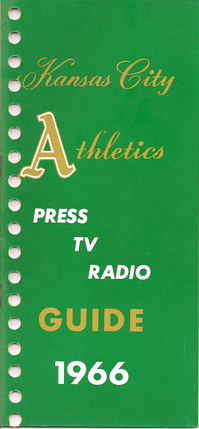
Thumbnail image for 66A.jpgThis monstrosity at the left is included because my friends Charley and Rick were victims of one of the standard media nightmares of the spring. In the bottom of the sixth, the White Sox sent number 83 out to play shortstop. And, of course, as can be the case from the first game of the exhibition season through the last, t
here was no number 83 on the White Sox roster. Managers, especially in split-squad situations and/or road trips, supplement even the usual mass of 40-man roster guys and non-roster invitees with as many as dozen extra minor leaguers on a one-game basis, whose identities are usually written down on the shirt cuff of the visiting Media Relations guy. Anyone in the press box is thus left as helpless as in high school, when whoever kept your scorecard had to exchange rosters with whoever kept theirs (I once had a hockey game in which the rival team wore several years’ worth of uniforms and thus had multiple players wearing the same numbers – they had at least three guys wearing number “5” and tried to fix this by stitching in a little “A” or “B” atop the number).
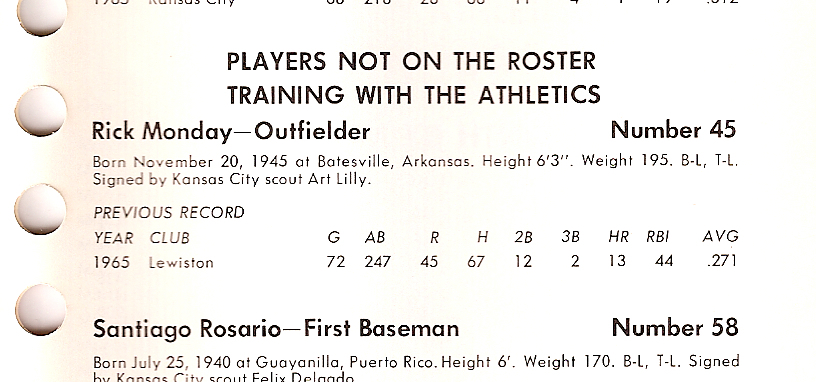
Anyway, 83 was eventually unmasked as minor leaguer Eduardo Escobar and Rick and Charley moved giddily on to the further disturbing truth that Mr. Escobar was wearing an expandable cap, the surest sign of minor league serfdom. Steiner assured his audience that having been the first pick in the first-ever amateur draft in 1965, Monday suffered no such degradations, whereupon Monday insisted that in his first spring training with the then-Kansas City A’s in 1966, he had been insulted in no less an astonishing way than being assigned uniform number 104.
A-hem.

Monday66.jpg

As they used to say on Letterman, “#104 Rick Monday” is a bit of writer’s embellishment. Conceivably in some instructional camp after they anointed him the first-ever draftee, the A’s made him wear such garb, but it wasn’t in spring training. 
It is kind of marvelous, though, that as late as 1966, number 45 was still the kind of number you gave to a non-roster second-year pro who wasn’t going to make your team. By the time Monday reached the bigs in the fall of ’66 he was wearing 28, and then moved to 7 the following year.
And the White Sox, by the way, later debuted an outfielder named Justin Greene and a pitcher named Justin Cassel (brother of quarterback Matt and pitcher Jack).  Both Justins were wearing number 86.

Johnny Orsino, Hall Of Famer

Ah, the joys of spring training games showing up on my television, enabling me fleeting glances between hospital visits of a spring that here in New York seems a long way off.

The first few exhibitions always make me wonder if any player ever made a greater debut than that of a fairly obscure catcher for the Baltimore Orioles during the exhibition season of 1963. In the preceding off-season, the Birds had moved on from the man who had been virtually the only catcher in their modern history, Gus Triandos, and were auditioning a kid with just 43 games of big league experience whom they’d gotten in a winter deal with San Francisco.
Orsino.jpg
Johnny Orsino had shown a power bat in the minors but was an unproven commodity as the Birds assembled in Miami 47 years ago. More over, he was hurt. A bad back forced him to miss Baltimore’s first six exhibition games. So his first at bat in an Orioles uniform on March 15th was by itself something of a triumph. 
Orsino promptly hit a three-run homer off Joe Moeller of the Dodgers. In his next at bat, he was accidentally intentionally walked (Boog Powell had been balked to second and manager Walter Alston was gesticulating wildly about the call; Dodger catcher Mike Brumley mistakenly believed he was being inexplicably ordered to walk his Oriole counterpart). In his third trip to the plate, Orsino hit another homer, a solo blast.
He came out of the game at that point, and missed Baltimore’s next two exhibitions. But against veteran Reds’ lefty Jim O’Toole at Al Lopez Field in Tampa on March 18th, Orsino made it three homers in three Baltimore ups. Then four in four. Then five in five. 
You read correctly. Not just home runs in five consecutive official at bats, nor just home runs in the first five at bats of spring training, but five consecutive home runs in the first five at bats with a new team. The streak was finally snapped when a Reds’ prospect named John Flavin got Orsino to pop up to the catcher.
Orsino’s unbeatable debut (What? somebody’s going to hit homers in his first six at bats with a new team, even in spring training?) got him considerable attention, and he had a strong season (19-56-.272) as Baltimore’s top receiver in 1964. But the bad back lingered, and he never again played in as many as 100 games in a season. By 1966 the Orioles had dished him off to the Senators, and he spent all but one game of 1967 in the Pacific Coast League, and by 1968 was in Double-A.
But the spring training world was his. It is largely forgotten now, but the Designated Hitter made its debut on the big league level not in 1973, but in a handful of exhibitions in 1969. And the first man to get a hit as “The Designated Pinch Hitter” was a non-roster invitee struggling unsuccessfully to catch on with the Yankees: John Orsino.
OFF TOPIC:
I promised no politics here and I stick to it. But I never said anything about never mentioning other sports, although I think I’ll start that rule about a paragraph from now. If you’d like to read the most poorly-informed conclusion I’ve come across in sports media this year, you have your link. Proceed with caution. In short, it is the contention that the comeback of Tiger Woods will be more difficult than the one Muhammad Ali faced in the 1960’s. If the writer can let me know when Woods is punitively drafted by the military even though he is about eight years older than almost all the other draftees, I’ll begin to take him seriously. In the interim I am again left to marvel how somebody can rise to a fairly prominent media position with no discernible insight or talent, save for an apparent ability to mix up a vast bowl of word salad very quickly. 

Yo, Out Of Here, Adrian – And The Bunning File

I guess you mention this now to decrease your client’s trade value, so maybe the best option for his current team winds up being letting him walk as a free agent. They take the draft choice; you take the percentage of whatever the market can bear. Otherwise there can’t be anything logical about the agent for Adrian Gonzalez explaining he is expecting a Mark Teixeira deal, from the Padres, or from which ever the Padres deal Gonzalez to, or from the free agent market in the winter of 2011-12.

The Padres are not going to summon $180,000,000 even to keep a popular hometown superstar, and it seems unlikely that many other franchises would. If the Cubs really aren’t looking at Derrek Lee long term (how is my Micah Hoffpauir recommendation working out, by the way?), the Chicago teams might battle for him, maybe the Mets, but without the Yankees there to help drive the market, the money just isn’t going to be like that for a player who is not Teixeira’s defensive equal, and it would presumably limit trading interest in a pre-free agent Gonzalez to lesser prospects.
Consider what a difference a year – and a conviction by one team that they could sign him, and the conviction by another that they could not – did to Teixeira’s “value.” In 2008 the nonpareil first baseman was a nice rental in Anaheim at a price of Casey Kotchman and Steve Marek. In 2007 Atlanta (in retrospect, disastrously) gave up Neftali Feliz, Elvis Andrus, Matt Harrison, Jarrod Saltalamacchia, and Beau Jones, thinking they were buying Teixeira.
If new Padres’ GM Jed Hoyer somehow doesn’t see those stark options, there is the added dimension of Gonzalez’s salary. At just $4.75 million this year, with an option for $5.5 million in 2011, he will be paid for two seasons what Jonathan Papelbon asked for in arbitration for just the one ahead of us.
With even the false pretense of a hometown discount erased by the agent’s remarks, there would seem there are three stages to the Padres’ end game with Gonzalez: 1) trade him immediately for a package not unlike what the Braves gave for Teixeira, to a team that believes it can sign him (if you are getting ten years of Gonzalez for the price of eight of Teixeira, the deal suddenly begins to make a little more sense). 2) It is conceivable the personnel price might peak as late as this year’s trade deadline, but certainly beyond it, it will deflate. 3) The last stage is when it just isn’t worth it for anybody to go to the prospect bank to rent Gonzalez for all or part of 2011.
Think of it this way. Trade him today and you can have Andrus, Feliz, and Saltalamacchia. Trade him in July and it might just be Andrus and Saltalamacchia. Wait until July 2011 and maybe it’s just Saltalamacchia.
BUNNING DECONSTRUCTED
I vowed when I started this blog last year to keep politics out of this, so I’ve waited until the news story involving Kentucky Senator/Baseball Hall of Famer Jim Bunning changed from active to past tense tonight, to share an odd bit of research I compiled awhile back.
One of the more intriguing measures of a pitcher is his record in the heat of pennant races. Don Drysdale, measured against the Dodgers’ chief rivals in each season of the ’60s, was only about a .500 pitcher. Juan Marichal pitched closer to .600 ball against the key teams in the Giants’ various pennant pursuits.
Another measure paints a very odd picture of Bunning the pitcher. He just wasn’t that good down the stretch.
Only once in his years with Detroit were the Tigers competitive. On July 15, 1961, they were tied for first with the Maris/Mantle Yankees. From that date on, Bunning posted a record of just 7-5 and his losses were not exactly to the cream of the crop (Baltimore twice, Boston, Chicago, and Minnesota). The Tigers plummeted to second place, eight games out.
1964 can hardly be blamed on Bunning alone, or even to a great degree. But it is still fascinating that however foolhardy Gene Mauch was in running his starters into the ground, the facts were pretty straightforward: On the morning of September 16, Bunning was 17-5 and the Phils were still five games in front. Their ace would make five starts between that day and September 30, and he went 1-4 with a 7.46 ERA. The Phils finished third, though Bunning did win on the last day of the season in a game that could have theoretically forced a playoff.
In 1966, the Phils were still on the outskirts of the pennant race on September 5th, seven out. Bunning had a 16-9 record. He dropped five of his remaining eight decisions and the Phils were no factor down the stretch.
In the winter of 1967-68, the Pirates stripped their farm system of a couple of top prospects (shortstop Don Money, who made it, and lefty pitcher Bill Laxton, who didn’t) and packaged them with quality lefthander Woody Fryman to pry Bunning from Philadelphia. I can recall vividly that many believed the addition of a pitching ace like Bunning made the Pirates the NL favorites for 1968. He went 4-14.
In 1969, the Pirates sold Bunning to the Dodgers in mid-August (and got a couple of fringe prospects to boot) as LA sought to replace the suddenly-retired Drysdale during the frantic five-team NL West title hunt. On August 19, Los Angeles was half a game out. They proceeded to lose six of Bunning’s nine starts (four of the five after September 5, when they were still only a game-and-a-half back). The Dodgers finished fourth, eight out.
Again, you can’t pin any of these pennant race collapses entirely on Bunning. In ’64 the Phillies would never have been in the position to fold had he not dominated the league until the middle of September. In ’68 a lot more went wrong with Pittsburgh than just Bunning. And in ’69 he pitched some fine games in LA that the Dodgers could not win for him. 
But it is odd that not once in four pennant sprints did he finish strongly.


The Real Test Is Of The Union

In a second chance to make a first impression, MLB is set to implement blood testing for Human Growth Hormone in the minors later this year – according to sources quoted by the estimable Michael Schmidt of The New York Times.


Schmidt says MLB’s decision comes on the heels of the first positive test for HGH, that of a British Rugby player.
The science is still behind the curve on this, but even the possibility of a breakthrough makes it incumbent upon the Major League Baseball Players Association to act, and act quickly. Executive Director Don Fehr has long said that when a reliable test was available, the union would have to look at it. That the process is not perfected is no excuse; Fehr needs to sign on to some sort of exploratory testing program on the big league level, if not this season, then for 2011.
Mark McGwire and the friends were hardly the only ones to be damaged by the Steroid Era. The owners have, at best, looked like hypocritical enablers, and, at worst, like passive-aggressive pushers. The lethargic pace of steroid testing, and the nonsensical, train wreck that is welcoming McGwire back to uniform this spring, has given the union the opportunity to look like the guys who are truly interested in preserving the integrity of the game, even at the partial expense of membership.
Rightly or wrongly (wrongly, I think; the owners probably had more knowledge than union non-player leadership, at least early on) the MLBPA draws the bulk of the public’s blame for the steroid test foot-dragging through the ’90s and ’00s. This – and I write this as one who has supported the union’s moves, stances and purposes, almost uniformly, since the ’70s – is the players’ chance to erase much of the perception in the fans’ minds that they care only for their wallets, and not for the sport itself.
Just come out and say you’re for HGH testing, in the majors, as soon as it is practical. 
Do it now.

Why Am I Whatting The Who Now?

One of the Baseball Prospectus authors was doing one of the group’s astonishingly pervasive and well-coordinated publicity-generating interviews yesterday (they show up as guests everywhere but the Olympics and Entertainment Tonight) and was asked “why is Keith Olbermann killing your book?” 

I just re-read my entry (below) and I don’t see where anybody might get that impression. But just to be clear, to me “BP” is to the sum total of all forecasting knowledge and its statistical and actuarial bases are impeccable. Years ago, preparing a piece on Tony Gwynn for Sports Illustrated, I discovered by accident that there was a plateau – an exact range of at bats (7,500 to 9,000) at which really terrific .340-.375 lifetime hitters started to plummet back towards the .340-.350 range (Cobb was at .373 through 8,762 AB; Gwynn .340 through 8,187; Keeler .355 through 7,475; Jesse Burkett .350 through 7,273 AB, Lajoie .350 through 8,254. Among them, and Rogers Hornsby, Paul Waner, and Honus Wagner at similar peaks, these eight guys lost an average of eight points from their career averages). 
So I believe fervently in this decline-and-full stuff and BP (and the Jeter prediction, too).
Now if somebody thinks I killed “The First Fall Classic” by Mike Vaccaro… yeah, pretty much (see below).

Swinging At The Future; Whiffing At The Past

Two books to address today, one brand new, one kinda.

BASEBALL PROSPECTUS 2010
Edited by Steven Goldman and Christina Kahrl
John Wiley, $25.95
Two caveats: the publisher is putting out my next book, and this really isn’t a review, because by now if you’re a baseball fan and you don’t know what BP is, you’re working in a mine without one of those helmets with the lights on it.
This is more about the headlines from the annual phone-book-sized tub of prophecies these figure filberts put out, than it is any kind of assessment of the publication as a hole, because we don’t really know how good each year’s edition is until after the season is over. But for once, there shouldn’t be much argument about what is the Statistical Reduction crowd’s biggest forecast for the season ahead: The collapse of Derek Jeter.
OK, “collapse” is a little strong. The actuarial tables of the game again prompt the editors to call Jeter’s team “still the class of MLB,” but they pummel the Captain personally. He finished 2009 at 18-66-.334-.406-.465 with 107 runs and 30 steals. BP sees 2010 as 11-58-.286-.359-.401 with 67 runs and 10 steals. 
As I understand the formulas with which the BP numbers are calculated, there is room for a dollop of common sense and/or extenuating circumstances. But mostly the stats-to-come are generated, in Jeter’s case, by comparing him to what happened to every 14-year veteran going into his 15th season, and what happened to every 35-year-old shortstop as he turned 36, and employing every other demographic comparison in baseball history. And the loss of 48 points of batting average and 40 runs and 64 points of slugging percentage, is the evident result.
It actually gets worse. The one BP number that gives you the best overall sense of a player’s total worth to his team is VORP (Value Over Replacement Player). In short, it measures in net runs (how many more do you score, how many fewer does the other team score) what were to happen if the player in question was suddenly reduced by the average bench guy. Last year, Derek Jeter’s VORP was 71.2 (Albert Pujols’ was 100.1), meaning if he had quit on Opening Day 2009 to be replaced full-time by Ramiro Pena, the number of fewer runs the Yankees would’ve scored, plus the number of more runs they would have allowed, would’ve been 71.
Jeter’s predicted 2010 VORP is just 20 – a loss of 51.2 when nobody else in the majors is predicted to lose more than 37.2 (and that’s Joe Mauer, by the way. The BP folks readily admit that their formulae tend to punish spectacular seasons). Merging the topics of catching and the Yankees, BP sees Jorge Posada dropping from 22-81-.285-.522 to 12-49-.263-.445 (and losing 21 VORP points in the process).
If BP is right, there are similar harrowing declines ahead for Ryan Howard (to hit .249 this year), and Michael Young (.297), and Kevin Youkilis (22-86-.283), and David Aardsma (15 saves). On the other hand, it sees Nick Johnson emerging to lead the AL in On Base Pecentage, Kelly Johnson to rebound in Arizona, Jeremy Hermida to blossom in Boston, and Geovany Soto to comeback in Chicago. Certainly two of the stranger computer-generated forecasts: Chris Davis with 33 homers, and your 2010 Major League Saves leader: Joakim Soria with 43 in Kansas City.
There’s also something in here about Rickie Weeks blossoming, but I think that may have been accidentally left over from the 2009 edition. Or the 2008. Or the 2007. Or the 2006…
THE FIRST FALL CLASSIC
THE RED SOX, THE GIANTS, AND THE CAST OF PLAYERS, PUGS, AND POLITICOS WHO REINVENTED THE WORLD SERIES IN 1912
By Mike Vaccaro
Doubleday, $26.95

More than 30 years ago I made an enemy for life of a baseball writer named Maury Allen. I panned his biography of Casey Stengel because I felt he had forfeited the credibility of the book’s essence – exclusive, heretofore unpublished anecdotes and quotes – because he had made so many simple historical mistakes. Allen had the Polo Grounds in which Stengel played and managed off-and-on for 50 years overlooking the Hudson River, when it in fact overlooked the Harlem River, a no-brainer mistake that nobody who had lived in New York for more than three weeks would make.
My point was not that it was fatal to make a few dozen such flubs, but that if I as the presumably less-expert reader could spot such obvious mistakes, how many more of them were in there that I wasn’t smart enough to catch? And why would I trust the accuracy of the quotes and the stories as offered by a writer who couldn’t keep his basic geography straight? If you could switch the Hudson for the Harlem, you could – I don’t know – switch Hugh Casey for Casey Stengel.

Sadly, this dynamic is reproduced in Vaccaro’s book about the epic eight-game World Series of 1912 between the Giants and Red Sox. The Series – and the topic – had everything: a dubious tie game, the first year of Fenway Park, Christy Mathewson, John McGraw, President John F. Kennedy’s grandfather, and the year Smoky Joe Wood won 37 of the 120 games (regular season and World Series) he would win in his lifetime. 
For an obsessive historian with a gift for composition, like my friend Josh Prager of The Echoing Green fame, the 1912 Series would basically sing itself and he would write down the notes as quickly as he could. I truly hoped this book would be like this (I went out and bought it retail – the ultimate sign of respect by somebody in the same business) and given the volume of startling stories and the in-the-clubhouse quotes from men dead half a century and more, Mike Vaccaro certainly seems to have tried to make it like that.

But I can’t trust him. The book is riddled with historical mistakes, most of them seemingly trivial, some of them hilarious. One of them is particularly embarrassing. Vaccaro writes of the Giants’ second year in their gigantic stadium, the Polo Grounds:

…to left field, the official measurement was 277 feet, but the second deck extended about twenty feet over the lower grandstand, meaning if you could get a little air under the ball you could get yourself a tidy 250-foot home run…

Unfortunately this wasn’t true until 1923. Any photograph of the 1912 World Series showing left field, indeed any photo of the new Polo Grounds in its first twelve years of use, clearly

Vaccaro Wood.jpg

shows that the second deck ends thirty or forty feet to the left of the foul pole, and the seats in fair territory are the bleachers. 
There are, in fact, actually at least two photos showing Joe Wood, with the Red Sox in the Polo Grounds, which show, in the background behind him, either the left field foul line leading directly to the bleachers, not a double deck, or, the left field foul pole standing like a lone tree with no “extended” deck even close to it.
One of him, warming up, is included in Vaccaro’s book, right after page 146.

That’s it, on the right. The white stripe next to
his glove, is the left field foul line.
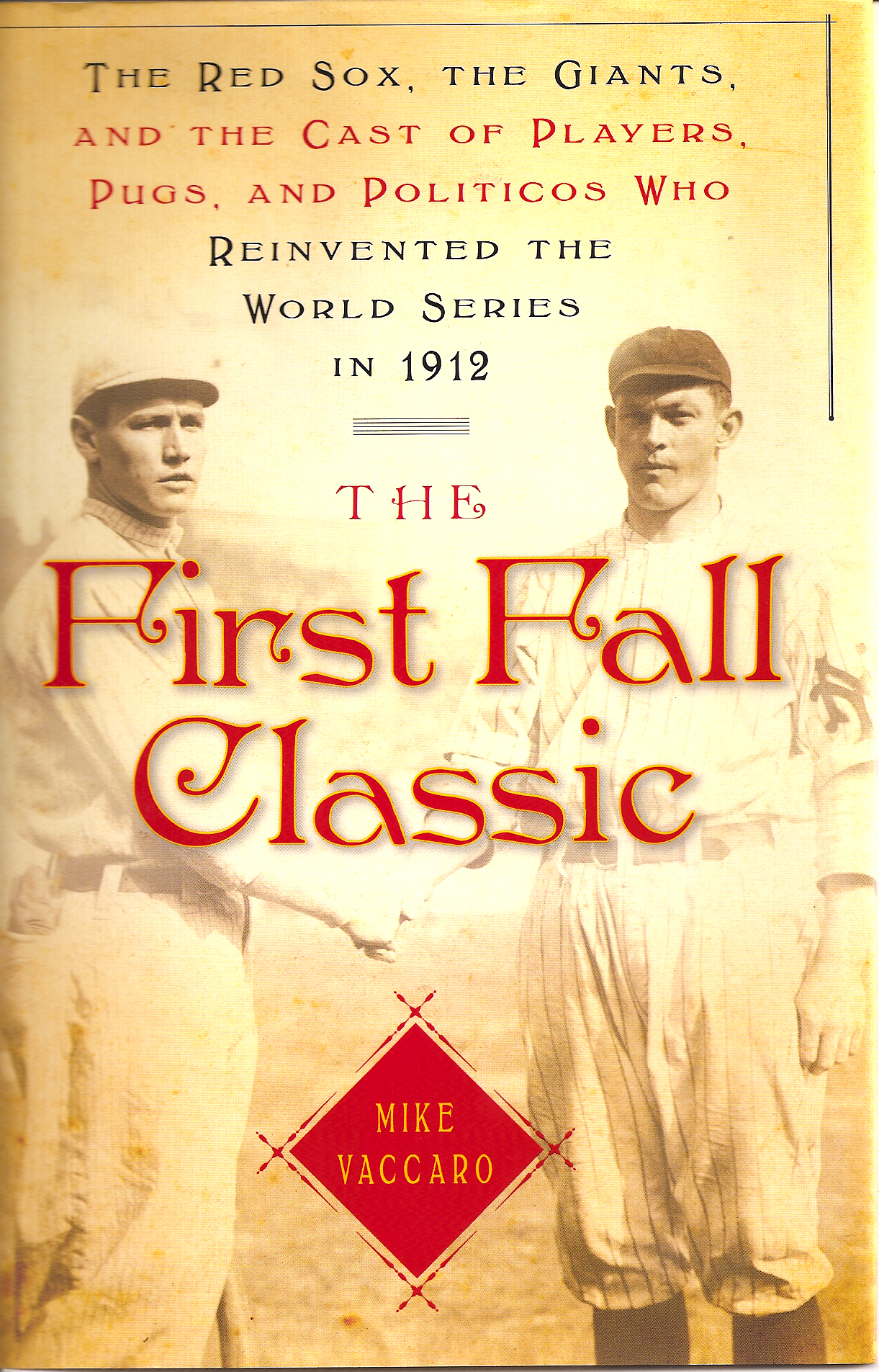
The other photograph – the background largely washed out but with the undecked left field corner still vaguely visible – shows him shaking hands with the Giants’ Jeff Tesreau, and it was chosen for publication on the cover of Vaccaro’s book, below.

Sigh.
Vaccaro Cover.jpg
The most often-repeated of the mess-ups, and thus both the most annoying and the most damaging, is Vaccaro’s insistence about Boston Mayor John “Honey Fitz” Fitzgerald, arch Sox fan and grandfather of the future president, around whom Vaccaro tries to develop a political thread to the book and who gets nearly as much attention from him as Tris Speaker or Mathewson. Four times in the book, Vaccaro notes that Fitzgerald liked to sing, or was singing, or was about to sing, his theme song “Sweet Adelaide.” There may have been such a song, but it wasn’t a favorite of Honey Fitz (or presumably of anybody else). The Mayor, as any political historian, or adult over 65, or anyone who’s ever encountered a Barbershop Quartet, or any Marx Brothers buff, could tell you, sang “Sweet Adeline,” an incredibly popular song published in 1903 that Groucho and company later performed in “Monkey Business.”
Of the remaining twenty or so that I caught, most have clearer connections to the sport itself. Hall of Famer Eppa Rixey becomes Rixley, 1912 Red Sox infielder Steve Yerkes becomes Sam, Redland Field in Cincinnati becomes “brand-new Crosley Field” (it wasn’t renamed Crosley Field until 1934 and the radio baron who did it was still a 20-something developing automobiles in Muncie, Indiana, when Redland Field was brand-new in 1912). 

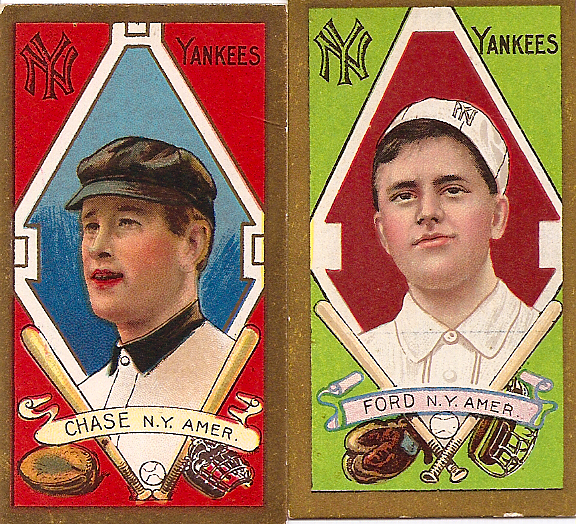
There is a lot of historical tone-deafness – particularly distressing considering Mr. Vaccaro often covers the Yankees. He recounts a conversation among McGraw and New York sportswriters about the Giants taking in the American League New York Highlanders as tenants at the Polo Grounds for the 1913 season. Vaccaro quotes the famed Damon Runyon telling McGraw that his paper’s headline writers have a new name intended for the team: The Yankees. McGraw is quoted as wondering if it will catch on in 1913. Even if the mistake originates elsewhere, it should’ve rung untrue to Vaccaro: The name “Yankees” had been used on the baseball cards as earlyYankees1912.jpg as 1911, and on a team picture issued by one of the New York papers in 1907. If McGraw and Runyon hadn’t heard the name “Yankees” by the time of the 1912 World Series, they’d both had undiagnosed hearing problems for five years.
Vaccaro also has a lot of trouble with geography. He indicates that Giants’ owner John Brush had a mansion in “upstate Pelham Manor” even though the town is essentially parallel to 241st Street in Northern Manhattan. He mocks the nickname “Swede” for Danish-born Boston outfielder Olaf Henriksen as an indication that baseball didn’t worry about geography in assigning monickers. But until 1905 Denmark was part of a union with Norway, and as late as the early 1800’s, those two countries were trying to reestablish a medieval tripartite union with Sweden. For all we know, Henriksen might have considered himself Swedish.
There are also mistakes so convoluted as to be baffling. Vaccaro writes of the fabulous game-saving catch by the Giants’ Josh Devore in Game Three:

“I took it over my left shoulder and with my bare hand although I clapped my glove on it right away and hung on like a bulldog in a tramp,” Evans would soon tell the mountain of reporters…

Evans? The catch was by Josh Devore. Evans – Billy Evans – was the umpire who confirmed the out. Later, there is the inexplicable observation that during the tense eighth game, so much of Manhattan was at the then-popular newspaper scoreboards that “Schoolrooms were scarce.” While this was doubtless as true in the New York of 1912 as it is in the city of 2010, it wouldn’t seem to have anything to do with baseball. Students in schoolrooms, yes. The rooms themselves?
The mistakes – and there are probably a dozen more – matter only in this context. When I read Vaccaro’s account of a supposed conversation, after the Red Sox took a 3-1 lead in games, between Boston’s owner and manager that clearly implies that the owner ordered the manager to hold back his ace pitcher in hopes Boston might lose the next game and thus gain the income from one more game in Fenway, I’m not inclined to take Vaccaro’s word for it. Because, lastly and most damningly, this may be how he researched the book. Years after retirement, Boston’s Hall of Fame centerfielder Tris Speaker went back to the minors as an executive. Vaccaro writes he would:

…become a part owner of the American Association, a top Triple-A-level minor league…”

In fact, Speaker would become a part owner not of the league, but of one of the teams in the league, the Kansas City Blues.
You know where else this mistake turns up?

Post professional career
In 1929 Speaker replaced Walter Johnson as the manager of the Newark Bears of the International League, a post he held for two years. He became a part owner of the American Association. The announcement of Speaker’s election to the Baseball Hall of Fame was made in January, 1937

Yep. Tris Speaker’s Wikipedia page.

How sad.

Unlikely Spring Training Questions From A Waiting Room

These have been bouncing around my head all off-season; some are tempests in teapots, some a little more substantial – I just havent heard many of them asked…DID the Yankees actually upgrade? Acknowledging that a healthy Nick Johnson, freed of all defensive worries, could win a batting championship (or at least the On Base crown), is a trade-off of Johnny Damon, Hideki Matsui, and Melky Cabrera for Curtis Granderson, Johnson, Randy Winn and Brett Gardner really a win? Has Cabreras clutch late-inning hitting been forgotten, or merely written off as a statistical fluke?…ON the other end of the Granderson trade, do the Tigers know Phil Coke wasnt that great against lefties during the first half of last year, and basically stopped getting them out at all after September 1 and in the post-season?…HAS Roy Halladay ever been tested in a pennant race? Does it matter? I seem to recall several clubs drooling over the various Javier Vazquezes who pitched in obscurity in Montreal and Arizona and even Chicago…DID the Angels look at Joel Pinieros last months worth of work in 2009? Did they break out his fly-ball to ground-ball ratio? Did they note that a sinkerball pitcher who cant get the ball down will probably end up in mopup relief?…WHY hasnt anybody else written that if Milton Bradley doesnt sink the Mariners, theyll be the first?…lastly IF you are the Nats and you have as exciting a prospect as Ian Desmond and you havent unloaded Cristian Guzman, why do you go ahead and sign Adam Kennedy?